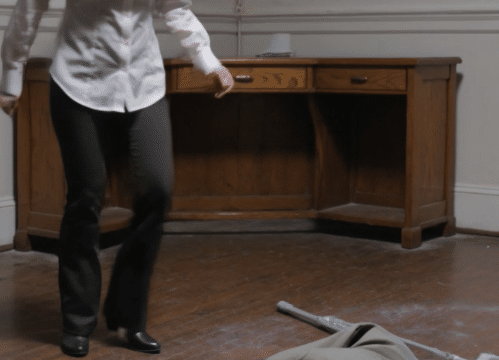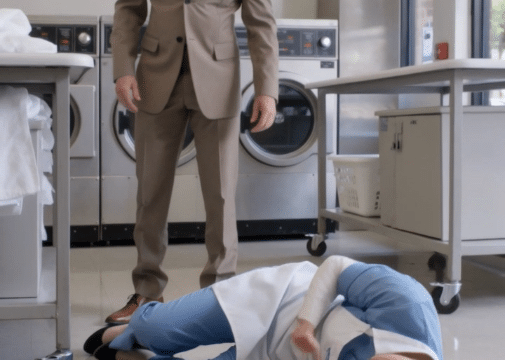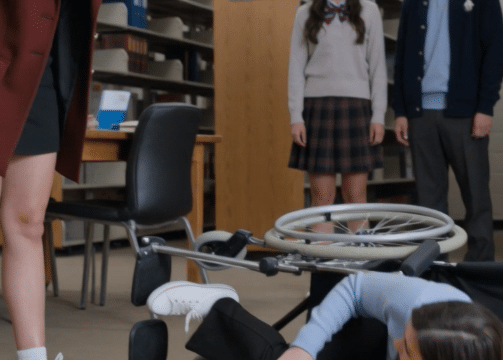
Act I
“That safety step stays.”
The words were quiet, but they stopped the warehouse floor for half a second.
The shift leader turned around so sharply that the clipboard in her hand struck a nearby pallet. Her orange safety vest flashed beneath the harsh fluorescent lights, and her expression hardened as she stared at the woman who had dared to challenge her.
“Excuse me?”
The woman standing beside the loading lane wore a plain gray warehouse jacket, black cargo pants, and scuffed safety boots. She looked like any other new employee—someone who had learned where the break room was, where the restrooms were, and which supervisors were best avoided during a difficult shift.
Her name was Claire Bennett.
At thirty-nine, she had come to the warehouse before dawn with no executive entourage, no designer clothes, and no announcement that she was coming. She had introduced herself as a temporary operations hire and spent the morning observing the workers, the equipment, and the way orders moved through the building.
Now she was looking at a safety barrier that the shift leader had ordered workers to bypass.
A pallet loaded with heavy boxes stood near the forklift lane. The marked pedestrian crossing had been partially blocked, and a required inspection step had been skipped so the team could clear a backlog before the morning shipment deadline.
Claire had watched a forklift approach the crossing while two workers hurried past it.
She had stopped them.
The shift leader, Denise Walker, was forty-four and had spent seven years building a reputation as the person who could make a warehouse move faster than anyone else. Her numbers were impressive. Her crews regularly cleared more orders than neighboring shifts, and senior management had praised her efficiency more than once.
But the workers knew what the numbers concealed.
Denise yelled when people slowed down to inspect equipment. She threatened to cut hours when employees questioned her instructions. She treated safety procedures as obstacles to be managed rather than protections that existed for a reason.
And she hated being challenged in front of her team.
“Move the barrier,” Denise ordered one of the workers. “We have a shipment waiting.”
Claire stepped between the worker and the marked crossing.
“No. The inspection has to be completed first.”
Denise stared at her.
“Who told you that?”
“It’s on the safety board. It’s in the procedure.”
“You’ve been here five minutes, and you’re already telling me how to run my shift?”
“I’m telling you we can’t send people through an unsafe lane.”
A few workers lowered their eyes. One man slowly pulled off his gloves, then put them back on without saying anything. Another looked toward the supervisor’s office as though hoping someone would appear before the confrontation went any further.
Denise took a step closer.
“Listen carefully. I decide what happens on this floor.”
Claire held her ground.
“And the safety step stays.”
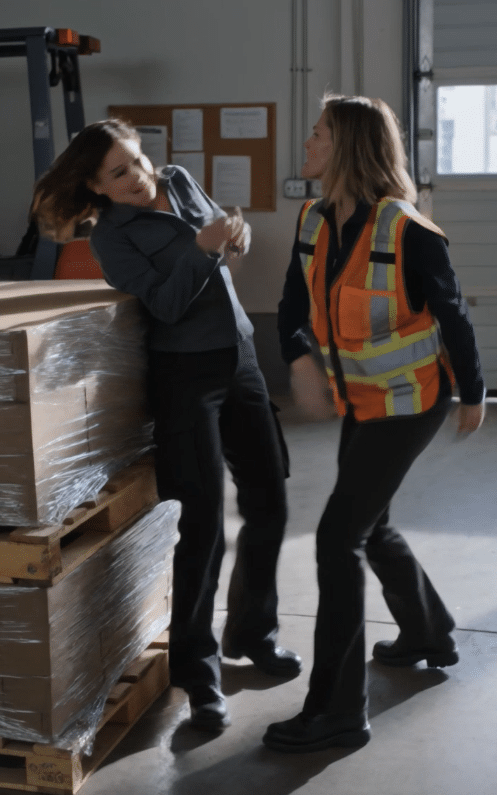
The slap came so quickly that several workers didn’t understand what they had seen until Claire fell.
Denise struck her hard across the face, knocking her down beside the pallet. Claire’s clipboard hit the concrete, and a hard hat rolled across the floor, spinning in a widening circle before settling near a stack of cartons.
A sharp gasp passed through the warehouse.
Claire tried to catch herself with one arm. Her elbow scraped against the rough concrete, leaving a thin red mark on her skin. She drew a trembling breath, one hand moving instinctively toward her face.
For one moment, she looked less like a confident employee than someone who could not believe another person had actually done this.
Denise wasn’t finished.
She stepped forward and delivered two forceful kicks to Claire’s back and side.
Claire curled inward, grimacing as pain tightened her face. Her breath came in short, uneven bursts. She tried to shield herself with her arms while the workers around them recoiled, stunned into silence.
Denise stood over her.
“Trash. New workers don’t lecture me.”
Claire looked up at her, shaken and hurting.
Denise leaned closer.
“Learn your rank from the floor.”
Nobody moved.
Then the metal warehouse door burst open.
Several board members entered with corporate lawyers and executive assistants close behind them. Security personnel followed, their footsteps echoing across the concrete.
One assistant hurried straight to Claire and knelt beside her, asking whether she could sit up. Another called for medical assistance while a lawyer looked from the fallen clipboard to Denise’s face.
The room seemed to shrink around the shift leader.
The assistant gently supported Claire as she tried to rise. Only when Claire was being cared for did he turn toward the stunned supervisor.
“Madam CEO, the board is here.”
Denise’s face drained of color.
She stared at Claire, then at the board members standing behind the assistant.
“The CEO?”
And for the first time in seven years, Denise Walker had absolutely no idea what to say next.
Act II
Claire Bennett had learned early that a company could look healthy from the outside while quietly damaging the people who kept it alive.
Her father had worked in manufacturing for nearly thirty years. He had come home with aching shoulders, grease beneath his fingernails, and stories about supervisors who cared more about production targets than the people meeting them.
He was not a bitter man. He believed in work, discipline, and the dignity of doing a job well.
But he had a saying that stayed with Claire long after she left home.
“A number doesn’t lift a box. A person does.”
When Claire entered business school, she was drawn to operations management. She wanted to understand how companies moved products, controlled costs, and coordinated thousands of decisions across factories, distribution centers, and shipping networks.
She discovered that efficiency could be a remarkable thing.
A well-designed process could reduce waste, shorten delivery times, lower prices, and make life easier for workers. A poorly designed one could produce the opposite: constant pressure, preventable mistakes, and an endless cycle of blaming employees for problems created by management.
After graduating, Claire joined a national logistics company and worked her way through nearly every level of its operations division. She spent time on loading docks, in inventory offices, at distribution hubs, and in meeting rooms where executives debated productivity charts.
She learned to read the numbers.
More importantly, she learned to ask what the numbers were hiding.
When a warehouse reported a sudden increase in output, Claire wanted to know whether equipment maintenance had been deferred. When a manager claimed that absenteeism had dropped, she checked whether workers had stopped reporting injuries because they feared losing their shifts.
She became known for asking questions that made some executives uncomfortable.
Why were experienced employees leaving? Why did certain facilities have unusually high injury rates? Why did managers with the best productivity numbers also have the most anonymous complaints?
Some colleagues admired her. Others accused her of being too cautious to understand the realities of running a business.
Claire listened to both sides.
She knew that companies had deadlines and customers to satisfy. She also knew that no shipment was worth sending someone home injured.
Over time, she became an executive responsible for improving operations across multiple facilities. When the previous chief executive of Meridian Distribution Group announced his retirement, the board began searching for a successor.
Claire was not the obvious candidate.
She was younger than several other executives under consideration, and she had never cultivated the public persona that investors often associated with a powerful CEO. She preferred site visits to conferences, conversations with employees to speeches, and evidence to polished presentations.
But she understood the business at every level.
She also knew that Meridian had a problem it could no longer ignore.
For three consecutive quarters, its productivity figures had improved. At the same time, internal reports showed rising employee turnover, inconsistent safety compliance, and a pattern of complaints from several warehouses.
The complaints were difficult to interpret.
Some were vague. Others described supervisors pressuring employees to skip inspections, work through equipment warnings, or avoid documenting minor incidents because those reports could affect performance bonuses.
A few complaints named Denise Walker’s facility.
Management had investigated individual issues and marked several as resolved. Yet the same concerns continued to appear in different forms.
Claire suspected that the company was treating symptoms rather than examining the culture that produced them.
When she became CEO, she could have announced a sweeping review from headquarters. She could have sent a formal notice to every facility, requested written explanations from management, and waited for carefully prepared reports to arrive.
Instead, she chose to visit several locations without announcing her position to the local teams.
She wanted to see what happened when workers believed no executive was watching.
The warehouse near the interstate was her third visit.
She had arrived before sunrise, signed in under an approved temporary inspection arrangement, and put on the same basic protective equipment as everyone else. Her jacket carried no executive insignia. Her badge identified her by name and gave only the access level required for the visit.
She didn’t pretend to be a lifelong warehouse worker. She simply introduced herself as someone there to learn the operation.
For several hours, she watched.
She saw employees rushing to meet targets. She noticed a safety board whose written requirements did not match the shortcuts being used on the floor. She observed workers glancing toward Denise before reporting minor problems, as though even a question could become a personal offense.
Then she saw the blocked crossing.
When Claire challenged the decision, she expected an argument. Perhaps Denise would defend the schedule, or insist that the barrier had been moved for a legitimate reason.
Claire was prepared to discuss the procedure.
She was not prepared to be attacked.
As the medical team examined her, the board members gathered nearby. Their expressions were controlled, but none of them could ignore what had just happened.
Denise tried to recover.
“She interfered with an active operation,” she said. “I was correcting a disruption.”
One of the lawyers glanced at the safety board.
“By striking her?”
Denise opened her mouth, then closed it.
Claire, still seated on the floor with assistance, looked at the workers around her. She saw fear, embarrassment, and the terrible familiarity of people who had witnessed something they believed they could never safely report.
That was when she understood the problem was larger than one violent supervisor.
Denise had behaved as though her authority made her untouchable.
And somewhere along the way, the company had taught its employees that challenging that authority could be dangerous.
The board had arrived expecting to discuss the warehouse’s performance.
Instead, it was about to discover what those performance numbers had cost.
Act III
The first person to speak was not a board member.
It was a forklift operator named Marcus Reed.
He had worked at the warehouse for six years, and his face was pale as he approached the lawyers. For several seconds, he kept glancing at Denise, who was standing beside the safety board with her clipboard pressed tightly against her chest.
Then he looked at Claire.
“I saw what happened,” he said. “I can tell you exactly what happened.”
Denise snapped toward him.
“Don’t get involved in something you don’t understand.”
Marcus flinched.
It was a small reaction, but Claire noticed it immediately. So did one of the lawyers.
“Mr. Reed,” the lawyer said, “you may speak freely. We need an accurate account.”
Marcus swallowed.
He explained that Denise had ordered the team to bypass the inspection because the outbound shipment was behind schedule. The pedestrian crossing had not been cleared, and the safety barrier had been moved before the required check was complete.
When Claire objected, Denise became angry.
Marcus described the slap. He described Claire falling beside the pallet and the two kicks that followed. His voice shook as he spoke, but he did not change his account.
Another worker stepped forward.
Then a third.
One employee admitted that she had been told to initial a checklist before completing the inspection. Another said she had raised a concern about the same crossing two weeks earlier and been warned that continued complaints would affect her shift assignments.
The warehouse grew quieter with every statement.
Denise began interrupting.
“They’re twisting everything. This is how warehouses operate. We have targets. We have deadlines. You can’t stop the entire floor every time someone gets nervous.”
Claire listened from the chair where the medical team had helped her sit. Her cheek hurt, and every movement sent a dull ache through her back and side.
But she kept her eyes on Denise.
“This isn’t about being nervous,” Claire said. “It’s about following a required safety procedure.”
Denise laughed sharply.
“You don’t know this facility.”
Claire’s expression did not change.
“Then explain why the procedure wasn’t followed.”
Denise looked toward the board, apparently expecting someone to rescue her from the question.
No one did.
The lead attorney requested that the relevant records be preserved, including inspection logs, shift reports, equipment records, and any available camera footage. The board’s operations committee ordered an immediate review of the warehouse’s safety practices.
Nobody declared the entire case solved in the middle of the loading floor. The lawyers were careful to separate what had been directly witnessed from the broader allegations that still needed investigation.
But the assault itself had occurred in front of multiple employees.
There was no reasonable way to dismiss it as a misunderstanding.
Denise’s clipboard slipped from her hand and struck the concrete.
For years, she had used that clipboard as a symbol of authority. It held schedules, production targets, and the figures she cited whenever someone questioned her decisions.
Now it lay open near the pallet, its papers scattered around the hard hat that had rolled away when Claire fell.
One page showed the shift’s expected output.
Another contained the inspection checklist.
A worker pointed toward the second page.
“That’s the one she told us to sign before the check.”
Denise spun around.
“You’d better be careful what you say.”
The lawyer stepped between them.
“Do not threaten any employee participating in this review.”
The words landed with a finality Denise had never heard directed at herself.
Claire looked at the workers.
“Has anyone else been pressured to skip a safety step?”
Silence followed.
She did not rush to fill it. She knew that people who had spent years fearing retaliation would not suddenly feel safe because a CEO had appeared in the building.
So she asked a different question.
“Has anyone here been injured or nearly injured because a procedure was ignored?”
Marcus raised his hand.
He described a near collision involving a pallet jack and a forklift the previous month. The incident had not resulted in serious injury, but he said the written report had described it as a minor delay rather than a safety concern.
A second employee recalled a damaged pallet that had been moved despite a warning tag. A third described being told to finish a shift after reporting a problem with a piece of equipment.
Each account required verification.
But together, they suggested a pattern that the company’s existing reviews had failed to uncover.
Claire turned to the board.
“I want an independent review of this facility’s safety practices, reporting system, and management culture. Not a report written by the people whose performance is being evaluated.”
Several board members nodded.
The lead attorney confirmed that the investigation would preserve relevant records and protect employees from retaliation for participating. Denise was removed from active supervisory duties pending review of the assault and the allegations concerning safety compliance.
She looked around the warehouse, searching for someone who might object.
Nobody did.
Then Claire spoke again.
“There will be no production target that overrides a required safety step. Not today. Not tomorrow. Not because a shipment is late.”
A worker near the loading bay lowered his head.
For the first time that morning, his shoulders seemed to relax.
But Denise was still struggling to understand the most important fact in the room.
The woman she had treated as a powerless new hire was the person who could change the rules she had been using to control everyone else.
And the board was not there to defend Denise.
It was there to answer to Claire.
Act IV
By noon, the warehouse had been placed under temporary operational review.
The loading schedule was adjusted to allow the team to complete the required safety checks. Equipment associated with unresolved concerns was taken out of service until it could be inspected, and the company began collecting records related to the allegations.
The board did not shut down the entire facility simply to make a statement. Instead, it required managers to identify specific risks, address them, and document the corrective measures before normal operations resumed in affected areas.
The distinction mattered.
Claire had no interest in punishing employees for delays caused by doing their jobs correctly. She wanted the company to stop treating safe work as a failure of productivity.
While the lawyers coordinated the review, an assistant helped Claire stand. She winced as she shifted her weight, and the assistant immediately offered to arrange transport for a more complete medical evaluation.
Claire accepted.
There was no prize for pretending she wasn’t hurt.
Before leaving the floor, however, she asked to speak with the employees.
They gathered near the safety board, leaving enough space for the medical team to move equipment through the aisle. Some looked frightened. Others appeared uncertain whether they were allowed to look directly at the person they had just learned was their CEO.
Claire did not stand on a pallet or demand their attention.
She spoke from the concrete floor.
“My name is Claire Bennett. I am the CEO of Meridian Distribution Group.”
A murmur passed through the group.
“I came here because the company has been reporting strong productivity while employees have raised concerns about safety and retaliation. I needed to understand the gap between what our reports say and what people experience at work.”
She paused, allowing the words to settle.
“What happened this morning is unacceptable. No supervisor has the right to assault an employee. No employee should have to choose between following a safety rule and keeping a job.”
A worker near the back raised his hand.
“What happens if we report something and our supervisor cuts our hours?”
Claire looked directly at him.
“Retaliation complaints will be reviewed independently of the supervisor involved. If you believe your hours have been changed because you raised a safety concern, report it through the designated channel. We will investigate the record, not simply ask the supervisor whether the complaint is true.”
Another worker spoke.
“What if the numbers look bad because we’re actually following the rules?”
“Then the numbers need to reflect the real cost of operating safely,” Claire replied. “We will not reward managers for producing impressive results by hiding risk.”
The workers exchanged glances.
It was a simple statement, but it challenged the system they had been living under. For years, they had been measured by the number of orders processed, the time required to clear a lane, and the number of shipments dispatched before a deadline.
The pressure had flowed downward.
Now, for the first time, the person at the top was acknowledging that the measurements themselves could be part of the problem.
Denise stood near the office entrance under the supervision of a security officer. She was no longer holding her clipboard.
Her anger had begun to give way to panic.
“Claire,” she said, trying to make her voice sound reasonable. “We can discuss this privately. I’ve delivered results for this company for years.”
Claire turned toward her.
“I know your productivity numbers.”
Denise seized on the response.
“Exactly. I’ve kept this warehouse running. You can’t judge my entire career by one bad moment.”
Claire’s voice remained calm.
“This review isn’t limited to one moment. The assault will be investigated, and the safety allegations will be examined separately. Your record will be considered along with the evidence.”
Denise’s eyes narrowed.
“So all those years mean nothing?”
“They mean we will examine your record honestly. They do not give you permission to hurt someone.”
For a moment, Denise seemed ready to argue again.
Then she looked at the workers.
Several had already provided statements. Others were speaking quietly with the lawyers. No one was rushing forward to defend her.
The authority she had depended on had been built partly on fear, and fear had worked only while the people beneath her believed she could act without consequence.
That belief was collapsing.
The company later placed Denise on administrative leave while the investigations proceeded. The review found substantiated violations of safety procedures and misconduct involving employee reporting. The assault was addressed through the appropriate legal and employment processes, with decisions based on the evidence and applicable policies.
The findings also exposed management failures beyond Denise herself.
Some supervisors had been evaluated almost entirely on output. Safety complaints had been routed through managers whose performance was affected by the results. Training records did not always establish that required checks had actually been completed.
Denise had been responsible for her actions.
But the company had also created conditions in which warning signs could be minimized, overlooked, or discouraged.
Claire refused to let the investigation end with one person removed from the floor.
She ordered a review of warehouse performance metrics, required clearer documentation of safety inspections, and established a reporting route that did not depend on a worker’s direct supervisor. Managers would be assessed on safety compliance, employee retention, and accurate reporting alongside productivity.
The board approved the changes.
Some executives worried that the new standards would slow operations. Claire asked them to calculate the costs of injuries, damaged equipment, lost experience, and employees who left because they no longer trusted management.
For the first time, the conversation moved beyond the next shipment deadline.
The warehouse had been built to move goods.
It also had to be a place where people could work without being punished for trying to stay safe.
And Claire intended to make that principle impossible to ignore.
Act V
Six weeks later, the warehouse looked almost exactly as it had on the morning Claire arrived.
Pallets stood in marked lanes. Forklifts moved between loading areas. Safety signs hung above the pedestrian crossings, and the familiar hum of machinery filled the building before the first full shipment of the day departed.
But there was one difference that mattered more than any new sign.
When a worker noticed a problem, people stopped to listen.
A damaged pallet could be flagged without a supervisor accusing the employee of slowing down the shift. An inspection could delay a shipment without automatically counting against the worker who insisted it be completed. Safety concerns could be reported through a process that did not require permission from the person being questioned.
The changes were not perfect.
Some employees remained skeptical, and a new reporting channel could not erase years of distrust overnight. Claire understood that trust would be earned through repeated decisions, especially when doing the right thing was inconvenient.
So she returned to the warehouse.
This time, she arrived openly as CEO.
She walked the floor with the operations team, reviewed the updated procedures, and spoke with employees who had participated in the investigation. She did not ask whether everyone liked the changes. She asked whether the changes were working.
Marcus Reed told her that workers were more willing to report problems, but some still worried about being labeled difficult.
Claire added that concern to the review.
A warehouse employee showed her how the revised checklist made it easier to document an inspection without interrupting the flow of information. Another described a supervisor who had stopped pressuring the team to rush through a required check.
Small improvements, Claire thought, were how culture changed.
Not through a speech or a dramatic visit, but through the accumulation of moments in which people learned that the rules applied even when nobody important was watching.
The investigation into Denise had concluded, and she was no longer employed as the warehouse’s shift leader. The company’s findings had established that her conduct violated workplace standards and that the safety concerns required formal corrective action.
Claire did not announce the outcome as a personal victory.
She was not interested in turning a workplace assault into a spectacle. She wanted the employees who had witnessed it to know that reporting misconduct would not be pointless, and that the organization would act on credible evidence.
One morning, Claire stopped beside the same safety board where the confrontation had begun.
The pedestrian crossing was clear. The inspection checklist was visible, and the barrier stood where it belonged.
A new employee approached with a question about the required procedure.
The supervisor on duty listened, checked the instructions, and confirmed the next step before allowing the equipment to move.
Claire watched from several feet away.
No one noticed her at first.
That was fine with her.
The point was not to make workers behave safely when the CEO was present. The point was to build a workplace where they could expect the same standards on an ordinary Tuesday morning, during an understaffed shift, or when a major shipment was running late.
As she turned toward the loading area, Marcus approached her.
“Can I ask you something?”
“Of course.”
“Why did you come here without telling anyone who you were?”
Claire considered the question.
“Because I wanted to see what happened when people thought nobody from headquarters was watching.”
Marcus nodded slowly.
“And now?”
“Now I want to make sure it doesn’t matter who’s watching.”
He glanced toward the safety board.
“I think people are starting to believe that.”
Claire hoped he was right.
She knew the company still had work to do. Policies could be rewritten in a day, but fear often lasted much longer. Employees who had learned to keep their heads down needed time to discover that speaking up would not automatically put their livelihoods at risk.
Still, there were signs of progress.
Reports were being documented more consistently. Supervisors were receiving clearer guidance about their responsibilities. Production targets were being reviewed against actual operating conditions instead of being treated as unquestionable demands.
And the workers were beginning to talk.
That was what Claire had wanted from the beginning: not obedience born of fear, but a workplace where people could question an unsafe decision without risking their dignity.
Before leaving, she paused beside the pallet where she had fallen.
The concrete had been cleaned. The scattered clipboard and rolling hard hat were gone, replaced by the ordinary order of another working day.
For a moment, she remembered Denise standing over her, telling her to learn her rank from the floor.
Claire had felt the humiliation. She had felt the pain, the shock, and the fear of being struck by someone who believed authority entitled her to do whatever she wanted.
She would not pretend that becoming CEO had made the assault meaningless.
Her position had given her the ability to demand accountability, but it had not made the experience less frightening. Nor did it mean that another employee without her title would have been equally protected.
That realization stayed with her.
The warehouse had not needed a CEO to make its safety rules valid. The workers had needed those rules to matter before anyone with power arrived.
Claire looked once more at the marked crossing, then continued toward the exit.
Behind her, a forklift slowed as an employee completed the required inspection. The operator waited. The worker checked the pallet, confirmed the lane was clear, and gave the signal to proceed.
The shipment left a few minutes later than planned.
No one was punished for it.
And that was the real reversal.
Denise had believed power meant forcing everyone else to move faster, speak less, and accept whatever treatment came from above. She had mistaken silence for respect and fear for loyalty.
Claire’s authority had not come from her jacket, her title, or the board members who walked through the metal door that morning.
It came with the responsibility to protect people who had no boardroom to enter and no executive title to reveal.
The slap had exposed one supervisor’s cruelty.
The investigation exposed the system that had allowed warning signs to go unanswered.
And the changes that followed proved something more important than either revelation: a company’s strength cannot be measured only by the speed of its shipments or the size of its profits.
It must also be measured by what happens when an ordinary worker says, “That isn’t safe.”
Because the right answer should never depend on whether the person speaking is a new hire or the CEO.
A safety rule does not become important when a powerful person defends it. It matters because every worker deserves to go home in the same condition they arrived.