Act I
“Who told you to walk through my lane?”
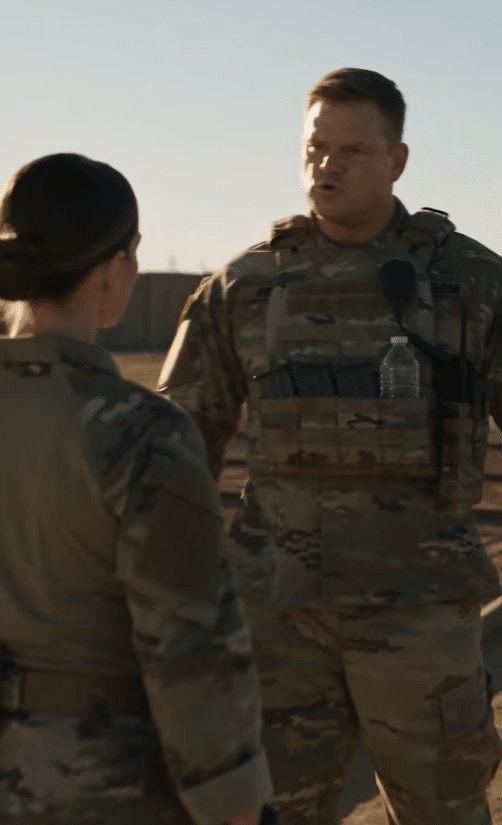
The Major’s voice cut across the tactical training field, sharp enough to make three soldiers turn their heads. Dust drifted around the boots of men moving through the marked lanes, and the low rumble of military trucks filled the late-afternoon air. Beside the field command table, a woman in a clean combat uniform stood perfectly still, watching the exercise with the kind of concentration that made her seem unaware of the confrontation.
She was thirty-four, with dark-blonde hair secured in a neat bun and a face that revealed almost nothing. Her uniform was regulation, her boots dusty from the field, and her rank insignia remained difficult to see beneath the way her jacket sat against her shoulders.
The Major, a broad-shouldered man named Daniel Cross, had spent years convincing himself that a training lane was his personal kingdom. At thirty-nine, he knew how to make junior soldiers straighten their backs with a glance. He also knew that fear could be mistaken for respect if nobody challenged him.
The woman looked at him without hostility.
“I’m observing the exercise.”
That answer should have been unremarkable. Officers observed exercises all the time. Evaluators appeared without warning, watched a unit work, and recorded what went wrong. A competent Major would have asked who authorized the observation, confirmed the training boundary, and continued his work.
Cross did none of those things.
He saw a woman who had crossed into what he considered his territory without asking his permission. He saw a calm expression he interpreted as defiance. Most of all, he saw an opportunity to remind the soldiers around him who was allowed to question his authority.
“You need to learn how things work around here,” he said, stepping closer.
She didn’t retreat.
Her gaze moved briefly past him, toward a team of soldiers negotiating a narrow tactical corridor. Their spacing was wrong. One soldier had drifted too close to the man ahead of him, and the entire formation had begun to bunch up near a simulated point of contact.
She had noticed it immediately.
Cross noticed where she was looking, and his face hardened.
He didn’t ask what she had seen. He didn’t want an observation. He wanted obedience.
Then he reached for a dirty water bottle on the command table.
The woman barely had time to register the movement before he threw its contents directly into her face. Water ran down her cheeks and collar, darkening the fabric of her uniform. The empty bottle hit the dirt a moment later.
A few soldiers stopped moving.
Cross slapped her hard across the face.
Her head snapped sideways. For a second, the world seemed to narrow around the impact, and a sharp red flush spread across one cheek. She caught herself before stumbling, her jaw tightening as she fought to steady her breathing.
But Cross wasn’t finished.
He took a driving step forward and kicked her in the stomach.
The force folded her at the waist. Her breath vanished, and she dropped painfully into the dirt, catching herself on both palms. Grit scraped her skin. She remained conscious, one arm instinctively guarding her abdomen as she struggled to draw a full breath.
No one rushed forward.
The soldiers around the lane stood frozen, their expressions caught between disbelief and the terrible calculation that sometimes takes hold when an officer commits an unmistakable abuse of power. They had seen Cross shout. They had seen him humiliate people. They had never seen him cross a line this far in front of so many witnesses.
He stood over her, breathing hard.
“Stay out of places above your pay grade.”
The insult landed almost as deliberately as the kick.
The woman looked up at him. Her cheek was swelling, a faint trace of blood marked the corner of her mouth, and pain tightened her expression whenever she tried to breathe deeply. Yet there was no pleading in her eyes.
Cross mistook her silence for surrender.
Then she shifted slightly, trying to push herself upright.
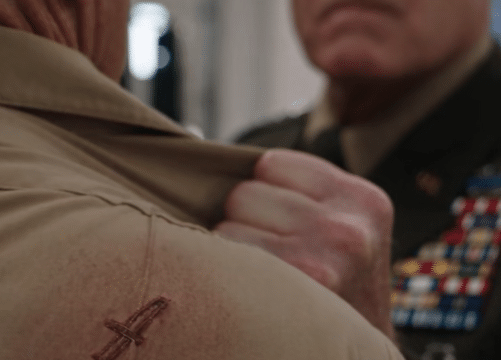
The movement pulled her field collar aside.
And an old, curved burn scar became visible, running from her collarbone toward her shoulder.
Across the lane, a gray-haired Sergeant Major stopped breathing for a moment.
He had spent decades in uniform. He had seen scars from explosions, vehicle fires, collapsed structures, and the terrible accidents that followed missions nobody discussed in public. Most scars told a story of survival.
This one matched a description he had heard only once, years earlier, in a conversation that had ended when an older soldier suddenly realized he had said too much.
The Sergeant Major stared at the woman’s shoulder.
Then he looked at the Major who had just kicked her into the dirt.
And the expression on his face changed completely.
Because the scar was not merely an old injury. It was the one clue that could connect the woman in the dirt to Black Ridge.
Act II
The Sergeant Major was named Robert Hayes, and he had learned long ago that the military’s most important stories were not always written into official histories.
Some were recorded in citations and service files. Others survived in fragments passed between veterans who had been told never to turn a mission into a legend. Black Ridge belonged to the second category.
Years earlier, Hayes had served alongside men who had returned from an operation so badly damaged that even experienced soldiers struggled to discuss it. He had not been at the center of the mission himself, but he had worked with survivors afterward and helped prepare personnel for the difficult work of rebuilding a unit that had lost people it could never replace.
The operation had taken place in brutal terrain where a small team found itself trapped after the plan collapsed. Communications failed. The evacuation window narrowed. The original command structure was disrupted, leaving a handful of exhausted personnel trying to survive long enough for anyone to reach them.
There had been fires, shattered equipment, and a desperate withdrawal through a position that should never have become a battleground.
One survivor had been described to Hayes as a young officer with a distinctive burn scar curving from the collarbone toward the shoulder.
The description was unusual enough to remain in his memory.
But it was not the scar alone that had made the story unforgettable. It was what the survivor had reportedly done after being injured: continued directing the evacuation, refused to leave while others were still exposed, and remained at the center of the effort until the last people who could be moved had been accounted for.
Hayes had never met that officer.
He had heard the name associated with the operation only in guarded conversations, spoken with the kind of restraint usually reserved for people whose records were incomplete, whose actions had been extraordinary, or whose survival had come at a price nobody outside the mission could fully understand.
Black Ridge.
The name had become a quiet reference point among certain veterans. Not a story they told at parties, and not a legend they used to impress younger troops. It was something more serious: a reminder that rank could not guarantee survival, that plans could fail, and that the person who held a team together in its worst hour might not be the person anyone expected.
Now Hayes was looking at a woman whose scar matched the description.
She was much younger than the people he remembered from those years. Her face showed the pain of the assault, but her eyes remained steady. She did not seem interested in making the scar visible. She had not pulled her collar aside to invite recognition.
It had appeared because Cross had thrown her to the ground.
That detail made Hayes’s stomach tighten.
The Major had not merely attacked an unknown evaluator. He had attacked someone who might have endured a kind of danger Cross could scarcely imagine—and had done so because she refused to act intimidated.
Cross, meanwhile, was still performing for the men around him.
He adjusted the front of his tactical vest and glanced toward the soldiers who had witnessed the assault. His expression suggested that the matter had been settled and that anyone who questioned his behavior would be volunteering for the same humiliation.
“You all have a lane to run,” he barked at the nearest personnel.
Nobody moved immediately.
That hesitation irritated him more than the woman ever had. His authority depended on the assumption that everyone around him would accept his version of events. If the soldiers began thinking for themselves, he would have to earn the obedience he preferred to demand.
The woman pressed one palm into the dirt and raised herself onto one knee.
Cross looked down at her with contempt.
He still saw no threat. He saw no senior officer. He saw no one whose career could reach beyond his own command.
He saw a person he had decided was beneath him.
Hayes took one step forward, then stopped. The assault had ended, but he understood that whatever happened next would matter. He needed Cross to look at the scar. He needed him to understand that the warning was not about appearances or some sentimental respect for an old injury.
It was about the possibility that he had just crossed a line whose significance he did not understand.
Hayes had spent years hearing people speak about Black Ridge in fragments. Now, in the dust of an ordinary training field, those fragments had taken on a face.
And the woman was beginning to stand.
Hayes knew he had to stop Cross from making one more mistake—but the Major was about to prove that arrogance could survive even when the warning was standing directly in front of him.
Act III
“Major… look at her shoulder.”
Hayes spoke quietly, but the urgency in his voice carried across the lane.
Cross turned toward him with visible irritation. Hayes was older, experienced, and respected by the people who had served long enough to recognize the difference between a seasoned noncommissioned officer and a man who had simply accumulated years.
But Cross did not like being corrected in public.
He followed Hayes’s gaze to the woman’s collar.
For a brief moment, he studied the exposed scar.
It was an ugly, curved mark, pale at the edges and uneven in the middle. It disappeared beneath the fabric toward the shoulder, suggesting an injury that had not been small or easily forgotten. There was nothing decorative about it. Nothing that could be mistaken for a symbol someone might wear to invite admiration.
Cross looked away.
“A scar doesn’t make her important.”
The words came quickly, almost too quickly. He delivered them with a mocking half-smile, as though Hayes had embarrassed himself by assigning meaning to an ordinary injury.
But the soldiers around them were no longer watching Cross with the same certainty.
They had heard the warning. They had seen Hayes’s face. The Sergeant Major had not looked amused, offended, or merely concerned about the way an officer treated a subordinate. He had looked as if he had recognized something that should never have been there.
The woman slowly got one foot beneath herself.
Her hand pressed briefly against her abdomen as she drew a shallow breath. The pain had not disappeared. It was visible in the tension around her mouth and in the careful way she moved, refusing to let her body make any sudden demand on the injured muscles.
Still, she did not ask anyone to help her.
She did not reach for her identification. She did not announce her rank. She did not threaten Cross with a court-martial or demand that the witnesses take down his name.
Instead, she looked directly at him.
“No. Where I got it does.”
The sentence was quiet.
That made it more unsettling than a shout would have been.
Cross’s smile faltered.
He glanced at the scar again, then back at her face. For the first time since the confrontation began, he seemed to be searching for information instead of trying to impose it. The name he had heard in old conversations surfaced somewhere behind his eyes, though he could not yet force himself to accept what it might mean.
Black Ridge was not a place most officers mentioned casually.
It was a name attached to an operation that had become shorthand for a mission that went wrong and the people who kept others alive when the plan no longer offered any protection. Cross had heard the name during his own training, though never in enough detail to satisfy his curiosity. The instructors who mentioned it spoke of decisions under pressure, of lives saved, and of a survivor whose actions had become part of the unit’s private history.
The story had been told without embellishment.
That was why it had stayed with him.
Cross had always believed the military was built on visible authority: rank on a collar, command on a roster, power in the ability to order someone else to move. He knew how to read insignia and how to make a junior officer feel small in front of a formation.
But Black Ridge was not a story about someone who had been protected by rank.
It was a story about what remained when rank, equipment, communications, and plans stopped being enough.
He looked at the woman again.
Her uniform was plain. Her rank was not visible. She had offered no name and no explanation. The scar was the only thing that connected her to the story, and it was not proof of anything by itself.
Yet Hayes had recognized it instantly.
Cross’s eyes moved toward the Sergeant Major, searching for a sign that the older man might be mistaken. Hayes gave him none. His face had settled into a grave stillness that made the warning impossible to dismiss as a joke.
The Major swallowed.
He wanted to ask who she was. He wanted to demand a name, an explanation, a document that would turn this moment back into something he understood. But the words caught behind his teeth because every question seemed to carry the same dangerous implication.
That he might have assaulted someone whose service was far beyond his knowledge.
That the woman he had treated as an intruder might have been sent to evaluate precisely the kind of behavior he had just displayed.
That the men who had watched him throw water in her face and kick her down had seen something no report could ever make respectable.
She finally reached her feet.
Her palms were scraped. Her cheek was reddened and swollen. Water darkened the front of her uniform, and dirt clung to one knee. She stood with the controlled stillness of someone who would not allow pain to dictate what she did next.
Cross did not move toward her.
He could no longer decide whether moving would look threatening or afraid.
And then, in the silence that followed her words, he remembered the name.
Black Ridge.
Act IV
For several seconds, the training field seemed to contract around the three of them.
The exercise continued in the distance, but the sounds felt remote: boots against packed earth, equipment shifting, a truck engine idling near the edge of the range. Close to the command table, nobody seemed willing to move first.
Cross studied Hayes’s expression one more time.
He had known the Sergeant Major for months. Hayes was not a man given to dramatic reactions. He corrected mistakes, enforced standards, and expected officers to withstand uncomfortable truths without turning every disagreement into a personal contest.
If Hayes was alarmed, there was a reason.
Cross tried to reconstruct the pieces. The unusual scar. The woman’s composure after an assault that should have left her shaken. The way she had observed the exercise without identifying herself. The fact that she had never begged him to stop, even when he had the physical advantage and every witness was waiting to see what she would do.
He had mistaken restraint for weakness.
Now he could not tell whether her calmness came from discipline, experience, or a level of authority he had been too arrogant to consider.
His gaze flicked toward her uniform collar, searching for insignia he might have missed. He found no immediate answer. There was only the scar and the expression of a woman who had no reason to help him understand what he had done.
The humiliation he had intended for her was turning back on him.
Not because she had insulted him. Not because she had threatened to destroy his career. She had done neither. The reversal was happening because the people around him were beginning to recognize the difference between someone who possessed authority and someone who merely enjoyed making others feel powerless.
One of the younger soldiers lowered his eyes, not in deference to Cross but in discomfort at having watched the assault without moving. Another stared at the ground where the woman had fallen, his jaw set hard.
Nobody applauded Hayes. Nobody announced that Cross had lost control of the lane. Yet the Major could feel the change in the formation around him.
His commands no longer seemed to settle the air.
He had spent years treating public humiliation as a management tool. A subordinate made a mistake, and he corrected it loudly enough for everyone to hear. Someone questioned him, and he made an example of them. He believed the memory of embarrassment would keep people obedient long after the immediate confrontation ended.
What he had never considered was that witnesses remembered the person who caused the humiliation, too.
They remembered the water thrown into someone’s face. They remembered the slap. They remembered the kick that sent a woman into the dirt. They remembered that she had been trying to observe an exercise when he decided to turn a routine encounter into a display of dominance.
And they would remember how he reacted when given a chance to stop.
The woman looked at him without triumph.
There was no smirk on her face, no satisfaction in watching his confidence collapse. She seemed almost disappointed, as though the assault had confirmed something she had hoped not to find.
That expression disturbed him more than anger would have.
Anger could be dismissed as personal. A threat could be answered with procedure. But disappointment suggested a judgment that had already been made.
Cross opened his mouth, then closed it.
He could have apologized. He could have asked whether she needed medical attention. He could have ordered the exercise paused and acknowledged that he had acted without justification. Even now, there were choices available to him.
But each one required him to admit that the problem had never been her presence in the lane.
The problem had been him.
Hayes remained beside the command table, watching Cross carefully. He was not trying to humiliate the Major in return. He was waiting to see whether Cross could understand the warning before the consequences became impossible to avoid.
The woman’s scar was still visible where the collar had shifted.
Cross stared at it again, and the final pieces came together—not as a complete biography, not as a name printed on a record, but as a recognition he could no longer push away.
He remembered the stories from his early years in uniform. The warnings that real courage was rarely theatrical. The accounts of a mission where survival had depended on a person who kept moving after the situation had become almost impossible. The scar described by those who knew the story, and the name they used when they did not need to say anything more.
Black Ridge.
His face lost its color.
The authority he had worn like armor suddenly felt thin. The tactical vest across his chest seemed heavier. His jaw tightened, but the expression no longer resembled anger. It was the strained, frightened look of a man discovering that the person he had dismissed might represent everything he had claimed to respect.
He looked from Hayes to the woman and back again.
Neither offered him an explanation.
They didn’t need to.
For the first time in his career, Major Cross understood that the most dangerous person on the field might be the one he had already thrown to the ground.
Act V
“Black Ridge…?”
The words barely escaped Cross’s mouth.
They were not a challenge. They were not a command. They were a fragment of recognition, spoken by a man who suddenly wished he could take back every second of the confrontation.
The moment ended without a dramatic arrival or a senior officer striding onto the field to announce the woman’s identity. No one produced a secret file. No one recited her decorations. The training lane remained exactly what it had been before Cross lost control: dirt, equipment, soldiers, and an exercise that had revealed more about the people watching than any planned evaluation could have done.
The woman stood facing him, breathing carefully.
She had not needed to say her rank. She had not needed to explain the scar. She had not even needed to confirm that Hayes’s recognition was correct. Cross had reached the name on his own, and whatever certainty he had once possessed about his place in the world had begun to unravel.
He looked at her cheek, at the dirt on her uniform, and at the scraped palms she had used to catch herself.
The physical evidence of what he had done was impossible to argue away.
For a moment, he seemed about to speak. Perhaps he wanted to explain that he had misunderstood the situation. Perhaps he wanted to claim that she had crossed a boundary or that he had been enforcing discipline. Those explanations had always come easily to him.
But every excuse would have required him to ignore the same basic fact.
She had not threatened him.
She had not challenged his authority.
She had said she was observing the exercise.
He had answered by throwing water in her face, striking her, and kicking her to the ground.
The Sergeant Major watched him in silence. His expression held neither satisfaction nor sympathy. Hayes understood that the real test was no longer whether Cross recognized the name. It was whether the Major could face what his behavior had revealed about him.
The soldiers around them waited.
They had watched the assault because they were shocked, because they were afraid, because the hierarchy had taught them to calculate the cost of stepping between an officer and the person he had chosen to target. Their stillness had not made Cross’s actions acceptable, but it had left them with their own uncomfortable questions.
What had they believed they were protecting by staying silent?
Their unit’s reputation? Their own careers? The assumption that an officer’s rank would somehow make his actions legitimate?
The woman shifted her weight, then straightened despite the pain in her abdomen. Her eyes remained on Cross, steady and unadorned by the kind of anger he could have used to make himself the victim.
She did not ask him to fear her.
She had not come to the field to be feared.
That was the part he had failed to understand from the beginning. A senior officer conducting an unannounced evaluation did not need to announce her importance to observe a unit’s behavior. In fact, revealing her identity too early would have changed what she was there to see.
She had watched the exercise. She had noticed the flawed spacing. She had watched how Cross responded to an ordinary interruption.
And when he chose humiliation instead of professionalism, she had seen the truth more clearly than any formal briefing could have shown her.
The scar had only made that truth impossible for him to ignore.
Hayes finally moved toward the field command table, his attention still fixed on Cross. The Sergeant Major would make sure the incident was recorded accurately. The soldiers who had witnessed it would be asked what they saw. Medical personnel would need to assess the woman’s injuries, and the chain of command would have to confront an assault that had taken place in front of an entire training lane.
Cross’s career would not be decided by a nickname alone. It would be decided by his actions, the testimony of witnesses, and the standards he had violated in plain sight.
There would be questions he could not answer with confidence. There would be a formal investigation, and the people responsible for reviewing it would have to determine what consequences his conduct warranted. His position would not protect him from the record of what he had done.
But the most immediate consequence had already arrived.
The soldiers had seen him clearly.
Not as the intimidating Major who could silence a formation with a look. Not as the man who claimed ownership over every patch of ground within his lane. They had seen an officer who used force against someone who had offered him no threat, then dismissed the one warning that might have given him a chance to stop.
The woman turned slightly toward the command table.
She still moved carefully. Pain had not made her invulnerable, and recognition had not erased the bruising on her face. Her uniform was stained, her hands scraped, and her breathing remained guarded.
Yet she walked away from the confrontation without asking anyone to clear a path.
The soldiers made room anyway.
It was not the exaggerated, fearful movement Cross had once demanded. It was quiet and instinctive, a space opening for someone whose presence no longer needed to be explained.
Hayes watched her pass, then looked at the Major.
Cross stood where she had left him, staring after her. The field had not changed, but the meaning of the last thirty seconds had become impossible to escape. The man who had tried to prove that she belonged beneath him had exposed the weakness in his own understanding of authority.
Black Ridge would remain a name associated with survival, sacrifice, and the cost of making decisions when every easy option had disappeared. For Cross, it would now carry a different memory: the instant he realized that the person he had treated as nobody had lived through something he could barely comprehend.
The scar had not made her important.
It had reminded him that he had never known enough to judge her.
And as the tactical exercise continued around him, Major Cross was left with the one lesson his rank had never taught him: you do not measure a person’s worth by how much authority they display. You measure it by what they do when they believe no one powerful is watching.