Act I
The pair of hiking boots slipped from Robert Kane’s hands just as Derek Shaw decided he had seen enough.
“Put those back,” the store manager snapped, snatching the boots away before Robert could finish his question.
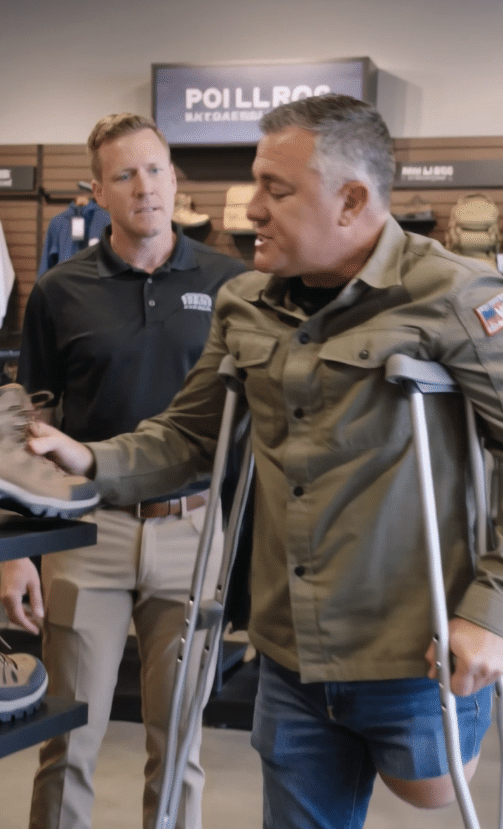
Robert stood beside the hiking boot display, leaning on a pair of metal crutches. His old Army jacket had faded at the shoulders, his blue jeans were worn at the knees, and his white T-shirt showed beneath the open collar. At sixty-nine, with one leg missing and a prosthesis that never fit quite the same way two days in a row, he had learned to be patient with his body.
He had not expected to need patience with a store manager.
“I just need boots that fit my prosthetic,” Robert explained.
Derek looked him up and down, his mouth curling into a contemptuous smile.
“Trash. This isn’t a charity shelf.”
The words carried farther than he intended. A woman browsing tactical jackets turned her head, while a young couple near the camping equipment exchanged uncomfortable glances.
Robert tightened his grip on one crutch.
“I’m not asking for charity. I’m asking which model might work.”
Derek held the boots away from him as though Robert had brought something dirty into the store.
“People come in here every day asking questions they don’t intend to pay for. I’m not wasting my time.”
Robert’s jaw tightened, but his voice remained calm.
“I can pay for a pair of boots.”
“Then you should know what you need before you come in.”
The manager tossed the boots onto a nearby shelf. One landed crookedly, its heel hanging over the edge.
Robert shifted his weight to steady his crutch. The rubber tip had caught awkwardly against the smooth retail floor, and he bent slightly to reposition it.
That was when Derek moved behind him.
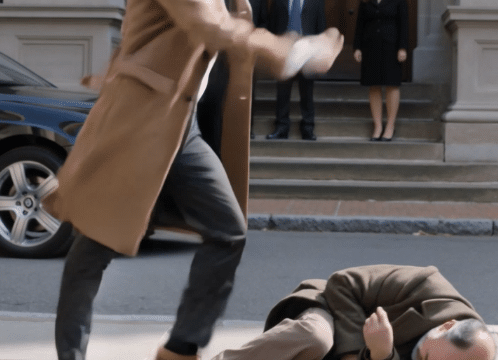
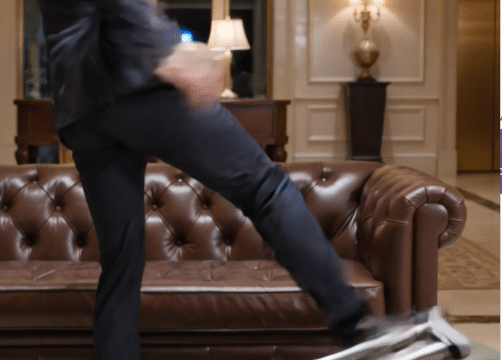
Without warning, the manager drove a forceful kick into Robert’s back.
The impact knocked the veteran forward. His crutches shot sideways, and he crashed onto the floor beside the boot display. His forearm scraped against the hard surface, leaving a thin trace of blood as the boots slid beneath the shelving.
For a second, Robert could do nothing but gasp.
Pain tightened his face. He tried to roll onto his side, but without his crutches within reach, even that small movement became difficult. His prosthetic leg shifted awkwardly, and he curled instinctively to protect himself.
Derek stepped closer.
Robert reached toward the nearest crutch.
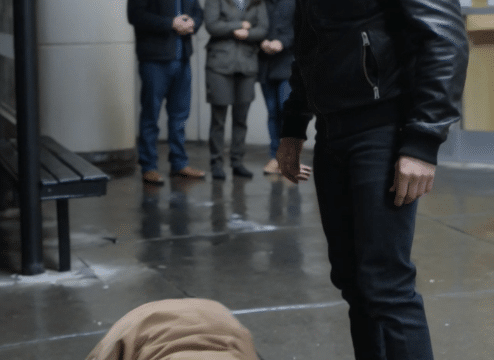
The manager kicked him twice more, striking his back and side as shoppers recoiled.
A woman covered her mouth. Someone near the backpack wall whispered, “Oh my God,” but nobody stepped forward.
Robert pressed one arm against his ribs and struggled to catch his breath.
“I just need boots that fit my prosthetic,” he repeated, his voice strained.
Derek stood over him.
“Beg somewhere else.”
Robert looked up, stunned by the casual cruelty in the manager’s face.
He had not shouted. He had not threatened anyone. He had not demanded special treatment. He had asked for help choosing footwear designed for the kind of terrain he loved.
Now he lay on the floor of a store filled with equipment advertised to help people survive the wilderness, unable to reach the crutches that allowed him to walk through an ordinary afternoon.
Derek straightened his black store polo and glanced toward the customers.
“Everyone can relax. He was causing a problem.”
Nobody answered.
Then a heavy back door flew open.
A man in a black jacket hurried into the showroom. He had been walking through the stockroom when he heard the commotion, and he moved quickly toward the boot display.
He saw the fallen veteran.
He saw the crutches scattered across the floor.
Then he recognized the face of the man struggling to breathe beside the shelf.
The newcomer stopped for half a heartbeat.
“Robert?”
He rushed forward, retrieved the nearest crutch, and placed it within the veteran’s reach before moving directly between Robert and Derek.
The man’s expression had changed completely.
He looked at the manager with a controlled fury that made Derek’s smugness begin to falter.
“He trained me,” the newcomer said. “Before I owned this company.”
Derek stared at him.
The man in the black jacket was Lucas Reed, the newly appointed CEO of the entire outdoor retail chain.
But the revelation that Lucas ran the company was only half the truth.
The man lying on the floor had helped make Lucas the leader he was.
And Derek had just attacked the person Lucas had spent years trying to repay.
“He trained you?” Derek whispered.
For the first time that afternoon, the manager had absolutely nothing to say.
Act II
Robert Kane had never considered himself a hero.
He had served in the Army when he was young, working in logistics and field operations. His job had often required him to solve practical problems under difficult conditions: damaged equipment, unpredictable weather, exhausted personnel, and supplies that had to last longer than anyone expected.
He learned to pay attention to details.
A boot that rubbed in the wrong place could become a serious problem after ten miles. A poorly fitted pack could turn a manageable hike into an ordeal. A small equipment failure in the wrong conditions could place an entire team at risk.
Robert understood that preparation was not about looking impressive.
It was about making sure people could get where they needed to go and return safely.
After leaving the military, he worked in outdoor equipment retail and later became a field trainer for a regional outfitter. He taught new employees how to assess customers’ needs instead of pushing whatever product carried the highest margin.
He taught them how to ask questions.
Where would the customer be hiking? What kind of terrain would they encounter? Had they experienced problems with their current equipment? Did they need more support, more flexibility, or a different fit?
Most importantly, he taught them not to assume that a person’s appearance told them what they could afford or what they understood.
“Never confuse the person asking for help with the person who doesn’t know anything,” he used to tell his trainees. “Sometimes the customer knows exactly what they need. They just need you to listen long enough to find it.”
Lucas Reed had been one of those trainees.
He was twenty-three when he first met Robert, a nervous new hire who knew every brand name in the catalog but almost nothing about helping customers choose equipment. Lucas could recite product specifications, explain waterproof membranes, and identify the newest backpack models.
But he had a habit of talking too much.
He would interrupt customers, rush toward recommendations, and assume that the most expensive option was usually the best one.
Robert noticed immediately.
Rather than humiliating him, he took Lucas aside after a difficult shift.
“You want to sell people equipment,” Robert said. “That’s fine. But first, learn what they’re trying to do with it.”
Lucas had frowned.
“I know the products.”
“That’s not the same thing.”
Over the following months, Robert trained him patiently. He showed Lucas how to fit hiking boots, how to recognize when a customer’s gait affected the way a shoe wore down, and how to recommend equipment without making someone feel ignorant for asking questions.
He taught him to notice people who hesitated before entering the store, customers who struggled to explain an unfamiliar need, and older hikers who wanted to keep exploring without pretending their bodies had never changed.
One afternoon, an elderly customer arrived with a complicated foot condition. Lucas had initially suggested a standard boot because it was the model he knew best.
Robert stopped him.
“Ask one more question.”
That question changed the recommendation.
The customer left with a pair of boots that fit comfortably and an invitation to return if the fit needed adjustment.
Afterward, Lucas asked Robert why he had not simply given him the answer.
“Because next time, I won’t be standing beside you,” Robert replied. “You need to know how to think when nobody is there to tell you what to do.”
Lucas never forgot it.
He eventually left the regional outfitter, worked in product development, and moved into operations. He learned the business from warehouse floors, purchasing offices, distribution centers, and retail stores. Years later, when the chain expanded, he became one of its youngest regional directors.
He credited Robert whenever someone asked who had influenced his leadership style.
Robert never expected anything in return.
By then, he had retired from full-time work and spent much of his time outdoors. He liked quiet trails, old maps, and long mornings when the weather was cool enough to walk without rushing.
Then a medical emergency changed his life.
Complications led to the loss of his leg. Recovery was long, exhausting, and filled with small humiliations that few people around him understood. Tasks he had once performed without thinking required planning. A short walk could demand more energy than an entire afternoon of work once had.
Robert struggled most with the loss of spontaneity.
He hated having to calculate distances, surfaces, and places to rest before leaving the house. He hated when strangers spoke to whoever accompanied him instead of addressing him directly.
But he refused to give up the outdoors.
He learned to use his prosthesis, adapted his routines, and returned to walking as his recovery allowed. His goal was not to prove that his disability did not matter. It was to discover how to keep living a life that still mattered to him.
That afternoon, he had entered the store looking for hiking boots he could wear comfortably with his prosthesis.
He had researched several models and brought notes about the terrain he hoped to tackle. He knew that the right boot might require a different interior volume, careful adjustment, and enough stability to accommodate the way his prosthetic foot met the ground.
He had come to ask questions before spending his money.
Instead, Derek Shaw had looked at his old jacket and metal crutches and decided he was a beggar.
Derek had become a store manager by the age of thirty-six, and he was proud of how quickly he had climbed the ladder. He tracked sales numbers closely and kept the showroom immaculate. His employees knew he disliked anyone who slowed down the sales floor.
He believed a premium store had to feel exclusive.
Customers who bought expensive gear made him feel successful. Customers who asked too many questions frustrated him. Anyone who appeared unable to afford the products, in his opinion, wasted valuable time.
That attitude had gradually hardened into contempt.
He had begun treating courtesy as something customers needed to earn. He corrected employees in front of shoppers and dismissed requests for extra fitting time as unnecessary complications. He had even discouraged his team from spending too long with customers who appeared unlikely to purchase anything.
But Derek had made a more serious mistake than misjudging Robert’s ability to buy boots.
He had mistaken his own authority for permission to be cruel.
Now Lucas Reed stood between him and the man who had taught him that leadership meant the opposite.
And Lucas was about to make sure the entire company understood why that lesson mattered.
Act III
Lucas lowered himself beside Robert just long enough to check that the veteran was conscious and to return the crutch to his hand.
“Don’t try to get up too quickly,” he said. “Take a moment.”
Robert winced as he shifted his arm.
“I’m all right.”
Lucas looked at the thin trace of blood on his forearm, then at the way Robert was guarding his back.
“No, you’re hurt. Let someone assess you.”
He turned toward a nearby employee.
“Call emergency medical services. Please make sure the floor is clear and that nobody moves anything near the display until security has documented what happened.”
The employee hurried away.
Lucas then rose and positioned himself directly in front of Derek.
“Did you do this?”
Derek’s face had gone pale, but he tried to recover his usual managerial confidence.
“Lucas, I can explain.”
“Did you kick him?”
“He was behaving aggressively.”
Lucas glanced back at Robert, who was still sitting on the floor, breathing carefully.
“Tell me what he did.”
“He came in asking about boots. He wouldn’t listen when I told him—”
“When you told him what?”
Derek hesitated.
“To stop wasting my time.”
Lucas’s eyes narrowed.
“So he asked about a product, and you decided he was wasting your time?”
“You don’t understand the situation.”
“Then explain it.”
Derek looked around the store. The customers who had witnessed the assault were still nearby. Some stood beside the hiking boot wall, while others had moved toward the front of the showroom but had not left.
Nobody appeared willing to confirm Derek’s version.
He lowered his voice.
“I was trying to maintain standards.”
Lucas stared at him.
“Standards?”
“This is a premium outdoor store. We have customers who expect a certain level of service.”
“And you decided that a disabled veteran didn’t deserve any?”
“I didn’t know he was a veteran.”
Lucas’s expression hardened further.
“You didn’t need to know.”
Derek swallowed.
“Lucas, I had no idea he was connected to you.”
For several seconds, the store seemed to go completely still.
Lucas looked at the manager as if he had finally exposed the belief underneath every excuse.
“Connected to me?”
“I mean, I didn’t know you knew him.”
“Would you have treated him differently if you had?”
Derek said nothing.
Lucas took one measured step closer.
“Would you have helped him choose boots if you knew he had trained me? Would you have spoken to him like a human being if you knew he was important to the company?”
“That’s not what I meant.”
“Then what did you mean?”
Derek’s gaze dropped.
Lucas’s voice remained controlled, but every word carried weight.
“Robert Kane trained me before I owned this company. He taught me how to fit boots, how to listen to customers, and how to understand what people actually need. He taught me that selling equipment is a responsibility because people depend on it.”
Lucas glanced toward the boot display.
“And you attacked him because he asked you for help.”
Derek’s mouth opened, but no response came.
The customers were watching now, and the manager could no longer hide behind vague references to store standards.
Lucas turned toward the employees.
“I want the security footage preserved. Every relevant camera angle. I want written statements from anyone who witnessed this, collected independently. Nobody is to pressure anyone about what they saw.”
Then he looked back at Derek.
“You are not to approach Mr. Kane again.”
Derek’s face tightened.
“You can’t just suspend me in front of everyone.”
“I can remove you from the sales floor while this is investigated.”
“You’re the new CEO. You’ve barely been here long enough to understand how this store operates.”
Lucas did not raise his voice.
“I understand enough to know that an employee who kicks a customer to the floor cannot continue managing that customer-facing operation while we establish the facts.”
“I made a mistake.”
“You made a decision.”
Derek glanced toward the front doors, then back at Lucas.
“I lost my temper.”
“You took the boots away from a man who asked a reasonable question. You insulted him. You kicked him from behind. Then you kicked him twice while he was down.”
Lucas paused.
“Which part of that was an accident?”
Derek’s expression shifted. The excuses had run out, leaving only the possibility that he might admit what he had done.
Instead, he reached for the one argument he thought might save him.
“You’re doing this because he trained you.”
Lucas looked almost disappointed.
“No. I’m doing this because I saw what you did, and the evidence needs to be preserved. If Robert had never met me, this would still be unacceptable.”
He turned toward the security supervisor, who had arrived from the back office.
“Follow the company’s process. Document everything. Bring in the appropriate corporate team and make sure the witnesses can speak freely.”
The supervisor nodded.
Derek stood motionless.
He had imagined that the new CEO would be impressed by his ability to control the showroom. He had expected praise for protecting the store’s image, perhaps even a recommendation for a larger location.
Instead, Lucas had made one thing clear.
The company would not measure a manager’s success by how efficiently he could remove people he disliked.
It would measure him by whether he could be trusted with the people who walked through the door.
And the man Derek had dismissed as a charity case had become the clearest test of that principle.
Act IV
The medical team arrived within minutes.
Lucas remained near Robert while the responders assessed his condition. Robert was alert, but his back and side hurt, and his forearm needed attention. They advised further evaluation rather than allowing him to stand and walk around as if nothing had happened.
Robert was reluctant.
“I don’t want to make a bigger scene than necessary,” he murmured.
Lucas shook his head.
“You didn’t make this scene.”
Robert looked toward the boot display.
“I came in to buy a pair of boots.”
“And you still deserve to be treated like a customer.”
Lucas stayed with him until the medical team had finished their initial assessment. He then made sure the relevant security recordings were secured and the incident was reported through the company’s established procedures.
Derek was removed from his managerial duties pending investigation.
The decision was not made because Lucas wanted revenge for a mentor. He knew that any disciplinary action needed to rest on documented facts, not personal loyalty. He also knew that his position could make employees feel pressured to tell him what they thought he wanted to hear.
So he directed the corporate team to conduct the review independently.
Witnesses were interviewed separately. Security footage was examined from multiple angles. The team reviewed Derek’s account against the visible sequence of events and the statements from customers and staff.
The evidence left little room for doubt.
Robert had been asking about footwear for his prosthesis. Derek had taken the boots away, insulted him, and kicked him from behind as he bent to steady his crutch. After Robert fell, Derek delivered two more kicks while the veteran tried to reach his crutches.
No witness described Robert threatening the manager.
No evidence suggested that he had been physically aggressive toward anyone.
The claim that Derek was defending the store’s standards could not explain the assault.
The company also reviewed earlier concerns about Derek’s management style. Several employees described an atmosphere in which questions were discouraged and customers who needed additional help were treated as burdens. Some said they had been reluctant to challenge Derek because he controlled their schedules and performance assessments.
Those accounts were examined separately from the assault itself, but they raised an important question: had Derek’s behavior continued because the people around him had learned that speaking up would cost them?
Lucas did not want the company to answer that question with a new poster about respect.
He wanted meaningful changes.
The company clarified its expectations for customer service, reinforced the procedures for reporting misconduct, and required managers to complete updated training on disability access and appropriate responses to conflict. Employees were reminded that they could report safety concerns directly through corporate channels without first seeking approval from the manager involved.
The review also looked at whether staff had the tools and knowledge to help customers who needed specialized footwear or equipment adjustments.
A customer using a prosthesis might need to consider interior volume, ankle support, sole shape, or compatibility with their prosthetic setup. Employees did not need to be medical specialists, but they did need to know how to ask respectful questions and when to recommend a fitting professional.
Lucas insisted that these changes be practical rather than symbolic.
The company would not solve every accessibility issue with one training session. But it could make clear that customers were entitled to ask for assistance without being mocked, dismissed, or treated as suspicious.
When the formal review concluded, Derek was dismissed for serious misconduct, including the assault and violations of the company’s conduct standards. The decision followed the company’s documented process, and the evidence was retained for any further proceedings that might be required.
Derek’s last meeting with corporate leadership was brief.
“I’ve worked here for years,” he argued. “I’ve made this store successful.”
The reviewer acknowledged his employment history but returned to the evidence.
“Your performance does not excuse what happened.”
Derek looked toward Lucas, who had attended only to ensure the company understood the consequences for the business and its staff.
“You’re really going to throw everything away over this?”
Lucas answered calmly.
“You threw it away when you decided that a customer could be assaulted because you didn’t think he belonged here.”
Derek looked down.
For once, he had no explanation that could make his actions sound reasonable.
After the meeting, Lucas visited Robert, who was recovering at home.
He brought no executives, no photographers, and no company publicity team. He carried a small bag of groceries and a folder containing the contact information for the company’s customer support and accessibility team.
Robert looked at the folder.
“What is that?”
“A direct contact if you ever need help with our products or have trouble getting an answer from one of our stores.”
Robert raised an eyebrow.
“Is that your way of apologizing for the whole company?”
“It’s my way of making sure you don’t have to fight through a dozen departments if you need something.”
Robert considered that.
“Good. But don’t make me a special case.”
Lucas sat down.
“I know.”
“Because if the only person who gets treated properly is the man who knows the CEO, you haven’t fixed anything.”
Lucas nodded.
That was the part he had been thinking about ever since he saw Robert on the floor.
He could remove Derek. He could revise procedures. He could require training and preserve records. But none of those actions would mean much if employees learned only that Robert was untouchable because of his connection to the top.
The point was not to create a company where powerful people received better treatment.
It was to build one where power could not be used to humiliate people who had less of it.
Robert studied him for a moment.
“Then do that.”
Lucas promised he would.
And for the first time since the assault, Robert allowed himself to believe that something useful might come from what had happened.
Act V
Several weeks later, Robert returned to the store.
He had waited until he felt ready. His recovery was progressing, but the experience had left him more cautious about crowded spaces and unfamiliar people. He did not want to rush the process or pretend that an apology from a company could erase the memory of being kicked while strangers watched.
Still, he needed hiking boots.
There were trails he wanted to return to, and he had no intention of allowing one cruel afternoon to decide the rest of his life.
The showroom looked much as it had before. Hiking boots lined the walls, backpacks hung from their display hooks, and tactical jackets were arranged beneath bright retail lights.
But when Robert entered, an employee greeted him without staring at his crutches.
“Good afternoon. Are you looking for anything in particular?”
Robert explained that he needed a boot suitable for use with his prosthesis and described the kind of walking he hoped to do.
The employee listened.
Rather than immediately reaching for the most expensive model, he asked Robert about the fit of his current footwear, the terrain he preferred, and whether there were any particular areas of discomfort he wanted to avoid.
Robert answered carefully.
The employee brought out two models and explained their differences. When he was uncertain about one detail, he checked the product guidance instead of guessing.
There was no dramatic announcement.
No one cleared the aisle.
No one rushed out of an office to recognize Robert as a distinguished veteran.
For the first time in weeks, he was simply a customer receiving the assistance he had come to seek.
That was exactly what he wanted.
He tried one pair while seated, taking his time to assess how the boot felt around the prosthesis. The employee gave him room to adjust, then returned when Robert asked a follow-up question.
After comparing the options, Robert found a model that seemed promising. He would still need to test the fit carefully and follow the guidance of his prosthetics specialist, but he had a sensible starting point.
He purchased the boots.
As the employee placed the box in a bag, Robert looked around the store.
“Thank you for taking the time.”
“Of course,” the employee replied. “That’s what we’re here for.”
Robert nodded.
It was a simple answer, but it carried more meaning than the employee might have realized.
Across the company, Lucas was reviewing the early results of the changes he had ordered. Managers had received updated guidance, reporting routes were clearer, and the company was monitoring customer complaints and employee feedback to identify problems before they escalated.
Lucas knew that a policy could not guarantee kindness.
Some people would still make assumptions. Some managers would still confuse authority with superiority. And some customers would still encounter employees who lacked the patience or judgment to help them properly.
But the company could no longer pretend that these failures were isolated from its responsibilities.
It could listen when people reported misconduct. It could protect the integrity of investigations. It could hold managers accountable for their actions instead of allowing sales numbers to excuse everything else.
Most importantly, it could make sure that employees understood what Robert had taught Lucas years earlier.
Listen first.
Ask questions.
Never decide what a person deserves before you understand what they need.
That afternoon, Lucas received a short message from Robert.
Found a pair that might work. I’ll test them on the local trail when I’m ready.
Lucas smiled at his phone.
He started typing a reply, then stopped to reconsider. He wanted to ask how Robert was feeling, whether his back still hurt, and whether the store had treated him well.
Instead, he wrote:
Glad you found something. Take your time on the trail. Let me know how the fit goes.
Robert replied a few minutes later.
That’s the plan.
For Lucas, the exchange mattered more than a public statement or a dramatic ceremony. Robert was making his own decisions again, moving at his own pace, and choosing what came next.
He had not returned to the store to help Lucas prove a point.
He had returned because he wanted boots.
That distinction was important.
Robert did not owe the company his forgiveness. He did not owe Lucas a heroic story about overcoming cruelty. And he did not need to become a symbol for anyone to recognize that what had happened to him was wrong.
He was a man who had served his country, built a life, trained younger workers, survived a devastating injury, and continued to pursue the things that gave him meaning.
His disability did not make him a charity case.
His history did not make him more deserving than another customer.
And his connection to the CEO did not create the right to treat him decently.
That right had been there from the beginning.
Months later, Lucas visited the store during a routine tour. He stopped beside the hiking boot wall, where an employee was patiently helping a customer compare two models.
He watched for a moment, then continued toward the stockroom.
He did not need to announce who Robert Kane was or repeat the story of the assault. The important lesson was not that a powerful executive might arrive at any moment and discover that someone had mistreated his mentor.
The important lesson was that nobody should have to fear such a discovery to do the right thing.
Derek Shaw had looked at Robert and seen a man he believed he could humiliate without consequence.
Lucas had looked at Robert and seen the person who taught him how to lead.
But Robert himself had never needed either man’s judgment to determine his worth.
He had walked into that store seeking a pair of boots. He left with something more difficult to measure: proof that the company had finally been forced to confront the gap between the values it advertised and the behavior it allowed.
And somewhere beyond the showroom, the trails were still waiting.
Robert would return to them when his body was ready. He would take his time, test his equipment, and walk as far as he safely could. There might be difficult days. There might be moments when the prosthesis hurt or the terrain demanded more than he expected.
But the decision to keep moving would remain his.
Because a man who had spent his life helping others find the right equipment did not need permission to keep exploring.
And a man who had already rebuilt his life after losing a leg did not need to prove anything to a store manager.
Derek had believed that a person’s worth could be measured by their clothes, their appearance, and the money they seemed likely to spend. Robert’s life told a different story: real character is revealed not by how someone treats the powerful, but by how they treat the person they mistakenly believe has no power at all.