Act I
“Please… you have not paid yet.”
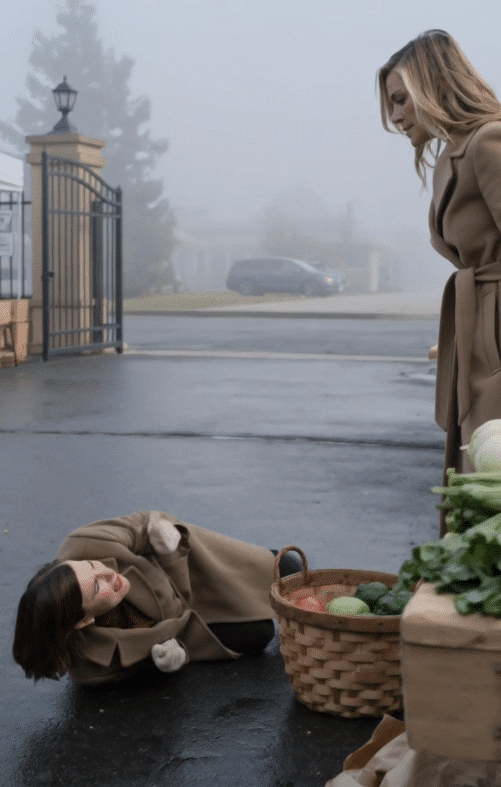
The words were barely audible over the rustling of paper bags and the distant rumble of trucks arriving at the farmers market. A 52-year-old woman stood beside her vegetable stall, her cracked hands trembling inside a pair of torn gloves as she watched an elegantly dressed customer turn away with a bag of fresh greens.
The customer stopped.
Slowly, she turned back.
Her expensive beige coat looked almost unreal against the damp wooden tables, muddy pavement, and thick morning fog. A gold bracelet glimmered beneath her sleeve as she glanced at the older woman with an expression of open disgust.
“Trash,” she sneered. “Your vegetables cost nothing.”
Before the seller could respond, the wealthy woman swept a basket of greens off the table.
The vegetables struck the wet pavement and scattered across the ground. Lettuce leaves landed in shallow puddles. A paper bag split open, spilling its contents beneath the feet of customers who had gathered nearby.
For a moment, the seller simply stared.
Those vegetables represented hours of work, the money she needed for groceries, and the small business she had fought to keep alive through years of rising costs and shrinking profits. She had risen before three in the morning to prepare her stall, loading each basket carefully into her battered truck while the rest of the neighborhood slept.
Now, an expensive stranger had destroyed part of her morning’s earnings simply because she had been asked to pay.
“Ma’am,” the seller whispered, swallowing the humiliation. “I only asked you to pay for what you took.”
The wealthy woman gave a cold laugh.
Then the older woman bent down to retrieve the vegetables.
That was when the attack came.
The woman in the beige coat drove a hard kick into her back, sending her sprawling face-first beside the table. A sharp impact echoed through the market. Several people gasped as baskets toppled and wooden crates scraped across the pavement.
The seller cried out, instinctively curling her arms around herself. Her elbow struck the ground, leaving a thin trace of blood against her weathered skin.
She tried to breathe through the pain.
Before she could push herself up, the attacker stepped closer and delivered two more forceful kicks to her back and side.
The seller collapsed against the scattered produce, her face contorted with pain. Her fingers curled around the edge of a paper bag as if holding on to that one small thing could keep the entire morning from falling apart.
Around them, the market froze.
A man in a navy jacket covered his mouth. A young woman took a step backward. An elderly customer stared in disbelief, but nobody moved to help.
The wealthy woman noticed their silence.
And she mistook it for permission.
“Grow some dignity,” she said, standing over the injured seller.
The older woman looked up at her, breathing hard.
There were tears in her eyes, but she did not beg for mercy. She did not curse the woman or promise revenge.
Instead, she glanced at the vegetables lying in the mud.
“Please,” she whispered again. “Those are all I have.”
The attacker rolled her eyes and adjusted the cuff of her expensive coat.
She believed the encounter was over. She believed a woman in a worn wool coat, standing beside a battered vegetable stall, had no way to challenge someone like her.
She had no idea that, less than ten seconds later, the entire balance of power would change.
Because at the market gate, the brakes of a black SUV suddenly screamed against the pavement.
And the man who stepped out had just witnessed enough to change both their lives.
Act II
Margaret Ellis had spent thirty years learning how to survive on very little.
At fifty-two, she knew the price of nearly everything she sold, from a bundle of parsley to a crate of heirloom tomatoes. She knew which restaurants paid on time, which customers returned every Saturday, and which farmers were struggling badly enough to need an extra order.
What she did not know was how to make the world treat honest work with respect.
Her late husband, Daniel, had once been a mechanic who could repair almost anything with a toolbox and a patient afternoon. When he died six years earlier after a sudden illness, Margaret inherited his debts, an aging pickup truck, and a small plot of land outside town.
She could have sold the land.
Instead, she planted vegetables.
At first, it was little more than a desperate attempt to keep the bills paid. She grew tomatoes, greens, squash, and herbs, selling them from a folding table at the local farmers market. The work was exhausting, especially during winter, when the cold settled into her joints and her fingers cracked despite layers of gloves.
But the vegetables grew.
And gradually, so did her business.
Margaret became known for something increasingly rare in the local food industry: she kept her promises. If she agreed to deliver twenty crates, she delivered twenty crates. If a restaurant needed extra produce for a busy weekend, she would find a way to help.
She never had much money left after paying her expenses.
Still, she had pride.
Every dollar she earned carried the memory of Daniel’s hands building their first greenhouse from salvaged wood. Every basket she arranged reminded her of the promise she had made at his hospital bedside: she would not let their life disappear simply because he was gone.
There was one particular vegetable basket she had refused to replace that morning.
It was an old wooden crate, its corners worn smooth and one side marked with a small brass plate engraved with the initials D.E. Daniel had made it from leftover timber on the day they planted their first commercial crop.
It was not valuable to anyone else.
To Margaret, it was a piece of the life they had built together.
When the wealthy customer swept the greens from the table, that basket struck the ground too. One of its wooden slats cracked, and the brass plate came loose.
Even as pain spread through her back, Margaret reached toward it.
That was the object she had tried to protect.
Not the vegetables alone.
A memory.
Meanwhile, the woman who had attacked her was accustomed to living in a world where consequences could be negotiated away.
Her name was Vanessa Whitmore, and she was thirty-nine years old. She lived in a gated estate, drove luxury vehicles, and attended charity galas where she liked to be photographed beside people whose names appeared in business magazines.
Her husband had inherited a regional hospitality group, and Vanessa had spent years cultivating the image of a woman who understood fine dining, philanthropy, and the importance of social connections.
In reality, she measured people by how useful they were to her.
A waiter who made a mistake could be humiliated in front of an entire restaurant. A delivery driver who arrived late could be threatened with dismissal, even if the delay had nothing to do with him. A shop assistant who questioned a return could expect an angry phone call from someone higher up.
Vanessa had learned that indignation was a useful weapon.
If she acted offended loudly enough, other people often apologized just to end the confrontation.
That morning, she had taken several bags of vegetables from Margaret’s stall without paying because she had convinced herself that the market’s rules did not apply to her. When Margaret politely reminded her of the bill, Vanessa heard something she could not tolerate.
A poor woman had challenged her.
And in Vanessa’s mind, that was an insult that demanded punishment.
She had not considered the consequences because, until that moment, she had rarely been forced to face any.
The witnesses knew her type. Some recognized the luxury SUV she usually drove. Others had seen her at local charity events, where she distributed generous smiles for cameras while barely acknowledging the people doing the actual work.
They watched Margaret fall.
And they stayed silent.
Later, several would remember that silence with shame.
But none of them understood why the black SUV at the market gate mattered so much.
The man who stepped out wore a dark overcoat and moved with the calm authority of someone who never needed to raise his voice to command a room. Behind him, two security officers followed, their footsteps cutting through the sudden stillness.
His name was Thomas Reed.
At sixty, Thomas owned the historic market where Margaret sold her produce. He had spent decades protecting independent vendors from rising rents, corporate buyers, and developers who wanted to turn the property into another polished shopping complex.
He also owned one of the most respected farm-to-table restaurants in the region.
And he had not come to the market merely to inspect his business.
He had come because Margaret had missed a delivery.
For the first time in three years.
Thomas knew something was wrong.
What he discovered beside the vegetable stall was far worse than he had imagined.
And standing just behind him, stepping out of the same black SUV, was a chef whose next words would make Vanessa’s confidence disappear.
Act III
“Give her some room.”
Thomas Reed’s voice cut through the crowd.
He crossed the wet pavement without looking at Vanessa and dropped to one knee beside Margaret. One of the security officers immediately moved to help keep the surrounding crowd back while the other called for medical assistance.
“Margaret, can you hear me?”
She nodded weakly.
“I’m here,” Thomas said. “Don’t try to get up yet.”
His voice softened as he checked whether she could respond clearly. He did not grab her or demand that she explain what had happened. He simply stayed beside her, shielding her from the staring crowd.
For the first time since the attack began, Margaret was no longer alone.
Then Thomas noticed the broken wooden basket.
His expression changed.
He picked up the brass plate, wiped the moisture from its surface with his thumb, and looked at the initials engraved upon it.
D.E.
He recognized them immediately.
Years earlier, before Margaret had become one of his most dependable suppliers, Thomas had visited her farm during a difficult season. He had found Daniel working in a half-collapsed greenhouse, repairing shelves with the same determination he brought to everything else.
Daniel had been ill even then, though he had hidden the seriousness of it from most people.
Thomas remembered the couple refusing an advance payment because they had not yet delivered the produce. He remembered Daniel saying that a business was only worth keeping if people could trust the person behind it.
After Daniel died, Thomas had quietly offered Margaret a standing supply contract for his restaurant.
She had accepted only after insisting that she meet every quality requirement he had.
Over time, her vegetables had become one of the restaurant’s signature ingredients. The kitchen’s seasonal menus depended on her heirloom tomatoes, her unusually fragrant herbs, and the greens she harvested before sunrise.
Thomas had turned down larger suppliers to keep buying from her.
Not out of pity.
Because her produce was excellent, and because she had earned his trust.
Now she was lying injured on the ground, and the woman responsible was still standing above her.
A second door of the SUV opened.
Chef Adrian Cole emerged, carrying none of the hurried panic that might have been expected from someone arriving at a scene of violence. He was fifty-eight, a celebrated chef whose restaurant had received national recognition for its seasonal cooking and its commitment to small American farms.
Adrian had worked with Thomas for nearly twenty years.
He had also developed a particular affection for Margaret’s produce.
Every autumn, when the first frost threatened her final tomato harvest, she sent the restaurant the last crate with a handwritten note. Every spring, she brought the first tender greens herself, often refusing to let anyone else carry them because she wanted to inspect their condition.
Adrian had once told his kitchen staff that the difference between a good meal and an unforgettable one often began with the person who had grown the ingredients.
Margaret had laughed when she heard about it.
She did not think of herself as important.
Adrian did.
He crouched beside her and began gathering the clean vegetables that had landed away from the puddles. He handled each one carefully, placing them in an undamaged crate while an employee hurried to bring a clean cloth and fresh packaging.
Then he looked up at Thomas.
Thomas did not need to ask what he was thinking.
He turned toward Vanessa.
Only then did she seem to understand that the two men had not arrived to rescue her from an embarrassing scene.
They had come to help the woman she had attacked.
Vanessa straightened her coat and attempted a dismissive smile.
“This is a private dispute,” she announced. “The woman became aggressive when I questioned the quality of her products.”
Several witnesses looked at one another.
They had seen Margaret ask for payment.
They had seen the basket thrown to the ground.
They had seen the kicks.
But until that moment, nobody had dared to contradict Vanessa.
Thomas rose slowly.
“Private dispute?” he repeated.
Vanessa’s smile faltered.
“You don’t know what happened.”
“I know enough to ask why a woman who works for a living is lying injured on my property while you stand here trying to rewrite what everyone just witnessed.”
Vanessa glanced toward the crowd.
Nobody came to her defense.
Then Adrian stepped forward, still holding the crate of clean vegetables.
He looked directly at Vanessa and spoke with a calmness that somehow made the words more devastating.
“She supplies my restaurant.”
The sentence landed harder than a shout.
Vanessa blinked.
For a moment, she seemed unable to understand what he had said. Her eyes moved from Adrian to Margaret, then back to the chef.
She had assumed the older woman was insignificant because she looked poor.
She had never considered that the produce she had contemptuously thrown into the mud might have been destined for a kitchen whose name she recognized.
Adrian continued.
“The greens you just destroyed were ordered for tonight’s tasting menu. Her farm supplies our kitchen every week. We’ve worked together for years.”
Vanessa swallowed.
“That doesn’t change anything.”
“No,” Adrian replied. “It doesn’t.”
He looked down at Margaret, who was still being assessed by the arriving medical team.
“It changes nothing about what you did to her.”
Thomas stepped between Vanessa and the market exit.
His security officers moved into position, not touching her, but making it clear that she would not simply walk away while the incident was being addressed.
Vanessa’s face tightened.
“Do you know who I am?”
Thomas held her gaze.
“I know exactly who you are.”
But he knew something else, too.
Something about Vanessa’s family, her husband’s business, and a series of complaints that had disappeared from official channels after people with money made a few calls.
The attack on Margaret was not the first time Thomas had heard Vanessa’s name connected to the mistreatment of someone who could not afford to fight back.
It was simply the first time he had witnessed the consequences with his own eyes.
And now he intended to find out how much of her carefully maintained reputation had been built on other people’s fear.
Act IV
Vanessa’s confidence began to unravel when Thomas asked for the market’s security footage.
She immediately objected.
“You cannot record people without their permission.”
“The cameras are installed for the safety of our vendors,” Thomas replied. “And you are welcome to explain your concerns to the police.”
Her eyes darted toward the security officers.
“I want my lawyer.”
“You can call one.”
“I want to leave.”
Thomas did not move.
“Not until the responding officers have taken your statement and the situation has been properly documented.”
For the first time that morning, Vanessa looked genuinely frightened.
She had expected anger. She had expected a crowd that might whisper about her behavior before returning to their shopping. She had even expected someone to demand an apology.
What she had not expected was an organized response.
The market had cameras at every entrance and along the main aisles. Thomas had installed them after several vendors suffered thefts and harassment. The footage could show precisely when Vanessa approached Margaret’s stall, took the vegetables, knocked the basket to the ground, and attacked the seller.
There would be no argument about who had started the confrontation.
No clever explanation could turn the sequence into an innocent misunderstanding.
A woman near the flower stand finally spoke.
“I saw the whole thing.”
Vanessa spun toward her.
“You saw nothing.”
The witness flinched, but another voice rose from the crowd.
“I saw it, too.”
Then a third.
A delivery driver who had been unloading crates admitted that he had watched Vanessa kick Margaret while everyone else stood frozen. His voice shook as he spoke, and he looked toward the injured seller with visible regret.
“I should have stepped in,” he said quietly.
Margaret heard him from the stretcher.
She did not answer. She was exhausted, and every movement sent pain through her back. But she gave him a small, weary look that made him lower his eyes.
The witnesses had finally begun to speak.
Adrian stood beside the clean crate of rescued vegetables, watching as a medical worker helped Margaret onto the stretcher. Before they wheeled her away, he leaned down.
“Your produce will be taken care of,” he promised. “And your place at the restaurant is secure. You don’t need to worry about the order.”
Margaret’s eyes filled with tears.
“I’m sorry,” she whispered. “I couldn’t save all of it.”
Adrian looked at the muddy greens scattered around the table.
“Margaret, you have nothing to apologize for.”
She closed her eyes briefly.
For years, she had trained herself to apologize whenever her life became inconvenient to someone else. She apologized when deliveries ran late because of bad weather. She apologized when customers complained about prices she could barely afford to charge. She apologized for needing help, even when the circumstances were beyond her control.
Now, for the first time that morning, someone had told her that the blame did not belong to her.
As the ambulance crew prepared to leave, Thomas turned back toward Vanessa.
“You owe her more than the price of those vegetables.”
Vanessa folded her arms.
“I’ll pay whatever she wants.”
Thomas’s expression hardened.
“This isn’t about money.”
He told her that the market would preserve its footage and cooperate with law enforcement. He also made it clear that her conduct would be reviewed under the market’s vendor and visitor policies, and that she would not be welcomed back while the matter was being investigated.
Vanessa’s lips parted in disbelief.
“You can’t ban me. My family has supported local businesses for years.”
“Supporting a business doesn’t give you permission to assault someone who works there.”
Then Thomas revealed the part she had not anticipated.
For months, he had been reviewing complaints from small vendors who claimed they had been threatened, bullied, or pressured into giving discounts to wealthy customers. Several had described a woman matching Vanessa’s appearance.
One farmer had stopped attending the market entirely after a confrontation that left him afraid of losing his biggest wholesale customer. A flower seller had reported being publicly insulted after refusing to provide a large order for free. Another vendor had quietly withdrawn a complaint after receiving a threatening letter from a law firm connected to one of the businesses Vanessa’s family knew.
Thomas had never been able to establish that the incidents were connected.
Now he had reason to examine them together.
He would not make accusations he could not prove. But he would preserve the records, contact the affected vendors, and make sure the new complaints were documented.
Vanessa listened, her expression shifting from anger to disbelief.
“You’re threatening my family?”
“No,” Thomas said. “I’m telling you that other people are finally being heard.”
Adrian stepped closer.
“And as far as my restaurant is concerned, any company that wants to work with us will be expected to treat our suppliers with basic respect. That includes the people who represent those companies.”
Vanessa knew what that meant.
Her husband’s hospitality group had been courting a partnership with Adrian’s restaurant for a major expansion project. The proposed collaboration had been discussed at private dinners and business meetings for months. Vanessa had repeatedly boasted to friends that the partnership would make her family even more influential in the regional dining industry.
Adrian did not threaten to destroy the deal.
He simply said that no business decision would be made until the incident had been properly reviewed.
The distinction was important.
He would not use his influence to manufacture a punishment. But he would not ignore what had happened, either.
Vanessa’s carefully constructed world suddenly felt much smaller.
She looked around the market, searching for a friendly face.
The man who had covered his mouth earlier was now speaking to an officer. The young woman who had stepped backward was giving her account. The delivery driver was pointing out the location of a nearby camera.
Nobody was looking at Vanessa with admiration.
They were looking at her as a person who had chosen to hurt someone weaker and then assumed she would never have to answer for it.
She had spent years believing that power meant never being challenged.
Now she was learning the difference between being feared and being respected.
Yet the most painful consequence had not arrived.
That would come later, when the footage was reviewed, when the witnesses’ accounts were recorded, and when the people who had once accepted Vanessa’s version of events were forced to confront the truth.
For the first time, she could not control the story by speaking the loudest.
And she had no idea how to survive in a world where the truth had the final word.
Act V
Margaret spent the rest of the day under medical observation.
Her injuries left her sore and shaken, and the doctor advised her to rest while the effects of the assault were assessed. She worried about her farm, the remaining vegetables, and the orders she might miss if she could not return to work quickly.
Even from the hospital, she asked whether the market had been cleaned.
Thomas visited that evening.
He brought a small paper bag containing a few of the vegetables Adrian had rescued. Beside it was the old wooden basket, carefully repaired by one of the market’s maintenance workers. The cracked slat had been secured, and the brass plate bearing Daniel’s initials had been fastened back into place.
Margaret stared at it for a long time.
“You didn’t have to fix that,” she said.
Thomas pulled a chair beside her bed.
“Yes, I did.”
She ran her thumb over the brass plate.
“Daniel made this from scraps. We couldn’t afford a proper crate back then.”
“I remember.”
“He used to say that if we couldn’t afford something new, we should learn to take care of what we already had.”
Thomas smiled faintly.
“He was right.”
Margaret’s eyes filled with tears, but this time they were not entirely tears of pain.
For the first time since the attack, she allowed herself to cry without trying to hide it. She cried for Daniel, for the years she had spent struggling to keep their dream alive, and for the terrifying moment when she had believed that the world could take everything from her simply because she was too poor to fight back.
Thomas did not interrupt.
He stayed until she had calmed down.
Then he told her what had happened at the market.
The security footage had been preserved. Several witnesses had provided statements, and the authorities were reviewing the incident. Thomas and Adrian had made clear that they would cooperate with the investigation.
The market had also arranged temporary help for Margaret’s stall. Her remaining produce would be collected, sorted, and delivered where possible, and the damaged goods would be documented rather than quietly written off as a loss she had to bear alone.
Adrian had gone further.
He had instructed his kitchen to honor the full value of Margaret’s scheduled order, including the portion that could no longer be used. He wanted her to recover without being forced to choose between medical care and keeping her business alive.
When Margaret heard that, she shook her head.
“I can’t accept charity.”
Thomas leaned forward.
“Then don’t call it charity.”
She looked at him.
“You earned that order. You grew those vegetables. You showed up when you said you would, season after season. You have given this market and that restaurant more than either of us could ever repay with a simple check.”
He paused.
“Let people stand beside you for once.”
Margaret looked down at the repaired basket.
For years, she had believed that accepting help meant admitting defeat. Daniel’s death had taught her how quickly life could collapse, and she had spent every day since trying to prove that she could survive without asking anyone to carry her burdens.
But perhaps dignity was not the same as isolation.
Perhaps there was no shame in allowing good people to do what good people were supposed to do.
The following week, Margaret returned to the market.
She wore the same old wool coat, though a new pair of gloves rested in her pocket. The morning was still cold, and the pavement still glistened with moisture, but the atmosphere around her stall had changed.
A florist came over with a thermos of coffee.
The delivery driver who had witnessed the attack offered to help unload her crates. The young woman who had stepped backward during the confrontation stopped by to apologize for not intervening sooner.
Margaret listened to each of them.
She did not pretend their silence had not hurt her. But neither did she demand that they spend the rest of their lives proving their remorse.
“Next time,” she told the delivery driver gently, “don’t wait for someone important to arrive.”
He nodded, unable to meet her eyes.
Those words stayed with him long after he left.
At ten o’clock, Adrian arrived from the restaurant kitchen. He inspected the vegetables, sampled a leaf of fresh lettuce, and announced that the evening’s menu would feature Margaret’s produce as planned.
Then he asked her whether she would consider expanding her supply contract when she was fully recovered.
Margaret laughed in surprise.
“I’m one woman with a small farm.”
“And I’m one chef with a very busy kitchen,” Adrian replied. “We can work something out.”
Thomas, standing nearby, shook his head with an amused smile.
The conversation turned practical. They discussed quantities, seasonal crops, delivery schedules, and a more sustainable payment arrangement that would help Margaret plan for the months ahead. Nothing was promised without calculation, and no one pretended that one good contract would erase years of hardship.
But for the first time, Margaret could see a path forward that did not depend entirely on how much pain she was willing to endure.
Meanwhile, Vanessa’s life became considerably less comfortable.
The incident was no longer a private confrontation that could be dismissed with a phone call. The footage and witness accounts gave investigators a clear basis to examine what had happened, and Vanessa had to answer questions about her actions.
The market’s management barred her from returning while the matter was addressed. Her husband’s business associates also began asking questions after the story reached people who had previously heard only her polished version of events.
The proposed restaurant partnership was put on hold pending a review of the situation.
There was no dramatic courtroom confession, no miraculous instant reversal, and no single speech that repaired every wrong Vanessa had committed. Consequences unfolded through ordinary processes: statements, records, business decisions, and conversations she could no longer control.
That was what made them difficult to escape.
Vanessa had always relied on the assumption that people with less money would eventually give up. They could not afford a prolonged dispute, she reasoned. They had jobs to protect, bills to pay, and families to support.
She had mistaken their exhaustion for weakness.
Now the witnesses were speaking, the records were preserved, and the woman she had treated as insignificant had the support of people who knew the value of her work.
Weeks later, Vanessa passed the market entrance in another vehicle.
She did not stop.
Through the window, she could see Margaret arranging fresh greens beneath the awning. Thomas was speaking to a farmer near the gate, and Adrian was laughing with one of the vendors.
Nobody was watching Vanessa.
Nobody was rushing to greet her.
For the first time, she was simply another person passing through a world she had once believed existed for her convenience.
She looked away.
But the memory followed her.
The wet pavement. The scattered vegetables. Margaret’s trembling hands. The sound of the black SUV arriving just as Vanessa had convinced herself that no one would ever challenge her.
Most of all, she remembered the chef’s words.
She supplies my restaurant.
At the time, Vanessa had heard them as a declaration of status. She had assumed Margaret’s value had suddenly increased because an important man had recognized her.
She had been wrong.
Margaret had possessed that value all along.
The chef had not made her worthy of respect. The market owner had not given her dignity. Their arrival had simply forced everyone to see what Vanessa’s arrogance had prevented her from seeing.
A woman’s worth had never depended on her coat, her bank account, or the number of powerful people willing to stand beside her.
It had been there in her cracked hands, in the vegetables she grew before sunrise, and in the quiet determination with which she had tried to protect a lifetime of honest work.
On a cold morning, in front of a crowd that had been too frightened to move, Vanessa had believed she could kick that dignity into the mud.
Instead, the truth had risen from the ground with it.
And when Margaret opened her stall the following morning, she placed Daniel’s repaired wooden basket at the center of the table, arranged the freshest greens inside it, and began serving her customers.
Her hands still hurt.
Her life was still difficult.
But she was no longer standing there alone.
And for the first time in a very long while, the future looked like something she could grow.