Act I
“That area is closed for safety.”
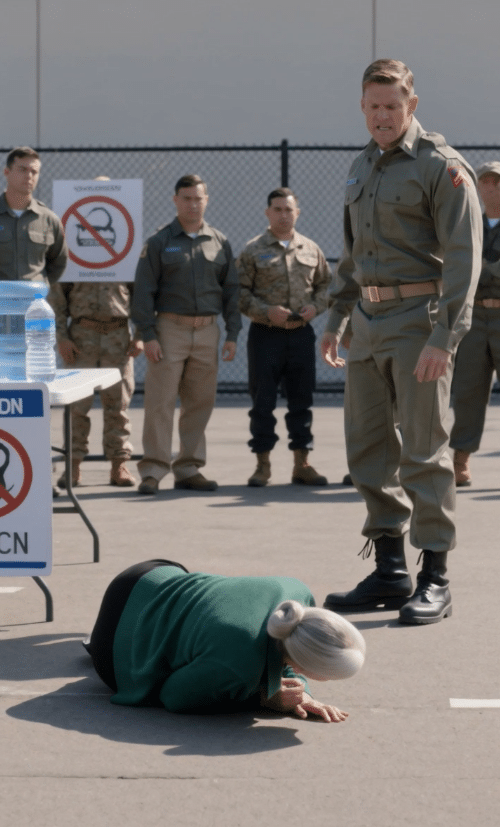
The elderly woman’s voice was calm, but firm enough to carry over the whistle blowing near the training grounds. She stood beside a small fundraiser table stacked with bottled water, her silver hair gathered into a neat low bun and her green knit coat buttoned against the wind.
Beyond the low safety fence, soldiers were preparing for a scheduled training exercise. A red-and-white sign clearly marked the entrance to the restricted zone, and another warning had been placed near the base roadway.
The officer ignored both.
He wore an olive military uniform, polished black boots, and the rigid posture of a man accustomed to having people move when he approached. At thirty-six, he had already developed a reputation for believing that rank gave him permission to speak to others however he pleased.
He glanced at the woman’s water table, then at her face.
“Trash. You sell water. You do not give orders.”
The words carried farther than he intended. Several visitors waiting near the viewing area turned toward them, including a group of cadets and parents who had come to watch the base’s open-day demonstrations.
The woman did not retreat.
“My name is Evelyn Carter,” she said quietly. “I’m volunteering for the veterans’ fundraiser. That area is closed because a safety drill is active. You shouldn’t cross the fence.”
She wasn’t trying to challenge his authority. She was trying to prevent an accident.
The officer stepped closer, his expression hardening as though her explanation had somehow insulted him.
“Did you hear what I said?”
“Yes, sir.”
“Then stay behind your little table.”
He turned toward the restricted area again.
Evelyn moved just enough to make him stop. Her small hand lifted toward the warning sign.
“Please. I’m asking you to follow the safety instructions.”
For a moment, the officer stared at her as if he couldn’t believe someone in a green coat, standing beside a table of bottled water, had dared to correct him.
Then his face changed.
He turned fully toward her, planted his boots, and drove a forceful kick into her chest.
Evelyn fell backward beside the fundraiser table. Several bottles toppled and rolled across the pavement, their plastic sides clattering against the legs of the folding table.
She struck the ground hard.
A sharp gasp escaped her as she tried to draw breath. Her forearm scraped against the pavement, leaving a thin trace of blood, and she grimaced while attempting to push herself upright.
The officer stepped toward her.
Before she could recover, he kicked her again, then delivered another blow to her back and side.
The visitors recoiled.
One woman covered her mouth. A father pulled his young son behind him. The cadets stood frozen near the viewing fence, watching an officer in uniform attack an elderly volunteer in front of them.
Nobody seemed to know what to do.
Evelyn curled instinctively against the pain, her breath coming in short, uneven bursts. Yet even as she struggled on the ground, her trembling hand pointed toward the restricted zone.
“The drill,” she whispered. “You can’t go in there.”
The officer looked down at her.
“Stay behind your little table.”
He spoke as though he had settled an argument.
He had not noticed the military vehicle approaching along the base roadway.
Its brakes sounded sharply as it stopped beside the training area. The engine continued to rumble while the driver’s door opened.
A senior officer stepped out.
He was fifty-five, broad-shouldered, with short gray hair and a face that had learned to remain composed in situations where other people lost control. His uniform carried command insignia that made his position unmistakable.
He looked first at the fallen woman.
Then at the officer standing over her.
His expression became terrifyingly still.
He crossed the pavement in long strides and stopped beside Evelyn, placing himself between her and the man who had attacked her.
“You… attacked… my… mother?”
The words cut through the training ground.
The officer’s posture changed. His shoulders stiffened, then seemed to collapse beneath the weight of what he had just heard.
He looked at the senior officer’s insignia.
He looked at the woman on the ground.
Then the color drained from his face.
“Commander…?”
The commander did not answer immediately.
He looked down at his mother, who was trying to breathe through the pain, and then back at the man who had put her there.
The entire training area fell silent.
And the officer finally understood that the woman he had called trash was the one person he should never have mistaken for someone beneath him.
But the truth was far more serious than her family connection.
Because Evelyn Carter had not merely been selling water that morning.
She had been protecting the very safety rule the officer had chosen to ignore.
Act II
Major General Thomas Carter had spent thirty-one years in uniform.
He had served in places where a careless decision could cost lives, led soldiers through exhausting deployments, and learned that authority meant accepting responsibility when things went wrong. His subordinates knew him as a disciplined commander who rarely raised his voice because he expected his words to be enough.
But before he became a general, before the medals and the command briefings, he had been a boy raised by a widowed mother who worked two jobs to keep a roof over their heads.
Evelyn had cleaned offices in the morning and worked in a diner at night. She had learned to stretch groceries, repair torn clothes, and make a modest home feel warm even when the heating failed.
She never told Thomas that their circumstances were unfair.
She told him that difficult circumstances revealed what a person was made of.
When he was sixteen, he once came home furious because a teacher had humiliated him in front of his classmates. He wanted revenge. He wanted to make the teacher regret speaking to him that way.
Evelyn had listened without interrupting.
Then she asked him a question he never forgot.
“If you become powerful one day, Thomas, how will I know you haven’t become the very thing that hurt you?”
He had no answer.
She had placed a hand on his shoulder.
“Watch how you treat the people who can’t do anything for you. That’s where the truth lives.”
Thomas carried that lesson into the military.
He learned to distinguish confidence from arrogance, discipline from cruelty, and obedience from blind loyalty. He also learned that rank did not make a person infallible. A superior officer could be wrong. A junior soldier could be right. And the person with the least authority in a room might be the only one paying attention to the danger everyone else had overlooked.
Years later, when Thomas became base commander, Evelyn found a way to remain close to the world that had shaped her son’s life.
She began volunteering at veterans’ events, helping organize donation drives, and selling bottled water during open days to raise money for local veterans and their families.
Thomas offered to fund the projects himself.
She refused.
“I know you can write a check,” she told him. “But people give differently when they stand here and hear the stories. Let them take part.”
So she kept her little table.
She remembered veterans by name, asked about their families, and sometimes slipped an extra bottle of water into the hands of an exhausted volunteer. She knew that some visitors came to the base carrying grief they couldn’t easily explain.
A young veteran might arrive with his wife and children, smiling for photographs while quietly worrying about finding work. An older former service member might stop near the fundraiser table simply because it was easier to talk to Evelyn than to admit he felt lonely.
She never treated those conversations as charity.
She treated them as human beings talking to one another.
That was why she had been standing near the safety fence that morning.
The base’s open day had brought families, veterans, and local community members onto the grounds for demonstrations and tours. The training area was supposed to remain closed during a scheduled exercise, and Evelyn had been asked to help keep visitors away from the boundary.
She was not a military police officer. She had no command authority over anyone in uniform.
But she had been given a clear safety instruction, and she understood why it mattered.
The officer who attacked her was Lieutenant Nathan Cole.
He had served long enough to know the rules and had received enough training to understand why a restricted training zone existed. Yet he had developed a habit of interpreting routine safeguards as personal obstacles.
He disliked being corrected, particularly in public.
During briefings, he sometimes interrupted junior personnel. When a subordinate raised a concern, he tended to hear it as a challenge rather than useful information. He was competent at many of the technical aspects of his job, and that competence had allowed his arrogance to survive longer than it should have.
Some people mistook his confidence for leadership.
Others had quietly learned to avoid disagreeing with him.
That morning, Nathan had been running late for a scheduled administrative meeting. He wanted to cross the training grounds rather than take the designated route around them.
When Evelyn warned him that the area was closed, he saw only an elderly volunteer standing in his way.
He did not see a safety warning.
He did not see a woman trying to prevent him from entering an active training zone.
He saw someone he believed had no right to tell him what to do.
And when she refused to step aside, he turned his wounded pride into violence.
Now, standing beside the woman he had attacked, Nathan could no longer hide behind the uniform.
General Carter knelt beside Evelyn.
“Mom, look at me.”
She turned her head slowly.
“Thomas?”
“I’m here.”
He kept his voice controlled, though his jaw was tight enough to make the muscles stand out. He asked her not to move while he called for medical assistance.
Evelyn tried to sit up.
“I was only trying to stop him.”
“I know.”
“He was going into the closed area.”
“I know, Mom.”
She looked toward Nathan, then back at her son.
“I didn’t want anyone to get hurt.”
Thomas lowered his head for a moment.
Even now, she was worried about the danger she had tried to prevent rather than the violence she had suffered.
He rose and faced Nathan.
“You will step away from her.”
Nathan obeyed immediately.
The commander did not shout. He did not threaten him with punishment. He simply looked at the lieutenant with an expression that left no room for confusion.
“Do not approach her again.”
The training area remained motionless.
Thomas turned to the nearest personnel and instructed them to secure the scene, summon medical assistance, and preserve any relevant evidence. His orders were concise and professional.
Then he looked back at Nathan.
“You’re going to explain what happened.”
Nathan swallowed.
“Sir, she was interfering with—”
Thomas’s eyes hardened.
“Choose your next words carefully, Lieutenant. My mother is on the ground because you assaulted her. I will not discuss excuses while she’s waiting for medical attention.”
Nathan fell silent.
For the first time that morning, he had no answer ready.
But as medical personnel approached, Thomas noticed something beyond the immediate violence.
Several cadets were still staring at Nathan with the same stunned expression.
They had just watched an officer attack an elderly woman who had been trying to enforce a safety boundary.
And if they believed that was how authority worked, then the damage would extend far beyond Evelyn’s injuries.
Thomas knew the incident would have to be investigated fairly.
He also knew that the truth would not end with one man’s temper.
Because a uniform could demand obedience.
It could not manufacture respect.
And before this day was over, the entire base would have to confront the difference.
Act III
Evelyn was taken to the base medical facility and then transferred for further evaluation. She was in considerable pain, and the medical team wanted to make sure the impact had not caused injuries that were difficult to identify immediately.
Thomas remained close enough to hear the medical updates but stepped aside whenever staff needed room to work.
His position could open doors.
It could not make his mother heal faster.
While Evelyn was being examined, the base’s designated security personnel began documenting the scene. Witnesses were identified, statements were requested, and available recordings from the open-day security system were preserved.
Thomas made one instruction unmistakably clear.
“No one edits, deletes, or selectively distributes any recording. Preserve the evidence in full.”
A senior staff officer nodded.
“Understood, sir.”
“And I want the incident handled through the proper investigative process. My relationship to the victim must not influence how the evidence is assessed.”
The staff officer paused, then answered.
“Yes, General.”
Thomas knew that his rank made the situation unusually sensitive. Some people might expect him to protect Nathan because they wore the same uniform. Others might assume he would demand the harshest possible punishment because the victim was his mother.
Neither response was acceptable.
The facts had to be established, and the process had to remain fair.
But fairness did not mean pretending that the assault was a minor disagreement.
The witnesses described the same sequence of events. Evelyn had warned Nathan about the restricted area. He had insulted her, kicked her down, and continued attacking her while she was on the ground.
The physical evidence was consistent with their accounts.
Security footage from the nearby viewing area provided additional confirmation.
The investigation also examined the reason Evelyn had approached Nathan in the first place. The training zone had been formally closed to unauthorized entry during the exercise, and the warning signs had been placed where they were supposed to be.
Her instruction had been reasonable.
Nathan had not been confused about whether the area was restricted. He had been told directly, and the posted warnings were visible.
The claim that she had somehow provoked him into an unavoidable confrontation did not withstand scrutiny.
Over the following days, the incident moved through the appropriate military channels. Nathan was removed from duties that would place him in a position of authority while the matter was reviewed, pending the decisions of the responsible command and investigative authorities.
Thomas did not personally decide the outcome.
He recused himself from matters where his family relationship could create a conflict and ensured that the case was handled by officials with the proper authority.
Some of his colleagues questioned whether that was necessary.
“You could simply make sure the process moves quickly,” one senior officer told him privately. “No one expects you to investigate the incident yourself.”
“That’s exactly why I need to keep my distance from the decisions,” Thomas replied. “My mother deserves justice. The institution deserves a process that can stand on its own.”
He understood the temptation to use his position to make the consequences immediate and unmistakable.
But his mother had raised him to understand that power without restraint was merely another form of intimidation.
He would not defend the values she had taught him by abandoning them.
Meanwhile, Evelyn began to recover.
The physical pain eased gradually, but the emotional shock lingered. She found herself remembering the moment Nathan had stepped toward her, the contempt in his voice, and the terrible surprise of realizing that a person in uniform could attack her in front of so many witnesses.
One evening, Thomas visited her room and found her staring through the window.
“What are you thinking about?” he asked.
She took a moment before answering.
“The young people who saw it.”
“The cadets?”
She nodded.
“They were watching. They saw him do it, and nobody moved.”
Thomas pulled a chair closer.
“They were frightened. Some of them may never have witnessed anything like that before.”
“I know. I’m not blaming them.”
She folded her hands in her lap.
“But I wonder what they thought. They saw an officer hurt someone who wasn’t threatening him. What are they supposed to learn from that?”
Thomas had spent decades thinking about how to train soldiers to act under pressure. He knew that training was not merely a collection of procedures. It was also the gradual formation of instincts: whom to protect, when to speak, and what to do when following the easiest path meant abandoning someone who needed help.
Evelyn’s question reached into the heart of that responsibility.
“The investigation will address what happened,” he said. “And we’ll review how the incident was handled by everyone who witnessed it.”
“Don’t turn this into a speech about me.”
“I won’t.”
“I’m serious, Thomas.”
“I know.”
She studied his face.
“I don’t need a parade. I don’t need people saluting me because I’m your mother. I need them to understand that the woman at the water table was allowed to tell someone not to walk into danger.”
Thomas nodded slowly.
“That is what we’ll address.”
She leaned back against the pillow, exhausted.
“Good.”
The conversation changed the way he approached the days that followed.
He had initially focused on Nathan’s actions and the investigative process. Those matters remained important. But Evelyn had forced him to consider the message sent to everyone who had watched.
The cadets.
The visitors.
The junior personnel who had learned to stay silent around an aggressive superior.
And the volunteers who helped make the base open day possible.
If the only lesson they took away was that assaulting a commander’s mother was a mistake, then the institution would have learned almost nothing.
The real lesson had to be that an elderly volunteer’s warning mattered because it was reasonable—not because of her family.
Thomas requested a review of how safety concerns were communicated during public events and how personnel were expected to respond when civilians or volunteers identified a potential hazard.
He also asked leadership to reinforce the obligation to report misconduct and to ensure that rank was never treated as an excuse to ignore a credible safety warning.
The review was not designed to invent guilt where none existed. It was intended to establish whether procedures had been followed, whether anyone had failed to respond appropriately, and what improvements were needed.
As the work progressed, one uncomfortable truth became impossible to ignore.
Nathan had not merely lost control of his temper.
He had behaved as though his status placed him above correction.
And if that belief went unchallenged, the next person he humiliated might not have been fortunate enough to survive the encounter.
Act IV
The military base had hosted hundreds of public events over the years.
Families came to see demonstrations. Veterans returned to reconnect with old friends. Children watched service members move through carefully planned exercises, their faces bright with curiosity.
The open day was supposed to strengthen the bond between the military and the community.
Instead, one violent act had exposed a question that no polished presentation could answer.
What did the uniform mean when the person wearing it refused to honor its responsibilities?
At the command review, Thomas listened as staff members presented the initial findings. The incident had occurred in a clearly marked restricted area. Evelyn had given a reasonable warning. Nathan had responded with insults and physical violence.
The evidence supported the witness accounts.
The review also considered whether the public event’s procedures had been sufficient to manage safety boundaries and respond to incidents involving military personnel.
Some recommendations were straightforward. Safety instructions would be reinforced before public events, volunteer roles would be clarified, and personnel responsible for managing restricted areas would receive refreshed guidance on responding to boundary violations.
More importantly, the command would reinforce expectations for professional conduct and reporting.
No rank, position, or personal frustration would excuse violence against a civilian or volunteer.
Thomas did not use the meeting to demand that Nathan be publicly humiliated. He did not describe his mother as a special case.
Instead, he addressed the officers in the room.
“Every person who comes onto this base should be able to trust that our rules exist for a reason,” he said. “That includes the people in uniform, the families visiting us, the veterans we honor, and the volunteers who help make these events possible.”
He let the words settle.
“If someone identifies a genuine safety concern, we assess the concern. We do not attack the person who raised it because we dislike being corrected.”
No one interrupted.
“Authority is not permission to act without restraint. It is a responsibility to exercise restraint when you have the power to do otherwise.”
The command review continued with the evidence, recommendations, and appropriate referrals. Nathan’s case proceeded through the relevant military and legal processes, with decisions left to the officials responsible for them.
Thomas refused to speculate publicly about the outcome.
He did, however, insist that the base communicate the standards expected of its personnel and ensure that the incident was not dismissed as an embarrassing family matter.
The consequences for Nathan would follow the findings and decisions of the proper authorities. His career could no longer proceed as though the event had never happened, and he would have to answer for the choices documented in the investigation.
But the more meaningful change took place among the people who had watched the assault.
A few days after the incident, Thomas met with a group of cadets who had been present near the safety fence.
He did not begin by asking why they had failed to intervene. He knew they had been startled by sudden violence, and he understood that a shocked person could freeze before knowing what to do.
Instead, he asked them what they had seen.
One cadet described the warning Evelyn had given. Another remembered Nathan’s first insult. A third admitted that he had been afraid to move because the attacker was an officer.
Thomas listened without interrupting.
Then he asked, “What could you do differently if you witnessed something like that again?”
The answers came slowly.
Call for help. Alert the appropriate personnel. Avoid escalating the danger. Make sure the incident is reported. Provide an accurate statement afterward.
Thomas nodded.
“Those are responsible answers. You are not expected to make a dangerous situation worse by rushing into it without thinking. But you are responsible for understanding that rank does not make misconduct acceptable.”
One cadet looked down at his hands.
“Sir, I thought I was supposed to follow an officer’s lead.”
“You are supposed to follow lawful orders and uphold the standards of the service,” Thomas replied. “You are not supposed to pretend that something wrong becomes right because the person doing it has a higher rank.”
The cadet absorbed the answer.
Thomas looked around the room.
“Discipline is not the same as silence. Respect is not the same as fear. And loyalty to an institution sometimes requires you to tell the truth about what happened inside it.”
The meeting was not a dramatic ceremony. There were no speeches about heroes or villains, no applause, and no public declaration that the base had solved every problem.
There was only a group of young service members being asked to think carefully about the difference between obedience and integrity.
For Thomas, that mattered more than a symbolic punishment delivered in front of a crowd.
He could not undo what Evelyn had endured. But he could help ensure that the people who witnessed it understood why the behavior was unacceptable.
Weeks later, Evelyn was well enough to visit the base again.
Thomas offered to arrange a quiet entrance away from the public areas.
She refused.
“If I come back, I want to walk in the same way I always did.”
He studied her for a moment.
“All right.”
They arrived on a cool morning when the training grounds were quiet. Her green coat was buttoned against the breeze, and her silver hair was again gathered into its familiar low bun.
Thomas walked beside her, resisting the urge to hold her arm every time she stepped over an uneven patch of pavement.
When they reached the fundraiser area, Evelyn stopped.
The safety fence had been checked, the warning signs were clearly visible, and the restricted boundary was marked more distinctly than before.
She studied the sign.
Then she looked at her son.
“That’s better.”
Thomas smiled faintly.
“That’s what the review recommended.”
“Good.”
She glanced toward the water table.
“Now, where are my bottles?”
For the first time in weeks, Thomas laughed without the heaviness that had followed him since the attack.
He helped her arrange the water, then stepped back while she greeted a veteran who had come to support the fundraiser.
No announcement was made about her identity.
No one was asked to gather around her.
She was allowed to be what she had always wanted to be: a volunteer doing something useful.
Then a young cadet approached.
He stopped a respectful distance from the table, his expression nervous.
“Ma’am?”
Evelyn turned.
“Yes?”
“I was here that day.”
She recognized him as one of the young people near the viewing fence.
He looked down briefly before continuing.
“I’m sorry I didn’t know what to do.”
Evelyn’s face softened.
“You were frightened.”
“Yes, ma’am.”
“Then learn from it.”
He looked up.
She gestured toward the safety sign.
“Next time, remember what matters. The person giving a warning isn’t your enemy just because the warning is inconvenient.”
The cadet nodded.
“I will.”
Evelyn handed him a bottle of water.
“Good. Now go enjoy the open day.”
He thanked her and walked away, holding the bottle in both hands.
Thomas watched him go.
His mother turned back to the table as though the conversation had been nothing more than another ordinary exchange.
But Thomas knew better.
The incident had left scars that could not be measured only by the injuries she had suffered. It had forced the base to examine how its people understood authority, how they responded to misconduct, and what they believed they owed to those who had less power.
That was a difficult lesson.
It was also a necessary one.
And there was still one final thing Thomas needed to tell his mother.
Act V
Late that afternoon, after the visitors had begun leaving, Thomas found Evelyn sitting beside the fundraiser table.
The bottles were nearly gone. The air smelled of damp grass and warm pavement, and distant commands carried across the training grounds as personnel prepared to close the public areas.
Evelyn looked tired, but peaceful.
Thomas pulled a chair beside her.
“How are you feeling?”
“Better than last week.”
“Any pain?”
“Some. Nothing I can’t manage.”
He nodded, though he knew she would never volunteer a complaint unless he asked directly.
For a while, neither of them spoke.
Then Thomas said, “I keep thinking about what happened.”
Evelyn looked toward him.
“So do I.”
“I wish I’d been there sooner.”
She reached over and touched his hand.
“You weren’t supposed to be there every second of my life.”
“I know.”
“You can’t protect everyone from every terrible thing that might happen.”
He stared at the pavement.
“That doesn’t mean I shouldn’t try.”
“No,” she said. “It means you have to understand what protection really is.”
Thomas looked up.
She continued gently.
“You could have punished that man yourself. You could have used your rank to make everyone afraid to question you. But that wouldn’t have made the base better. It would only have shown that power belongs to whoever can use it most forcefully.”
He remained silent.
“You did the right thing by making sure the evidence was preserved and the case was handled properly,” she said. “You made sure the other people who saw it weren’t forgotten. And you looked at the rules instead of pretending one bad man was the whole problem.”
Thomas swallowed.
“I was angry.”
“Of course you were.”
“I still am.”
“You can be angry and still be fair.”
She squeezed his hand.
“That’s the part that matters.”
He looked at his mother and remembered the woman who had raised him on a modest income, who had worked late shifts without complaint, who had taught him that character was not revealed by the way people behaved when they were being watched.
It was revealed by what they did when they believed they could get away with something.
Nathan had believed Evelyn’s lack of rank made her an easy target.
He had believed that a volunteer’s warning was an insult, that authority meant never having to accept correction, and that fear could substitute for respect.
His uniform had not protected him from the truth.
It had made the truth more serious.
Evelyn gathered the last few unsold bottles into a small crate.
“Will you help me carry these?”
Thomas stood immediately.
“Of course.”
He lifted the crate, and she rose beside him. They walked toward the storage area together, moving slowly across the pavement.
A pair of young service members passed them and greeted Thomas. He returned the greeting, then watched as they nodded politely to Evelyn too.
They knew who she was now.
But for once, that knowledge did not seem to change the way they treated her. They held the door because her hands were occupied. They asked whether she needed anything. They thanked her for volunteering.
Small gestures.
Ordinary respect.
The very things she had offered other people for years.
When they finished putting away the supplies, Thomas walked his mother toward the base roadway. The military vehicle waited nearby, its dark windows reflecting the last light of the afternoon.
Evelyn paused before getting in.
“Thomas?”
“Yes?”
“Don’t let this become a story about how dangerous it is to mistreat a commander’s mother.”
He met her eyes.
“I won’t.”
“Make it a story about how wrong it is to mistreat anyone.”
He nodded.
“I will.”
She climbed into the vehicle, and Thomas closed the door carefully.
As they drove away, he looked back once at the training area. The safety fence stood where it belonged. The warning signs were visible. The fundraiser table had been cleared.
Everything looked ordinary again.
But he knew the day would remain with him for the rest of his career.
He would remember the sound of the safety whistle. The sight of the fallen bottles. His mother’s trembling hand pointing toward the restricted zone even after she had been hurt.
And he would remember the look on Nathan Cole’s face when he recognized the command insignia.
“Commander…?”
That had been the moment the lieutenant realized he had attacked the wrong woman.
But Thomas understood something Nathan had not.
There was no wrong woman to attack.
Evelyn did not deserve dignity because her son commanded the base. She deserved dignity because she was a human being who had offered a reasonable warning in an effort to keep others safe.
Her age did not make her weak.
Her volunteer badge did not make her insignificant.
Her lack of rank did not make her voice less worthy of being heard.
The uniform Nathan wore represented service, discipline, and responsibility. It was never supposed to be a shield for arrogance or a weapon against people who could not fight back.
And the command insignia Thomas wore did not make his mother more valuable than the veterans she served, the families who visited, or the strangers who walked past her table.
It only gave him a greater responsibility to make sure the institution lived up to the principles it claimed to defend.
The most important reversal that day was not that a powerful commander had arrived and frightened an abusive officer into silence.
It was that a woman who had been dismissed as powerless had been right all along.
She had recognized a danger.
She had warned someone who refused to listen.
And even after he hurt her, she had kept pointing toward the place where people could have been injured.
Thomas had spent a lifetime learning how to command soldiers.
His mother had taught him something harder: how to deserve the authority he carried.
Because true leadership is not measured by how quickly people obey when you enter a room.
It is measured by whether you protect the people who cannot command anyone at all.
And sometimes, the person who reminds you of that truth is not a decorated officer, a senior official, or a celebrated hero.
Sometimes, she is a seventy-six-year-old woman in a green coat, standing beside a folding table full of bottled water, brave enough to say three simple words:
“That area is closed.”