Act I
The key had barely touched the pavement when the man behind her decided she deserved to be punished.
“Move faster or stay inside.”
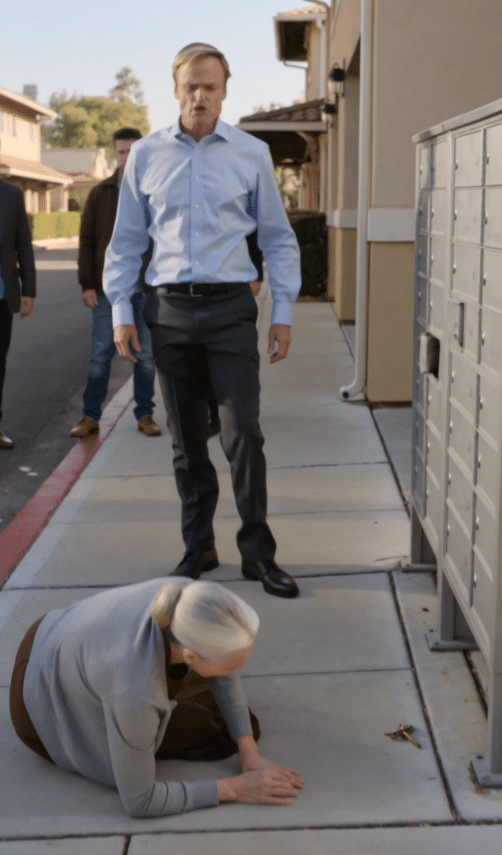
The words sliced through the quiet late-afternoon air, sharp enough to make several residents turn toward the row of shared mailboxes. An elderly woman in a gray cardigan was bent over the narrow sidewalk, one trembling hand reaching for the little brass key she had accidentally dropped.
She was seventy years old. Her silver hair was twisted into a neat bun, and her long brown skirt brushed against her ankles as she struggled to lower herself without losing her balance. The key had slipped from her fingers only seconds earlier. It was an ordinary mistake, the kind anyone could make after a long day.
But the man standing behind her had already decided that her mistake was an insult.
He wore a light blue dress shirt, black slacks, and a loose tie that suggested he had spent the day trapped in an office, counting the minutes until he could go home. A laptop bag hung from his shoulder. His expression was tight with impatience, his jaw working as though the entire neighborhood had personally conspired to waste his time.
He could have waited.
He could have stepped around her.
Instead, as she bent to retrieve her key, he drove a forceful kick into her back.
The woman lurched forward and crashed onto the pavement beside the metal mailbox cluster. Her elbow struck the ground, leaving a thin trace of blood. The key skittered across the concrete and stopped near her hand.
For a moment, she could not seem to understand what had happened.
Her mouth opened, but only a startled gasp emerged. She tried to push herself up on one arm, then faltered, her face tightening as pain traveled through her back and side.
Around them, the neighborhood went strangely still.
A woman holding a stack of envelopes covered her mouth. A man standing near the next mailbox took an involuntary step backward. Someone whispered, but nobody moved toward the woman on the ground.
The man in the blue shirt looked down at his victim with contempt.
“I’m sorry,” the elderly woman managed to say. “I dropped my key.”
She was apologizing.
Not because she had done anything wrong, but because years of being polite had taught her to smooth over other people’s anger before it could become something worse.
The man gave a short, bitter laugh.
“Trash. You’re holding up the whole row.”
He stepped closer.
Before anyone could find the courage to speak, he delivered two more forceful kicks to her back and side while she remained on the ground. The woman curled instinctively, one arm pressed against the pavement, struggling to protect herself without being able to stand.
“Move faster or stay inside,” he repeated.
The cruelty of the words seemed almost worse than the violence itself. He was not simply hurting an elderly woman. He was telling her that the space she occupied in the world was a privilege he could take away whenever she inconvenienced him.
Then the sound of hard braking shattered the silence.
A black official vehicle stopped at the curb.
The driver’s door flew open, and a woman in a dark coat stepped out so quickly that she nearly left the door swinging behind her. She crossed the sidewalk with a frightening sense of purpose, her polished shoes striking the concrete in rapid succession.
She saw the woman on the ground.
She saw the key beside her mother’s hand.
And she saw the man standing over her.
The newcomer moved directly between them, blocking him from taking another step.
Her expression was controlled, but something in her eyes made the residents instinctively fall silent.
Then she spoke.
“Who… kicked… my mother?”
For the first time that afternoon, the man in the blue shirt had absolutely nothing to say.
And when he finally recognized the woman standing in front of him, the anger drained from his face so quickly that it was almost difficult to watch.
“Judge…” he whispered. “Your mother?”
He had just made the worst mistake of his life.
But he had no idea how much of his life was about to unravel.
Act II
Margaret Bennett had lived in the townhouse community for eleven years.
She had moved there after her husband, Thomas, died of a heart attack at sixty-eight. Their home had been filled with books, old photographs, and the comfortable silence of two people who had spent decades learning each other’s habits. After his death, the house became too large and too quiet, and Margaret eventually chose a smaller place where she could walk to the pharmacy, tend a few flowers, and know her neighbors by name.
She had never been wealthy in the way people measured wealth.
There were no expensive cars in her driveway, no designer clothes in her closet, and no impressive titles attached to her name. Her favorite cardigan had belonged to her sister before Margaret inherited it. She bought groceries according to weekly discounts and still folded paper shopping bags because her mother had taught her that wastefulness was a form of disrespect.
But Margaret possessed something that money had never been able to purchase for her.
She had raised a daughter who believed that power meant responsibility.
Elizabeth Bennett was forty-five, a county judge known for her disciplined courtroom manner and her refusal to bend the law for influential people. She had earned her position through years of difficult work, beginning as a public defender before moving into prosecution and eventually taking the bench.
People who encountered Elizabeth in court often mistook her composure for coldness.
She rarely raised her voice. She did not make theatrical speeches. She listened, studied the evidence, and asked questions that made dishonest people uncomfortable.
Her mother understood where that steadiness came from.
Elizabeth had been seventeen when Thomas died. For months afterward, Margaret worked extra shifts at a local medical office while helping her daughter prepare for college entrance exams. She never told Elizabeth how often she sat alone in the kitchen after midnight, calculating whether they could afford another semester.
When Elizabeth received her first scholarship letter, Margaret framed it and placed it beside the family photographs.
“You earned this,” she had told her daughter.
Years later, when Elizabeth became a judge, Margaret had attended the swearing-in ceremony wearing a modest navy dress and the same pearl earrings she had worn to her husband’s funeral.
She had cried quietly when her daughter took the oath.
Afterward, Elizabeth had held her mother’s hands and said, “Everything I have, I owe to you.”
Margaret had smiled.
“No, sweetheart. You owe me nothing. Just remember the people who don’t have anyone standing beside them.”
Elizabeth had never forgotten those words.
That afternoon, however, neither woman had expected them to be tested so brutally.
Elizabeth had been returning from an official meeting when her driver slowed near the townhouse community. She noticed the gathering beside the mailboxes, then saw the familiar gray cardigan on the pavement.
She did not remember unfastening her seat belt.
She remembered the door opening, the sudden rush of air, and the terrible sight of her mother trying to lift herself from the ground.
Everything else narrowed to a single question.
Who had done this?
Now, standing between Margaret and her attacker, Elizabeth could feel her own heartbeat hammering against her ribs. Every instinct urged her to turn, grab the man by his shirt, and make him understand what he had done.
But she was a judge.
And the distinction between personal fury and public authority mattered more than ever.
Behind her, Margaret let out a strained breath.
“Elizabeth?”
The sound nearly broke her.
Elizabeth turned just enough to see her mother’s face. Margaret’s eyes were wet, but she was not crying. She looked confused, frightened, and embarrassed in a way that made Elizabeth’s stomach twist.
Even now, after being attacked, her mother seemed worried that she had caused a scene.
“Don’t try to get up yet, Mom,” Elizabeth said softly. “Stay still. Help is coming.”
Then she faced the man again.
He had taken a small step backward.
His laptop bag slipped down his shoulder, and he caught it clumsily. His eyes moved from Elizabeth’s face to the official vehicle at the curb, then to the residents watching from behind her.
He was beginning to understand.
This was no ordinary neighbor rushing to defend a relative.
The woman he had just confronted was a county judge.
And the elderly woman he had kicked was her mother.
Yet the most devastating part of the truth was still waiting to emerge.
Because the man had not merely assaulted a stranger.
He had spent months building a reputation as the kind of person who never lost an argument, never accepted blame, and never believed that rules were meant for him.
For the first time, all of that confidence was slipping away.
And Elizabeth had not even asked his name.
Act III
His name was Daniel Mercer.
At forty-two, Daniel considered himself a man who had done everything right.
He had a respectable office job, a townhouse he was still paying off, and a professional profile filled with photographs of company dinners and smiling colleagues. He talked frequently about discipline, personal responsibility, and the importance of people respecting one another’s time.
What he rarely mentioned was how much he resented anyone who could not move at his preferred speed.
At work, he snapped at junior employees who asked questions he considered obvious. In traffic, he leaned on his horn before a light had fully changed. At neighborhood meetings, he complained about delivery drivers, children playing too loudly, and older residents who took too long to cross the parking lot.
He had learned to disguise his impatience as efficiency.
When people challenged him, he called them oversensitive.
When they complained, he accused them of creating drama.
And when they backed down, he interpreted their silence as proof that he had been right.
Margaret had encountered his temper before.
Three weeks earlier, she had asked him to move his car slightly because it blocked part of the shared walkway. Daniel had responded with a lecture about how she should mind her own business. She had apologized to end the conversation, then mentioned nothing about it to Elizabeth.
Another time, he had mocked an older resident who needed extra time to unload groceries. Daniel’s words had been ugly, but the woman had simply lowered her eyes and continued carrying her bags.
People had begun avoiding him.
They knew he could be cruel, but most believed that confronting him would only make their lives more difficult.
Margaret had tried to see the best in him anyway.
She knew nothing about his private disappointments, the resentment he carried toward colleagues who had been promoted ahead of him, or the bitterness that surfaced whenever he felt insignificant. She had simply assumed that a man who behaved badly might be having a difficult day.
It was a generous assumption.
Daniel had mistaken it for weakness.
Now, as Elizabeth stood before him, he tried to recover the familiar posture of a man who expected the world to accommodate him.
“Judge Bennett,” he said, forcing a strained smile. “I think there’s been a misunderstanding.”
Elizabeth stared at him.
Behind her, Margaret shifted slightly and winced.
That small sound erased whatever patience Elizabeth had managed to preserve.
“A misunderstanding?” she repeated.
Daniel swallowed.
“She dropped something. I was waiting. Things got out of hand.”
“You kicked a seventy-year-old woman while she was bending down to pick up a key.”
“I didn’t—”
Several residents flinched at the interruption.
Elizabeth’s voice remained low.
“Don’t lie to me.”
Daniel closed his mouth.
The people watching from the sidewalk seemed to be holding their breath. The same neighbors who had stepped away when Margaret was attacked now watched as the man who had frightened them discovered that his usual tactics were failing.
But Elizabeth was not interested in humiliating him for the sake of spectacle.
She was interested in what had happened.
And she was determined that it would not disappear beneath an apology, an excuse, or a familiar claim that everyone had simply misunderstood his intentions.
She glanced toward the residents.
“Did anyone see what happened?”
For several seconds, nobody answered.
Then a middle-aged woman stepped forward.
“I did,” she said, her voice trembling. “He kicked her. More than once.”
Daniel turned toward her.
“You don’t know what you saw.”
The woman recoiled, but she did not retreat.
“I know exactly what I saw.”
Another resident spoke up.
“I saw him kick her the first time. I froze. I’m sorry.”
The admission hung heavily in the air.
A younger man near the mailboxes raised his phone. He had begun recording only after the attack started, but the footage showed Daniel standing over Margaret and shouting at her while she struggled on the pavement.
“I have video,” he said.
For the first time, Daniel looked genuinely frightened.
He turned back toward Elizabeth.
“Judge, please. We can settle this privately. I know people in the community. I have a good job. My family—”
“My mother was on the ground,” Elizabeth interrupted. “You were standing over her.”
Daniel’s mouth opened.
Nothing came out.
Elizabeth had heard every imaginable excuse in her courtroom. People blamed stress, alcohol, bad relationships, difficult childhoods, and circumstances they claimed had left them with no choice.
Sometimes those explanations helped establish the truth.
Sometimes they were attempts to escape it.
But there was a difference between understanding why someone had become cruel and allowing that cruelty to go unanswered.
Elizabeth looked down at Margaret again.
Her mother had spent a lifetime making herself smaller whenever someone else became angry. She had apologized for dropped keys, for delayed conversations, for asking strangers to repeat themselves, and for needing help carrying heavy bags.
She had never asked anyone to be afraid of her.
And now, on a concrete sidewalk in a neighborhood where she had once felt safe, she was lying hurt while the man responsible tried to negotiate his way out of consequences.
Elizabeth straightened.
“Call emergency services,” she instructed one of the residents. “And please preserve that recording. Do not edit it or send it around. Give it to the responding officers.”
Then she looked directly at Daniel.
“You are going to tell the responding officers what happened. I will not discuss your case with you, and I will not use my position to influence the investigation.”
The statement was deliberate.
Her mother was the victim. Elizabeth’s office did not make her the prosecutor, the investigator, or the person who would determine Daniel’s guilt.
But neither would she pretend that her position required her to stand aside while an injured woman lay at her feet.
Daniel looked toward the street as if searching for an escape.
For the first time, he seemed to understand that this would not be settled by talking louder than everyone else.
Then Elizabeth noticed something that changed the meaning of his panic.
He was not only afraid of what he had done.
He was afraid of what people might finally be willing to say about him.
And once the first witness had spoken, the others were beginning to remember.
Act IV
The first siren sounded in the distance.
Daniel’s face tightened.
He began speaking rapidly, trying to construct a version of events in which his actions had somehow become an unfortunate accident. He insisted that he had been stressed, that Margaret had startled him, that nobody understood the pressure he had been under.
Nobody interrupted him.
That silence seemed to encourage him until he realized the residents were no longer listening.
They were watching Margaret.
Elizabeth had lowered herself beside her mother without blocking the path of the arriving responders. She held Margaret’s hand and kept her voice steady, asking whether she could breathe comfortably and whether anything hurt more when she moved.
Margaret answered in short phrases.
Her back hurt. Her side hurt. She felt shaken and terribly cold despite the warm afternoon sun.
“I didn’t mean to cause trouble,” she whispered.
Elizabeth’s eyes closed for one brief second.
“Mom, you didn’t cause this.”
Margaret looked toward Daniel.
“He seemed so angry.”
“He chose what he did,” Elizabeth replied. “You don’t have to take responsibility for that.”
It was a simple sentence, but Margaret seemed to struggle to accept it.
For seventy years, she had believed that kindness meant giving people room to recover from their worst moments. She had forgiven thoughtless remarks, overlooked insults, and accepted apologies from people who never changed.
She had thought that if she remained patient enough, other people would eventually remember their humanity.
Now she was beginning to understand something more painful.
Kindness could give a person another chance.
It could not make that person choose to be kind.
The emergency responders arrived and moved carefully toward Margaret. Elizabeth gave them space, identifying herself as the victim’s daughter and explaining what she had witnessed after arriving.
She did not exaggerate.
She did not tell them what to conclude.
She described what she had seen and pointed them toward the people who had witnessed the earlier moments.
Margaret was examined and prepared for further medical evaluation. Her injuries needed professional attention, and the responders would determine the appropriate next steps.
As they helped her, Daniel watched from several feet away.
He looked smaller now.
The loose tie that had once made him appear merely impatient seemed absurd against the seriousness of the scene. His laptop bag rested on the pavement beside his shoes, forgotten.
When one of the responding officers approached him, Daniel immediately began explaining himself.
He talked about the dropped key.
He talked about the delay.
He talked about how he had been trying to get home.
The officer listened, then asked him to describe exactly what he had done.
Daniel hesitated.
For once, the ordinary details of his life offered no protection.
His office title did not change the testimony. His mortgage did not erase the recording. His frustration did not transform an attack into an accident.
And Elizabeth’s presence did not need to threaten him.
The facts were enough to demand attention.
As the officer continued the investigation, one of the neighbors approached Elizabeth. She was the woman who had watched from beside the mailboxes, her envelopes pressed against her chest.
“I should have helped her,” she said.
Elizabeth looked at her.
“Yes,” she replied gently. “You should have.”
The woman lowered her eyes.
“I was scared he would turn on me.”
“I understand that fear. But someone was hurt while the rest of us stood back.”
There was no triumph in Elizabeth’s voice. She was not interested in making the witness suffer for her failure. She wanted her to understand that fear explained silence without making the silence harmless.
The woman nodded, tears gathering in her eyes.
“I’ll tell the officers everything I saw.”
“Thank you.”
One by one, other residents began offering their accounts. Some had seen the first kick. Others had heard Daniel’s insults. The younger man preserved his recording and agreed to provide it to investigators.
Their voices did not erase the moment when Margaret had been left alone.
But they changed what happened next.
Daniel could no longer rely on the neighborhood’s silence to protect him.
As the investigation continued, he finally turned toward Elizabeth, his face pale.
“Judge Bennett, I have a career. I have a family. Please.”
Elizabeth remained beside her mother.
“So does she,” she said.
Daniel looked at Margaret.
For a moment, it seemed he might finally apologize.
Instead, he asked, “What are you going to do to me?”
Elizabeth’s expression hardened.
“Nothing that isn’t lawful. Nothing that isn’t supported by the evidence. That is exactly how this must be handled.”
She paused, then added, “And nothing you do now can change what happened to her.”
It was the answer Daniel had feared most.
He could not bargain with Elizabeth’s anger because she was refusing to make the case about her anger. He could not portray himself as the victim of a personal vendetta when she was insisting that the investigation proceed independently.
There would be witnesses. There would be evidence. There would be a record of what he had done.
And there would be a woman who no longer needed to apologize for being in his way.
But the deepest consequence of that afternoon would not begin with Daniel at all.
It would begin with Margaret, when her daughter finally asked her the question she had been too frightened to ask before.
Act V
The medical evaluation confirmed that Margaret had suffered painful injuries from the fall and assault. She was fortunate not to have sustained a more serious injury, but the physical discomfort was only part of what she carried home.
For several nights, she woke whenever she heard a noise outside her window.
The sound of footsteps behind her made her shoulders tense. When she went to retrieve her mail, she found herself glancing over her shoulder before approaching the metal boxes.
The place that had once represented the ordinary comforts of home had become a reminder of how quickly an everyday moment could turn dangerous.
Elizabeth stayed with her whenever her schedule allowed.
She brought groceries, made tea, and sat at the kitchen table while her mother sorted through the mail. Sometimes they talked about the investigation. More often, they discussed small things: the weather, a neighbor’s new flowers, an old recipe Margaret had been meaning to try.
Elizabeth knew that recovery could not be forced by a single reassuring conversation.
She also knew that her mother had a habit of hiding pain behind politeness.
One evening, as the sun faded beyond the townhouse windows, Elizabeth found Margaret sitting with the little brass mailbox key in her palm.
It had been recovered after the incident.
Margaret was turning it over and over, rubbing the worn edge with her thumb.
“Do you remember when you were little?” she asked.
Elizabeth pulled out the chair beside her.
“Which time?”
“The first day of school. You were so frightened you wouldn’t let go of my hand.”
Elizabeth smiled faintly.
“I remember you telling me that I was braver than I thought.”
“You were.”
Margaret looked down at the key.
“I keep thinking about that afternoon. If I’d picked it up faster, if I’d stayed out of his way, if I’d just left the mail until later…”
Elizabeth reached across the table and covered her mother’s hand.
“No.”
Margaret fell silent.
“You dropped a key,” Elizabeth continued. “That’s all you did. You didn’t provoke him. You didn’t deserve it. You were allowed to take three seconds to pick something up.”
Her mother’s eyes filled with tears.
“I know that in my head.”
“Then we’ll keep reminding your heart until it believes it, too.”
For the first time since the attack, Margaret began to cry.
Not the quiet, embarrassed tears she had shed while trying to hide her fear, but the kind that came when a person finally felt safe enough to stop pretending she was fine.
Elizabeth held her.
Neither of them spoke for a long time.
Outside, the neighborhood continued its ordinary life. Cars entered driveways. Porch lights flickered on. Somewhere down the street, a child laughed.
The world had not stopped because something terrible had happened.
But for Margaret, the meaning of home had changed, and rebuilding it would take time.
The investigation proceeded independently, with the witnesses’ statements and available footage forming part of the evidence. Daniel’s conduct was no longer a private confrontation that could be dismissed as a disagreement between neighbors.
He had to face the process that followed his actions.
Elizabeth did not contact the investigators to demand a particular outcome. She did not ask anyone to treat Daniel more harshly because he had hurt her mother. She also refused to use her influence to shield him from ordinary legal scrutiny.
Her role was not to secure revenge.
It was to ensure that the truth had room to stand.
Daniel eventually faced formal legal consequences for the assault, determined through the appropriate proceedings and the evidence presented. The details of his punishment mattered less to the residents than the fact that the incident could no longer be explained away as a moment when an old woman had inconvenienced an impatient man.
The community began changing in smaller, less dramatic ways.
Residents who had once avoided difficult conversations started speaking up when someone was being mistreated. The property association reviewed its procedures for reporting threatening behavior. Neighbors who had previously exchanged little more than polite greetings began checking on one another, especially those who lived alone.
None of those changes could undo what had happened to Margaret.
But they meant the afternoon had not ended with her pain being ignored.
One week later, Margaret returned to the mailbox cluster.
Elizabeth offered to accompany her, but her mother surprised her by shaking her head.
“I think I can do it.”
They walked together to the sidewalk anyway, stopping a few steps short of the metal boxes.
The late-afternoon sun fell across the pavement, almost exactly as it had on the day of the attack. Margaret wore her gray cardigan, buttoned carefully over a pale blouse. Her silver hair was once again arranged in its neat bun.
She approached the mailbox.
For a moment, she hesitated.
Then she took out her key.
Her fingers trembled slightly, but she inserted it into the lock and opened the small metal door. She collected her letters, closed the compartment, and turned back toward her daughter.
A breath escaped her.
“I did it.”
Elizabeth smiled.
“You did.”
Margaret glanced at the narrow strip of pavement where she had fallen.
“I don’t want to spend the rest of my life being afraid of that place.”
“You don’t have to.”
Margaret slipped the key into her pocket.
Then she did something Elizabeth had not expected.
She walked toward the other residents gathered near the mailboxes and greeted them, one by one. She accepted their apologies without pretending that nothing had happened. She thanked those who had spoken to the investigators and listened as they told her how ashamed they felt for not helping sooner.
She did not tell them they were terrible people.
She did not tell them they were forgiven before they had finished speaking.
She simply let the conversations happen.
And in doing so, she reclaimed something that Daniel had tried to take from her: the right to occupy her own life without apologizing for it.
As mother and daughter walked back toward the townhouse, Elizabeth slipped her arm through Margaret’s.
“Are you all right?” she asked.
Margaret considered the question carefully.
“I think I will be.”
It was not a triumphant answer. It was an honest one.
Healing would not arrive all at once. Some days would still bring fear, and certain sounds might always remind her of the pavement beneath her hands. But she was no longer alone with the memory, and she no longer believed that the violence had been her fault.
At the end of the sidewalk, Margaret stopped and looked back at the mailboxes.
“I dropped a key,” she said quietly. “That’s all.”
Elizabeth squeezed her arm.
“That’s all.”
A few seconds of inconvenience had been enough for Daniel Mercer to reveal the kind of man he had become. He had believed that anger gave him authority, that cruelty could silence a vulnerable person, and that the people around him would remain too frightened to speak.
He had been wrong.
The elderly woman he kicked had not been powerful because her daughter wore a judge’s robe. She had not become worthy of protection when an official vehicle arrived or when witnesses finally found their voices.
She had been worthy of dignity before the first kick.
Before anyone recognized her daughter.
Before the entire neighborhood understood who was watching.
And that was the truth Daniel could never outrun.
The greatest reversal that afternoon was not that a judge arrived to defend her mother. It was that a man who believed an elderly woman was beneath him discovered, in front of everyone, that her dignity had never depended on his permission.