Act I
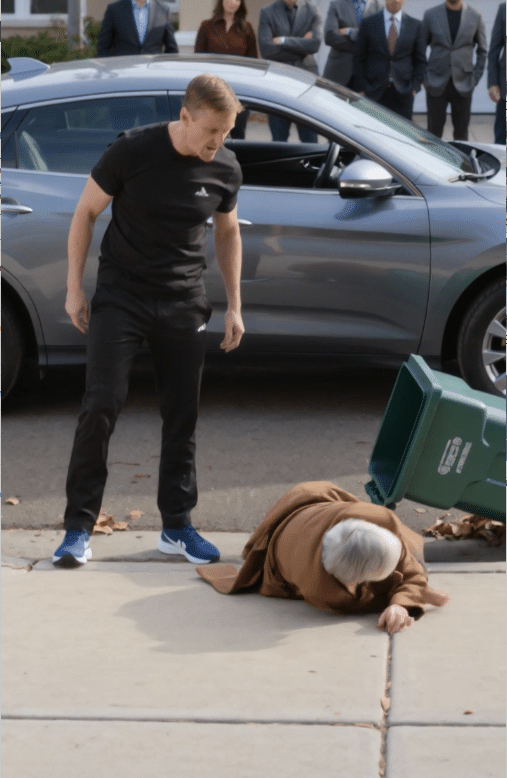
“Trash. Your bin is blocking my car.”
The insult came seconds before the attack.
An elderly woman stood at the edge of a suburban driveway, struggling to pull a rolling trash bin back toward the curb. The morning wind had pushed it several inches out of position, leaving one corner barely inside her neighbor’s driveway.
She was already moving it.
But the man climbing out of the expensive black car apparently couldn’t wait another second.
He slammed the driver’s door shut and marched toward her, his athletic shoes striking the pavement as his face twisted with anger. Dressed in expensive black sportswear and a sports watch, he looked like a man accustomed to getting his way simply because he expected everyone else to move first.
The woman tightened her grip on the bin.
“I’m moving it back now,” she said hurriedly.
Her name was Eleanor Brooks. At sixty-nine, she had lived in the neighborhood long enough to know that the easiest way to handle an impatient neighbor was usually to apologize, fix the problem, and get on with her day.
She didn’t want an argument.
She certainly didn’t want trouble over a trash bin.
But her neighbor, Grant Miller, had already decided that the few inches separating the bin from the curb were an unforgivable insult.
“Keep your trash off my driveway,” he snapped.
Eleanor tried to pull the bin toward her.
Grant stepped directly in front of her.
Before she could move out of his way, he drove a forceful kick into her chest.
The impact sent her backward onto the curb. Her forearm scraped against the pavement, leaving a thin trace of blood, and the trash bin rattled violently beside her.
For a moment, she couldn’t catch her breath.
She curled onto her side, one hand pressed against her ribs, struggling to understand how a minor inconvenience had turned into something so terrifying.
Grant didn’t back away.
He stepped closer and kicked her twice more in the back and side as she tried to lift herself off the ground.
Eleanor gasped and drew her arms protectively around her body.
Across the street, a man standing on his porch froze with a coffee mug in his hand. A woman watching from an upstairs window covered her mouth. Another neighbor stepped backward through an open garage, unwilling to draw Grant’s attention.
Nobody had expected violence.
Nobody knew what to do.
Grant looked down at Eleanor as though she had deliberately wasted his morning.
“Keep your trash off my driveway,” he repeated.
Eleanor blinked through the shock.
“I’m sorry,” she whispered. “I was moving it.”
Her apology seemed to make him angrier.
He had already attacked her, and she was still trying to explain herself as though the misunderstanding could somehow be repaired if she found the right words.
Grant glanced toward his car.
He had somewhere to be. He had plans, appointments, and a schedule he believed everyone else should respect.
In his mind, Eleanor’s existence had become an obstacle to those plans.
What he failed to notice was the dark city vehicle approaching the intersection at the end of the street.
It slowed sharply, then pulled toward the curb.
The driver’s door opened.
A woman in a dark gray suit and city-issued coat stepped out. Her black heels struck the pavement as she hurried toward the driveway, her expression changing the moment she saw the elderly woman on the ground.
“Mom?”
Eleanor lifted her head.
The woman crossed the remaining distance and moved directly between Grant and her mother.
She was Vanessa Brooks, the city’s director of residential services.
And she was looking at Grant as if she could hardly believe what she was seeing.
“You assaulted my mother over a trash bin?”
Her voice cut through the quiet street.
The neighbors fell silent.
Grant’s expression shifted. His anger faltered as he looked from Vanessa to the city vehicle behind her, then back to Eleanor.
For the first time that morning, he seemed to understand that the situation was no longer under his control.
“Your mother?” he stammered.
Vanessa didn’t look away.
Behind her, Eleanor remained on the pavement, shaken and in pain.
The trash bin stood only inches from the driveway.
That was all it had taken.
A few inches. A few seconds. One man’s belief that his time mattered more than another person’s dignity.
And now, the entire neighborhood was about to discover just how much Grant had misunderstood about the woman he had attacked.
Act II
Eleanor Brooks had never considered herself an important person.
She lived in a modest house with white shutters, a narrow front garden, and a small porch where she drank tea in the afternoon. Her late husband, Thomas, had planted roses beside the front steps decades earlier, and Eleanor still tended them whenever the weather allowed.
She had raised Vanessa there.
The house held the familiar marks of a life built through patience rather than privilege: faded family photographs, a kitchen table polished by years of use, and a drawer full of handwritten recipes that Eleanor refused to replace with anything digital.
Thomas had worked for the city for most of his career, maintaining public facilities and helping coordinate repairs after severe weather. He wasn’t a department head or a public figure. He was the kind of employee whose work became visible only when something stopped working.
He had taught Vanessa that public service wasn’t about standing behind a desk or wearing an official badge.
It was about making ordinary people’s lives a little easier.
When Vanessa was young, she once complained that her father spent too much time helping strangers with problems that weren’t his responsibility.
Thomas had laughed.
“If everyone waits for someone else to care, nothing gets better,” he told her.
Eleanor had reinforced the lesson in quieter ways.
She remembered neighbors’ birthdays, checked on people during winter storms, and brought soup to families who were sick. When someone made a mistake, she preferred to give them a chance to correct it before deciding what kind of person they were.
She had raised Vanessa to believe that authority carried a responsibility to listen, not a license to command.
Years later, when Vanessa became the city’s director of residential services, Eleanor had been proud of her daughter. But she rarely mentioned Vanessa’s position to anyone.
She didn’t want neighbors treating her differently.
She didn’t want special favors.
And she certainly didn’t want anyone believing that a city title made her more deserving of ordinary courtesy than the person living next door.
Vanessa understood that.
Whenever she visited, Eleanor asked about her work, listened to stories about difficult meetings, and reminded her that every policy affected real people.
“Don’t let the paperwork make you forget the people,” she often said.
Vanessa kept those words close.
Her position involved coordinating housing-related services, addressing neighborhood concerns, and working with different departments to improve residential conditions. It was demanding work, and she knew how easily a person’s authority could be mistaken for personal power.
She had no desire to use her position to settle private disagreements.
But she had never imagined that one day she would arrive at her mother’s street and find Eleanor injured at the hands of a neighbor.
Grant Miller had lived there for just over a year.
He was forty-four, physically fit, financially comfortable, and intensely protective of his property. He kept his driveway spotless, washed his car frequently, and complained whenever leaves blew onto his lawn.
At first, the neighbors had regarded him as merely particular.
Then the complaints began.
A delivery driver had once left a package near his garage instead of his front door. Grant had shouted at him from the driveway.
A teenager riding a bicycle had crossed the edge of his lawn. Grant had followed him down the sidewalk, demanding an apology.
When a neighbor’s guests parked too close to his driveway, he left an angry note beneath their windshield wiper.
None of these incidents had resulted in a serious confrontation, but together they created a pattern.
Grant treated the boundaries of his property as though they extended beyond the legal lines into the behavior of everyone around him. He expected others to anticipate what might irritate him, then blamed them when they failed.
Most residents chose not to challenge him.
They had families, jobs, and their own problems. They didn’t want to spend their evenings arguing over parking, landscaping, or a few leaves on the pavement.
Grant interpreted their silence as agreement.
He became increasingly comfortable speaking to people with contempt because nobody seemed willing to make him stop.
Eleanor had never been part of his conflicts.
She had greeted him politely when they first met. She had even complimented the flowers he planted beside his front steps.
Grant barely remembered those exchanges.
He remembered only that she was an older woman who moved more slowly than he did and who, in his estimation, should have been more careful about inconveniencing him.
That morning, the wind had caught her trash bin as she rolled it toward the collection point.
The bin drifted into the edge of his driveway.
Eleanor noticed immediately.
She was already correcting the problem when Grant appeared.
There was no prolonged obstruction. No refusal to move. No argument over property lines.
There was only an ordinary mistake being corrected by an ordinary person.
Grant had decided that the mistake was an insult.
And because he had grown accustomed to treating frustration as permission to intimidate others, he escalated before Eleanor could finish.
Now, standing on the same driveway, Vanessa was looking at the man who had turned a few seconds of inconvenience into a violent assault.
She knelt beside her mother long enough to check on her and ask whether she could breathe comfortably.
Eleanor grimaced.
“My ribs hurt,” she whispered.
“I know, Mom. Stay still for now.”
Vanessa called for emergency medical assistance and asked a nearby resident to help direct responders to the correct house.
Then she stood.
Grant was still staring at her.
“You need to calm down,” he said, as though Vanessa were the one who had caused the scene.
She looked at him in disbelief.
“You kicked a woman who was trying to move a trash bin.”
“She was blocking my driveway.”
“She was moving it.”
“She shouldn’t have let it get there in the first place.”
Vanessa’s expression hardened.
For the first time in his life, Grant seemed to be encountering someone who would not allow his explanation to replace the facts.
But Vanessa wasn’t interested in winning an argument with him.
She wanted the truth documented, her mother treated, and the situation handled properly.
And as the neighbors slowly emerged from their houses, she began to realize that the attack might reveal a problem far larger than one angry man.
Act III
The first witness to speak was a retired schoolteacher named Helen Parker.
She had been standing near her front window when she saw Grant get out of his car.
At first, she assumed he intended to help Eleanor move the bin. When he began shouting, she leaned closer to the glass.
Then she saw the kick.
“I watched the whole thing,” Helen said, her voice trembling.
Grant turned toward her.
“You don’t know what happened.”
Helen stepped onto her porch.
“I know what I saw.”
Another neighbor, Daniel Reeves, came down his driveway. He had heard the shouting and looked up just in time to see Eleanor fall beside the curb.
“I saw her trying to move the bin,” he said. “She wasn’t blocking him on purpose.”
Grant looked from one witness to the other.
“This is ridiculous. It was my driveway.”
Vanessa remained between him and her mother.
“Your driveway doesn’t give you the right to assault someone.”
“I didn’t just attack her for no reason.”
“Then explain the reason.”
Grant hesitated.
The answer should have been simple. He was angry because a trash bin had drifted several inches out of place.
But spoken aloud, in front of the injured woman and the neighbors who had witnessed what happened, the explanation sounded as absurd as it was.
He tried another approach.
“She was being careless.”
Vanessa glanced at the bin.
“It was windy.”
“She should have secured it.”
“She was securing it.”
Grant’s jaw tightened.
He had expected Vanessa to be intimidated by his confidence. Instead, she was asking questions he couldn’t answer without exposing how little justification he had possessed for his actions.
A city vehicle had drawn several curious glances from the neighbors, and Grant now seemed painfully aware of it.
He pointed toward it.
“Are you going to use your job to threaten me?”
“No,” Vanessa replied. “I’m going to make sure this is handled properly.”
She did not threaten to have him arrested. She did not promise to take his house away or use her title to influence the outcome.
She identified herself to the responding authorities, explained her relationship to Eleanor, and made clear that she would cooperate with the investigation as a family member and witness to the aftermath.
The distinction mattered.
Vanessa understood that public authority could become dangerous when personal anger replaced procedure. She had spent years telling other people that fairness depended on following the same rules, even when the situation was emotionally difficult.
She wasn’t about to abandon those principles now.
When emergency responders arrived, they examined Eleanor and arranged further medical evaluation. Vanessa stayed beside her mother, answering questions and making sure she understood what was happening.
The officers then began speaking with witnesses.
Helen gave her account.
Daniel described what he had seen.
Other neighbors who had watched from their windows came forward with additional details about the moments before and after the assault.
Grant attempted to interrupt more than once.
Each time, he was told to allow the witnesses to speak.
For the first time, the quiet neighborhood had become a place where his behavior was being examined rather than endured.
As the officers documented the scene, one of them asked about the trash bin.
Eleanor’s bin was standing upright near the curb, its wheels turned slightly toward the driveway. Dry leaves lay scattered across the pavement.
There was nothing unusual about it.
No significant obstruction. No damage. No evidence that Eleanor had deliberately placed it there to prevent Grant from leaving.
The object at the center of the confrontation was so ordinary that it seemed almost impossible to reconcile with what had happened.
Vanessa watched the officers take photographs and record the relevant details.
She knew the investigation would have to establish the facts independently. She also knew that any legal consequences would depend on the evidence and applicable law, not on her position.
Grant, however, appeared to believe that he could still talk his way out of the situation.
He approached Vanessa while the officers were speaking with another witness.
“Look, I didn’t know she was your mother.”
Vanessa stared at him.
He continued quickly.
“If I’d known, I would have handled things differently.”
For a moment, she said nothing.
Then she asked, “Would you have kicked her if she weren’t my mother?”
Grant opened his mouth.
No answer came.
“Would you have kicked a stranger? A delivery driver? Someone who had no family nearby and no one important standing beside them?”
He looked away.
Vanessa’s voice grew quieter, which somehow made it more forceful.
“My mother was trying to fix a problem. You saw someone who couldn’t stop you from being cruel, and you chose to hurt her.”
Grant shook his head.
“You’re making me sound like a monster.”
“No. I’m describing what you did.”
He glanced toward the neighbors.
Several of them were still watching.
The man who had spent months acting as though his driveway made him the most important person on the street now looked trapped by the attention he had never expected to receive.
But Vanessa wasn’t finished.
“Your mistake wasn’t that you failed to recognize who my mother was,” she said. “Your mistake was believing you didn’t need to recognize her as a person.”
Grant’s face went pale.
He had been waiting for Vanessa to reveal some official power that would frighten him.
Instead, she had exposed something he could not blame on her title.
His own behavior had become impossible to disguise.
And the neighbors, who had once avoided challenging him, had finally begun to speak.
Act IV
By the following afternoon, the incident had become the main topic of conversation on the street.
Not because Vanessa was a city official.
Not because a city vehicle had appeared at the curb.
But because so many residents had seen the same thing and recognized a pattern they had previously tried to ignore.
Grant had built his reputation on small acts of intimidation. Each confrontation had seemed too minor to justify a prolonged dispute, so people had walked away.
Now they were comparing their experiences.
One neighbor recalled being shouted at for parking near the sidewalk. Another remembered Grant berating a delivery driver who had left a package in the wrong place.
A third resident admitted that she had stopped greeting him after he mocked her for allowing her children to play near the front lawn.
Their accounts were not automatically proof of a crime, and Vanessa cautioned people against turning rumors into facts. If someone had experienced threatening behavior, they could report it through the appropriate channels.
What mattered was that the residents no longer felt obligated to pretend that nothing had happened.
The assault on Eleanor had forced them to confront a difficult question.
How many times had they mistaken Grant’s aggression for a personality quirk because it was easier than challenging him?
And how often had their silence made him believe that his behavior was acceptable?
Vanessa returned to her office and informed the relevant city personnel that she would not participate in any official decision involving the incident beyond providing information as a family member and witness to the aftermath.
She wanted no suggestion that her position had influenced the response.
The appropriate authorities would investigate the assault. The property owner, if separate from the city, would handle any tenancy issues according to the lease and applicable law. Any formal consequences would follow the established process.
There would be no secret phone call demanding special treatment.
There would be no threat based on Vanessa’s job.
There would simply be evidence, testimony, and accountability.
Meanwhile, Eleanor rested at home.
The physical pain made ordinary tasks difficult, and the memory of the attack left her uneasy whenever she heard a car door slam outside. She had spent decades feeling safe in her neighborhood. Now, even the sight of the driveway could bring back the moment she had fallen onto the pavement.
Vanessa visited as often as she could.
She brought groceries, helped with household tasks, and listened when her mother needed to talk.
One evening, Eleanor sat in her kitchen with a cup of tea between her hands.
“I keep thinking I should have moved faster,” she admitted.
Vanessa pulled out the chair beside her.
“Mom, you were moving the bin.”
“I know.”
“You were doing exactly what you should have done.”
Eleanor looked toward the window.
“I just wish I’d known how angry he was.”
Vanessa felt a sharp wave of frustration, but she kept her voice gentle.
“You shouldn’t have to predict whether someone is going to hurt you because the wind moved a trash bin.”
Her mother gave a small, tired nod.
For the first time since the incident, Eleanor allowed herself to cry.
Vanessa moved closer and held her.
There was no speech that could make the attack disappear. No official title could give her mother back the feeling of safety she had lost.
All Vanessa could do was stay.
And that, she realized, was what Eleanor needed most.
Not revenge.
Not a dramatic display of authority.
Someone who would listen without asking her to minimize what had happened.
Several days later, Grant attempted to contact Vanessa again.
He had sent a message asking for a private conversation, then another suggesting that the situation had spiraled out of control because everyone had misunderstood his intentions.
Vanessa did not discuss the investigation with him privately.
When they encountered each other near the street, he approached her with visible irritation.
“I’m trying to make this right,” he said.
“Then cooperate with the process.”
“I’ve already said I made a mistake.”
“You’ve said you made a mistake because you didn’t know who she was.”
Grant rubbed his face.
“What do you want me to say?”
“The truth.”
He looked at her.
Vanessa continued.
“You were angry about a bin. My mother was moving it. You attacked her anyway. Start there.”
For a long moment, he seemed to consider arguing.
Then he lowered his eyes.
“I shouldn’t have done it.”
“No,” Vanessa said. “You shouldn’t have.”
It was the first time she had heard him acknowledge the essential fact without immediately attaching an excuse.
But an admission was not the same as accountability.
The investigation still had to proceed, and Eleanor’s recovery would take as long as it took. The neighborhood’s trust could not be restored by a single sentence.
Grant had spent a long time assuming that the consequences of his behavior could be controlled by the confidence with which he explained it.
Now he was learning that other people had the right to tell their own accounts.
And he could no longer silence them simply by becoming angry.
Act V
Three weeks later, Eleanor walked down her driveway for the first time without Vanessa beside her.
She wore her old brown coat and comfortable shoes. The morning was cool, and dry leaves skittered across the pavement as the wind moved through the trees.
Her trash bin stood near the curb.
Eleanor paused before reaching for it.
The memory came back quickly: Grant’s shouting, the sudden impact, the cold pavement beneath her hands.
She took a slow breath.
Then she grasped the handle and rolled the bin into position.
It was a small act, almost embarrassingly ordinary.
But for Eleanor, it marked the beginning of reclaiming a part of her daily life that had suddenly become frightening.
Across the street, Helen Parker stepped out onto her porch.
“Good morning, Eleanor.”
Eleanor looked up.
“Good morning.”
Helen hesitated before walking closer.
“I wanted to tell you something,” she said. “I’m sorry I didn’t come over sooner that morning.”
Eleanor looked at her for a moment.
Helen continued, her voice unsteady.
“I saw what was happening, and I was scared. I told myself I didn’t know what to do. I should have called for help immediately.”
Eleanor could have dismissed her apology. She could have told Helen that it didn’t matter, that everyone had been frightened, that the past was the past.
Instead, she answered honestly.
“I wish someone had come.”
Helen lowered her head.
“I know.”
“But you came forward afterward,” Eleanor added. “That mattered too.”
Helen’s eyes filled with tears.
The two women stood together beside the curb, with the trash bin between them and the morning sun warming the pavement.
Neither pretended that everything was fine.
They simply acknowledged what had happened.
Over the following weeks, the neighborhood began to change in small ways. Residents checked on one another more often. People who had previously avoided difficult conversations began reporting serious concerns instead of hoping they would disappear.
They agreed to share emergency contact information and remind one another to call for help when someone was in immediate danger.
It wasn’t a grand community campaign.
It was a collection of ordinary people deciding that the next time something went wrong, they would not automatically retreat behind their doors.
Vanessa noticed the change when she visited her mother one Saturday morning.
She found Eleanor sitting on the porch, watching a neighbor help another resident move a heavy planter.
“They’re being kinder,” Eleanor said.
Vanessa sat beside her.
“Maybe they always wanted to be.”
“Maybe.”
Eleanor looked toward the street.
“Sometimes people need to see what happens when nobody speaks up.”
Vanessa nodded.
The investigation and any related proceedings continued through the appropriate channels. Vanessa did not interfere, and Eleanor did not demand a particular outcome. The evidence would determine what could be established, and the relevant authorities would decide what action was warranted.
But the neighborhood had already reached its own understanding.
Grant’s behavior had not become unacceptable because the woman he attacked was the mother of a city director.
It had been unacceptable from the beginning.
One afternoon, Vanessa helped Eleanor sort through a drawer of old photographs. They found pictures of Thomas standing beside the roses he had planted, Vanessa in her graduation gown, and Eleanor holding a birthday cake in the family’s old kitchen.
Vanessa studied one photograph for a long time.
“Dad would have hated what happened.”
Eleanor smiled faintly.
“He would have hated the cruelty. But he would have wanted us to handle it fairly.”
“He would have told me not to use my position to get even.”
“He would.”
Vanessa placed the photograph carefully on the table.
“I didn’t want to become the kind of person who thinks authority means she can do whatever she wants.”
Eleanor reached across and touched her hand.
“Then don’t.”
Vanessa laughed softly.
It was the simplest advice her mother could have given her, and perhaps the most important.
They sat together until the afternoon light began to fade, remembering a man who had believed that the dignity of ordinary people was worth protecting.
Thomas had never needed a title to understand that principle.
Eleanor had never needed one either.
Grant had looked at an elderly woman struggling with a trash bin and seen someone he believed he could punish without consequence. He had mistaken physical strength for superiority and a private driveway for permission to control everyone around him.
He had assumed that because Eleanor appeared vulnerable, she was insignificant.
The arrival of Vanessa’s city vehicle had shattered that assumption.
But the real lesson was not that Eleanor’s daughter held an important public position.
It was that Eleanor had deserved better before Vanessa arrived, while Vanessa stood beside her, and long after the official vehicle drove away.
The wind might move a trash bin again tomorrow.
A package might be delivered to the wrong door. A car might be delayed. Someone might make an ordinary mistake that inconveniences a stranger for a few seconds.
Those moments would always happen.
What mattered was what people chose to do next.
Grant had chosen violence when patience would have solved the problem. He had chosen humiliation when a simple request would have been enough. And when the truth emerged, he discovered that the person he had treated as powerless was surrounded by people who could no longer pretend they had seen nothing.
Eleanor never asked to become the center of a neighborhood controversy.
She had only wanted to move her trash bin back to the curb.
Yet her experience changed the way the people around her understood silence, responsibility, and the everyday choices that reveal a person’s character.
Vanessa would always remember the moment she stepped out of the city vehicle and saw her mother on the ground.
But she would also remember what Eleanor said afterward.
“Let the truth do the work.”
It was a reminder that justice did not require cruelty in return, and that authority meant little if it was used only to protect the powerful.
The trash bin had moved only a few inches into Grant’s driveway.
His reaction revealed a distance far greater: the distance between believing you own the space around you and understanding that other people deserve to stand in it with dignity.
Grant thought he was defending his driveway. Instead, he exposed the kind of man he had become—and learned that no amount of money, muscle, or arrogance could make his actions disappear when the people he had intimidated finally found the courage to speak.