Act I
“The brakes are not cleared yet.”
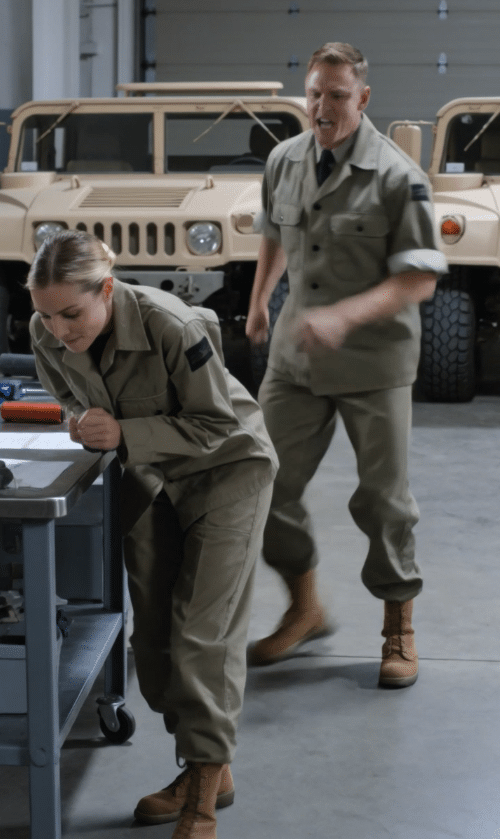
Lieutenant Claire Bennett stood beside the Humvee with a safety checklist in one hand and a firm expression on her face. The military maintenance garage echoed with the hum of industrial lights, the metallic clatter of tools, and the low voices of mechanics preparing vehicles for an upcoming convoy.
Across from her, Captain Richard Lawson stared at the checklist as though it were a personal insult.
“Release the vehicle,” he ordered.
Claire didn’t move.
“The brake system failed inspection. It cannot leave this garage until the defect is corrected and the vehicle passes the required checks.”
Richard’s jaw tightened. At thirty-five, he had built his reputation around being the officer who never accepted delays, never admitted uncertainty, and never allowed anyone to question his authority. He was broad-shouldered, sharp-tongued, and accustomed to people stepping aside when he entered a room.
Especially women.
He looked at Claire’s uniform, then at the inspection badge clipped neatly to her chest.
“You’re holding up my convoy over a checklist?”
“I’m holding the vehicle because its brakes aren’t safe.”
Richard took a step toward her.
“Do you understand how many people are waiting on me?”
“I understand the inspection requirements.”
A mechanic near the next Humvee suddenly found something fascinating on his workbench. Two trainees exchanged a nervous glance. Nobody wanted to become part of an argument with a captain who had a reputation for making life difficult for anyone who challenged him.
Claire noticed their silence.
She also knew that the convoy was scheduled to depart soon, and that the pressure to meet the timetable would tempt people to overlook problems they should never ignore.
She had seen it happen before: a minor defect became an accepted risk, an accepted risk became an unchecked assumption, and eventually someone had to explain why a preventable failure had been allowed to happen.
She would not be that person.
Richard stepped closer.
“Give me the keys.”
“The vehicle has not been cleared.”
His face hardened.
“Trash. You don’t keep my vehicle from me.”
Claire held the checklist against her chest.
“Captain, this is a safety issue. You can take it up with the maintenance supervisor, but I will not sign off on a failed inspection.”
For one second, the garage seemed to hold its breath.
Then Richard moved.
He took a hard running step, jumped, and drove a forceful kick into Claire’s chest, throwing her backward into the edge of the technical inspection table.
The impact knocked the air from her lungs.
She fell beside the table as the safety checklist slipped from her hand and skidded across the concrete. Her forearm struck the table edge, leaving a thin trace of blood. Pain flashed across her face, and she struggled to draw a full breath.
The mechanics stared.
One trainee raised a hand to his mouth. Another stepped backward, his eyes fixed on the captain as though he had just witnessed something impossible.
Claire tried to push herself upright.
“The brakes,” she managed to say. “They’re not cleared yet.”
Richard looked down at her.
Even now, even hurt and struggling to breathe comfortably, she was still thinking about the vehicle.
He stepped over the fallen checklist and kicked her twice more in the back and side.
Claire grimaced, her breath catching sharply. She curled instinctively against the pain, but her eyes remained fixed on the Humvee.
“Stay down and let men handle the convoy,” Richard said.
Nobody intervened.
Not because they believed he was right, but because fear had paralyzed them. They knew his rank. They knew the influence he carried. And they knew how quickly a powerful officer could turn a subordinate’s life into an endless series of punishments.
Then the garage door swung open with a violent metallic rumble.
A senior general strode inside.
His dark green uniform bore the insignia of decades of command. His expression was stern, his posture unmistakable, and his eyes moved from the fallen checklist to Claire on the floor before locking onto Richard.
The captain’s confidence faltered.
The general stepped between him and the injured officer.
“You just attacked the officer who saved your convoy.”
Richard went still.
For the first time since entering the garage, he seemed unable to find a command to issue.
He looked at the general, then at Claire, then at the Humvee he had been so desperate to drive away.
“Saved my convoy?” he whispered.
He had believed Claire was an obstacle standing between him and his mission.
He was about to discover that she was the only reason his mission had not become a disaster.
And the truth behind that failed brake inspection was far more serious than he could have imagined.
Act II
Three days earlier, Claire Bennett had noticed something that other people had missed.
It was a subtle inconsistency in the maintenance records for a group of Humvees assigned to an upcoming convoy. The paperwork showed that the vehicles had received routine inspections, and most of the entries appeared complete.
But Claire had learned not to confuse a completed form with a safe vehicle.
At twenty-eight, she had spent years building a reputation for meticulous work. She had entered military service after watching her father, a civilian emergency-response mechanic, spend long nights repairing equipment that other people depended on without ever seeing.
He had taught her that machinery did not care about rank.
A brake line did not become stronger because a colonel was impatient. A worn component did not repair itself because a mission had an important deadline. And a signature could not make an unsafe vehicle safe.
“Machines don’t respect your confidence,” her father used to tell her. “They only respond to what you actually did.”
Claire had carried that lesson into the Army.
She wasn’t the loudest officer in the maintenance unit. She didn’t try to dominate conversations or impress people with dramatic speeches. Her authority came from preparation, technical knowledge, and a willingness to stand behind the decisions she made.
That combination had earned her the trust of many mechanics.
It had also made her unpopular with officers who considered inspection a formality rather than a responsibility.
Captain Richard Lawson belonged to the latter group.
He was ambitious, disciplined about his appearance, and skilled at presenting himself as a man who could deliver results under pressure. His reports were polished. His briefings were confident. His superiors generally heard about his successes before they heard about his problems.
But those who worked closely with him knew that he had a dangerous habit.
When facts contradicted his expectations, he treated the facts as the problem.
A delayed vehicle was not a maintenance issue. It was a personal insult. A request for clarification was not due diligence. It was insubordination. And a junior officer who challenged his judgment was, in his mind, attempting to undermine his command.
Claire had witnessed his impatience during a previous equipment review.
He had dismissed a mechanic’s concern about a recurring fault, insisting that the unit had already passed inspection. Claire had checked the records afterward and discovered that the earlier assessment had not actually addressed the specific defect.
The problem had eventually been corrected.
But Richard never forgot that Claire had been the one to question him.
He began referring to her as overly cautious. He complained that she slowed everything down. When she insisted that a vehicle remain out of service until a required repair was verified, he told colleagues that she was more interested in paperwork than operational readiness.
Claire heard the remarks.
She documented her work and continued doing it.
She understood that a safety officer could not afford to make technical decisions based on whether someone liked her.
Then the convoy schedule changed.
A larger movement of personnel and equipment was brought forward, placing additional pressure on the maintenance team. The garage became louder, busier, and more crowded. Vehicles were repositioned, inspection sheets passed between workstations, and supervisors began asking how quickly each unit could be released.
Richard’s Humvee was among the vehicles scheduled to depart.
He had already told his team that he intended to lead from the front, and he had made it clear that he would not tolerate any delay attributed to maintenance.
Claire approached the vehicle with her checklist.
At first, the inspection appeared routine.
Then she found a problem in the braking system.
The issue was serious enough that the Humvee could not be cleared for operational use. Claire followed the established procedure, recorded the defect, and marked the vehicle as awaiting corrective maintenance and verification.
She didn’t dramatize the finding.
She didn’t accuse anyone of negligence.
She simply documented what she had observed.
When Richard arrived and demanded the keys, she explained the result.
He didn’t ask to see the test results.
He didn’t request a technical review.
He didn’t even ask what needed to be repaired.
He demanded that she release the vehicle.
Claire refused.
The confrontation that followed had little to do with the brake system and everything to do with the fact that Richard had expected obedience where professional judgment was required.
He was accustomed to getting his way through force of personality.
Claire was accustomed to letting evidence determine her decisions.
Neither realized how much was about to be exposed by that difference.
Because the defect she had found was not an isolated inconvenience.
It was connected to a wider maintenance problem that had been quietly building across the convoy’s preparation process.
And Richard’s determination to get his Humvee released would soon reveal why the distinction between a completed inspection and a genuine one mattered so much.
Act III
The first warning had appeared in the maintenance records.
A vehicle had been returned to service after a repair, but the documentation did not clearly establish that the relevant follow-up verification had been completed. Another entry referenced a replacement component without the supporting details Claire expected to see.
Neither discrepancy, by itself, proved deliberate misconduct.
But together, they demanded attention.
Claire began comparing the records against the physical inspections. She checked serial numbers, dates, work orders, and the required sign-offs. Where the paperwork left questions unanswered, she requested clarification rather than filling in the gaps with assumptions.
The pattern became harder to ignore.
Several entries suggested that the unit’s readiness reports had been updated before all the required verification steps were documented. The reasons varied. Some involved scheduling pressure. Others appeared to be administrative shortcuts. Claire could not yet determine whether anyone had knowingly concealed a defect, but she could see that the records were not reliable enough to justify releasing every vehicle without further review.
She elevated the issue through the appropriate maintenance and safety channels.
That decision made Richard furious.
He believed the additional scrutiny threatened his reputation and the convoy schedule. He complained that Claire was turning routine paperwork into a crisis, and he began telling others that her standards were unrealistic.
But Claire had no authority to invent a clean inspection result simply because the timetable was inconvenient.
She also knew that the people who would ride in those vehicles had no way to evaluate the maintenance records for themselves. They would trust the unit to do its job.
That trust was the reason she kept going.
The Humvee assigned to Richard’s team failed the brake inspection.
Claire marked it accordingly.
She also ensured that the defect was recorded and that the vehicle could not be treated as cleared merely because its departure time was approaching.
Richard interpreted the decision as a public challenge.
He arrived in the garage determined to force the issue, expecting that his rank and anger would make Claire reconsider.
Instead, she repeated the facts.
“The brakes are not cleared yet.”
Those words were the last thing he heard before he attacked her.
Afterward, as Claire lay injured beside the inspection table, the general’s accusation changed the atmosphere in the garage.
“You just attacked the officer who saved your convoy.”
General Thomas Whitaker had been overseeing the convoy’s safety review. He had received Claire’s preliminary report and understood that the maintenance concerns required immediate attention. He had come to the garage to verify the status of the affected vehicles and speak with the personnel responsible for the inspection process.
He had not expected to find a captain assaulting the very officer whose judgment had helped prevent an unsafe vehicle from being released.
Now he stood between Richard and Claire, his face controlled but unmistakably furious.
Richard swallowed.
“Sir, I—”
“Do not move.”
The command stopped him.
General Whitaker turned his attention to Claire, who remained on the floor, breathing hard and visibly in pain. He called for medical assistance and instructed the nearest personnel to secure the area without disturbing the inspection records.
Only then did he look back at Richard.
“Your vehicle failed its brake inspection?”
Richard hesitated.
“Yes, sir.”
“And you attempted to have it released anyway?”
“I believed the issue could be addressed without delaying the convoy.”
“That was not my question.”
Richard’s face tightened.
“No, sir.”
The general glanced at the checklist lying on the concrete.
It was still open to the inspection section. Claire’s notes were legible, the defect clearly recorded, and the release status unmistakable.
There was no ambiguity to hide behind.
“Did Lieutenant Bennett tell you the vehicle was not cleared?”
“Yes, sir.”
“Did she explain why?”
Richard said nothing for a moment.
“Yes, sir.”
“And you assaulted her because she refused to disregard that finding?”
“I did not—”
He stopped himself.
The garage was silent.
General Whitaker did not raise his voice. He didn’t need to.
“You are an officer in the United States Army. Your authority comes with obligations, not permission to use violence against someone who is performing a legitimate safety duty.”
Richard looked toward the Humvee.
For the first time, he seemed to understand that the failed inspection was no longer the central problem.
The general had seen the attack. The mechanics had seen it. The trainees had seen it.
And the records that Claire had protected were still lying on the floor.
The investigation would now examine both the assault and the circumstances surrounding the vehicle’s maintenance status. Richard could not know what the final findings would be, and neither could the general promise a particular outcome before the evidence was reviewed.
But one fact was already beyond dispute.
Claire had refused to release an unsafe vehicle.
Richard had responded with violence.
And the man who had tried to force his way past her was now standing in front of a general who understood exactly why her refusal mattered.
Act IV
“Saved my convoy?”
Richard’s question came out weaker than he intended.
General Whitaker stared at him.
“Yes. And you nearly made her work meaningless.”
Richard’s expression shifted.
The general did not explain the entire maintenance review in the middle of the garage. There was an injured officer to protect, a serious incident to document, and an investigation that needed to proceed without speculation.
But he made one thing clear.
The convoy would not depart with any vehicle whose required safety checks remained incomplete.
That included Richard’s Humvee.
It also included any other vehicle whose inspection status could not be verified.
The decision was not a punishment designed to embarrass the captain. It was the only responsible response to the information available.
General Whitaker ordered the affected maintenance records preserved and directed that the unresolved issues be reviewed through the appropriate channels. Medical personnel attended to Claire, and the assault was reported for formal investigation.
Richard remained beside the Humvee, unable to recover the confidence he had carried into the garage.
He had expected a dispute about timing.
Instead, he was facing questions about judgment, conduct, and the safety of the people under his command.
The general looked at him again.
“You were told the brakes had not passed inspection. You had a choice. You could have requested a review through the proper channels, or you could have accepted the delay while the defect was corrected.”
Richard stared straight ahead.
“Instead, you attacked the officer responsible for enforcing that restriction.”
“Sir, I lost my temper.”
“That explains nothing.”
Richard’s shoulders stiffened.
General Whitaker continued.
“Anger does not authorize assault. Rank does not override a safety finding. And a mission does not become safer because someone is willing to ignore a warning.”
The words struck harder than shouting would have.
Richard had spent years cultivating an image of absolute control. He had believed that decisiveness meant refusing to yield, that strength meant never allowing anyone to challenge him, and that a delay could be overcome by making the person responsible afraid to say no.
Now those beliefs were collapsing in front of the people he had expected to impress.
The general’s presence made it impossible to pretend that the attack had been a private disagreement.
Claire was not a troublesome subordinate who had embarrassed him.
She was an officer performing a duty that protected the entire unit.
And the safety checklist on the floor was proof that she had done so.
As Claire was prepared for further medical evaluation, she turned her head toward the Humvee one more time.
“Make sure it stays grounded,” she said quietly.
A medic assured her that the vehicle would not be released until the inspection and repair requirements were satisfied.
She nodded.
She did not ask whether Richard would be punished. She did not demand an apology. She did not ask the general to destroy the captain’s career.
She was still concerned about the people who might have been placed at risk if the vehicle had been released.
That was what unsettled Richard most.
Even after he had hurt her, Claire had not abandoned the responsibility he had tried to take away from her.
He had attacked her to prove that he was in control.
Yet the person who had remained focused on the mission was the woman lying injured beside the table.
The formal process that followed examined the assault, Richard’s conduct, and the maintenance documentation. Witnesses were interviewed, records were reviewed, and the technical defect was assessed by qualified personnel.
The findings had to be based on evidence, not anger or rank.
But Richard could not escape the consequences of what had happened in the garage.
His actions raised serious questions about his fitness to exercise authority. The assault was not excused as a moment of frustration, and the vehicle’s failed inspection could not be erased by a last-minute signature.
The command also examined the broader maintenance concerns Claire had identified. Some issues required corrective documentation; others required additional technical verification before vehicles could be cleared. The review focused on establishing what had happened, what remained unresolved, and what changes were necessary to prevent a similar situation.
Claire’s report became an important part of that process.
Not because she had accused Richard of anything beyond what she could support, but because she had recorded the facts when doing so would have been easier to avoid.
She had documented the defect.
She had refused to sign a clearance she could not justify.
And when pressure turned into violence, she had not changed her account to protect the man who attacked her.
General Whitaker later met with her privately.
He found her recovering, with her arm bandaged and her movements still cautious.
“I want you to understand something,” he told her. “You did your job.”
Claire looked down at her hands.
“I was worried about the convoy.”
“You were right to be worried about the safety of the convoy. That’s why we have inspection procedures.”
She hesitated.
“Some people think I’m too strict.”
“Some people confuse being questioned with being disrespected.”
The general’s expression softened slightly.
“You don’t have to be popular to do the right thing, Lieutenant. You do have to be willing to stand behind it.”
Claire nodded.
For the first time since the assault, she felt the tension in her shoulders ease a little.
The general wasn’t praising her because she had been attacked. He was acknowledging the decision she had made before the attack ever occurred.
She had refused to let pressure replace evidence.
And that decision had mattered.
Act V
Claire returned to the maintenance garage after she was medically cleared to resume her duties.
She entered through the same door, wearing the same olive-green uniform, her blonde hair tied neatly back. The industrial lights hummed overhead. Mechanics worked along the row of Humvees, and the familiar scent of metal, rubber, and machine oil filled the air.
For a moment, the room grew quiet.
Some people looked away, uncomfortable with the memory of what had happened. Others greeted her with a respect that had not always been expressed so openly before.
Claire didn’t make a speech.
She walked to the technical inspection table and reviewed the outstanding work orders.
Her first priority was still the vehicles.
Richard Lawson was no longer in a position to dictate the release of the Humvee through intimidation. His conduct was addressed through the formal military process, with the relevant authorities determining the appropriate disciplinary consequences based on the evidence and applicable regulations.
The assault carried professional consequences, and the maintenance issue remained subject to independent review.
No one simply declared the matter resolved because a general had witnessed it.
The process took time.
That was how it was supposed to work.
The affected vehicles were examined, repairs were completed where necessary, and required verification steps were documented before release. The convoy’s readiness was assessed on the basis of actual conditions rather than a timetable or an officer’s personal expectations.
The review also led to renewed attention on maintenance documentation and the importance of reporting unresolved defects clearly. Supervisors reinforced that no one should be pressured to certify work that had not been completed or verified.
For Claire, those changes mattered more than any public praise.
She had never wanted to become a symbol.
She wanted the people riding in the vehicles to return safely.
One afternoon, a young mechanic approached her while she was checking a work order.
“Ma’am?”
Claire looked up.
“Yes?”
He shifted his weight, clearly uncomfortable.
“I was there that day.”
She waited.
“I should have done something.”
Claire studied him for a moment.
He had been one of the trainees standing near the vehicle row when Richard attacked her. She remembered the shock on his face, the way he had stepped back, and the silence that had followed.
“I was scared,” he admitted. “I knew what he was like. I thought if I spoke up, he’d come after me next.”
Claire set down her pen.
“Fear makes people hesitate,” she said. “I understand that.”
The young man looked relieved, but she wasn’t finished.
“But if you see someone being hurt, or you see a safety issue being ignored, you need to use the channels available to you. You don’t have to make a reckless move. You do have to make sure the truth doesn’t disappear because everyone is afraid to speak.”
He nodded slowly.
“I understand.”
Claire picked up her pen again.
“Good. Now tell me what you found on the second vehicle’s inspection sheet.”
He blinked.
Then he opened the folder he had brought with him.
It was a small moment, almost ordinary.
But it marked a change in the garage.
The lesson had not been that every person needed to challenge a superior in a dramatic confrontation. It was that professional responsibility could not survive if everyone assumed someone else would speak up.
The maintenance team began paying closer attention to discrepancies and asking questions earlier. Supervisors encouraged accurate reporting instead of treating every delay as a personal failure. The goal was not to create suspicion between colleagues, but to ensure that a concern could be raised before it became a danger.
Claire continued her work.
She remained meticulous, sometimes frustratingly so to people who wanted every vehicle released as quickly as possible. She still checked details other people overlooked. She still asked for clarification when records did not match the physical evidence.
But she also began to notice that the room responded differently.
Mechanics brought her concerns before they became larger problems. Younger personnel asked why certain checks were required. Officers who once treated inspections as an obstacle began to understand that the procedure existed for a reason.
They had seen what happened when someone confused authority with entitlement.
And they had seen what happened when an officer refused to surrender her judgment simply to avoid a confrontation.
Months later, General Whitaker visited the garage again.
The Humvees stood in orderly rows, their inspection status documented, their maintenance requirements tracked. Claire was reviewing a technical report when the general approached.
“How’s the work going, Lieutenant?”
“Good, sir. We have a few items awaiting verification, but nothing is being released until the requirements are met.”
He glanced at the report.
“That’s what I wanted to hear.”
Claire closed the folder.
“Sir, I never wanted the convoy delayed.”
“I know.”
“I just couldn’t sign off on something that wasn’t safe.”
The general regarded her for a moment.
“That is precisely why you were assigned to do the job.”
He moved on, leaving Claire beside the inspection table.
She looked toward the Humvee that had started everything.
The brake defect had been corrected and the required checks completed. The vehicle was no longer a symbol of confrontation. It was simply a machine that had needed attention before it could be trusted on the road.
That was the point Claire had tried to make from the beginning.
A safety restriction was not an insult.
A checklist was not a challenge to someone’s masculinity.
And a woman doing her job was not an obstacle to be removed.
Richard had seen her refusal as humiliation because he believed authority meant getting what he wanted. He had been so determined to defend his pride that he ignored the responsibility attached to his rank.
The general’s arrival had exposed him, but it had not created the truth.
The truth had been there all along, written on the inspection sheet and confirmed by the failed brake test.
Claire had protected the convoy before anyone praised her for it.
She had protected people whose names she might never know, passengers who would never see the defect, and fellow service members who had trusted the maintenance team to do its work properly.
Her reward was not that a powerful man had defended her.
It was that the vehicle was not released until it was safe.
One day, another officer would arrive in the garage, impatient and convinced that a schedule mattered more than an inspection. Someone would be tempted to take a shortcut or sign a document before every requirement had been met.
When that happened, the people who had witnessed Richard’s downfall would remember the woman beside the technical table.
They would remember the safety checklist lying on the concrete.
They would remember the general’s words.
And they would remember the question Richard had asked when his certainty finally collapsed.
“Saved my convoy?”
Yes.
She had saved it by refusing to look away.
She had saved it by trusting the evidence instead of the pressure.
And she had saved it by doing the one thing Richard could not forgive until it was too late: she had chosen the safety of everyone under his command over the pride of the man who believed he was entitled to control her.