Act I
“Repeat the technique correctly.”
The words had barely left Lieutenant Sarah Bennett’s mouth when the young officer cadet standing across from her decided he would rather attack her than admit he was wrong.
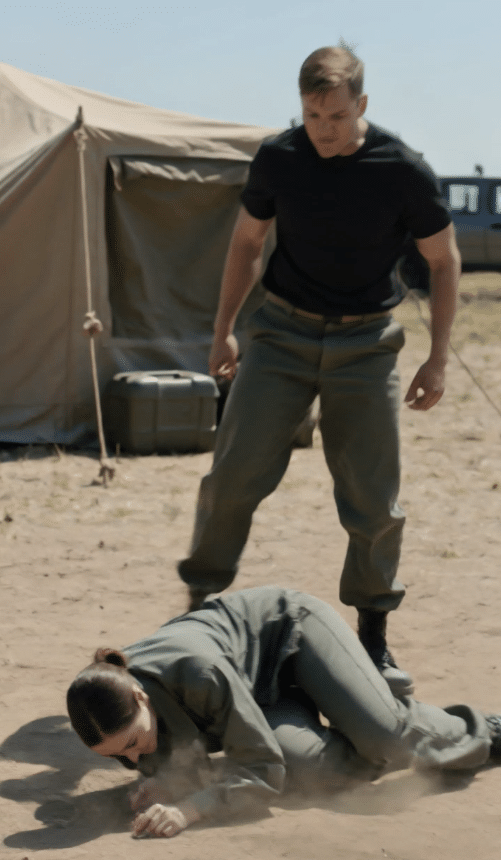
The survival training area sat beneath a hard afternoon sun on an American military base. Dry earth stretched between a small canvas tent and a weathered instruction board, while a water container rested beside the demonstration station. Around them, a dozen cadet officers waited for their turn to complete the exercise.
Sarah, thirty-two, stood beside the board in an olive field uniform, her brown hair tied low at the back of her neck. Her expression was calm, her posture disciplined, and her instructor patch was clearly visible.
She had just corrected a water-conservation technique that twenty-six-year-old Cadet Ryan Cooper had demonstrated incorrectly.
Ryan stared at her as though she had committed an unforgivable offense.
“Trash. Women don’t teach men survival.”
Several cadets exchanged uneasy glances.
Sarah did not raise her voice.
“The procedure is the same regardless of who teaches it. Repeat the technique correctly.”
Ryan’s face hardened.
He had spent his entire life believing that strength meant never allowing another person to make him look foolish. He could accept losing a competition if he could blame the weather, the equipment, or an unfair opponent. What he could not tolerate was a woman calmly pointing out a mistake in front of other men.
And Sarah had done exactly that.
She had not insulted him. She had not questioned his courage. She had simply told him that his technique was wrong.
To Ryan, that was enough.
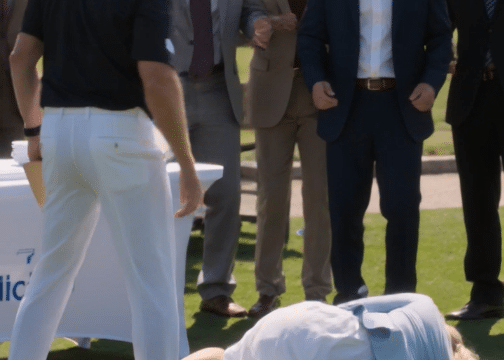
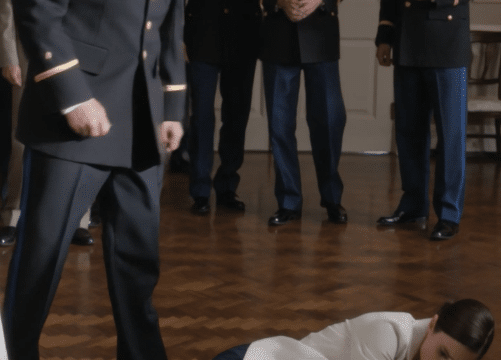
He took a hard running step, launched himself forward, and drove a forceful kick into Sarah’s chest. The impact knocked her backward beside the survival instruction board, sending her down onto the dry ground.
The water container shook against the earth.
Sarah’s elbow struck the dirt, scraping her skin and leaving a thin trace of blood. Pain tightened her face as she tried to catch her breath.
For a moment, the cadets seemed unable to comprehend what they had witnessed.
Then Ryan stepped toward her.
He delivered two more forceful kicks into her back and side while she remained down, her body recoiling against the impact. A sharp gasp escaped her, and her hand pressed instinctively against the ground.
The cadets backed away.
One covered his mouth. Another looked toward the tent as if someone might emerge and explain that this could not possibly be happening.
Nobody intervened.
Sarah struggled to draw a steady breath. Her eyes watered from the pain, but her expression retained a stubborn clarity that Ryan seemed determined to destroy.
He stood over her, breathing heavily.
“Teach from the dirt.”
The words carried across the training area.
Ryan glanced at the cadets, expecting them to recognize his dominance. He had made his point, or so he believed. The instructor who had corrected him was on the ground, and he was still standing.
Then a command vehicle stopped abruptly near the training area.
Its engine dropped into silence.
The driver’s door opened, and a fifty-three-year-old colonel stepped out in a dark green command uniform. His stern eyes moved from the instruction board to Sarah on the ground, then settled on Ryan.
Colonel Michael Hayes walked directly toward them.
He did not shout. He did not run.
He simply placed himself between Ryan and the fallen instructor, and when he spoke, every cadet fell silent.
“She wrote the survival manual you failed to read.”
Ryan’s expression changed.
His eyes flicked toward the instruction board.
Then he looked at Sarah.
For the first time, the man who had been so certain of his own superiority seemed frightened by what he had done.
“She wrote it?”
He sounded as if the answer might somehow rescue him.
It would not.
Because the manual was only the beginning of what Ryan had failed to understand about the woman lying in the dirt.
Act II
Sarah Bennett had not written the survival manual to prove that she belonged in the military.
She had written it because she had seen what happened when people treated survival as a test of toughness rather than a discipline of judgment.
Three years earlier, during a prolonged field exercise in the American Southwest, Sarah had watched a promising young soldier become dangerously dehydrated despite carrying what appeared to be an adequate supply of water. The soldier had not lacked courage. He had lacked a reliable understanding of how to manage his resources, recognize changing conditions, and make sound decisions when fatigue began to cloud his judgment.
The incident ended without a fatality, but it stayed with her.
She began studying the small decisions that could determine whether a unit remained effective when ordinary support disappeared. How did people prioritize limited water? When should a team stop moving? How could an instructor teach someone to distinguish a genuine emergency from the discomfort of an exhausting exercise?
Sarah read field reports, reviewed established guidance, interviewed experienced survival instructors, and worked with medical personnel to make sure the material reflected practical realities rather than dramatic myths.
She was not interested in teaching cadets how to look fearless.
She wanted them to know what to do when fear made clear thinking difficult.
The result was a revised survival-training manual that combined established field principles with clearer instructional sequences, safety checks, and practical assessment criteria. It explained not only what a trainee should do, but why the technique mattered and what kinds of errors could make a difficult situation worse.
Colonel Hayes had reviewed the material during its development. He had seen how much care Sarah took to distinguish sound instruction from the kind of confident guesswork that often passed for experience.
When the revised manual was adopted for the training program, Sarah was assigned to help teach it.
That assignment had not come easily.
She had spent years being tested by people who assumed her physical size, quiet manner, or gender made her less suited to field instruction. Some questioned whether she could command a group of male cadets. Others treated her corrections as personal challenges, even when they knew she had more relevant experience.
Sarah learned to answer those doubts with preparation.
She arrived early. She checked her equipment. She studied each exercise before teaching it and kept detailed notes on the mistakes her students made most often.
She did not expect everyone to like her.
She expected them to learn.
Ryan Cooper had entered the program with a different understanding of what it meant to be a soldier.
He was athletic, competitive, and unusually good at the physical portions of training. He could run hard, carry heavy loads, and push through discomfort without showing much outward strain. Instructors had praised his determination, and his fellow cadets often looked to him when an exercise became physically demanding.
Those successes had convinced Ryan that his instincts were more reliable than written guidance.
He viewed manuals as things people memorized to pass evaluations, not tools that could prevent mistakes. He respected instructors who reinforced his existing beliefs and distrusted those who challenged them.
His attitude toward women was even more revealing.
Ryan did not necessarily announce his prejudice every time he entered a room. Sometimes it appeared in a smirk, a dismissive interruption, or a refusal to repeat a task after a female instructor corrected him. He was careful around senior male officers, but with women he believed he could intimidate, his politeness often disappeared.
Several cadets had noticed.
Most had learned to ignore it.
They told themselves that Ryan was simply intense. They assumed he would mature as his career progressed. And because he was physically capable, they found it easier to excuse the behavior than to challenge it.
Sarah had seen this pattern before.
She did not mistake aggression for confidence, and she did not believe humiliating a student was the answer to arrogance. Her approach was direct: explain the standard, demonstrate the correct method, and require the trainee to repeat it until the skill was reliable.
That morning’s water-conservation exercise was designed around precisely that principle.
The cadets had been asked to demonstrate a technique from the manual and explain the reasoning behind each step. Ryan rushed through the demonstration, skipping part of the required sequence. When Sarah corrected him, he waved away the instruction and insisted that his approach was faster.
She asked him to repeat it properly.
He heard something else.
He heard a woman telling him that he was wrong.
And rather than confront that possibility, he chose to make her afraid to speak again.
The attack did not prove that Sarah was unqualified.
It revealed how little Ryan understood about the profession he wanted to enter.
Yet when Colonel Hayes arrived, he was about to learn that the man who had approved Sarah’s manual had also been watching the cadets for a reason Ryan had never considered.
Act III
Colonel Hayes remained between Ryan and Sarah, his expression hardening as he assessed the situation.
“Stand where you are, Cadet.”
Ryan froze.
“Sir, she was disrespecting me in front of the class.”
The colonel’s eyes narrowed.
“She corrected your technique.”
“She questioned my ability.”
“She was instructing you.”
Ryan swallowed and glanced toward the board.
The manual’s title was printed across the top of the display sheet, followed by the training sequence Sarah had been explaining before the attack. It was the same material Ryan had been required to study before arriving at the field exercise.
He had skimmed it.
He remembered the diagrams, the headings, and the questions at the end of each section. He had memorized enough terminology to sound knowledgeable during a discussion, but he had never taken the time to understand why the procedures were arranged as they were.
He had considered the reading a formality.
Now Colonel Hayes was telling him that the woman he had kicked was the person who had helped create the very material he had dismissed.
“She wrote the survival manual you failed to read.”
The colonel repeated the fact slowly, giving Ryan no opportunity to mistake its meaning.
“Lieutenant Bennett developed the revised training framework with the medical and field-instruction teams. Her work is used throughout this program because it teaches cadets to make decisions based on evidence, not ego.”
Ryan’s lips parted.
“But she’s—”
He stopped himself.
“She’s an instructor, sir.”
“She is.”
Hayes glanced briefly toward Sarah, who remained on the ground, breathing carefully while she waited for medical assistance.
“And she was doing her job.”
Ryan’s eyes moved back to the instruction board. He seemed to be searching for a contradiction, some small detail that would allow him to reinterpret what the colonel had said.
There was none.
The technique Sarah had asked him to repeat was not an arbitrary demand invented to embarrass him. It was part of the curriculum she had helped develop, based on the training standards the command had approved.
She had corrected him because he had made a mistake.
He had attacked her because he could not tolerate being corrected by her.
The simplicity of that truth made every excuse he had prepared sound weaker.
“Sir, I didn’t know she wrote it.”
Colonel Hayes stared at him.
“Would that have made your actions acceptable if you had known?”
Ryan had no answer.
“Would you have listened if another instructor had given you the same correction?”
Silence.
“Would you have attacked a male instructor?”
Ryan’s face reddened.
He looked down at the ground.
The colonel did not need to explain what the cadets were thinking. Their silence had changed from the fear that followed the assault into something more complicated: disbelief, disappointment, and the uncomfortable recognition that they had watched a classmate cross a line they had previously assumed he would never cross.
Hayes turned his attention back to Ryan.
“You are here to learn skills that may one day protect you and the people serving beside you. You are not here to prove that nobody can correct you.”
Ryan stood rigidly, his earlier aggression draining into uncertainty.
“The instructor’s gender does not change the standard. Her rank does not make the technique more or less correct. And your pride does not give you permission to use violence.”
The colonel’s voice remained controlled, but every word carried the weight of command.
“You will not approach her.”
Ryan’s eyes flicked toward Sarah again.
She had managed to sit up with assistance from the arriving medical personnel. Pain tightened her expression, but she did not look at Ryan. Her attention was on the people assessing her injuries and the work that still needed to be done.
That seemed to unsettle him more than anger would have.
He had expected her to shout at him, plead with him, or respond in a way that would allow him to portray himself as the victim of a personal dispute.
Instead, she had maintained her dignity, even after he had done everything he could to strip it away.
Colonel Hayes turned slightly toward the training staff and ordered the exercise suspended. Ryan was separated from the class while the incident was documented and referred through the appropriate command channels.
The assault would be investigated. Witness statements would be collected. The command would determine the appropriate disciplinary action under the governing procedures.
No decision about Ryan’s future would be made solely because the colonel was angry.
But the attack had already answered a question that every leadership program needed to ask.
Could Ryan Cooper accept correction from someone he did not believe deserved to teach him?
The answer, witnessed by an entire class, had been devastating.
And the colonel was not finished explaining what that answer meant.
Act IV
Medical personnel attended to Sarah while the training staff secured the area.
Her injuries required proper assessment, and the exercise was halted. The instruction board and the water container remained beside the demonstration station, ordinary objects that now seemed strangely out of place after the violence.
Ryan was kept away from Sarah.
The cadets who had witnessed the attack were instructed to provide independent accounts of what they had seen. The command did not ask them to defend the program, protect Ryan’s reputation, or agree with one another. It needed accurate information about the sequence of events.
Their accounts were consistent.
Sarah had corrected Ryan’s technique and asked him to repeat it. Ryan had insulted her because she was a woman. He had then kicked her to the ground and continued the assault while she was down.
The attack had not occurred during a legitimate defensive maneuver. It had not been an accidental collision during a physical exercise.
It had followed a verbal correction.
That distinction mattered.
Ryan’s first instinct was to argue that Sarah had undermined him in front of the class. He said he had felt provoked and that he had been trying to make her stop embarrassing him.
Colonel Hayes listened to the initial account without interrupting.
Then he asked Ryan to describe the technique Sarah had corrected.
Ryan hesitated.
He could recall the broad purpose of the exercise, but when asked to explain the sequence and the reason for each step, he struggled to provide a coherent answer.
Hayes waited.
“Did you understand why she asked you to repeat it?” the colonel asked.
“I thought my method would work.”
“That wasn’t the question.”
Ryan looked down.
“No, sir.”
“Had you read the assigned manual?”
Ryan hesitated again.
“Not all of it, sir.”
The admission settled between them.
He had dismissed the manual as unnecessary, disregarded the instructor who had helped write it, and then attacked her when she required him to follow the curriculum.
His actions had revealed a failure that went beyond one exercise. He had treated his own confidence as a substitute for preparation and his physical strength as a substitute for discipline.
Hayes explained that the incident would be reviewed under the applicable military procedures. Ryan’s participation in the training program and his eligibility for future leadership opportunities would be assessed in light of the findings.
There would be no automatic declaration that his career was over before the review was complete.
There would, however, be no presumption that physical ability made him fit to lead.
For Ryan, that distinction was difficult to accept.
He had imagined his future as a steady progression from one achievement to the next. He expected his performance in demanding exercises to carry him toward greater responsibility. He believed that his ability to endure discomfort and push others through difficult conditions made him a natural leader.
But leadership required more than endurance.
It required listening when another person had information he lacked. It required controlling anger when a decision went against his preference. It required treating the people around him as professionals rather than obstacles to his own status.
Ryan had demonstrated none of those qualities when Sarah corrected him.
Colonel Hayes understood the difference because he had spent much of his career observing people under pressure. He had seen strong service members make mistakes and recover by acknowledging them. He had also seen talented individuals become liabilities because they could not admit that their first instinct was wrong.
The most dangerous person in a survival situation was not necessarily the weakest, the slowest, or the least experienced.
Sometimes it was the person who refused to learn.
Sarah’s manual had been written to help prevent that kind of failure. Its central purpose was not to turn every cadet into an expert overnight. It was to give them a dependable framework for making decisions when stress, exhaustion, and uncertainty threatened to overwhelm their judgment.
Ryan had rejected that framework before he even understood it.
Then he had attacked the person trying to teach it.
The command’s response would therefore have to address both the assault and the larger question of whether he could be trusted to continue training toward a position of responsibility. Any disciplinary action would follow the evidence and the established process, but his performance could no longer be judged solely by how fast he ran or how much weight he carried.
The cadets understood that now.
They had watched Ryan treat Sarah’s correction as an attack on his masculinity. They had watched him use force against someone who had not threatened him. And they had watched Colonel Hayes reveal that the woman he had dismissed had contributed to the very standards he had failed to study.
Nobody laughed at Ryan’s jokes that afternoon.
Nobody rushed to defend his behavior.
The silence was not revenge. It was the recognition that the image he had cultivated could not survive what everyone had witnessed.
Before leaving the training area, Colonel Hayes addressed the class.
“Survival is not a contest to see who can appear the toughest,” he said. “It is a discipline of judgment. If you cannot listen to a correction in training, you cannot expect people to trust your judgment when the consequences are real.”
He let the words settle.
“You will work with people whose experience differs from yours. Some will know things you do not. Some will catch mistakes you have missed. Your responsibility is to recognize useful information and act on it—not punish the person who provides it.”
The cadets listened without moving.
For many of them, the lesson would last longer than the exercise itself.
Ryan had believed he was humiliating Sarah.
Instead, he had given the entire class a demonstration of why arrogance could be more dangerous than ignorance.
And there was one final consequence he had not anticipated: the manual he had refused to read was about to become the first thing he would be required to study if he wanted any chance of rebuilding his standing.
Act V
Sarah returned to the training program only after receiving appropriate medical assessment and clearance.
She did not come back with a speech prepared for Ryan. She did not demand that the cadets admire her or treat her differently. She returned because she believed in the work and because the trainees still needed to learn the skills they had come to the field to practice.
Colonel Hayes met with her before the next session.
He asked whether she felt ready to resume instruction and made clear that the command would support her if she needed additional time. He also confirmed that the assault would be handled through the proper process, independently of her role in the training program.
Sarah appreciated the directness.
“I don’t want the class to think the standards change because something happened to me,” she said.
“They won’t,” Hayes replied. “But neither will our responsibility to address what happened.”
Sarah nodded.
She knew the difference between maintaining standards and pretending that nothing had gone wrong. The class would continue, but the incident would not be erased. The command had to make sure the cadets understood that violence was not an acceptable response to instruction and that a person enforcing the curriculum deserved the same protection as anyone else performing an authorized duty.
The investigation proceeded through the established channels. Witnesses gave their statements, the circumstances of the assault were reviewed, and Ryan’s conduct was considered alongside the requirements of the training program.
His future would depend on the findings and the decisions made under the applicable procedures. The colonel did not promise a particular punishment, and Sarah did not ask him to.
What mattered was that Ryan could no longer pretend the incident had been a simple disagreement between a difficult student and an instructor.
The evidence showed what had happened.
And the command would have to decide whether the cadet who had responded to correction with violence could meet the standards required of someone entrusted with other people’s safety.
Ryan was eventually required to revisit the curriculum he had dismissed. The manual was no longer a document he could skim for a few phrases before an assessment. Its principles had become inseparable from the questions raised by his own conduct.
He had to confront the difference between knowing a procedure existed and understanding why it mattered. He had to reckon with the fact that preparation did not make him weak, that correction was not humiliation, and that being physically capable did not grant him the right to dominate others.
None of that guaranteed redemption.
An apology, if offered, would not erase the assault. Studying the manual would not automatically restore trust. Any future opportunity to serve in a position of responsibility would require more than a change in vocabulary or a few weeks of outward compliance.
He would have to demonstrate that he could accept limits, control his behavior, and learn from people he had previously dismissed.
That work would be his responsibility.
For Sarah, the lesson was different.
She had known before the attack that not every student would welcome her instruction. She had learned to recognize the small signs of resentment and the ways insecurity could disguise itself as confidence. But she had not allowed those experiences to convince her that the standards should be lowered or that she should soften a necessary correction to protect someone else’s pride.
She had written the manual because sound preparation could save lives.
She would continue teaching for the same reason.
During a later session, the cadets gathered around the instruction board again. The water container sat beside the demonstration station, and the dry ground was marked by footprints from the previous exercise.
Sarah stood at the front of the group.
“Today, we’ll repeat the technique,” she said. “This time, I want you to explain why each step matters.”
The cadets opened their manuals.
No one treated the instruction as a challenge to their status. They listened, asked questions, and corrected their demonstrations when necessary.
The change was not dramatic. There was no applause, no grand announcement, and no sudden transformation of every trainee into a perfect student.
There was simply a group of people beginning to understand that learning required the humility to admit what they did not know.
Colonel Hayes watched from the edge of the training area.
He had no need to announce Sarah’s credentials again. Her work was already there in the curriculum, and her authority came from the responsibility she had been assigned and the expertise she brought to it.
Ryan’s outburst had not diminished that work.
If anything, it had exposed why the work mattered.
A survival manual could explain how to manage resources, assess risks, and make decisions under pressure. It could offer procedures for moments when fear and exhaustion threatened to cloud judgment.
But no manual could do the work of character on someone’s behalf.
A trainee still had to choose whether to listen.
A leader still had to decide whether to accept correction.
And a soldier still had to understand that discipline was not the ability to force other people into silence.
It was the ability to do what was right even when pride demanded something else.
Ryan had looked at Sarah and seen a woman he believed had no right to teach him.
Colonel Hayes had looked at the same woman and seen the author of a manual used to prepare the next generation of service members.
The difference was not merely a matter of information.
It was a difference in judgment.
When Ryan finally asked, “She wrote it?” he was reacting to the revelation that the woman he had tried to humiliate was more accomplished than he had assumed.
But the deeper truth was harder to escape.
She had not needed to write the manual to deserve his respect.
She had deserved to be heard because she was doing her job, because her instruction was correct, and because no person’s dignity should depend on whether an angry cadet considers them worthy.
The manual was the twist Ryan never saw coming.
The real lesson was the one he should have learned before he ever stepped onto the training ground: the person who corrects your mistake may be the very person whose knowledge keeps you alive—and the moment you refuse to listen is often the moment you reveal how much you still have to learn.