Act I
“Trash. You don’t give orders here.”
The words rang across the military guesthouse, silencing conversations around the buffet table. Officers in formal dress uniforms stood beneath warm lights and American flags, their polished shoes reflecting off the spotless floor, while a pregnant woman in a modest navy dress stared at the man blocking her path.
She was eight months pregnant, with brown hair pinned into a low bun and a thin white coat draped over her shoulders. One hand rested beneath her belly as she tried to keep her voice calm.
“Please don’t cut in front of her.”
The woman she was defending was an elderly military mother holding a small plate, her silver hair neatly arranged and her hands trembling slightly as she waited for her turn.
The officer in front of them glanced at the older woman, then back at the pregnant stranger.
His expression hardened.
“Excuse me?”
“You were behind her,” the pregnant woman said. “She was waiting. Please let her go first.”
The officer gave a short, disbelieving laugh.
He was Lieutenant Colonel Richard Hale, thirty-nine years old, broad-shouldered, decorated, and accustomed to having people move when he entered a room. His dark blue dress uniform was immaculate. His service ribbons sat in precise rows, his shoes shone beneath the lights, and his confidence carried the unmistakable arrogance of a man who had confused rank with personal superiority.
He looked at the pregnant woman as though she had committed an unforgivable offense.
“Do you know who you’re speaking to?”
She blinked.
“I was only asking you not to cut in line.”
“Then perhaps you should learn when to keep your mouth shut.”
A few people nearby turned toward them.
The elderly woman quietly lowered her plate.
“It’s all right, dear,” she murmured to the pregnant woman. “You don’t need to get involved.”
But the younger woman shook her head gently.
“You were here first.”
That simple sentence seemed to infuriate Richard more than any insult could have.
He stepped closer, forcing her to move backward until the edge of the buffet table was behind her.
“Listen carefully,” he said. “This is a military guesthouse. Officers are not required to take instructions from people who don’t understand how things work.”
She stared at him.
“I’m not giving you orders. I’m asking you to show an older woman some courtesy.”
Richard’s face flushed.
“Respect officers before you speak.”
The woman took a slow breath.
“Respect is something you show people, too.”
The silence that followed was immediate.
Someone near the far end of the table stopped pouring coffee. A young lieutenant glanced toward his commanding officer, then looked away. Two military spouses exchanged a horrified look but remained frozen in place.
Richard had expected embarrassment.
He had expected the woman to apologize, step aside, and disappear into the crowd.
He had not expected her to answer him.
“You think you can lecture me?” he demanded.
“No.”
“Then why are you still talking?”
“Because you haven’t let her pass.”
The elderly woman whispered the younger woman’s name.
“Please, Claire. Let it go.”
Richard caught the name but paid it no attention.
Claire Bennett.
To him, she was simply another civilian who had mistaken politeness for permission to challenge a man in uniform.
He had no idea that Claire had spent years attending military family functions, listening to officers discuss the burdens of command, and watching her husband insist that leadership began with responsibility rather than privilege.
He had no idea that she had married a man who commanded thousands of service members but still stood whenever an elderly veteran entered a room.
And he certainly didn’t know that her husband was the four-star general whose authority reached far beyond the guesthouse.
Richard only saw a woman he believed had no power over him.
“Move,” he ordered.
Claire tried to step aside.
But he moved with her, blocking the path again.
“I’m leaving,” she said quietly. “Just let me pass.”
Richard’s mouth twisted into a cruel smile.
“You should have thought about that before embarrassing an officer in front of his colleagues.”
“I wasn’t trying to embarrass you.”
“Too late.”
Then he attacked.
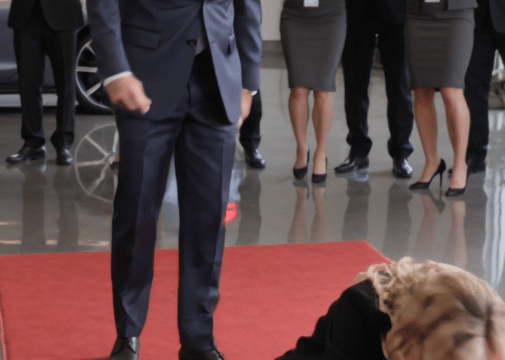
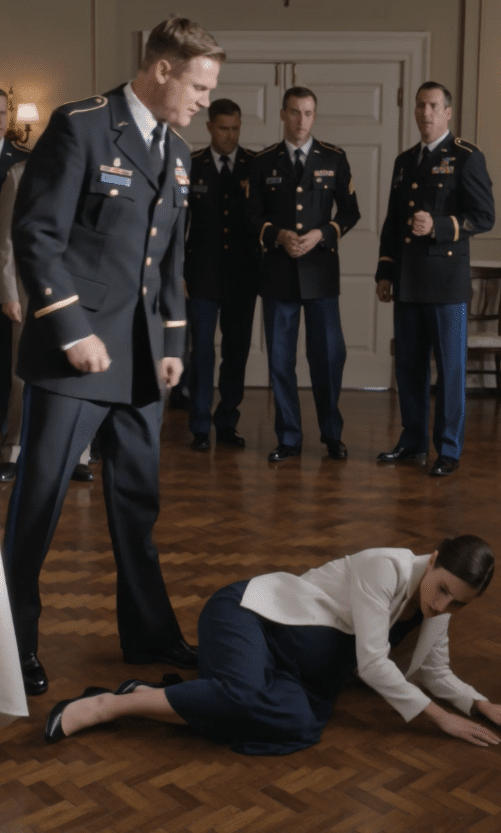
Richard surged forward and drove a forceful kick into Claire’s chest, knocking her backward onto the polished floor beside the buffet table.
A plate crashed against the ground.
Claire’s forearm struck the floor, leaving a small scrape as she curled inward, instinctively protecting her unborn child. Her breath caught, and her hand moved immediately toward her belly.
For a moment, nobody seemed able to understand what they had witnessed.
Then Richard stepped around her.
He delivered two more forceful kicks into her back.
A woman screamed.
Several guests recoiled, covering their mouths. A young officer took half a step forward but froze when Richard turned sharply toward the crowd.
“Stay out of this!”
Claire lay on her side, struggling to breathe through the shock and pain.
Richard adjusted his uniform as though the violence had been an ordinary disciplinary correction.
“Respect officers before you speak,” he repeated.
The elderly woman stood trembling beside the buffet, her plate abandoned on the table.
“She’s pregnant,” she whispered.
Richard looked down at Claire.
“She should have learned to mind her own business.”
Then the main guesthouse doors flew open.
A man in a high-ranking military uniform strode into the room, his face stern and his shoulders rigid. Four stars gleamed on his shoulders beneath the warm lights.
He saw the scattered plates.
He saw the terrified guests.
Then he saw Claire on the floor.
Everything in his expression changed.
He crossed the room in seconds, dropped beside her, and shielded her with his body.
“Claire.”
Her eyes opened.
“David…”
General David Bennett took her hand, his composure cracking for a single moment as he saw the pain in her face.
Then he looked up.
Lieutenant Colonel Richard Hale stood several feet away, suddenly motionless.
The general rose just enough to place himself between his wife and the officer.
His voice was low.
“Stand… down… from my wife.”
Richard’s face lost its color.
His eyes dropped to the four stars.
Then he looked at Claire again.
“General…” he stammered. “Your wife?”
For the first time that evening, the officer who had demanded respect from everyone else appeared to have no idea what to do with himself.
And the general had not yet asked him the most important question.
Act II
General David Bennett had never wanted his marriage to become part of his command.
At fifty-five, he had spent more than three decades in uniform, rising through assignments that tested his judgment, his patience, and his ability to make decisions when every available option carried a cost.
He had commanded soldiers in dangerous environments, briefed senior officials, and faced families whose lives had been changed by decisions made far from home.
Those experiences had taught him that authority could be necessary.
They had also taught him that authority could become dangerous when the person holding it stopped questioning himself.
David had met Claire before his career reached its highest levels.
She had been twenty-six, working with a nonprofit that helped military families navigate housing transitions and access community support. David was a major at the time, still learning that a uniform could open doors without guaranteeing that the person wearing it knew what to do once inside.
They met at a volunteer event on a rainy Saturday.
David had arrived late after an unexpected briefing, expecting to help move supplies and leave before anyone noticed his absence. Claire handed him a stack of boxes and pointed toward a storage room.
“You’re tall,” she told him. “You can reach the top shelf.”
He laughed.
She didn’t ask about his rank. She didn’t treat his military career as a fascinating story waiting to be told. She wanted to know whether he intended to finish the work before going home.
David fell in love with that straightforwardness.
Claire married him knowing that the military would demand long absences, sudden changes of plan, and years in which ordinary family life would have to bend around the needs of his profession.
She never pretended those sacrifices were easy.
But she also refused to believe that being married to an officer made her more important than anyone else.
When David was promoted to general, people began addressing her differently. Invitations became more formal. Strangers who had once barely noticed her suddenly remembered her name.
She disliked it.
“I married you,” she told him one evening, “not the stars on your shoulders.”
David smiled.
“Good. The stars can be exhausting.”
“Then don’t bring them home.”
He never forgot that conversation.
Over the years, Claire had developed her own way of navigating military life. She learned when to speak, when to listen, and when to intervene if she saw someone being treated unfairly.
She knew that military families often carried burdens that remained invisible to the people who praised the institution from a distance.
Spouses moved across the country, children changed schools, and parents spent holidays worrying about sons and daughters stationed thousands of miles away. Some families endured years of uncertainty while loved ones served in dangerous assignments.
Claire had also seen how rank could distort ordinary interactions.
A junior service member might hesitate to report mistreatment because the person responsible controlled their evaluations. A civilian employee might fear that one complaint could cost them a job. A military parent might remain silent rather than risk embarrassing a son or daughter in uniform.
She believed respect should protect people from that kind of fear.
It should never create it.
The dinner at the military guesthouse had been organized to bring together officers, their families, retired service members, and parents whose support had sustained loved ones through long careers.
It was not an official command briefing or a classified event. It was a formal family gathering, the kind of evening meant to remind people that military service existed within a wider community of sacrifice and support.
Claire had arrived early.
David was expected to join the dinner after finishing an obligation elsewhere on the installation. She had told him not to rush, knowing how often his schedule changed at the last moment.
Before the incident, she had been speaking with an elderly woman named Margaret Ellis.
Margaret’s son had served in the Army for more than twenty years. She had attended the dinner because the organizers wanted to honor parents who had supported service members through deployments, relocations, and difficult years away from home.
She was proud of her son, but the long years had taken a toll.
Her husband had died several years earlier, and her son was stationed overseas. She had traveled to the guesthouse with a neighbor and was still getting used to formal events where everyone seemed to know precisely where to stand.
Claire had noticed her standing alone near the buffet.
They began talking about family, travel, and the peculiar loneliness of waiting for a loved one to come home.
When Margaret mentioned that her son had called from overseas the previous evening, Claire listened as if the story mattered.
Because it did.
They joined the buffet line together.
Then Richard Hale arrived.
Richard had built his reputation on efficiency and forceful leadership. His performance reports were strong, and he had a gift for appearing decisive in front of senior officers.
He spoke confidently during briefings. He expected immediate compliance with his requests. He liked order, and he disliked anyone who questioned his interpretation of it.
Over time, he had begun to believe that a successful officer was one who never allowed himself to be challenged.
He had been reprimanded informally for his temper, but he dismissed those concerns as misunderstandings. He described himself as demanding, not abusive; direct, not disrespectful.
His colleagues had learned to work around him.
Some avoided disagreeing with him in public. Others laughed at his sharp comments because they didn’t want to become his next target. A few privately believed that his behavior would eventually create a serious problem.
But Richard’s record remained strong enough to protect his reputation.
Until Claire asked him not to cut in front of an elderly woman.
It was a small request, delivered without anger or disrespect.
Richard could have stepped back.
He could have apologized.
He could have allowed Margaret to continue and forgotten the exchange before he reached the end of the table.
Instead, he treated the request as an assault on his authority.
The distinction mattered.
Claire had not challenged his military competence. She had not interfered with an operation or disobeyed a lawful order. She had simply asked him to behave courteously at a family dinner.
But Richard saw a civilian questioning him, and he could not tolerate the feeling.
He did not know who Claire was.
He believed that meant she was safe to intimidate.
By the time David entered the guesthouse, that belief had shattered.
Yet the revelation of Claire’s identity would not be the only thing Richard had to confront.
Because David Bennett had not reached four-star rank by allowing personal anger to replace judgment.
And what he would discover about the culture surrounding Richard’s behavior would prove almost as troubling as the assault itself.
Act III
“Someone call the medical team,” David ordered.
His voice carried across the room with the clarity of a command given under pressure.
A staff member hurried toward the telephone. Another went to alert the guesthouse’s medical personnel. David remained beside Claire, carefully following the responders’ instructions as they assessed her condition.
“Look at me,” he said softly.
Claire tried to focus on his face.
“I’m scared.”
“I know.”
“What about the baby?”
“We’re getting you checked immediately.”
He didn’t promise that everything would be fine. He knew better than to offer certainty when a medical assessment was still needed.
Instead, he held her hand and stayed close enough for her to hear his voice.
When the medical team arrived, David gave them space to work. Claire was transferred for urgent evaluation, with the responders taking precautions appropriate to a pregnant patient who had suffered a serious assault.
Only after she was on her way to receive care did David turn toward Richard.
The lieutenant colonel had regained enough composure to stand at attention, though his face remained pale.
“General, I can explain.”
David looked at him.
“Explain what?”
“There was an altercation.”
“An altercation?”
Richard swallowed.
“She challenged me in front of the other guests. I was trying to maintain order.”
David’s expression did not change.
“What did she do?”
“She interfered with the line.”
“What did she say?”
Richard hesitated.
“She asked me not to cut in front of an elderly woman.”
A murmur moved through the room.
David glanced at Margaret, who stood near the buffet table with tears in her eyes.
“Is that what happened?”
Margaret nodded.
“Yes, General. She was only trying to help me.”
Richard tried to interrupt.
“Sir, you weren’t here. The situation became disrespectful—”
“Did she threaten you?”
“No, sir.”
“Did she touch you?”
“No.”
“Did she obstruct an official duty?”
Richard’s jaw tightened.
“No, sir.”
David took one step closer.
“Then tell me why my wife is being taken away for medical care after you kicked her.”
Richard looked toward the doors through which Claire had been carried.
For the first time, he seemed to understand that no explanation could make the facts sound acceptable.
“I lost my temper.”
“You attacked an unarmed civilian at a family dinner.”
“I didn’t know she was your wife.”
The words landed like a second offense.
David stared at him.
“Would that have made it acceptable if she were someone else’s wife?”
Richard’s mouth opened.
Nothing came out.
“Would it have been acceptable if she were a private’s wife? A civilian employee? A stranger who had come here to honor a family member?”
“No, sir.”
“Then why did you say it?”
Richard’s shoulders stiffened.
“I meant that I didn’t understand the circumstances.”
“You understood enough to insult her. You understood enough to kick her while she was standing in front of you. You understood enough to strike her again after she fell.”
David’s voice remained controlled, but the room seemed to grow colder with every sentence.
“You did not need to know her name to understand what you were doing.”
Richard lowered his eyes.
Around them, officers who had once tolerated his temper now stood silently watching. Some looked ashamed. Others appeared shocked by the bluntness of the exchange.
David turned toward the senior officer responsible for coordinating the event.
“Preserve any available security footage. Identify every witness, and ensure that their statements are collected independently.”
“Yes, General.”
“I want the incident reported through the appropriate channels. No one is to pressure witnesses, alter records, or interfere with any investigation.”
“Understood.”
David looked back at Richard.
“You are not to approach my wife or contact her family about this incident. Your conduct will be reviewed through the proper process, and the authorities will determine any further action within their jurisdiction.”
Richard’s face tightened.
“General, please. I’ve served this country for almost two decades.”
David’s eyes hardened.
“So have people who would never dream of doing what you just did.”
Richard looked around the room as if searching for someone willing to support him.
No one stepped forward.
The young lieutenant who had witnessed the attack finally spoke.
“Sir, I saw the whole thing.”
David turned toward him.
“Thank you. Give an honest statement. You have my assurance that no one should retaliate against you for reporting what you witnessed.”
The lieutenant nodded, visibly relieved.
Another guest came forward.
Then another.
Margaret described how Claire had tried to help her. The event staff confirmed that no argument had occurred before Richard began insulting Claire. Several witnesses independently reported seeing the kicks.
One of them had recorded part of the confrontation on a phone.
The video was incomplete, but it captured Richard’s final insult and the moments immediately before the assault. It also recorded the sudden silence when David entered and knelt beside his wife.
The evidence left little room for Richard’s original account.
An initial review established that Claire had not threatened him or interfered with any military duty. The incident was referred to the appropriate authorities, and Richard was removed from his event responsibilities while the formal review proceeded.
David did not order an instant verdict.
He did not demand that anyone invent a punishment to satisfy his anger.
He wanted the facts established, the procedures followed, and the people responsible held accountable under the applicable rules.
That distinction was important.
He was Claire’s husband, and the thought of what had happened to her filled him with an anger he could barely contain. But he was also a senior commander responsible for maintaining trust in the institution he served.
He could not allow his personal relationship to become an excuse to bypass due process.
Nor could he allow the military’s respect for rank to become a reason for concealing misconduct.
That night, after giving his initial account to the investigators, David went to the hospital.
He found Claire under medical observation, with doctors monitoring her and assessing the potential effects of the assault.
She looked exhausted.
When she saw him, she reached for his hand.
“Did you speak to him?”
“Yes.”
“What happens now?”
“The incident is being investigated. The evidence will be preserved, and the appropriate authorities will handle it.”
She watched his face.
“And you?”
David sat beside her.
“I am going to stay here as long as you need me.”
Her eyes filled with tears.
For the first time since entering the guesthouse, he let his own fear show.
He bent his head and pressed her hand against his forehead.
“I should have been there.”
Claire squeezed his fingers as best she could.
“You can’t be everywhere.”
“No.”
“But you can make sure this doesn’t disappear because he’s an officer.”
David lifted his head.
“I promise you that.”
And this time, the promise would require more than confronting one man in a crowded room.
It would require examining why so many people had been afraid to challenge him before that night.
Act IV
The investigation revealed a pattern that reached beyond the buffet table.
Richard Hale had not been known only for his demanding standards. Several people had privately described him as intimidating, especially toward junior personnel and civilian staff.
The accounts varied in detail, but they shared a familiar theme.
When someone questioned him, he treated the disagreement as a challenge to his rank.
When a subordinate asked him to reconsider a decision, he accused them of undermining authority. When support staff made mistakes, he sometimes corrected them in front of others, using embarrassment as a tool.
Not every complaint had been formalized.
Some people had simply avoided working with him whenever possible. Others had kept their concerns to themselves because they believed reporting an officer with a strong record would accomplish nothing.
A former staff member recalled being told that Hale was “hard on people because he expected excellence.”
The phrase had been used so often that it had become a shield.
But demanding excellence was not the same as demanding submission.
And military discipline was not permission to abuse people.
The investigators reviewed the available records, interviewed witnesses, and distinguished substantiated allegations from rumors or personal disagreements. They did not treat every negative opinion as proof of misconduct.
They focused on what could be established.
The assault at the guesthouse was supported by multiple witness accounts, and the central facts were consistent: Claire had made a polite request, Richard had insulted her, and he had used physical violence after she attempted to disengage.
His own explanations changed as the evidence became clearer.
First, he claimed that Claire had been aggressive.
Then he acknowledged that she had only asked him to let the elderly woman go first.
Finally, he said he had lost control because she had embarrassed him in front of other officers.
That admission revealed the deeper problem.
He had not acted to protect anyone or maintain order.
He had acted because he believed his pride had been injured.
David received regular updates through the proper reporting channels, but he made it clear that he would not direct investigators to reach a particular conclusion. He also ensured that the case was handled by officials who could review the facts without relying solely on his personal account.
His responsibility was to protect the integrity of the process, not to replace it.
When the initial findings were presented to the relevant leadership, the response was serious.
Richard was relieved of his duties pending the applicable administrative and disciplinary proceedings. The evidence was referred to the proper authorities for decisions about any further legal action, and the military review continued according to established procedures.
The outcome would not be decided by one dramatic speech.
It would be determined by evidence, policy, and the obligations that came with wearing the uniform.
But David also asked a question that troubled the senior officers who reviewed the incident.
“How did a man with this reputation become so comfortable believing that nobody could challenge him?”
The answer was uncomfortable.
Richard had been rewarded for performance while his interpersonal conduct received too little attention. His ability to produce results had repeatedly been treated as a reason to overlook warning signs.
People had seen the behavior.
Some had reported it informally.
Others had decided that avoiding conflict was easier than confronting it.
And because the consequences had seemed manageable, the pattern had continued.
Until it reached Claire.
At a leadership review, David spoke without raising his voice.
“We spend a great deal of time teaching people to follow lawful orders. We should be equally serious about teaching those who give orders that rank does not erase responsibility.”
A senior officer asked whether the incident should be treated as an isolated case.
David paused.
“We should not assume it is widespread without evidence. But we also should not call it isolated simply because we would prefer not to examine it.”
The review led to renewed attention to reporting procedures, leadership conduct, and protections against retaliation. Commanders were reminded that allegations of abuse required a serious response regardless of the rank or performance record of the person accused.
The goal was not to make every disagreement a disciplinary matter.
It was to make sure that legitimate concerns could be raised without fear and that rank would not become a shield against accountability.
David insisted that the message be clear.
A military organization depended on discipline, trust, and lawful authority. None of those things could survive if officers treated personal humiliation as a legitimate reason for violence.
Meanwhile, Claire continued her recovery.
The uncertainty surrounding her pregnancy made every medical appointment emotionally exhausting. She and David followed the guidance of her doctors, taking each assessment as it came rather than assuming an outcome before the professionals could establish it.
David accompanied her whenever his responsibilities allowed.
He learned how to sit quietly in waiting rooms without checking his phone every thirty seconds. He learned that there were moments when a general’s authority meant absolutely nothing.
He could not command fear to disappear.
He could not order time to move faster.
He could only hold his wife’s hand and wait beside her.
One evening, Claire noticed him staring at the floor.
“What are you thinking about?”
David hesitated.
“I keep replaying the moment I walked through those doors.”
“You saw me.”
“I saw you on the floor, and all I could think about was how close I came to arriving too late.”
Claire looked at him.
“You arrived when you could.”
“I should have been able to prevent it.”
“You didn’t cause it, David.”
He said nothing.
She shifted carefully against her pillows.
“Listen to me. I need you to be my husband right now, not a general trying to solve something he can’t undo.”
He looked up.
“I can’t change what happened,” she continued. “But I need you here. I need you to help me through what comes next. And I need you to make sure the investigation is honest.”
David reached for her hand.
“I can do that.”
“Then do that.”
For the first time in days, his shoulders relaxed.
He could not reverse the violence or erase the fear it had caused. But he could refuse to let the incident be buried, and he could make sure his wife never had to carry the burden of proving that what happened to her mattered.
The next chapter would not be written by Richard’s panic or David’s anger.
It would be written by the truth.
Act V
Several weeks later, Claire sat beside David in a quiet room at home, folding a small blanket for their daughter.
The doctors had continued monitoring her condition, and she followed their recommendations carefully. Recovery was not a straight line. Some days she felt stronger; on others, the memory of the guesthouse returned without warning.
David learned not to mistake silence for comfort.
Sometimes Claire wanted to talk about the attack. Sometimes she wanted to discuss the nursery or the weather or whether they had bought far too many newborn clothes.
He followed her lead.
The formal proceedings concerning Richard continued through the appropriate channels. The assault was documented, witness statements were preserved, and his conduct was reviewed under the rules that applied to his position.
David did not make public threats or use his rank to announce a punishment before the process was complete.
He didn’t need to.
The facts were serious enough on their own.
The case also prompted broader conversations among leaders about the difference between authority and intimidation. Some changes were immediate, while others required training, review, and sustained attention.
No policy could guarantee that no officer would ever behave badly again.
But policies could make it harder to ignore a complaint, easier for witnesses to speak, and clearer that performance did not excuse misconduct.
Margaret Ellis sent Claire a handwritten note.
She thanked her for speaking up at the buffet and apologized for not being able to help when Richard attacked her.
Claire read the note twice before answering.
She told Margaret that she had nothing to apologize for. She understood how frightening the moment had been, and she was grateful that Margaret had told investigators what she saw.
A few days later, Margaret visited with a small gift for the baby.
It was a knitted blanket in soft blue and white.
“I made it while my son was away,” Margaret explained. “I thought perhaps someone else might use it one day.”
Claire accepted it with tears in her eyes.
“It’s beautiful.”
Margaret sat beside her.
“I keep thinking that you stood up for me, and then I watched him hurt you.”
“You didn’t make him do that.”
“I know. But I wish I had been braver.”
Claire covered the older woman’s hand with her own.
“Being frightened doesn’t make you responsible for what someone else chooses to do.”
Margaret looked down at the blanket.
“Your husband must be a very powerful man.”
Claire smiled faintly.
“He is.”
“And he came straight to you.”
“Yes.”
Margaret’s eyes filled.
“That must have been a relief.”
“It was,” Claire said. “But the thing I remember most is that he didn’t ask who was right or who had embarrassed whom. He saw that I was hurt, and he came to help.”
She paused.
“That’s what I wish everyone had done.”
Margaret nodded slowly.
The two women sat together for a while, speaking quietly about their families and the people they loved.
There was no ceremony, no official announcement, and no photographer waiting to capture the moment.
Just two women sharing the understanding that ordinary kindness could become an extraordinary act when someone else was determined to deny it.
As the weeks passed, David prepared for the arrival of their daughter.
He attended appointments, assembled furniture, and discovered that following instructions for a baby crib required a different kind of concentration from reading an operational briefing.
Claire laughed when she found him staring at a bag of screws.
“Four stars,” she teased.
“Not one of them tells me which screw goes where.”
“You could ask for help.”
“I am asking for help.”
“You’re staring at the instructions like they’re going to surrender.”
He finally laughed with her.
For a few minutes, the guesthouse seemed very far away.
Then their daughter arrived.
The birth was an emotional blur of medical staff, quiet instructions, and hours that seemed to pass both too slowly and too quickly. When David finally held the baby, his eyes filled with tears.
She was tiny, warm, and entirely unimpressed by the importance of the man holding her.
Claire watched him from the bed.
“What’s her name?” he whispered, even though they had already chosen it.
“Elizabeth,” Claire replied. “Elizabeth Anne Bennett.”
David looked down at his daughter.
“Hello, Elizabeth.”
The baby closed her fingers around his thumb.
He bowed his head, overcome by the fragile certainty of the moment.
For years, he had carried responsibility for decisions that affected thousands of people. He had been expected to remain composed when circumstances became frightening and decisive when others were uncertain.
But holding his daughter, he understood again that the most important responsibilities were often the ones no rank could make easier.
To protect someone.
To be present.
To teach a child that strength was not the same as cruelty.
Months later, when Claire was ready, she returned to the military guesthouse for a small family gathering.
It was not a ceremony celebrating the investigation or a public statement about Richard. Claire had no desire to make the worst night of her pregnancy the defining event of her life.
She wanted to reclaim an ordinary place in her own memory.
David walked beside her as they entered the room.
The buffet table had been moved. The polished floor had been cleaned, and the American flags stood in their usual places. Several guests greeted them warmly, though a few seemed uncertain whether to mention what had happened.
Claire smiled at them.
She did not need everyone to know how she felt.
She only needed to be there on her own terms.
Near the buffet, a young service member was helping an elderly guest carry a plate.
The older man thanked him.
The service member replied, “Of course, sir. Take your time.”
Claire watched the exchange.
It was a small thing.
Nobody applauded. No one called a senior officer to witness it. The young service member did not look around to see whether anyone important had noticed.
He had simply seen someone who needed help and offered it.
David followed Claire’s gaze.
“Are you all right?” he asked.
She nodded.
“Yes.”
He waited.
She slipped her hand into his.
“That’s what it should have looked like the first time.”
He understood.
The real victory was not that Richard had been exposed in front of a general. It was not that a powerful husband had entered the room and changed the balance of power in a single sentence.
It was that the truth had been made impossible to ignore.
Richard had believed that rank gave him the right to humiliate a woman who questioned him. He had believed that her lack of visible authority made her an easy target. And when she refused to accept his arrogance, he had answered with violence.
The arrival of General Bennett did not make Claire worthy of protection.
She had been worthy of protection all along.
David’s four stars had only forced the room to recognize what it should have understood from the beginning.
As Claire and David left the guesthouse that evening, their daughter sleeping peacefully in her stroller, Margaret called after them.
“Claire?”
Claire turned.
Margaret smiled.
“Thank you for standing up for me.”
Claire returned the smile.
“Thank you for telling the truth.”
They said goodbye, and David opened the door for his wife.
Outside, the evening air was cool and quiet.
Claire paused beside the car, looking back once at the guesthouse windows glowing in the dark.
For a moment, she remembered Richard’s voice.
Respect officers before you speak.
Then she remembered David’s answer.
Stand down from my wife.
She had once thought the most powerful part of that night was the general’s arrival. Now she understood that the more important moment had come earlier, when she had chosen to speak for an elderly woman who was being pushed aside.
She had no rank.
She had no authority over Richard.
She had no way of knowing that her husband would walk through those doors seconds later.
She had simply seen someone being treated unfairly and decided not to pretend she hadn’t noticed.
That was not weakness.
It was the kind of courage that didn’t wait for permission.
And the lesson David carried from that night was one he repeated whenever leadership and authority were discussed.
A uniform could represent service. Rank could carry responsibility. Experience could earn trust.
But none of those things gave anyone permission to forget the humanity of the person standing in front of them.
Richard had believed respect flowed in one direction—from everyone else toward him.
He had learned, too late, that genuine leadership required something very different.
Because the strongest person in the room was never necessarily the one wearing the most decorations.
Sometimes it was the woman who spoke calmly when a stranger was being mistreated.
Sometimes it was the witness who finally told the truth.
And sometimes it was the person with the greatest authority who understood that power meant nothing unless it was used to protect those who had less of it.
Claire Bennett had never needed four stars to deserve respect. She had deserved it when she stood beside that buffet table, when she fell to the floor, and long before anyone in the room knew her name.