Act I
“Trash kid. Civilians don’t know generals.”
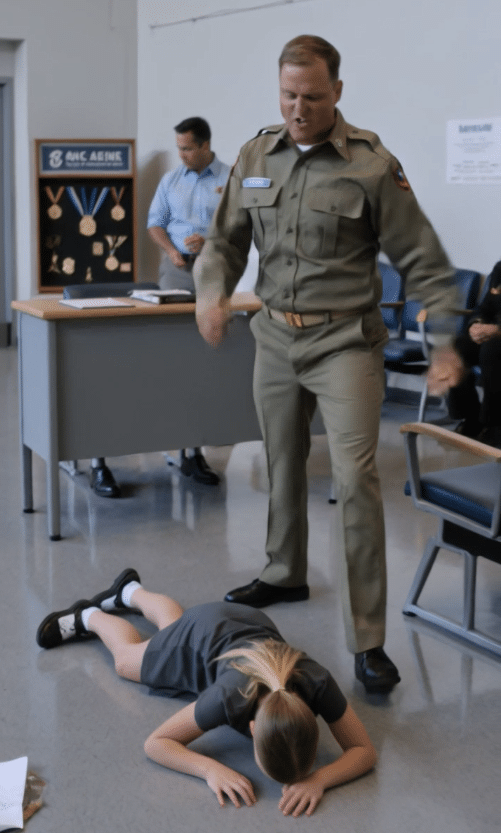
The officer’s voice cut through the military base reception area, loud enough to silence the conversations around the family check-in table.
The thirteen-year-old girl standing before him tightened her fingers around a cream-colored invitation letter. Her blonde hair was tied neatly behind her head, and her dark blue coat hung just below her waist. She had come to the base for a family-day reception, carrying the one document her mother had told her not to lose.
Now a uniformed man was looking at her as though she had walked into a restricted military installation to steal something.
“I’m here to see my grandfather,” she said quietly.
The officer gave a short, humorless laugh.
“Your grandfather?”
“Yes, sir.”
“Do you have any idea how many people come through here pretending they know someone important?”
The girl swallowed.
“I have an invitation. My mother said I should check in here and ask for directions to his office.”
She held out the letter.
The officer did not take it.
His name was Captain Daniel Mercer, a thirty-eight-year-old officer who had spent years cultivating a reputation for strictness. He kept his uniform immaculate, his posture rigid, and his expression permanently arranged into a look of disapproval. He believed that people respected authority only when it was enforced harshly.
Unfortunately, Mercer had begun confusing discipline with humiliation.
He glanced at the girl’s coat, her flat shoes, and the handwritten envelope she held. He saw no uniform, no rank insignia, and no obvious connection to anyone he considered important.
In his mind, the conclusion was already settled.
“You expect me to believe a child can simply walk up here and ask to see a general?”
“I’m not asking to walk into his office,” she answered. “I just need to know where to go.”
“Then you should have read the instructions.”
“I did, sir. They said to check in at the reception desk.”
She pointed toward the sign behind him.
Family Day Reception.
The officer looked at the sign, then back at her, as though her attempt to clarify the situation had somehow challenged him.
Around them, soldiers moved quickly through the command hallway. Families waited in rows of chairs beneath a display of military medals and photographs. A staff member at the check-in table had begun watching the exchange, but she remained silent.
The girl tried again.
“Could you please tell me where my grandfather’s office is?”
Mercer’s expression hardened.
“Wait outside with the rest of them.”
“But my invitation says—”
He snatched the letter from her hand.
The girl flinched as the paper tore free of her fingers.
“Please, sir. That’s my invitation.”
Mercer glanced at the page without reading it. He had already decided that the document was part of her lie.
“People like you think a piece of paper makes you important.”
“I didn’t say that.”
“You don’t belong in the command area.”
“I only asked for directions.”
For a brief moment, the girl looked toward the waiting families. A father stood beside two children near the chairs. An older couple had stopped speaking. A young soldier carrying a folder had slowed his steps.
She searched their faces for someone who might explain that there had been a misunderstanding.
Nobody moved.
Mercer stepped directly in front of her.
“You need to learn that a military base isn’t a place where you can make up stories and expect everyone to believe you.”
The girl’s eyes widened.
“I’m not making anything up.”
That was the last answer he wanted to hear.
Mercer drove a forceful kick straight into her chest.
She fell backward beside the waiting chairs, her arms instinctively reaching out to break the fall. Her elbow struck the floor, leaving a small scrape and a thin trace of blood. The invitation slipped from Mercer’s hand and landed beside her.
A woman gasped.
The girl stared up at the ceiling, struggling to understand what had just happened. The impact had knocked the breath from her, and for several seconds she could do little more than try to inhale.
Mercer stepped around her.
Instead of backing away, he moved to her side and delivered exactly two more forceful kicks into her back and side while she lay on the floor.
The waiting area erupted in startled gasps.
A mother pulled her children closer. A soldier near the medal display froze with his folder clutched against his chest. The staff member behind the check-in table pressed one hand to her mouth.
The girl curled inward, trying to protect herself.
Mercer looked down at her.
“Wait outside with the rest of them.”
He said it as if he were correcting a minor breach of etiquette rather than standing over a thirteen-year-old child he had just attacked.
Then a door opened at the end of the command hallway.
The sound was sharp enough to turn every head.
A tall, silver-haired man in a dark blue command uniform stepped into the reception area. The high-rank insignia on his shoulders caught the overhead lights as he moved forward.
He was not walking toward the check-in desk.
He was looking at the girl on the floor.
“Emily?”
His voice changed the atmosphere instantly.
The older man crossed the room with a speed that made two officers step aside. He reached the girl and lowered himself beside her, shielding her from Mercer before asking anyone else a question.
“Emily, look at me. Are you hurt?”
The girl blinked up at him.
“Grandpa?”
General William Harrington, a sixty-three-year-old senior military commander, looked at his granddaughter’s frightened face, then at the invitation lying beside her hand.
For one suspended second, he seemed unable to speak.
Then he rose and placed himself between Emily and the officer.
His voice was low, controlled, and unmistakably furious.
“You kicked my granddaughter on my base?”
Mercer went rigid.
The color drained from his face as he recognized the man standing in front of him.
He stared at the general’s insignia, then at Emily, then back at the general.
“Your base?”
The question escaped him before he could stop it.
And suddenly, the officer who had been so certain that a frightened child needed to learn her place appeared to have forgotten where he was standing.
Act II
General Harrington had commanded soldiers in difficult environments, overseen high-pressure operations, and spent decades making decisions where a careless word could have consequences far beyond the room in which it was spoken.
He was not a man who needed to shout to be heard.
His authority came from preparation, consistency, and a reputation for holding himself to the same standards he expected from others. Officers who served under him knew he could be demanding, but they also knew that he did not tolerate cruelty disguised as discipline.
Emily had grown up hearing stories about his work.
Her mother, Sarah, had never presented her grandfather as a celebrity or a figure to be feared. She described him as a man who carried a heavy responsibility and tried to remember the people affected by his decisions.
When Emily was younger, she had once asked whether soldiers were supposed to be brave all the time.
Her grandfather had smiled.
“No,” he had told her. “Being brave doesn’t mean you never feel afraid. It means you do the right thing even when you do.”
She had remembered those words.
That morning, she had been nervous about visiting the base. The family-day reception was her first opportunity to see where her grandfather worked, and she had spent the previous evening checking that her invitation was safely tucked into her coat pocket.
Her mother had been delayed by a family emergency and told Emily that her grandfather’s staff would help her get checked in. The instructions had seemed simple enough.
Find the reception table.
Show the invitation.
Ask for directions.
Emily had done exactly that.
She had not known that Captain Mercer had been assigned to help manage access around the command hallway. She had not known that he had spent the previous hour dealing with a scheduling dispute involving visiting contractors. And she certainly had not known that he had already decided the reception area was being overrun by people who did not understand military procedure.
None of those circumstances excused what he did.
But they helped explain the moment in which an ordinary question became a confrontation.
Mercer had looked at a child who lacked the outward signs of military authority and assumed she had no legitimate reason to be there. Every attempt she made to clarify the misunderstanding had sounded, to him, like defiance.
By the time she mentioned her grandfather, he had stopped listening.
Now, with General Harrington standing over him, Mercer seemed desperate to recover the authority he had tried to impose.
“General, I was dealing with an unauthorized civilian.”
Harrington did not move.
“My granddaughter is thirteen years old.”
“Yes, sir, but I had no way of knowing—”
“You had an invitation in your hand.”
Mercer glanced toward the paper on the floor.
“I hadn’t reviewed it fully.”
“Then why did you decide she was lying?”
The officer hesitated.
“I believed she was attempting to gain access to a restricted area.”
“Did she attempt to enter the command hallway?”
“No, sir.”
“Did she try to bypass the check-in desk?”
“No, sir.”
“Did she threaten you?”
Mercer’s jaw tightened.
“No, sir.”
Harrington looked down at Emily, who was still beside the chairs. He crouched again, keeping his attention on her rather than the officer.
“Don’t try to stand yet,” he told her gently. “Let the medical team check you first.”
Emily nodded, but her eyes kept drifting toward the people watching.
“Grandpa, I didn’t do anything wrong.”
The words struck him harder than the sight of the fallen invitation.
“I know you didn’t.”
“I just asked where your office was.”
“I know.”
Her lower lip trembled.
“He said I was trash.”
Harrington’s expression became still.
He did not answer immediately. He reached for her hand, letting her hold his fingers while a member of the base medical staff was called to assess her.
“You don’t deserve to be spoken to that way,” he said at last. “Not here. Not anywhere.”
Emily’s eyes filled with tears.
Harrington stayed beside her while the medical staff checked her condition. He asked them to examine her carefully and avoid moving her unnecessarily until they had assessed the pain from the fall and the kicks.
Only after they had taken over did he turn back toward Mercer.
“Step away from her.”
Mercer obeyed.
The general’s aide had arrived at the hallway entrance and was staring at the scene in disbelief. Two security personnel approached from the reception corridor, their expressions tightening as they took in the fallen invitation, the frightened girl, and the officer standing several feet away.
Harrington addressed them.
“Secure the area. Preserve any available camera footage. Identify everyone who witnessed this, and make sure a complete incident report is prepared.”
“Yes, sir.”
“Do not alter or discard anything. I want the facts established properly.”
Mercer swallowed.
“General, I understand how this looks.”
Harrington turned toward him.
“How it looks?”
“Sir, I was enforcing access rules.”
“Access rules do not authorize you to kick a child.”
“I thought she was trespassing.”
“You thought she was lying. That is not the same thing.”
Mercer tried to speak, but the general raised one hand.
“You will have an opportunity to provide your account through the appropriate process. Until then, you will not approach my granddaughter.”
The instruction was calm, formal, and absolute.
For the first time since the confrontation began, Mercer appeared to understand that he could not intimidate his way out of the situation.
But the general had not yet heard from the witnesses.
And the most damaging evidence would come from people Mercer had barely noticed while he was busy proving how powerful he believed himself to be.
Act III
The reception area was cleared enough for the medical team to work, but no one who had witnessed the attack seemed able to return to ordinary conversation.
The medals behind the display glass reflected the overhead lights. The waiting chairs stood slightly out of alignment where Emily had fallen. Her invitation remained on the floor until a security officer carefully retrieved it and placed it with the incident documentation.
General Harrington accompanied Emily to a nearby medical room after the initial assessment. He wanted her checked thoroughly and wanted her mother informed before any further decisions were made.
Sarah arrived less than half an hour later.
The moment she saw her daughter sitting on the examination bed, she crossed the room and wrapped her arms around her carefully.
“What happened?”
Emily tried to answer, but the words came out unevenly.
“I asked an officer where Grandpa’s office was.”
Sarah looked at Harrington.
He explained what was known, leaving no detail out but refusing to speculate about anything that had not yet been verified.
When he finished, Sarah closed her eyes for a moment.
Then she sat beside her daughter and took her hand.
“You did the right thing by asking for help.”
Emily looked down.
“He thought I was lying.”
“That doesn’t make it your fault.”
“I kept telling him I had the invitation.”
Sarah glanced at the letter on the table. Its edges had been creased when Mercer snatched it from Emily’s hand.
“I know, sweetheart.”
“He wouldn’t even read it.”
Sarah’s expression hardened, but she kept her voice gentle.
“You don’t have to prove that you’re worthy of being treated decently.”
Emily looked at her mother, trying to absorb the idea.
Outside the room, Harrington’s aide was coordinating the formal response. The relevant security footage was being preserved, and the names of the people present were being collected. The general had also made clear that his personal relationship with the victim could not replace an impartial investigation.
He wanted the facts documented accurately.
He also wanted the people responsible for reviewing them to understand that this was not simply an argument between an officer and a visitor.
It was an allegation of serious misconduct involving a child.
The first witness was the civilian employee assigned to the check-in desk. Her name was Rebecca Miller, and she had watched the exchange from the moment Emily asked for directions.
She described the girl’s manner as respectful and anxious.
“She wasn’t trying to get past anyone,” Rebecca explained. “She asked where to check in. Captain Mercer told her she didn’t belong there.”
“Did she argue with him?” the investigator asked.
“She explained that she had an invitation. She kept saying she was there to see her grandfather.”
“And what happened next?”
Rebecca took a breath.
“He took the letter away from her. Then he kicked her.”
The investigator asked whether Rebecca had seen Emily strike Mercer or make any threatening movement.
“No.”
“Did the girl attempt to attack him?”
“No. She was frightened.”
Her account was consistent with the footage.
The next witness was a sergeant who had been walking through the reception area when Mercer began shouting. He had not intervened before the assault, a fact he seemed ashamed to admit.
“I thought the captain was going to send her back to the public entrance,” he said. “Then it happened so fast.”
“Why didn’t you step in?”
The sergeant stared at the table.
“I should have.”
The investigator waited.
“I saw her on the floor, and I froze. I was trying to understand what I was seeing.”
He did not offer the answer as an excuse.
He offered it as an admission of failure.
Harrington learned about the exchange later that afternoon. He did not treat the sergeant’s hesitation as equivalent to Mercer’s deliberate actions, but he made a note of it. The base needed to ensure that witnesses understood how to summon immediate assistance and protect someone from further harm without recklessly escalating a confrontation.
Then came the footage.
The recording showed Emily approaching the check-in desk with the invitation in her hand. It showed her speaking to Mercer and pointing toward the reception sign. It captured the officer taking the letter, followed by the attack.
The video also showed what happened after Emily fell.
There was no sudden threat from the girl. No attempt to strike the officer. No physical confrontation that might have been mistaken for an accident.
Mercer had remained standing.
He had chosen to continue.
When the review was finished, the investigator closed the file and looked at the officers in the room.
“The available evidence is consistent,” he said. “The witness accounts corroborate the footage.”
Mercer had been placed under appropriate restrictions while the incident was reviewed. He was informed that his conduct would be assessed through the military’s established procedures, separate from any medical care Emily received or any decisions her family might make.
He was not permitted to return to his ordinary duties while the immediate review continued.
The news reached him in a small administrative office, where he sat rigidly with his hands clasped in front of him.
“This is being blown out of proportion,” he said.
The officer delivering the notice did not argue.
“You have been informed of the process. You will have an opportunity to respond.”
“I was protecting a restricted area.”
“Then your account should address what you actually observed.”
Mercer looked away.
He knew what he had observed.
A child had asked for directions. She had shown him an invitation. She had apologized for a misunderstanding that had not even involved a deliberate breach of access rules.
He had decided she was lying because he believed she looked like someone who would lie.
And when she refused to disappear simply because he ordered her to, he had used violence to force her submission.
The footage had taken away the story he wanted to tell about himself.
He was no longer the officer enforcing rules against an intruder.
He was the officer who had attacked a child.
Yet even then, Mercer continued to return to the same defense.
“I didn’t know who she was.”
When Harrington heard that statement, he requested a formal meeting with the officials overseeing the review.
He did not ask them to impose a particular punishment. He did not demand that the process bypass the applicable rules.
Instead, he asked that the investigation address the central question directly.
“Whether or not she was my granddaughter, what authority did he believe allowed him to do that?”
No one in the room had a satisfactory answer.
And for Mercer, that question was more difficult to escape than any accusation tied to Emily’s family name.
Act IV
By the next morning, the incident had become a serious concern across the base.
The command staff had to address three separate issues: the alleged assault, the failure to intervene before it ended, and the possibility that an officer had used his position to intimidate someone he believed had no influence.
General Harrington insisted that all three be examined.
He knew that his own presence could complicate the process. As Emily’s grandfather, he had every reason to be angry. As a senior commander, he also had a responsibility to ensure that the review was not shaped by personal vengeance.
He made that distinction clear to the officers assigned to the case.
“My granddaughter deserves protection and a fair process,” he told them. “So does every other person who comes through this reception area. Establish the facts, follow the applicable procedures, and document every decision.”
The review also examined how visitors were directed around the command hallway. The signs were clear enough for regular personnel, but the reception arrangements relied too heavily on visitors knowing where to go before they arrived.
That did not cause Mercer’s violence, and nobody involved in the review suggested otherwise.
But it was a problem the base could correct.
Staff were instructed to provide clearer directions to family-day guests, and reception personnel received renewed guidance on helping visitors verify their invitations and contact their hosts. Procedures for reporting aggressive conduct were reviewed, along with expectations for responding when someone was in immediate danger.
Harrington wanted the changes made because the reception area had to be safe for ordinary families, not because his granddaughter had been injured there.
At the same time, the formal review of Mercer’s conduct continued.
He was asked to provide a detailed account of the confrontation. He described his concern about unauthorized access and claimed he had believed Emily was attempting to use a fabricated connection to reach a senior officer.
But the invitation had been genuine.
The reception was an authorized family event.
And the footage showed that Emily had remained at the check-in desk rather than attempting to enter the command hallway.
Mercer could not explain why he had failed to review the document before taking it from her. He could not explain why he had insulted her rather than referring the question to the reception staff. Most importantly, he could not point to any action by Emily that justified his use of force.
His account began to sound less like a defense and more like an effort to disguise a personal assumption as a professional judgment.
The officer conducting the review asked him one final question.
“If the visitor had been the granddaughter of someone without military rank, would your actions have been acceptable?”
Mercer stared at him.
“That isn’t what happened.”
“It’s a question about your conduct.”
He said nothing.
The silence answered more than he intended.
Outside the administrative offices, the atmosphere around the base had changed. Personnel spoke more carefully about what they had witnessed. Some admitted that they had assumed a senior officer must have a legitimate reason for acting as he did. Others acknowledged that the uniform had made them hesitate, even when the situation had become visibly wrong.
Harrington did not want that hesitation to become a habit.
Military discipline depended on a chain of command, but it did not require people to pretend that misconduct was acceptable. Rank carried responsibility, not immunity.
An officer’s authority was supposed to help maintain order and protect people. It was not a personal license to humiliate those with less status.
Mercer’s own colleagues struggled with the contrast between the officer they thought they knew and the man visible in the footage.
He had been punctual, precise, and strict about regulations. He corrected minor uniform violations and expected junior personnel to follow instructions without complaint.
For years, some had mistaken that rigidity for integrity.
Now they were forced to consider whether they had confused a polished appearance with good judgment.
One senior noncommissioned officer put it bluntly during a private conversation.
“Anyone can look disciplined when the only thing being tested is whether they can keep their uniform straight.”
The comment circulated quietly, but it captured the problem.
Discipline was not merely the ability to make others obey. It was the ability to control one’s own actions when anger, pride, or frustration made cruelty tempting.
Mercer had failed that test in front of an entire reception area.
As the review progressed, he requested a meeting with General Harrington.
The request was considered through the appropriate channels. Harrington agreed to hear what Mercer wished to say, but he made it clear that the conversation would not replace the formal process.
Mercer arrived looking less confident than he had in the lobby. He stood before the general’s desk, his hands stiff at his sides.
“General, I wanted to apologize for what happened.”
Harrington looked at him.
“What exactly are you apologizing for?”
Mercer hesitated.
“For the incident with your granddaughter.”
“That is not an answer.”
The officer swallowed.
“For kicking her.”
“And?”
Mercer looked down.
“For insulting her. For taking the invitation without checking it. For assuming she was lying.”
Harrington remained silent.
“I was frustrated,” Mercer added. “I believed I was protecting the command area.”
“You were standing beside a family check-in desk.”
“I understand that now.”
“No,” Harrington said. “You understand that the person you attacked was connected to me. I am asking whether you understand why your conduct was wrong before you knew who she was.”
Mercer’s face tightened.
He seemed to search for a response that would satisfy the general without forcing him to confront the answer.
Finally, he said, “I should have asked the reception staff to verify her invitation.”
“That would have been the correct procedure.”
Harrington leaned forward slightly.
“But the greater failure was not procedural. You had a frightened child in front of you who was asking for help. You chose to humiliate her. Then you chose to hurt her.”
Mercer said nothing.
“An apology cannot change that. The review will continue.”
The meeting ended without a promise of leniency or a dramatic threat.
Harrington had not needed to raise his voice.
He had simply refused to let Mercer substitute regret over the consequences for accountability for the act itself.
And for the first time, the officer left a room without believing he could talk his way back into control.
Act V
Emily spent the following days recovering at home with her mother close by.
The physical injuries were not the only part of the experience that troubled her. She found herself remembering the faces of the people who had watched, the sound of Mercer’s voice, and the terrible uncertainty of lying on the floor while no one seemed to know what to do.
She wondered whether she should have said something differently.
Perhaps she should have asked a different person for directions. Perhaps she should have shown the invitation sooner. Perhaps she should have walked away when Mercer first insulted her.
Her mother listened to every question without rushing to dismiss it.
“You were trying to do something ordinary,” Sarah reminded her. “You asked for help. Nothing you said gave him the right to hurt you.”
Emily nodded, but reassurance did not make the memories disappear overnight.
Her grandfather visited whenever his duties allowed. He brought her favorite snacks, listened to her talk about school, and resisted the temptation to turn every conversation into a lesson.
One afternoon, Emily finally asked him whether the officer would lose his job.
Harrington paused before answering.
“The people responsible for reviewing what happened will make decisions according to the applicable rules.”
“But he’s an officer. Doesn’t that mean he should know better?”
“Yes,” Harrington said. “It means he has a greater responsibility to control himself, not a greater right to control everyone else.”
Emily considered that.
“Are you angry with him?”
“Very.”
“Then why don’t you just tell them to punish him?”
Harrington sat beside her.
“Because being angry doesn’t give me the right to ignore the process. If I expect people to follow rules, I have to follow them too.”
She looked at him for a moment.
“Even when it’s your family?”
“Especially then.”
He explained that the review would consider the evidence, the relevant regulations, and the appropriate disciplinary procedures. He would not promise a particular outcome, but he would make sure the incident was not ignored or quietly buried.
Emily seemed relieved by that.
She had been frightened by Mercer’s power in the reception area. He had worn a uniform, spoken with absolute confidence, and acted as though no one could question him.
Her grandfather was showing her a different kind of authority.
It did not need to frighten people into silence.
It could listen, ask questions, and accept limits.
Several weeks later, the formal process resulted in significant professional consequences for Mercer under the applicable military procedures. His actions were documented, and he was removed from his ordinary assignment while the consequences were addressed. The incident also led to renewed guidance for personnel responsible for visitor access and responding to aggressive conduct.
Harrington did not release Emily’s private details or turn the outcome into a public celebration.
He knew the important thing was not to make the officer suffer in front of an audience.
It was to ensure that his conduct had been taken seriously, that the process had been followed, and that the same behavior would not be excused simply because the person responsible wore a uniform.
The base continued to host family events.
At the next reception, the check-in area looked much the same from a distance. There were still waiting chairs, a table for invitations, and a display of medals honoring generations of service. Soldiers continued moving through the command hallway, focused on the work waiting for them.
But the directions for visitors were clearer, and staff had been reminded that asking for help was not evidence of wrongdoing.
Emily returned to the base with her mother and grandfather when she felt ready.
She stopped briefly beside the medal display.
Her eyes moved across the rows of ribbons and decorations behind the glass. Each represented a different service, achievement, or chapter in the history of the people who had worn the uniform.
“Grandpa,” she asked, “does wearing a uniform mean someone is a good person?”
Harrington followed her gaze.
“No,” he said. “A uniform tells you that someone has a role and responsibilities. It doesn’t make every decision they make right.”
“Then how do you know?”
“You look at what they do when they have power over someone else.”
Emily thought about Captain Mercer.
“He had power over me because I was just a kid.”
“He believed he did.”
“And he thought I couldn’t do anything about it.”
Harrington nodded slowly.
“That is why responsibility matters. The more power someone has, the more careful they should be with it.”
Emily looked toward the check-in desk.
A young family was asking an employee for directions. The employee smiled, pointed them toward the waiting area, and explained where they needed to go.
The exchange lasted only a few seconds.
No one raised their voice. No one demanded proof that the family deserved help. No one treated a simple question as a challenge to authority.
Emily watched them continue down the hallway.
“That’s how it should have been,” she said.
“Yes,” her grandfather replied. “It should have.”
He did not tell her that everything had happened for a reason. He did not suggest that being hurt had made her stronger or that the humiliation was somehow necessary for her to learn a lesson.
What happened to Emily had been wrong.
The responsibility for that wrong belonged to the person who chose to commit it, not the child who had asked for directions.
As they walked toward the family reception, Emily held her invitation in one hand. Her grandfather did not take it from her or insist on carrying it himself.
She had come to the base as a guest, just as the invitation said.
She deserved to be there before anyone knew her name.
She deserved help before anyone recognized her grandfather.
And she deserved safety even if she had no powerful relative waiting behind a command hallway door.
Captain Mercer had believed that the girl standing before him was insignificant. He had mistaken her youth and anxiety for weakness, and he had assumed that a person without visible authority could be treated however he pleased.
The general’s arrival forced him to face the consequences of that assumption.
But the deepest lesson was not that Emily belonged to a powerful family.
It was that she never needed to.
A uniform should represent duty, restraint, and service. Rank should make a person more accountable, not less. And no child should have to prove a connection to a general before an adult decides not to hurt her.
When Emily entered the reception area, her grandfather walked beside her—not as a warning to anyone who might challenge her, but as the family member who had promised to keep her safe while she found her own confidence again.
Behind them, the command hallway door closed quietly.
The incident was over, but the standard it exposed would remain.
Authority is not measured by how quickly someone can make others afraid. It is measured by what they choose to do when the person standing in front of them has no power to fight back.