Act I
“I go first.”
The words cut through the chaos of the forward surgical station.
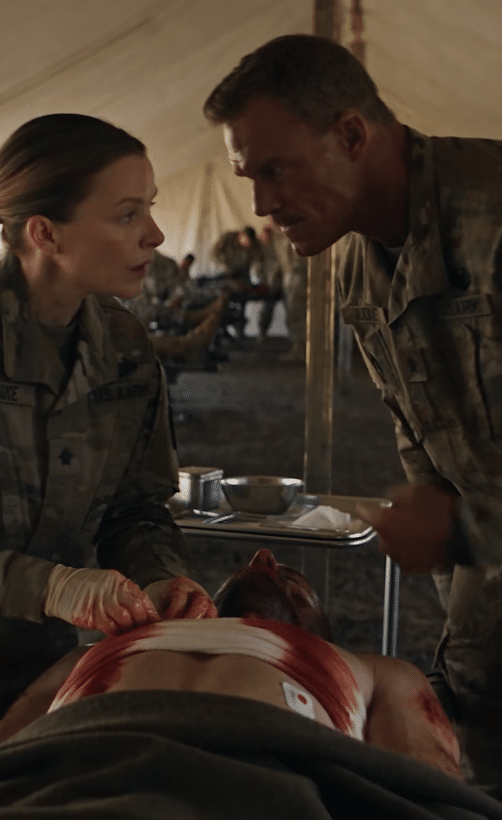
A wounded soldier lay motionless on a stretcher, his condition critical. Medical personnel moved urgently between the canvas surgical bays, while exhausted medics carried additional casualties through the muddy entrance.
But one man seemed completely uninterested in the emergency unfolding around him.
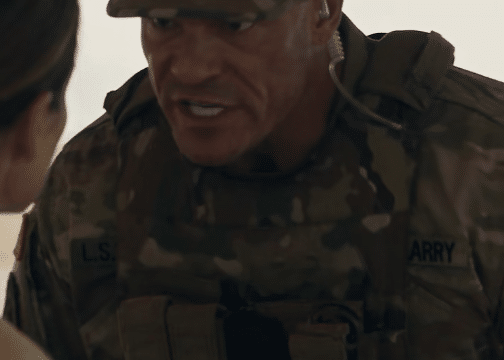
A 51-year-old Major General stood beside the surgical table, his muddy combat uniform bearing the insignia of his rank. A minor injury marked his forearm, but his expression suggested that he considered himself the most important person in the entire medical station.
He pointed toward the surgical area.
“I go first.”
The woman holding the medical tray didn’t even look impressed.
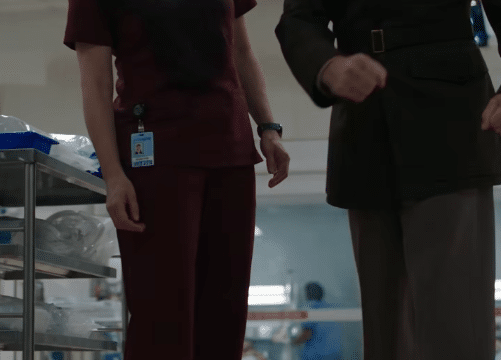
She was 44, dressed in dark-blue medical scrubs beneath an olive protective apron. Her brown hair was tied into a neat bun, and her gloved hands moved with the precision of someone who had spent years making decisions under impossible pressure.
She was not wearing visible military insignia.
To the impatient general, she looked like another field doctor who needed to be reminded of the chain of command.
But she had already assessed the casualties.
And she knew exactly who needed attention first.
She turned toward the critically injured soldier.
“No. He does.”
The general stared at her.
For a moment, he seemed unable to believe what he had heard.
Around them, medical staff continued working, but several people had begun watching the confrontation.
The general stepped closer.
He wasn’t accustomed to waiting.
He certainly wasn’t accustomed to being told no by someone he considered beneath his authority.
And inside that crowded surgical station, his wounded pride was about to become more dangerous than his actual injury.
Act II
The Major General had spent decades climbing the military hierarchy.
He understood discipline, command structures, and the importance of following orders.
But somewhere along the way, he had begun confusing respect for his rank with the right to disregard everyone else’s needs.
His forearm injury was relatively minor compared with the casualties arriving from the battlefield.
He knew that.
The medical staff knew that.
And the woman standing beside the surgical table knew it better than anyone.
She had already made the triage decision.
The critically wounded soldier needed immediate attention. Every passing minute mattered, and there was no medical justification for allowing a relatively minor injury to take priority.
The general, however, refused to accept the decision.
His eyes moved from the doctor to the injured soldier.
Then back to her.
He expected an apology.
Perhaps an explanation.
Instead, she returned her attention to the patient.
That small gesture seemed to infuriate him.
He stepped forward and grabbed the surgical tray from her hands.
The metal instruments crashed onto the floor.
Several medical staff turned sharply toward the noise.
Before anyone could react, the general raised his hand and struck the doctor hard across the cheek.
Her head snapped sideways.
Her cheek immediately reddened and began to swell, while a faint trace of blood appeared at the corner of her mouth.
The medical staff froze.
Then he drove a hard punch into her stomach.
She folded forward, losing her breath, and caught herself against the side of a nearby stretcher.
For a moment, she struggled to breathe.
But even through the pain, her eyes returned to the critically injured soldier.
The general stood over her, furious that she had dared challenge him.
“You don’t tell a general to wait.”
His voice carried through the surgical tent.
Nobody answered.
The doctor slowly straightened, one hand briefly resting against the stretcher.
She was visibly injured.
But she had not forgotten why she was there.
And the general still had no idea how badly he had misjudged the woman he had just attacked.
Act III
The silence inside the surgical station was different now.
It wasn’t the focused silence of medical professionals concentrating on their work.
It was the stunned silence of people who had just witnessed something they could hardly believe.
A nurse stood beside the instrument table, staring at the scattered surgical tools.
A medic looked toward the entrance, as though expecting someone to intervene.
The injured soldier remained on the stretcher.
And the doctor was still trying to recover her breath.
The Major General adjusted his uniform.
He appeared satisfied with himself, as if striking a medical professional had somehow restored the authority he believed she had questioned.
But the woman didn’t argue.
She didn’t threaten him.
She didn’t even turn toward him again.
Instead, she looked back at her patient.
That was the detail that made the entire incident so revealing.
Even after being assaulted, she was thinking about the soldier who needed her.
She carefully steadied herself and began moving toward the medical equipment.
Her swollen cheek and controlled breathing betrayed the pain she was experiencing, but her hands remained steady.
The general watched her.
He expected her to finally submit.
He expected the entire tent to return to treating him as the most important person in the room.
Instead, the medical staff remained focused on the casualty.
Nobody rushed to comfort him.
Nobody congratulated him.
And nobody treated his outburst as an acceptable display of authority.
Then something happened outside the tent.
A military vehicle approached at speed.
Its brakes sounded sharply against the muddy ground.
The general turned his head.
Rapid footsteps followed.
More than one person was approaching.
The tent flap suddenly opened.
And the atmosphere inside the surgical station changed completely.
Act IV
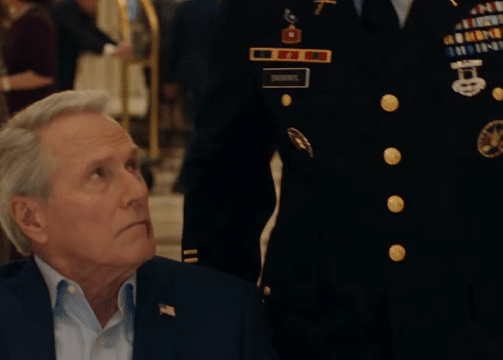
A Four-Star General entered the forward surgical station.
He wore a decorated field uniform, four stars on his shoulders, combat ribbons across his chest, and heavy field boots covered with mud.
Three aides followed behind him.
The camera never revealed his face.
Only his decorated shoulders, his insignia, and his purposeful movements were visible as he walked directly toward the injured doctor.
The medical staff immediately noticed him.
A nurse stopped for half a second.
A medic straightened.
The Major General slowly turned toward the entrance.
At first, his expression showed confusion.
Then he looked more carefully.
The four stars were unmistakable.
This wasn’t an ordinary visiting officer.
This was someone whose authority extended far beyond the small surgical station.
The arriving general ignored the crowded medical bays.
He didn’t stop at the security personnel.
He didn’t approach the Major General.
His destination was clear.
He walked directly toward the woman in the dark-blue scrubs.
The doctor remained beside the stretcher, her cheek swollen and her protective apron slightly displaced.
She looked toward the approaching figure.
There was no dramatic reaction.
No attempt to announce her position.
No explanation of what had happened.
But the senior commander’s movements suggested that he knew exactly who she was.
And he had come directly for her.
The Major General watched the scene unfold.
His expression began to change.
He looked at the four-star insignia again.
Then at the doctor.
Then back toward the approaching figure.
Something about the situation was suddenly becoming very clear.
He had made a terrible mistake.
But he still hadn’t understood just how serious it was.
Act V
The Four-Star General continued walking.
His three aides followed in silence.
The camera remained behind him, keeping his face completely out of view.
Inside the tent, the Major General stood motionless.
Only moments earlier, he had been shouting about his rank and demanding priority treatment.
Now he seemed unable to find a single word.
His eyes widened.
The confidence drained from his face.
He looked toward the injured doctor again, as though trying to reconcile the woman he had just assaulted with the person the senior commander had come to see.
The medical staff watched quietly.
The critically injured soldier remained the center of the emergency, but the atmosphere around the general had changed.
He began to understand that the doctor was not an ordinary field medic.
And the man approaching her was not someone he could dismiss or intimidate.
The Four-Star General took another step forward.
The Major General’s jaw tightened.
His eyes followed the decorated shoulders moving through the tent.
Then recognition finally struck.
His face went pale.
The arrogance that had defined his behavior moments earlier disappeared completely.
He swallowed.
His lips parted, but for a moment no words came out.
Then, barely above a whisper, he said:
“No… not him.”
And for the first time since entering the surgical station, the Major General looked genuinely afraid of the consequences of his own actions.