By the time the boy stood up, the courtroom had already decided who the villain was supposed to be.
The walls were lined with dark wood polished so often they reflected the afternoon light like old amber. High above everyone else, the judge sat beneath a circular seal that seemed to weigh as much as the law itself. Rows of spectators filled the gallery in pressed suits, narrow ties, pearl earrings, and polished shoes, all of them leaning forward with the same hungry look people get when they believe they are about to watch justice arrive in a neat and satisfying package.
At the center of it all sat Eleanor Whitmore.
She looked nothing like the woman the newspapers had built.
The headlines had called her cold, unstable, and desperate. They said she had lashed out after months of financial strain, that grief had turned to rage, that the death of her husband in the family estate had been the tragic but predictable end of a crumbling marriage. Reporters repeated every rumor they could package into a clean sentence. They wrote about unpaid loans, a disputed life insurance policy, and whispered tensions over the Whitmore family’s banking interests and real-estate holdings, as if money alone could explain a human soul.
But the woman sitting at the defense table that morning did not look dangerous.
She looked exhausted.
Her navy dress was simple, almost severe, with a white collar that made her appear even paler under the courtroom lights. Her hands trembled in her lap. Her eyes were swollen from too many sleepless nights. Every few seconds she pressed her lips together as though trying to hold her whole life inside by force.
At the table beside her sat her son, Henry.
He was only nine years old, with curly light-brown hair and a face still young enough to belong in a schoolyard instead of a murder trial. His feet barely touched the floor from the chair. He wore a light blue button-down shirt tucked into dark trousers, and from the way his small fingers gripped the edge of the seat, it was obvious he had been told the one thing adults always tell children when they need silence more than truth.
Stay quiet.
Just a little longer.
This will be over soon.
On the opposite side of the table sat Victor Whitmore, his late brother’s business partner, family adviser, and now the calmest man in the room.
Victor wore a blue three-piece suit so sharp it looked ironed into place. His hair was slicked back. His expression was composed. He had spent weeks presenting himself as the grieving uncle doing everything possible to protect his nephew from scandal and instability. He had spoken to bankers, insurance investigators, reporters, and even the family physician. He had explained, in a tone of perfect concern, that Eleanor had not been herself for months.
He never raised his voice.
Men like Victor never had to.
By then the prosecution had nearly finished constructing its final wall around Eleanor. A house servant had testified that the marriage had grown tense after the elder Whitmore changed his will. A clerk from the bank confirmed there had been pressure on the family accounts. The insurance company had introduced records showing the policy on Charles Whitmore’s life had recently been updated. A doctor had admitted Eleanor had been prescribed rest after a period of stress and fainting spells.
The story was elegant.
Too elegant.
A wealthy man dies behind a locked study door. His wife is the last one seen near the room. The family fortune is tangled in estate disputes and insurance concerns. The widow appears distraught enough to seem guilty. The uncle steps in to “help.” The public nods along because the picture is easy to understand.
The only problem was that the wrong woman was sitting at the defense table.
“Mrs. Whitmore,” the prosecutor said, pacing slowly before the jury, “is it not true that you argued with your husband shortly before his death?”
Eleanor looked at the judge before answering, as if asking permission to keep breathing.
“Yes,” she whispered.
“And is it not true,” he continued, “that you were found outside the study door, insisting it not be opened?”
Tears gathered in her eyes again.
“Yes.”
A rustle passed through the gallery. Pens scratched in notebooks. The prosecutor turned toward the jury with the confidence of a man who believed he had all the pieces.
“No further questions.”
The judge adjusted his glasses. “Does the defense wish to redirect?”
Eleanor’s attorney rose slowly, but before he could speak, there was a sharp scrape of wood against the floor.
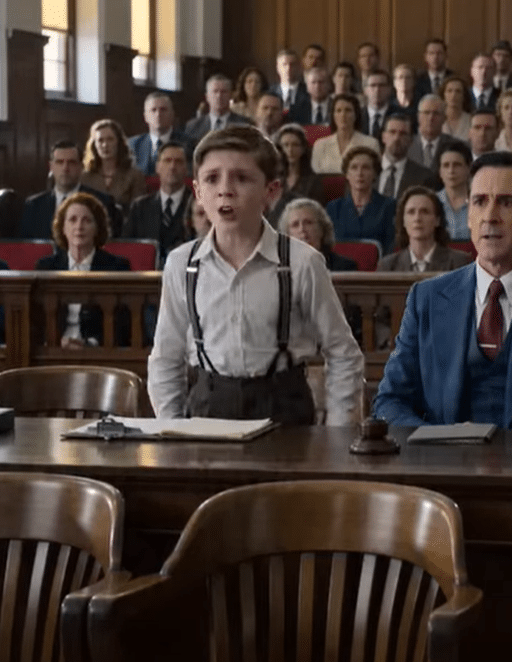
Henry had stood up.
The sound was small. The effect was not.
Every head in the courtroom turned.
The boy’s voice came out shaky at first, then all at once too loud for his own body.
“It wasn’t her!” he cried. “I saw every—everything!”
The judge’s gavel struck hard.
“Sit down, young man!”
But Henry did not sit.
His chest rose and fell so quickly it seemed he might choke on the truth before he could finish it. He looked at his mother, and for one terrible second the whole room watched the exact moment a child chooses between obedience and conscience.
“She was protecting me!” he shouted.
A low murmur broke across the gallery.
Victor moved first.
He gripped Henry by the arm with controlled urgency, the kind that looked almost fatherly unless one noticed how white his knuckles had gone.
“Enough,” Victor hissed. “Sit down.”
Henry jerked against him, eyes blazing now with the kind of terror that stops being fear and turns into courage.
“Don’t touch me!”
The judge hammered the gavel again. “Order!”
Victor leaned close, his polished voice suddenly fraying at the edges. “He’s confused, Your Honor. He doesn’t know—”
Henry twisted free just enough to point straight at him.
Not at the bench.
Not at the lawyers.
At Victor.
“You did!” Henry shouted, tears spilling down his face. “You locked the door, Uncle Victor!”
The courtroom went silent so completely that even the ceiling fan seemed to hesitate.
Victor did not speak.
For the first time that day, the perfect structure of his expression cracked.
The defense attorney stared. The prosecutor stopped moving. Eleanor made a sound so soft it was almost not a sound at all, just the breaking of a heart that had been holding itself together by threads.
The judge lowered his gavel slowly.
“Bring the child forward,” he said.
What happened next unfolded with the strange stillness of a dream and the brutal precision of truth.
Henry was sworn in despite the objections Victor tried to raise. The judge overruled them after a brief conference, deciding the child was competent to testify if he understood the difference between the truth and a lie.
“I do,” Henry said, voice trembling. “A lie is what’s been happening here.”
No one in the gallery moved.
Henry told the story in fragments at first, then with more strength as the room stopped fighting him.
On the night Charles Whitmore died, there had been an argument in the study. Henry had gone downstairs because he could not sleep. His father and Uncle Victor were speaking in hard, angry voices about money. Not household money. Not temporary debt. Bigger money. Business money. Hidden money. Henry did not understand all the words, but he remembered enough.
Bank transfers.
False signatures.
Insurance.
A shipping account tied to the Whitmore company that had been used to move money where no auditor would quickly look.
Charles Whitmore had discovered discrepancies in the books and had decided to cut Victor out of the company entirely. He was planning to notify the bank in the morning and bring in outside investigators. He had also changed documents related to the family trust and removed Victor from several controlling positions in the estate.
Victor had smiled through all of it.
Then, according to Henry, everything changed when Charles opened the study door and ordered Victor to leave.
Henry, hidden on the staircase, saw Victor turn back.
He saw him shove Charles inside.
He saw him slam the door.
And he saw him turn the key from the outside.
A sound passed through the courtroom like a cold wind.
Henry’s hands shook as he continued. He said his mother came running when she heard him crying. Victor caught sight of the boy and knew instantly he had been seen. He told Eleanor that if she wanted Henry safe, she would keep quiet. By the time the servants arrived, Victor was already shouting for help, performing panic like an actor stepping into his favorite role.
Eleanor had refused to tell the full story.
Not because she was guilty.
Because Victor had threatened her son.
The prosecutor, visibly rattled now, asked why Henry had not spoken earlier.
The boy looked down at his shoes.
“Because my mother said some people can make lies sound important,” he said. “And Uncle Victor said they could send me away to a hospital school if I kept talking nonsense.”
The phrase landed heavily in the room. In that era, everyone knew what such threats meant. A child labeled unstable could disappear behind closed institutional doors while adults called it care.
Eleanor began to cry openly then, no longer trying to hide it.
“Yes,” she said hoarsely before anyone could stop her. “That’s why I stayed silent. He told me Henry would be taken from me. He told me no jury would believe a child over a man with documents and influence.”
Victor rose halfway from his chair. “This is outrageous. This is hysteria.”
But the performance was over.
Because once the first crack appeared, the rest of the structure failed quickly.
Under renewed questioning, the household maid admitted she had seen Victor carrying a ring of study keys earlier that evening, something she had omitted because she feared losing her position. A junior accountant from Whitmore & Hale, the family firm, was recalled and reluctantly confirmed that Victor had ordered certain ledgers removed days before Charles’s death. The bank clerk, pressed harder this time, admitted the disputed signatures had looked inconsistent but that Victor insisted the matter remain private for the family’s reputation.
Even the insurance representative, who had once seemed helpful to the prosecution, became a problem for Victor. The recent policy change had not increased Eleanor’s benefit at all. It had reduced Victor’s indirect access to company-controlled assets if Charles died before restructuring the estate.
Suddenly the case that had looked simple became what it always had been: a desperate man protecting power.
The judge ordered a recess, but no one truly relaxed. Spectators buzzed in hushed disbelief. Reporters rushed for telephones. The courtroom deputies moved closer to Victor without making it obvious.
When proceedings resumed, the prosecution no longer sounded certain.
By late afternoon, the judge dismissed the charges against Eleanor Whitmore pending immediate review and ordered Victor held for further investigation on suspicion of fraud, coercion, obstruction, and criminal responsibility in Charles Whitmore’s death.
Victor finally lost control then.
Not loudly.
Not dramatically.
He simply turned to Henry with a look so cold and furious that it confirmed everything words had not yet proven.
The bailiff stepped between them.
That was the moment the room understood who he really was.
Eleanor fell to her knees beside her son and held him so tightly that even the judge looked away for a second, as if some griefs were too private to witness directly.
Henry buried his face in her shoulder.
“I’m sorry,” he whispered.
She kissed his hair again and again. “No, my darling. No. You saved me.”
In the weeks that followed, the rest came out like coins spilling from a torn pocket. Investigators uncovered manipulated business ledgers, concealed transfers, and a scheme Victor had hidden beneath the respectable language of estate management and corporate restructuring. He had counted on his reputation, his tailored suits, and the public’s trust in men who spoke smoothly about finance, family duty, and preserving stability.
He had underestimated one thing.
A frightened child who finally decided he would rather tell the truth than live inside a lie.
The scandal shook the city. Columns were written about corruption among men once praised as guardians of tradition. The Whitmore company was reorganized under independent oversight. The bank conducted internal reviews. The insurance dispute was resolved in Eleanor’s favor. And though no legal victory could return Charles, the truth restored something almost as important to the people he left behind:
their names.
Years later, people still remembered the trial not because of the judge’s gavel or the lawyers’ arguments, but because of the instant a small boy stood in a room full of powerful adults and refused to let fear finish the story for him.
That was the real verdict.
Not guilty was only the beginning.
The deeper judgment fell on the man who believed money, status, and influence could lock every door that mattered.
He was wrong.
Because in the end, karma did what the courtroom alone could not.
It took the quietest voice in the room and made everyone listen.