Act I: The Sound From Inside the Coffin
The sun was too bright for a funeral.
It flashed off polished headstones and the brass corners of my sister’s casket until the whole cemetery looked cruelly overexposed, as if grief itself had been dragged into daylight and forced to perform. The priest stood at the head of the grave in black with a white collar, speaking in that practiced voice clergy use when they want sorrow to sound orderly.
Then I saw the casket move.
Not much.
Just enough.
A tiny shift under the spray of white lilies, so small I would have doubted myself if I hadn’t been staring at it with the kind of focus only panic can produce. Everyone else was listening to Father Corbin talk about peace, mercy, eternal rest.
I wasn’t listening to a word.
I ran before I understood I had moved.
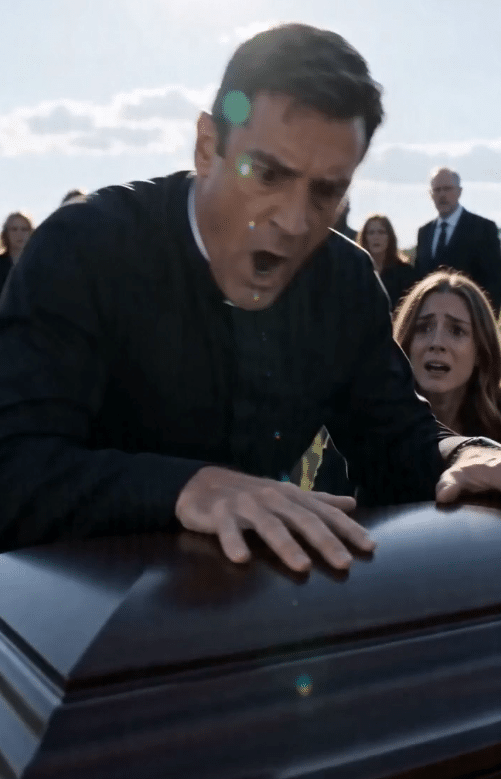
My heels sank into the fresh grass. My black dress caught at my knees. By the time anyone reacted, I had reached the casket and thrown myself across the lid, both hands gripping the dark wood like I could hold the earth back through force alone.
“No!” I screamed. “Stop! Don’t bury her! She’s alive! I saw her move, I swear!”
Gasps rippled through the mourners.
Someone cried out behind me. A man dropped his folded funeral program. The workers at the lowering device froze, hands hovering over the straps as though uncertainty itself had locked their joints.
Father Corbin did not freeze.
He came at me fast.
His fingers clamped around my shoulders with surprising force, and for one sickening second I thought he meant to rip me off the casket and let the burial continue before anyone else could decide whether to believe me. His face was flushed, not with grief but with irritation, the expression of a man whose ceremony had been interrupted by something messy and inconvenient.
“Get out of here!” he snapped.
His voice cracked across the cemetery so sharply that several mourners flinched. If you didn’t look closely, you might have mistaken him for a holy man trying to manage a hysterical woman through tragedy.
I looked closely.
He wasn’t angry the way compassionate people get angry when chaos erupts around pain. He was angry the way cornered men get angry when a plan starts slipping.
“I saw her move,” I said again, trying to twist back toward the casket. “I know what I saw.”
“You are in shock,” he hissed.
Then the sound came.
Soft.
Dull.
Rhythmic.
Three knocks from inside the coffin.
Father Corbin went still so suddenly his hand loosened from my shoulder. His whole body seemed to pull inward for one bare second, not in confusion but in recognition. He bent slightly, head tilted, listening like a man who had just heard something he had spent days praying would never happen.
“What?” he whispered.
The knocks came again.
Not imagination.
Not grief.
Not the wood settling in the afternoon heat.
Knuckles.
From the inside.
The mourners heard it too this time. Their silence changed shape all at once. It was no longer discomfort. It was fear.
Father Corbin stared at the casket as the color drained from his face.
And in that instant, before he shouted for anyone to move, before he lunged for the lid himself, I knew something worse than a funeral mistake was happening.
He wasn’t surprised she was alive.
He was terrified everyone else had just found out.
Act II: The Last Thing My Sister Told Me
My sister Lila had been afraid for weeks before they put her in that coffin.
Not dramatic fear. Not the kind that makes people believe you right away. Worse than that. Quiet fear. Administrative fear. The kind that hides inside lowered voices, second phones, and carefully copied files tucked where only family will think to look after something goes wrong.
Lila was thirty-four and worked as financial director for Saint Bartholomew’s outreach foundation, the diocesan charity Father Corbin had turned into the darling of every donor luncheon in the county. On paper, the foundation funded hospice support, widow relief, burial assistance, and emergency housing for older parishioners.
On paper, it was holy.
In reality, Lila said, the numbers felt rotten.
At first it was little things. Estate gifts recorded in one amount and deposited in another. Funeral assistance checks routed through vendors no one in the parish had ever heard of. Three elderly widows who signed emergency “care transition” forms and died within months, each leaving property to a church-managed trust they had supposedly chosen in their final weeks.
Lila noticed because she noticed everything.
She was the sort of woman who straightened receipts on restaurant tables and alphabetized spices for fun. As children, she used to laugh at how different we were. I was all instinct. Lila was systems. I would jump a fence and ask permission later. She would study the lock first and tell you which hinge was weakest.
Three nights before she died, she came to my apartment after midnight with her hair unwashed and her hands trembling.
“I need you to promise me something,” she said.
I thought she wanted wine.
She wanted witnesses.
She stood in my kitchen under the weak yellow light and told me Father Corbin wasn’t simply stealing from the foundation. He was working with a probate attorney and a county doctor to fast-track dying parishioners through paperwork they barely understood. Assets were transferred before families knew what had happened. Complaints disappeared into sealed pastoral files. Funerals came fast. Too fast.
“And if the person isn’t actually dying?” I asked.
Lila looked at me for a long moment.
Then she said the sentence that still wakes me before dawn.
“Then they make sure the paperwork says otherwise.”
I laughed then.
Not because it was funny. Because my mind rejected it on instinct. People in blazers and collars steal money all the time. That part I could believe. But the rest felt too dark, too theatrical, too impossible to survive in ordinary daylight.
Lila didn’t argue.
She just reached into her bag and set a blue church hymnal on my table.
“If anything happens to me,” she said, “open this.”
I wanted to ask if she was hearing herself.
Instead I asked the practical thing.
“Why not go to the police?”
Her smile was tired and bitter.
“Because Father Corbin blesses half their fundraisers and the county doctor signs the other half of their wives’ boards.”
The next afternoon, she collapsed in the parish office after lunch.
They called it sudden cardiac arrest. The county doctor pronounced her before sunset. Father Corbin personally arranged the church viewing, the rushed burial timeline, the closed-casket recommendation “for family peace,” and the language everyone kept using around me like repetition might turn nonsense into truth.
Unexpected.
Tragic.
God’s timing.
I hated him instantly for all of it.
But hatred is not evidence.
The viewing was the night before the funeral. Father Corbin kept the line moving. He prayed too loudly. He urged me to remember my sister as she had been, not in “the broken stillness of the body.” It was an odd thing to say at the time. I realize now it was worse than odd.
When the funeral home attendant cracked the lid a final inch so I could see her face, I leaned close and whispered her name.
Lila’s fingers moved.
Just once.
A tiny scrape against the satin lining.
I jerked back and said so immediately. Father Corbin called it postmortem settling. The funeral director murmured about nerves and grief. Even my aunt Susan put both hands around my face and begged me not to do this to myself.
I let them close the coffin.
But I did not stop watching it.
Which is why, the next morning under that brutal noon sun, when I saw the slightest shift beneath the lilies, I ran.
And when the knocking started from inside the casket, it was not panic that hit me first.
It was vindication.
Because my sister had not died in that parish office.
She had been put to sleep inside a lie.
Act III: The Woman Who Came Back From Her Own Funeral
Once Father Corbin heard the knocking, his performance collapsed.
He dropped to the casket so fast his cassock twisted around his legs. Both hands searched the brass edges frantically, not with reverence, not even with organized urgency, but with naked panic. He looked like a man who had rehearsed one ending and suddenly found himself trapped in another.
“Open it!” he shouted. “Open it now! Open it now!”
The workers needed no second instruction.
Neither did the mourners.
When a coffin starts knocking from the inside, society sheds dignity very quickly. Men in tailored black suits ran instead of walked. Someone tore flowers off the lid and flung them into the grass. A woman screamed behind me as the funeral director fumbled with the latch.
The lid came open on the third attempt.
Lila sucked in air like she was surfacing from deep water.
That sound will stay with me forever.
Not dramatic. Not cinematic. Thin, desperate, and horribly human. Her skin was gray with sweat, her lashes wet against her cheeks, and her lips moved before any full word came out. She was alive. Sedated, weak, barely coherent—but alive.
The cemetery broke open around us.
Some mourners backed away as if life returning was a kind of blasphemy. Others rushed forward, suddenly eager to help now that helping no longer required imagination. Father Corbin himself reached toward her first, barking for oxygen, an ambulance, anyone, as though the loudness of his panic might erase what his face had revealed seconds earlier.
I blocked him.
Not gracefully.
Not politely.
My forearm hit his chest hard enough to make him stumble backward off the grave frame.
“Don’t touch her,” I said.
He stared at me with open fury then, and beneath it, for one unguarded heartbeat, I saw something much cleaner than anger.
Hatred.
For me.
For Lila.
For the fact that she had come back before the dirt went in.
The paramedics arrived within minutes. That part is a blur of straps, questions, oxygen, and the sickly rattle in Lila’s breathing as they loaded her into the ambulance. I climbed in beside her, still in funeral black, dirt on my knees, no idea which part of the nightmare we had actually escaped.
Halfway to Saint Agnes Medical Center, Lila’s eyes opened fully for the first time.
She looked at me as if swimming upward through fog.
“The hymnal,” she whispered.
I squeezed her hand. “I know.”
“No,” she said, trying again. “Inside cover. Not the pages.”
Then she slipped back under.
At the hospital, they took her from me for toxicology, cardiac review, and a dozen emergency questions no one could answer because no one wanted to admit what it already looked like. A physician with tired eyes said the words “sedative load inconsistent with natural collapse.” Another said “pronounced too quickly.” A third asked who signed the original death paperwork.
I already knew.
Father Corbin was nowhere in the waiting room.
That told me enough to leave for thirty-seven minutes while Lila was stabilized.
I drove to my apartment, found the blue hymnal where I had shoved it onto my kitchen counter three nights earlier, and peeled back the inside front cover with shaking fingers. Beneath the cloth binding was a flat black flash drive taped carefully into the spine.
On it were scanned ledgers, photographed signatures, voice memos, and one folder labeled RAPID BURIALS.
I opened that one first.
Inside were seventeen parish files.
Same doctor.
Same probate lawyer.
Same two funeral homes.
Same compressed timeline between “collapse” and burial or estate transfer.
And on six of those files, in red text added by Lila herself, were the words:
NEVER SAW THE BODY.
I stared at that line until my eyes watered.
Then I opened the final audio file.
At first all I heard was clinking glass and distant music, as if someone had recorded under a table during a fundraiser. Then Father Corbin’s voice came through cleanly enough to freeze the blood in me.
“The family always slows things down,” he said. “You move it before they start thinking.”
A man I later learned was probate attorney Neal Mercer laughed softly.
“And if they wake?”
Father Corbin answered without hesitation.
“Then you make sure they’re buried before anyone listens.”
By the time the audio ended, I understood something terrible.
Lila was not the first body they had nearly sent into the ground alive.
She was only the first one to knock loud enough for the whole cemetery to hear.
Act IV: The Trap Beneath the Cross
The police came once the hospital made the right calls.
Not county. State.
That was the one piece of grace in the chaos. Saint Agnes had its own mandatory escalation protocol for suspected fraudulent death certification, and once those wheels started turning, Father Corbin lost the advantage of local friendships and golf-course loyalty.
Detective Mara Ellis arrived at the hospital at 9:40 p.m. in a tan coat and exhausted heels. She listened once, fully, without interrupting. Then she put in earbuds and heard Father Corbin’s recorded voice say the line about burial before anyone listens.
Her face changed by degrees.
Not shock. Professionals learn to ration shock. This was something colder. Recognition of scale.
“Do not give that file to anyone else,” she said. “And do not go home alone.”
By midnight, Saint Bartholomew’s rectory, the probate office, and both funeral homes were under warrant review.
What nobody expected—least of all Father Corbin—was that the church accountant he had tried to bury had spent six months arranging backup copies to move automatically if her credentials ever went dark. The moment the parish system logged her “death,” encrypted folders began distributing to two state regulators, one diocesan investigator, and a journalist in Boston who specialized in faith-linked financial fraud.
Lila had anticipated her own murder better than most people anticipate a delayed flight.
That made me proud and sick in equal measure.
I sat beside her bed until 2:00 a.m., then watched Detective Ellis come back into the room holding a legal pad and looking grimmer than before.
“We searched Corbin’s office,” she said.
I braced for ledgers.
For cash.
For forged papers.
What she said was worse.
“There’s a secondary chapel basement under the old sacristy. Cold storage, records, and a private counseling room he didn’t disclose on any diocesan inventory.”
A pressure started building behind my eyes.
Ellis kept talking.
“We found sealed pastoral files tied to emergency estate revisions, handwritten burial schedules, and correspondence with Mercer and the county doctor about preserving family calm through expedited rites.”
“Family calm,” I repeated.
It sounded obscene.
She nodded once. “There’s also a list.”
“Of what?”
She looked at me carefully before answering.
“People Lila flagged.”
Not victims.
Not exactly.
Targets.
Parishioners who had money, no powerful children nearby, illnesses serious enough to be manipulated, and enough trust in the church to sign anything placed in front of them with the right blessing attached.
Lila’s name was on the last line.
Scheduled.
I don’t remember standing.
I only remember my chair tipping over backward so hard it hit the wall.
Ellis didn’t flinch.
“There’s more,” she said.
I laughed then.
It was not a sane sound.
Of course there was more.
Because institutions like that do not build crimes one at a time. They build them in systems, then in habits, then in language gentle enough to survive Sunday worship.
“What more?”
She slid a photocopy toward me.
At the bottom of the page, beneath numbered names and coded dates, was one line in Father Corbin’s handwriting.
Rose Bennett — unstable, but manageable through grief.
Rose was me.
For a moment I could not feel my hands.
He hadn’t merely tried to kill my sister. He had already begun writing the story he intended to tell about me after the burial. Emotional. Hysterical. Unreliable. A grieving woman who saw what wasn’t there and would eventually embarrass herself into irrelevance if anyone bothered waiting.
I understood then why he grabbed me so hard at the grave. Not to calm me. To get me off the casket before I changed which version of reality the mourners accepted.
I looked up at Ellis.
“Where is he?”
The detective’s expression didn’t move.
“Gone.”
Father Corbin had fled twenty-two minutes before the state warrant hit his office. Mercer was missing too. The county doctor was at home under watch and already claiming everything medical had been in good faith.
That was when I stopped feeling like a witness.
I started feeling like bait.
Because men like Father Corbin don’t run forever when their whole system depends on paper, ritual, and control. They go first to whatever still matters to them.
And in his case, there was only one place left.
The church.
Act V: The Morning My Sister Opened Her Eyes
They found Father Corbin back at Saint Bartholomew’s just before dawn.
Not in the sanctuary.
In the basement chapel under the sacristy, kneeling beside an industrial shredder jammed with pastoral files and estate amendments. When the deputies moved in, he was still in his black clerical shirt, sleeves rolled up, hands gray with paper dust, looking less like a man of God than a desperate office clerk caught trying to erase a decade.
Neal Mercer was with him.
So was a lockbox holding cash, deed copies, unsigned death forms, and three emergency sedative vials the county doctor would later insist he had “no clear memory” of authorizing. The system, at last, had stopped pretending it was made of misunderstandings.
By noon, every television outside the hospital was running the same story.
FUNERAL HALTED AFTER WOMAN FOUND ALIVE IN COFFIN
PRIEST, LAWYER DETAINED IN EXPANDING FRAUD PROBE
The phrasing was clinical.
The truth was not.
Lila regained full consciousness late that afternoon.
There is no speech noble enough for that moment, no quote tidy enough to hold it. One second her lashes trembled in the antiseptic hospital light. The next, her eyes were open and looking for me with the raw confusion of someone who had crossed through terror and come back unsure where the world had resumed.
I stood so quickly my knees hit the bed rail.
“Hey,” I said, and the word broke in the middle.
She tried to smile and couldn’t manage it. Her throat was too dry. Her body shook once beneath the blanket. I pressed the call button, then ignored it, because all that mattered for those few seconds was that her hand moved toward mine and I was there to catch it.
“You heard me?” I asked.
She nodded almost imperceptibly.
“At the grave?”
Another small nod.
Her lips moved before the sound came.
“I knew you wouldn’t let them.”
That sentence nearly finished me.
All those hours since the cemetery, all the police, the files, the warrants, the press, the furious machinery of justice finally grinding forward after years of pretending not to see—and what she had carried through sedation, darkness, and wood was not the law.
It was me.
By the end of the week, the state had opened reviews into seven previous parish deaths. The diocese suspended every associated burial authorization. Families began calling with stories that sounded impossible until they no longer were. Some wanted money back. Some wanted names. Some wanted to know whether their dead had truly died when they had been told.
The answer, in too many cases, was that the timing had been massaged by men who treated grief like an administrative opening.
Father Corbin was charged with conspiracy, fraud, obstruction, and attempted murder. Mercer followed. The county doctor lost his license before his own indictment came down. The church issued a statement about betrayal, sorrow, and cooperation. It was the kind of document institutions release when their first instinct was silence and their second is damage control.
I never read it twice.
A month later, Lila and I went back to the cemetery.
Not for closure.
I don’t believe in closure anymore. Too neat a word. Too much like paperwork.
We went because there was still a rectangle of raw earth where a grave had been opened and then refused. The lowering device was gone. The flowers were gone. Only sunlight, grass, and a patch of disrupted ground remained, as if the place itself was embarrassed by what had almost happened there.
Lila stood quietly a while, one hand resting on my arm.
Then she said, “He thought he had time.”
She meant Father Corbin.
Maybe she meant all of them.
The doctor who signed too fast. The lawyer who prepared the forms. The priest who turned death into logistics. Men like that always believe time belongs to them because it has for so long. They think they can compress it, speed it, seal it shut under enough paperwork and prayer.
They almost did.
But at the last moment, when the earth was waiting and the mourners were ready to go home and everyone with power thought the story had reached its official end, my sister knocked.
And because I listened, because I threw myself across that coffin and refused to move, because the man who wanted her buried heard the same sound and let his own fear betray him, the whole rotten structure cracked open in daylight.
I still think about the flowers sometimes.
How white they were.
How expensive.
How carefully arranged over a lie.
That may be the truest thing about evil in places like that. It rarely arrives dirty. More often it arrives polished, prayerful, and very concerned with the dignity of the occasion.
Until something buried answers back.
And then all at once, everyone has to hear what was inside the coffin all along.