Act 1: The Sign on the Sidewalk
It was one of those quiet autumn mornings that make small towns look like postcards.
Orange leaves rolled along the sidewalk. The windows of Main Street Bakery glowed warm with fresh bread and cinnamon. Shopkeepers swept their entrances. A black sedan idled at the curb while the town moved at its usual gentle pace.
Then I saw the sign.
FOR SALE.
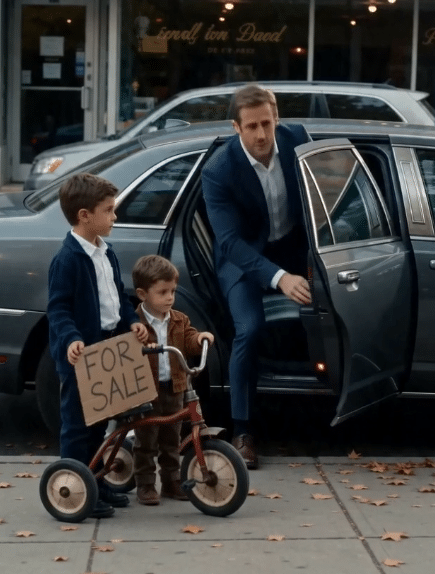
It was written in uneven marker on a piece of cardboard held by a boy who couldn’t have been older than nine.
He stood straight despite the cold, wearing a denim jacket over a flannel shirt that had seen better days. Beside him sat a toddler in a navy hoodie, gripping the steering wheel of a bright red pedal car like it was a real machine.
The toy looked polished. Loved. Protected.
The older boy looked like a child trying very hard not to be one.
I stepped out of the car and walked toward them.
He didn’t flinch.
Didn’t smile.
Didn’t beg.
He simply waited.
“You’re selling this?” I asked, nodding toward the little red car.
I crouched to meet him at eye level.
“Yes, sir,” he said. “It’s my car.”
His voice was calm. Too calm for someone his age.
The toddler looked from me to him, sensing something he couldn’t understand.
I pointed gently at the pedal car.
“Why would you sell your favorite toy?”
The older boy held my gaze.
No tears.
No drama.
Just truth.
“Because our mommy needs medicine.”
The street around us kept moving.
But for me, everything stopped.
And when I asked where their mother was, the boy gave an answer I still hear to this day.
Act 2: Upstairs Over the Bakery
“She’s above the bakery,” he said quietly.
I followed his eyes to the second-floor windows above Main Street Bakery. The curtains were drawn.
“What’s your name?” I asked.
“Eli.”
“And your brother?”
“Ben.”
The toddler gave me a shy wave from the toy car.
I looked back at Eli. “Where’s your dad?”
The question changed him instantly.
His jaw tightened.
“Gone.”
One word.
No explanation needed.
I stood slowly and glanced at my driver, who remained near the car. He knew me well enough not to interrupt.
“How much for the car?” I asked.
Eli looked down at the cardboard sign as if remembering he had written it.
“Thirty dollars.”
Thirty dollars.
For a toy worth far more.
For a childhood worth everything.
I reached for my wallet, but something stopped me.
This wasn’t about buying a toy.
It was about why two children were standing alone on a sidewalk trying to solve an adult problem.
“Take me to your mom,” I said.
He hesitated.
Then nodded once.
The apartment stairs smelled like dust, old paint, and burnt coffee. Each step creaked under our weight. Ben insisted on pushing the red pedal car up one stair at a time.
When Eli opened the door, the truth hit harder than I expected.
The apartment was nearly empty.
One couch.
A folding chair.
A stack of unpaid envelopes on the table.
And on a mattress near the window lay their mother.
She looked young enough to still be dreaming about life.
Instead, she was fighting to keep it.
Act 3: The Medicine They Couldn’t Afford
Her skin was pale. Her breathing shallow. A blanket covered her up to the shoulders though the room was warm.
She tried to sit up when she saw me.
“Boys,” she whispered, alarmed. “Who is this?”
“No one dangerous,” I said gently. “My name is Daniel.”
I set my coat on the chair and noticed several prescription bottles on the floor. All empty.
The labels carried dates from weeks ago.
She saw me looking.
“I’m fine,” she said automatically.
People in pain say that a lot.
Eli stepped beside her mattress.
“Mom, I almost sold the car.”
Her eyes widened.
“You did what?”
“We need your medicine.”
She covered her face and began to cry silently.
Not loud sobbing.
The kind of crying people do when they’ve run out of ways to survive.
I learned her name was Sarah. Two months earlier, she had been diagnosed with a severe autoimmune condition. The medication kept her stable, but after losing her job and health insurance, the cost became impossible.
Her husband had left when the bills started growing.
No calls.
No child support.
No return.
She had stretched every dollar until there were none left to stretch.
And now her children had taken over the burden.
I picked up one of the empty bottles.
I knew the medication.
I also knew its price.
Too high for families like this.
But what I didn’t know yet was why this family felt strangely familiar.
Then I noticed a framed photo turned face down on the windowsill.
And when I picked it up, my hands went cold.
Act 4: The Face in the Picture
The photo showed Sarah smiling in a graduation gown.
Standing beside her was a younger version of me.
Ten years younger.
Arm around her shoulders.
Laughing like the world belonged to us.
I stared at it.
Sarah closed her eyes.
“I hoped it wasn’t you,” she whispered.
Memory hit like a train.
College nights. Shared textbooks. Cheap coffee. Big plans.
Sarah Morgan.
The woman I once loved before ambition pulled me to another city and another life.
We had promised to stay in touch.
We didn’t.
I looked at Eli.
Then at Ben.
Then back at Sarah.
My voice barely worked.
“How old is he?”
She knew which one I meant.
“Nine.”
The room became impossibly quiet.
Eli looked between us, confused.
Sarah’s eyes filled again.
“You left before I knew,” she said. “And when I tried to find you, you were gone. Then everything kept happening too fast.”
I sat down slowly.
Nine years.
Nine birthdays.
Nine first days of school.
Nine years my son had stood in the world without me.
Eli frowned. “Mom?”
She reached for his hand.
“This is your father.”
No one moved.
Ben clapped because he thought it was good news.
Eli did not.
He just stared at me with the expression of a child measuring whether a stranger deserved that word.
And honestly—
I wasn’t sure I did.
Act 5: What I Bought That Day
I did not buy the toy car.
I bought time.
That same afternoon, my attorney reinstated private medical coverage for Sarah and the boys. My accountant created an education trust for both children. By evening, a specialist was reviewing her treatment plan.
Money can’t fix everything.
But it can remove cruelty disguised as circumstance.
The harder part was earning two boys who owed me nothing.
I started small.
Breakfast on Saturdays.
Homework at the kitchen table.
Showing up when I said I would.
Listening more than speaking.
Eli took longest.
He had spent years being the man of the house. Children like that do not hand over trust easily.
One evening months later, I found the red pedal car in my garage. Freshly cleaned. New wheels. Restored chrome.
I rolled it into the driveway.
Ben screamed with joy and jumped inside.
Eli stood at the porch pretending not to care.
“Need a push?” I asked.
He looked at me for a long moment.
Then handed me the cardboard sign he had kept all this time.
FOR SALE.
He had crossed out the words and written something new beneath them.
NOT ANYMORE.
That was the first day he called me Dad.