Act I: The Sound of Glass on the Street
The first thing I heard was the boy’s voice.
Not the traffic.
Not the crowd.
Not even the crack of my own breathing as I sprinted off the curb toward the black SUV.
Just his voice.
Thin, ragged, and desperate behind tinted glass.
“Help me, please! It hurts!”
There are sounds the body understands before the mind catches up. A child screaming from inside a locked car on a hot city street is one of them. By the time I reached the rear passenger door, I was already looking for something heavy enough to break the window.
The SUV sat parked against the curb in front of a row of old stone buildings with carved facades and expensive flags hanging from brass poles. Golden-hour light reflected off the black paint so cleanly it almost made the vehicle look unreal, like the kind of machine that belongs to men who don’t expect consequences to apply to them.
It was real enough.
And so was the boy inside.
He couldn’t have been older than five. Light brown hair plastered to his forehead with sweat, cheeks red, little palms slapping weakly at the glass. He was twisted half-sideways in the back seat, crying so hard the words barely formed.
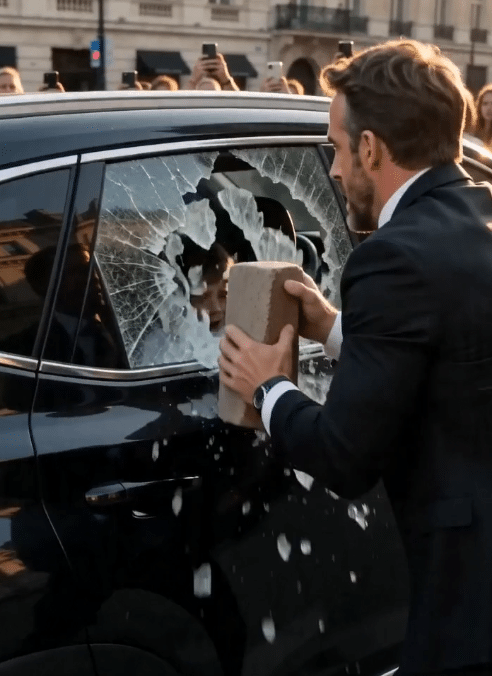
I grabbed the first thing I saw—a broken chunk of paving stone near a storm drain—and drove it into the rear window.
Glass burst outward in a sharp, ugly sound that turned half the block toward me.
Shouts followed.
Then the sudden intake of a crowd that has just discovered something worth recording.
I reached through the shattered edge, found the lock, threw the door open, and leaned in. The heat trapped inside the SUV hit me like a furnace. The boy recoiled at first, then clung to me the second I got both arms around him.
“You’re okay,” I said, though he clearly wasn’t. “Stay with me. Stay with me.”
He wrapped himself around my neck with the strength terrified children always find when they believe the right adult has finally arrived. His face pressed against my shoulder. His body trembled so hard I could feel the panic in his bones.
By then the sidewalk was full of witnesses.
Phones were up.
Always phones now.
A circle of strangers had formed with the eager moral confusion city crowds wear when they’re deciding whether what they’re seeing is heroism, madness, or entertainment. A woman in athletic wear stood near a parking meter with both hands over her mouth. A man in a denim jacket muttered something about calling 911 even as he kept filming. Somewhere farther down the block, sirens had begun to move in our direction.
I stepped away from the SUV with the boy in my arms.
He was still crying into my chest.
Then she arrived.
I heard her heels first.
Fast.
Sharp.
Controlled.
The kind of stride that belongs to someone used to entering chaos as if she owns the right to redefine it.
When I turned, I saw a woman in a white sleeveless dress moving straight toward us through the crowd. Dark hair. Hard face. Perfect posture. She didn’t look panicked by the smashed window or the child’s terror or the phones recording every angle.
She looked angry.
Not at the situation.
At me.
She stopped three feet away and stared at the boy in my arms with a coldness that made my grip tighten instinctively.
“What do you think you’re doing?” she said. “That is not your child.”
The sentence didn’t hit me first.
His reaction did.
The boy buried his face deeper against my chest and let out a broken whimper.
Then he said the words that turned the entire street into something far darker than a rescue.
“Don’t let her take me.”
Act II: The Child Who Knew My Name
I didn’t know the boy.
That is the part people always want clarified first, as though blood relation is the only reason a man should break a car window to save a child. He wasn’t mine. I had never seen him before in my life.
At least, that’s what I believed for about four seconds.
Then he whispered my name.
Not loudly.
Not clearly.
But enough.
“Evan.”
I froze.
The woman in white heard it too. Her expression changed only slightly, but I saw it. A flicker of calculation beneath the anger. Not surprise exactly. Recognition, maybe. Or the quick internal check of someone realizing the variables on the street no longer matched the story she came prepared to control.
My name is Evan Mercer.
Thirty-six. Former paramedic. Divorced. No children. At least none I had ever been legally allowed to claim, though there are some truths men carry in shadow long enough that they stop knowing whether to call them guilt, grief, or unfinished business.
Three years earlier, I had been engaged to a woman named Claire Halston.
She had dark hair, expensive taste, and the kind of intelligence that made people relax around her right up until they realized she was listening harder than they were speaking. She worked in private family office administration for some wealth preservation firm that called itself discreet and meant untouchable.
We met at a gala I attended only because my brother needed a last-minute plus-one and I happened to own a suit that still fit. Claire laughed at my hatred of champagne flutes, told me wealthy people were just poor people with better lighting, and kissed me in the parking garage at the end of the night with the kind of certainty that makes caution feel insulting.
For a while, loving her felt like relief.
Then it felt like confusion.
Then it felt like standing in a room where someone had quietly begun moving the walls while insisting the furniture was in the same place.
Claire hated mess.
Not ordinary mess. Human mess. Unpredictability. Dependency. Emotion that interrupted a schedule. She liked plans. Silence. Clean exits. She once told me children ruined women’s lives because the world always forgave men for leaving and punished mothers for staying.
At the time, I thought she was talking about someone else.
Maybe her own mother.
Maybe a client.
Maybe one of those high-net-worth families she managed from the inside without ever really belonging to. That was the thing about Claire. She could say something devastating in such a calm tone that you didn’t realize until hours later she had been confessing rather than commenting.
The last month we were together, she got secretive.
Then sick.
Then gone for whole weekends with explanations that shifted too smoothly to challenge. When I pushed, she said it was work stress. When I pushed harder, she accused me of wanting a version of her that existed only in my need.
We broke two weeks later in a restaurant where the dessert menu cost more than my first apartment’s electric bill. She returned the ring in a velvet box and told me, with visible irritation, that love was not a legal obligation.
Six months after that, I got drunk enough at my brother’s place to admit I had once thought she might have been pregnant.
He asked if I’d ever known for sure.
I said no.
That should have been the end of it.
Then, on a crowded city sidewalk, with shattered glass behind me and a child clinging to my neck hard enough to bruise, I heard that boy say my name in the voice of someone who had practiced it from stories.
The woman in white stepped closer.
“Give him to me,” she said.
I didn’t move.
The boy started shaking again.
“I said,” she repeated, jaw tightening, “that child is not yours.”
By then, the sirens were louder. The crowd had spread into a wider ring, no one wanting to miss what this confrontation was becoming. Somewhere to my left, a teenager whispered, “This is insane,” into her phone camera as if narrating a live event instead of a possible crime.
I kept my eyes on the woman.
“Who are you?”
Her answer came too fast.
“His guardian.”
The boy made a sound against my shoulder that was not a sob.
It was something closer to dread.
That was when I knew the question had not been whether he was mine.
The real question was why she needed him to stay where no one could hear him scream.
Act III: The Woman in White and the Story She Brought
Her name was Lydia Vale.
I learned that from the officer who reached us first, a patrol sergeant with enough scene sense to separate me, the child, and the woman before the street turned into a trial by smartphones. He asked for names. She supplied hers in a clipped, offended tone that implied the city itself had inconvenienced her by failing to recognize her authority on sight.
“Lydia Vale,” she said. “Temporary guardian.”
Temporary.
That word sat in the air like a pin.
The boy—whose name, I would soon learn, was Noah—did not lift his head when she said it. He only tightened his arms around me and whispered again, “Don’t let her take me.”
The sergeant heard that.
So did three dozen people with phones.
Good.
Public record has become a strange creature, but sometimes it is still better than none at all.
Lydia handed over a sleek leather card case and a folded paper clipped inside it. Court order. Emergency guardianship. Child welfare transfer authorization. Everything clean, stamped, and official in the way dangerous paperwork so often is. She said Noah had been left in the car for “only a moment” by a house manager and that I had overreacted violently by breaking the window.
The officer nodded without agreeing.
Then he turned to me.
“You know the child?”
I should have said no.
The truth would have been simpler and cleaner and less likely to ruin what little remained of my peace.
Instead, I looked at Noah’s damp hair, his thin shoulders, the terror in the way he flinched every time Lydia took half a step forward, and I said the only answer my body was willing to give.
“I think I might.”
The officer’s expression sharpened.
Lydia’s changed again, more visibly this time. The first controlled cracks of panic had begun to show beneath the surface of her face. She recovered quickly, but not quickly enough.
“What does that mean?” the officer asked.
I almost told him the whole thing right there.
About Claire.
About the timing.
About the boy knowing my name.
Instead, I asked Noah something small.
“How do you know me?”
He looked up then.
His eyes hit me like a physical blow.
Not because they resembled mine exactly, though that would have been easier to process. They didn’t. They had Claire’s shape, maybe, but the color was closer to my mother’s—gray-blue with a dark ring around the iris. What undid me was not resemblance.
It was trust.
The absolute, trembling certainty in his face that he had finally reached the person he had been told might save him.
“My mom kept your picture,” he whispered.
The street disappeared for a second.
Not literally.
But the noise went out of it.
Noah kept talking, words coming through hiccuping breaths and fear.
“She said if I ever got away, I should find Evan.”
Lydia stepped forward immediately.
“That child is confused.”
The officer raised a hand.
“Ma’am, stop moving.”
For the first time, I saw true anger flash across her face—not at me, not at the crowd, but at Noah. Just a flicker, quick and ugly, the kind adults think children never notice.
They do.
He buried his face again.
“My mom said she was sorry,” he said into my shirt.
I don’t know what expression crossed my face then, but the sergeant took a step closer and changed his entire posture. No longer routine response. No longer property-damage review. He was reading the scene the way seasoned cops do when the wrong paperwork is meeting the right fear.
“Where is your mom, son?”
Noah shook his head against me.
“She’s sick.”
Lydia cut in too fast.
“His mother is deceased.”
Noah made a wounded sound and clung harder.
There it was.
The first contradiction.
Too fast, too flat, too eager to close the question before it could breathe.
The sergeant looked from her to me to the boy and made a decision that, in another city, under another officer, might have gone differently.
“No one is taking the child anywhere until Child Protective Services and detectives arrive.”
Lydia went still.
Then she did something unexpected.
She smiled.
Not warmly.
Not for the child.
At me.
It was the smile of someone who believes the next layer of power has not entered the room yet, but soon will.
“You should be careful, Mr. Mercer,” she said softly. “You don’t know what kind of woman Claire became.”
That sentence told me two things at once.
Claire was alive when Lydia wanted me to believe otherwise.
And whatever Noah had escaped from, it had already been wrapped in a story prepared specifically for me.
Act IV: The House on Willow Crest
Detective Raina Solis arrived seventeen minutes later with CPS, two uniformed officers, and the tired patience of someone who had long ago learned that family law, money, and child custody can turn a sidewalk into a battlefield faster than any gang corner. She listened once. Then she separated all of us.
Noah stayed with a female officer after he refused to leave my sight until she promised, on camera and in front of everyone, that Lydia wouldn’t touch him again.
Smart kid.
Smarter than any five-year-old should need to be.
Lydia’s paperwork was real, at least on first glance. Emergency temporary guardianship signed three days earlier. Authority based on maternal incapacitation. Child welfare concerns noted. Primary residence listed not as some anonymous foster transition but as a private address in Westchester under her name.
Willow Crest.
I recognized it instantly.
Not the house itself.
The street.
Claire once told me, half-drunk in bed, that if she ever vanished from the world she’d do it somewhere on Willow Crest because every house there looked like it had been designed by lawyers trying to apologize to their wives with architecture.
She laughed when she said it.
I remember because something in her voice made me think she wasn’t joking.
Solis caught the flicker in my face when Lydia named the address.
“You know it?”
“I know who used to talk about it.”
That was enough.
By early evening, we had a judge willing to sign a welfare check order on the property based on the child’s statements, the possible false declaration of maternal death, the circumstances of the vehicle confinement, and the not-insignificant fact that Noah screamed when Lydia got within ten feet of him.
Lydia kept her composure all the way to the house.
That impressed me.
Not because I admired her.
Because it takes a special kind of person to remain elegant when the police convoy behind you might be driving straight toward the lie your life depends on.
Willow Crest was exactly the sort of estate Claire used to describe with contempt she never admitted was partly envy. Black gates. Stone pillars. Curved drive. A white house set back under old trees with enough symmetry to look planned by committee. The kind of place where abuse can wear cream cashmere and still be called concern.
The front door was answered by a house manager with perfect hair and catastrophic instincts. He saw the badges and tried to close the door. That bought us the legal threshold instantly.
Solis moved first.
I followed because Noah gripped my hand and would not release it.
The house smelled like expensive candles and withheld information.
Upstairs, the first locked door was the nursery.
The second was empty.
The third held Claire.
She was alive.
Pale, weak, and tied not with ropes or chains but to a medical story. Adjustable bed. Sedative bottles on the nightstand. Monitoring paperwork. A home nurse’s chart signed twice daily. The room was dressed to look therapeutic, but even before she opened her eyes, I knew what it really was.
Containment.
Claire looked older than her years and lighter than memory. Her dark hair had thinned at the temples. One wrist showed bruising where an IV line had been recently taped. When Noah saw her, he made the kind of sound that should never come from a child’s body twice in one day.
“Mom.”
Her eyes opened slowly.
She saw him first.
Then me.
Then the officers.
And in those three glances I watched an entire trapped life understand that it had finally run out of places to hide.
“Evan,” she whispered.
Lydia, who had remained silent until then, stepped into the doorway and said the ugliest thing I’ve ever heard delivered in such a calm voice.
“She can’t take care of him. She signed him over.”
Claire tried to sit up so fast the nurse’s monitor cord tore loose.
“No,” she said.
Just that.
But it came from so deep in her body it sounded like something being ripped back out of the grave.
Act V: The Child Behind the Glass
Claire had not signed Noah over.
She had signed two postoperative medication consent forms after a complicated infection six months earlier and one “temporary care coordination agreement” while heavily sedated. Lydia and a private family attorney had converted the rest through emergency filings built on psychiatric allegations, selective medical records, and one key lie: that Claire’s prior relationship history included instability and abandonment risk.
Meaning me.
Meaning our past, recut into paperwork.
Claire had told them about me once, years earlier, during one of those terrible moments when trapped people start explaining themselves to the wrong person because secrecy becomes lonely. Lydia, who was not a sister or cousin as I first assumed but Claire’s father’s widow from his second marriage, stored the information the way snakes store warmth.
When Claire got sick and the child became administratively useful, she weaponized it.
Claire cried only once that night.
Not when the detectives photographed the medication logs. Not when Solis found the hidden nanny-camera memory cards in Lydia’s desk. Not even when the attorney arrived and realized the police already had the safer side of the story.
She cried when Noah crawled into the hospital transport beside her and fell asleep holding both our hands.
That was the point I nearly broke.
Because everything awful about the day had started with a child trapped behind glass, screaming that it hurt.
I thought the glass was the SUV window.
It wasn’t.
It was years of class, law, fear, and paperwork keeping the truth visible but unreachable until someone finally used force in the right direction.
Lydia was arrested before midnight on charges tied to unlawful imprisonment, child endangerment, fraudulent guardianship filings, and interference with medical autonomy. More charges came later, after investigators found financial transfers connected to Claire’s trust distributions and two previous contested family conservatorship matters tied to Lydia’s name.
Turns out Noah and Claire were not the first lives she had tried to reorganize into dependence.
Some people do not commit violence with fists.
They do it with forms, signatures, and the calm insistence that only they know what is best.
The paternity test came back twelve days later.
Positive.
There are no clean emotions for learning you have a son after five years of absence wrapped in lies. Joy is there, yes, but it arrives tangled in grief, guilt, and the awful knowledge that someone else had to suffer long enough for the truth to become testable.
Claire and I are not a love story repaired by revelation.
Life is not that obliging.
What we are, slowly and carefully, is two exhausted adults trying to build honesty where manipulation once lived and let a little boy grow inside something sturdier than fear.
Three months after the SUV, Noah asked me why I broke the window.
We were in the kitchen by then, in a small rented house upstate with bad cabinets and no locked interior doors. Claire was asleep on the couch after a long treatment day. Rain tapped softly at the back windows. Noah sat cross-legged on the floor building a crooked tower from mismatched blocks someone at the support center had donated.
“You didn’t know me yet,” he said. “So why did you do it?”
I thought about answering like an adult.
Duty.
Instinct.
Any child in danger.
All true.
None complete.
So I told him the real thing.
“Because you sounded like someone who needed to be believed right away.”
He nodded as if that made perfect sense.
Then he went back to the blocks.
I think about that often now.
How much of evil depends on delay.
Wait for the mother to weaken.
Wait for the paperwork to clear.
Wait for the child to stop crying.
Wait for the right adult to doubt what he hears.
Wait long enough and people will start calling captivity stability, coercion care, theft guardianship.
Lydia believed in delay.
She believed in locked doors, tinted glass, and the social power of looking composed while everyone else seemed emotional. She believed one frightened child in the back of an SUV could be managed because the city had taught too many people that wealth means there’s probably an explanation.
She was wrong.
He screamed.
I ran.
The glass broke.
And once that happened, nothing else held for very long.