Act I: The Necklace on the Glass
The rain had been hammering the front windows since noon.
At Halpern Gold & Loan, bad weather usually meant two things: fewer serious buyers and more desperate sellers. Wet umbrellas dripped by the door. Cheap perfume mixed with damp wool. The fluorescent lights made the glass cases look colder than they were, and by three in the afternoon I had already bought three wedding bands, one cracked Rolex, and a saxophone nobody would ever come back for.
Then she walked in.
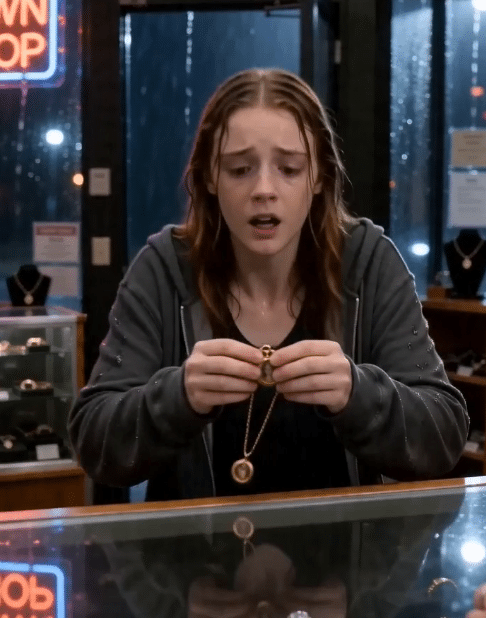
She was young. Early twenties, maybe. Dark hair soaked through and clinging to her hoodie, blue jeans ripped hard at both knees, sneakers gray with rainwater and city filth. She looked like someone who had either run a long way or been running for years.
She came straight to the counter.
No browsing. No hesitation. No glance at the diamond trays or the pawn slips or the old man in the corner trying to sell a military medal that almost certainly wasn’t his. She reached into the pocket of her oversized olive hoodie and placed a gold locket on the glass between us.
“How much will you give me for this necklace?” she asked.
Her voice was steady.
That caught my attention before the locket did.
People selling the last thing they own usually sound one of three ways: ashamed, angry, or rehearsed. She sounded like none of them. She sounded cold. Not emotionally. Physically. As if her body had started shutting things down to conserve heat.
I picked up the locket.
Heavy. Old. Real gold. Not museum-level, but not common either. The hinge had been repaired once with skilled hands. The clasp was worn smooth in exactly the way jewelry gets worn when it has lived close to a heartbeat for years.
“I’ll give you fifty,” I said. “Not more.”
I expected her to argue.
Everybody argues.
Instead, she nodded too fast.
“Okay. Deal.”
That was when the back of my neck went cold.
No one carrying a real gold heirloom accepts fifty dollars without blinking unless one of two things is true: they don’t know what they’re holding, or they need the cash badly enough that price has stopped being the main story.
I turned the locket over in my hand.
The engraving on the back had nearly worn away, but I could still feel the grooves under my thumb. A sunburst. Tiny initials. Familiar workmanship. My own, though I didn’t understand that yet. Not consciously.
“Where did you get this?” I asked.
She looked at the door.
Not because she wanted to leave.
Because she was checking whether someone had followed her.
“It was my mother’s,” she said.
There are sentences that arrive like warning bells. That was one of them.
I opened the clasp.
Inside was a photograph so small and old it should have meant nothing to me at first glance. A man in a white shirt, younger than I was now, holding a little girl with light curls and serious eyes. Beneath the image, in handwriting I recognized before I was willing to admit it, were six words:
For my daughter Clara. Always.
The man in the photo was me.
The child in my arms had been dead for seventeen years.
Or so I had been told.
The room dropped away around me. The rain, the lights, the glass counter, the door buzzer chiming for some new customer behind her—everything went thin and far.
“It can’t be,” I said.
She saw my face change.
Then she ran.
By the time the locket fell from my hand to the glass with a sharp metallic click, she was already at the door and out into the rain.
I vaulted the counter after her, shouting the name I hadn’t said out loud in almost two decades.
“That necklace belongs to my daughter! Clara!”
She didn’t turn around.
That was how I knew the locket wasn’t the only thing she recognized.
Act II: The Fire They Said Took Her
My daughter disappeared in a fire that never made sense.
That’s the official version, anyway. Seventeen years earlier, my wife Elise left our house in Harbor Point with Clara just before midnight after one of those awful married-people arguments that start about one thing and reveal ten others. She took the old Volvo, Clara’s overnight bag, and the blue blanket my daughter refused to sleep without.
At 2:16 a.m., the Volvo was found burned out near the freight yards by the river.
No bodies.
Just fire damage, twisted metal, and enough heat for the police to tell me identification would have been impossible anyway. They called it likely fatal. Then probable. Then, over the next few months, inevitable. By the end of the year, everybody in the city spoke about Elise and Clara in the past tense so automatically that correcting them felt obscene.
I never saw a body.
That mattered to me.
Apparently, it mattered to no one else.
The detectives said the fire started from spilled fuel and electrical failure. Insurance investigators said the same. My father-in-law, Victor Lorne, said grief was making me suspicious because grief had nothing else useful to do.
Victor said a lot of things in those days.
Mostly with lawyers.
He was richer than I was, more connected than I was, and far more accustomed to getting people to accept neat endings when neat endings served him. He also despised me. Not quietly. Not philosophically. Personally. I had stolen his daughter from a life of old-money expectations and then, in his view, failed to keep her safe.
Within six months, my jewelry business was drowning in legal pressure, debt calls, and a tax review that arrived with such beautiful timing it almost deserved applause. I sold the boutique, paid what I could, and opened the pawn shop because it was the only thing left that still involved gold and people telling me the truth only after they had run out of options.
I kept two things from my old life.
My tools.
And Clara’s memory.
The locket had been my work. I designed it when she was born. Tiny hidden hinge. Hand-engraved edge. A sunburst on the back because Elise said Clara looked at light like she expected it to answer her. I’d placed the photo inside myself three years later, on Clara’s birthday, after she told me she wanted a “grown-up treasure” like her mother’s pearls.
When Elise took Clara that last night, the locket went with them.
I never saw it again.
Not until the wet-haired girl in the hoodie placed it on my glass counter and accepted fifty dollars with the calm of someone who didn’t care whether the deal was fair, only whether it was fast.
I hit the sidewalk hard.
Rain slapped my face. Tires hissed over the wet street. She was already half a block ahead, cutting between pedestrians with the instinct of someone who had learned to flee through cities without apologizing for it. I ran anyway.
I hadn’t chased anything that mattered to me in years.
That changed something in the body. It makes you younger for about forty seconds, then punishes you with age all at once. My knee screamed near the corner of Mercer and Fifth, but adrenaline kept me moving.
She glanced back once.
That was my first clear look at her face.
Pale from the rain and cold. Eyes too guarded for her age. A tiny scar near the left eyebrow. And on the right side of her neck, just above the hoodie collar, a crescent-shaped birthmark the size of a thumbnail.
Clara had been born with the same mark.
I nearly stopped running.
Not because I doubted anymore.
Because I suddenly believed too much.
She darted into the old bus terminal across from the pharmacy, and I followed, heart slamming so hard it made the fluorescent lights overhead feel unstable.
By the time I reached the south platform, she was gone.
All she left behind was a damp paper pharmacy envelope crushed under a bench.
The name on the prescription label wasn’t hers.
It was Elise’s.
Which meant my wife had not died in that fire either.
And whatever story I thought grief had forced me to survive all these years was about to become something much uglier.
Act III: The Name on the Prescription Bottle
The pharmacy envelope held three things.
A receipt for antibiotics paid in cash.
A motel keycard with the name Harbor Rest Inn printed in fading blue.
And a folded index card with a sentence written in Elise’s handwriting so quickly the letters slanted downhill.
If Daniel sees the locket, run first. Listen second.
I stood in the bus terminal with rainwater dripping off my coat and read that line until anger replaced shock.
Run first. Listen second.
That was Elise all over. Even in crisis, she always believed she could choreograph emotion if she arranged the sequence correctly. I hadn’t seen her in seventeen years, and she was still telling our daughter what to do with me before I got the chance to speak.
The Harbor Rest Inn sat three miles away under the elevated rail on the edge of the old industrial district. It was the kind of place that rented by the week, asked no questions, and wore its mildew like a business model. I knew it because people sometimes came into my shop to pawn wedding china and pain medication after checking out of rooms there.
The woman at the desk lied first.
Then she saw the locket in my hand and went pale enough that I knew I had found the right door before she even gave me the number.
Room 214.
I didn’t kick it in.
I should have, maybe. That would have been cleaner for the nerves. Instead I knocked once, heard movement inside, and said her name through the cheap wood before I could stop myself.
“Elise.”
Silence.
Then a voice I knew even through illness, years, and fear.
“Go away.”
I opened the door.
She was in the far corner of the room sitting upright in bed, blankets over her legs, cheeks hollow, hair thinner and lighter than I remembered. There was a pill organizer on the nightstand beside a half-drunk cup of water and an inhaler. Clara stood near the bathroom door like an animal deciding whether the stranger who found the den is hunter or kin.
For one second none of us spoke.
Elise looked at the locket.
Then at my face.
Then closed her eyes like the worst possible version of the future had arrived exactly on time.
“She sold it,” she whispered.
Clara—because by then I no longer had the strength to think of her by any other name—looked between us with open, furious confusion.
“You know him?”
Elise gave a short, broken laugh that turned into a cough.
“Yes,” she said. “I know him.”
That was when Clara’s fear turned to anger.
Not at me.
At her.
She looked about eight years old again in that moment, not twenty-one. Just a girl discovering that the adults in her life had built an entire house out of omissions and expected her not to notice the missing walls.
“You said he was dangerous.”
Elise stared at the blanket in her lap.
“I said if he found you, it meant they had too.”
They.
One word. Enough to move the ground again.
I stepped closer to the bed.
“What fire, Elise?”
Her eyes lifted to mine then, full of exhaustion and something worse.
Shame.
“There was no accident,” she said. “Victor arranged the fire.”
My father-in-law.
Of course.
Some part of me had known the moment I saw the prescription in her name. Men like Victor never lose a daughter quietly. They reposition her. They absorb the scandal. They turn catastrophe into narrative and dare the rest of the world to prove otherwise.
“He said Clara would ruin the family,” Elise whispered. “Not because she existed. Because of what she proved.”
I didn’t understand.
Then Clara said something so softly I almost missed it.
“I’m not yours.”
The room went very still.
Elise shut her eyes.
And suddenly I realized the locket, the fire, the flight, the false deaths—none of it had been built only to keep me away from my daughter.
It had been built to keep me from asking whether Clara was ever biologically mine at all.
Act IV: The Man Who Needed Her Gone
I should have left after that.
Any reasonable man would have. The last thread holding my grief together had just been cut with one sentence. Clara was not mine. Not by blood, at least. Not in the neat, legal, comforting way some men imagine parenthood works.
But parenthood had never been neat in that room.
Elise started talking before I could decide whether to hate her properly.
Victor discovered she was pregnant two months before the wedding. The father was a man named Adrian Vale, a married investor from one of the families Victor needed for a land consolidation deal on the harbor redevelopment. Adrian refused scandal. Victor refused humiliation. Elise refused the quiet solution they both preferred.
Then she met me.
A jeweler with decent hands, bad timing, and enough earnest love to look like salvation.
Victor encouraged the marriage.
That was the part that made me laugh when she told it. Not because it was funny. Because it was so exactly him. Don’t clean the stain. Paint over it with something photogenic and let the right man take responsibility without knowing he’s doing it.
“She was born early enough,” Elise said. “Everyone pretended the dates worked.”
“And later?” I asked.
“Later you loved her.”
That answer landed like a fist.
Because it was true.
I had loved Clara in midnight fevers and school shoe fittings and birthday cakes and those endless little negotiations children force you to make with wonder. Blood had never been part of the feeling. Not once.
Victor, however, saw blood everywhere.
When Adrian Vale reentered the family orbit years later during the redevelopment financing, old risks reopened. He had married well, acquired more money than grace, and become the kind of man who treated private scandals like dormant viruses. Victor decided the safest thing was to make Elise and Clara disappear permanently.
“He had people watching us,” Elise said. “When I found the documents, I knew what he was planning.”
“What documents?”
She pointed weakly toward the old canvas bag Clara had dropped by the motel dresser.
Inside, beneath some clothes and the damp pharmacy bottle, were copies of paternity agreements, trust memos, and one transfer letter from Victor’s counsel outlining a “protected quiet settlement” to Adrian Vale in exchange for continued silence regarding paternity and maternal relocation.
Maternal relocation.
That was what they called erasing women when the paperwork was expensive enough.
Elise had stolen the file, fled with Clara, and planned to go to the press. The fire happened the next night. Victor’s men thought they had trapped all three of us by the river warehouse because I was supposed to meet Elise there after her call. I never got the message. She took Clara and ran before the building went up. Victor convinced the police the rest.
Seventeen years of my life had been built atop the efficiency of that lie.
“Why not come back?” I asked.
Elise looked at me then with the rawest honesty I’d seen from her in twenty years.
“Because I didn’t know if I was saving her from them or from what I’d done to you.”
That was the first answer she gave that felt worthy of the damage.
Clara stood motionless by the bathroom door, arms wrapped around herself as if cold had become structural. She had spent her life believing one man abandoned her and another story explained the rest. Now both versions were crumbling in front of a motel bed under bad lighting while the rain kept hitting the window like a countdown.
“Why sell the locket?” I asked her gently.
She lifted her chin.
“Mom’s meds ran out.”
That should not have broken me.
It did.
Before I could answer, someone hit the motel room door hard enough to rattle the frame.
Not housekeeping. Not management. The knock carried entitlement, not uncertainty.
Elise’s face drained.
“He found us,” she said.
I didn’t need to ask which he.
Because as the second knock came, I saw Clara reach instinctively toward the canvas bag—not for money, not for clothes, but for a sealed manila envelope tucked inside a side pocket.
She had known this moment might come too.
Act V: The Daughter I Chose Anyway
Victor Lorne did not come to the motel room himself.
Men like him rarely arrive for the mess. They send their language first, then their lawyers, then—when they miscalculate—the police. This time he sent a private security contractor with a county detective who looked bored enough to be dangerous.
By then I had already called someone Victor never thought to buy.
Marlene Sosa.
Investigative reporter.
Three years sober, two Pulitzers’ worth of instinct, and exactly the right amount of personal hatred for men who weaponize family offices and sealed settlements against women they think the public won’t miss. I’d met her once when she tried to pawn a watch gifted by a disgraced mayor and ended up staying two hours to ask me questions about how the city launders sentiment through jewelry.
Elise had one smart move left in her.
The manila envelope Clara handed me was addressed to Marlene.
Inside were the original paternity letters, the redevelopment settlement memo, Victor’s instruction to create a memorial narrative around the river fire, and one notarized statement Elise had signed just two weeks earlier in anticipation of dying before she could fix any of it. There was also a second statement, written in her uneven handwriting and meant for Clara alone.
Blood is an accident. Love is a decision. Daniel made his long ago.
I read that sentence once and folded it away before Clara could see my face.
By the time Victor’s men got through the motel manager, Marlene was already downstairs with two camera operators and one state investigator from the financial crimes task force she’d been sleeping with—professionally or otherwise, I never asked. Public scandal is the one weather pattern men like Victor cannot fully insure against.
The next six hours blew his life open.
Adrian Vale admitted the paternity quietly and immediately once he understood there were cameras. Of course he did. Men like him always prefer the clean shame to the dirty one. Victor’s counsel tried to claim Elise had been protected voluntarily. The redevelopment memo killed that narrative on contact. The county detective left in cuffs before midnight after it turned out he’d signed two suppression orders tied to the warehouse fire file.
Victor was arrested three days later at his club.
Not for attempted murder at first. That would take longer. Rich men buy delay the way others buy umbrellas. But the fraud, coercion, and conspiracy pieces moved fast enough to begin the public collapse. Once that starts, family mythology stops working nearly as well.
Elise died nine weeks after the motel.
Cancer, aggressive and already too far gone by the time Clara sold the locket. There was no redemption arc left for her, only truth, apology, morphine, and the miserable, dignified labor of trying to return a daughter to the world with fewer lies than the one she inherited.
Clara asked me once, near the end, why I stayed.
It was late. Hospital late. The hour when all machines sound accusatory and no one says what they really mean unless sleep has beaten their defenses down first. She sat in a plastic chair by the window, knees drawn up, trying and failing to look older than her face.
“You don’t have to,” she said. “I’m not really yours.”
There are sentences that can either end a family or start one.
I looked at her for a long moment.
Then I told her the only thing that mattered.
“You are the child I buried for seventeen years,” I said. “I don’t care what the blood says.”
She cried then.
Not loudly.
Not dramatically.
The kind of crying that comes from a person whose life has been arranged by other people for so long that kindness feels structurally suspicious at first.
A year later, the pawn shop still smells like rain whenever the weather turns.
The locket sits in my safe now, not because it’s precious in the way collectors mean, but because it survived a fire that never should have happened, a lie that lasted too long, and a girl desperate enough to trade gold for antibiotics without realizing she was carrying the last working key to her own life.
Clara comes in twice a week after class. She’s studying paralegal work. Says she wants to spend the next ten years ruining men who hide behind signatures. I believe her. She laughs more now, though not easily. Some scars never soften; they just stop deciding every room.
Sometimes customers notice the small framed photograph by the register and ask if she’s my daughter.
I say yes.
That answer no longer feels complicated.
Because the truth is this: Victor built an empire on bloodlines, leverage, and the belief that biology gives rich men the final word over everyone else’s lives. He thought parenthood was ownership, that silence was protection, and that a woman and child could be burned out of a story if the paperwork afterward was elegant enough.
He was wrong.
A child doesn’t belong to the man who paid to hide her.
She belongs, in every meaningful way, to the person who stays when the lies finally stop working.