Act I: The Bag Falling to the Floor
The front door was unlocked.
That should have told me something before I stepped inside, but after ten months overseas, exhaustion makes you stupid in sentimental ways. I had imagined a hundred versions of that moment on flights, buses, and base transport vans—the house quiet, the warm light from the kitchen, my wife hearing the door and turning with that split second of disbelief before joy reaches the face.
Instead, I walked into a silence so wrong it felt staged.
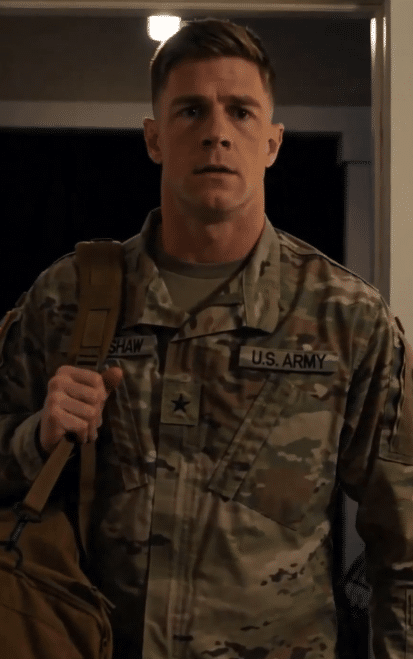
The living room was dim except for the floor lamp by the door and the pendant lights hanging over the kitchen island. My duffel bag was still on my shoulder. My boots were still wet from the evening rain. I had barely taken two steps onto the hardwood when I saw them on the sectional.
My wife, Rachel, in an oversized white sweater and almost nothing else beneath it.
And a man in a blue shirt and jeans sitting much too close.
He jumped first.
That’s what I remember most clearly. Not my wife’s face. Not the slow, heavy drop of my duffel hitting the floor. Him. He sprang up from the couch like guilt had yanked him by the spine, and for one weird second all three of us just stared at each other in the yellow half-light of the room.
Rachel looked like she had seen a ghost.
Which, in a way, maybe she thought she had.
“Daniel?” she whispered.
My name came out of her mouth like an error.
I should have been furious right away. Some part of me was. But what I felt first was confusion, then the strange, detached clarity trauma sometimes gives you before the rest of your emotions catch up. I noticed the wineglass on the coffee table. The half-unpacked tote bag by the couch. The fact that my framed deployment photo had been moved from the mantel to the sideboard.
And then I saw the folder.
It lay open on the coffee table beneath the wineglass, cream-colored and thick, the kind of legal packet people leave visible when they think the right person won’t be home for hours. My name was printed across the top page in bold serif letters.
IN THE MATTER OF DANIEL BRADSHAW
EMERGENCY GUARDIANSHIP PETITION
The room shifted under me.
Rachel saw where I was looking and moved too late, one hand darting toward the folder as if she could still make it vanish back into whatever lie had been holding the evening together.
“You weren’t supposed to be back until Monday,” the man said.
He must have realized what he’d admitted the instant the words left his mouth.
Rachel turned on him with naked fury, but it didn’t matter. I already had the shape of it. The affair was real, yes. That was obvious. But it was no longer the only story in the room.
I stepped past them and picked up the packet.
Pages clipped neatly. Physician statements. Bank schedules. Asset summaries. One line near the top in highlighted yellow that made my mouth go dry.
Petitioner requests temporary conservatorship due to respondent’s combat-related cognitive instability and inability to manage financial affairs or maintain a safe domestic environment.
My wife stood barefoot on the rug, pale and shaking.
The man beside her straightened and reached for a tone that sounded professional until you listened closely enough to hear the panic.
“Daniel,” he said, “this is not what it looks like.”
That was when I looked at the signature line.
Attorney of record: Evan Mercer.
The man on my couch wasn’t just sleeping with my wife.
He was helping her bury me alive on paper.
And the hearing was scheduled for 9:00 a.m. the next morning.
Act II: The Man on My Couch Had My Future in His Briefcase
I took the folder into the kitchen without asking permission.
Funny how fast a house stops feeling like yours when betrayal has already been reorganizing the furniture in your absence. The pendant lights hummed softly overhead. Someone had changed the hand towels. My daughter’s artwork was gone from the fridge.
Rachel followed me halfway and stopped.
“Daniel, listen to me—”
“No,” I said. “You listen.”
My voice came out flatter than I expected. That frightened her more than yelling would have. Rachel understood anger. She had spent years learning how to redirect it, soothe it, or outtalk it. Flatness meant she no longer knew where she stood.
Evan Mercer stayed in the living room at first, then came into the kitchen with his palms slightly open, a lawyer’s body language for I’m not the threat even when he clearly is.
“I represent Rachel in a limited protective filing,” he said. “Given your documented blast injury and the medical evaluations already in place—”
“You represent my wife,” I cut in, “while sitting on my couch with your shirt half untucked.”
He didn’t even blink.
That told me everything I needed to know about the kind of man he was. Some people only lie when cornered. Others have built entire careers around keeping their pulse steady while they describe the collapse they created as a technical necessity.
I flipped through the petition.
There it was: my concussion history from the convoy strike outside Basra, the post-evac neuro notes from Landstuhl, the months of rehab for balance issues and memory disruption, all repackaged into the language of unfitness. They had attached my pending medical retirement paperwork, the trauma insurance payout, the contractor liability claim from the faulty armored carrier, and the preliminary value of my disability settlement.
They had totaled my suffering and titled it an estate.
“She thought I wouldn’t be safe with you,” Evan said.
I looked up slowly.
“Our daughter,” I said. “Where is Emma?”
Rachel answered too fast.
“At my mother’s.”
It might have worked if I didn’t know the little tells of her face. The way she blinked twice when the lie was assembled on the fly. The way her right hand curled inward when she wanted her own body to stay out of the conversation.
I moved past them and toward the hallway.
Rachel caught my arm.
Hard.
“Daniel, stop.”
That was the first truly honest thing she’d done since I walked in.
Because fear stripped the script from her voice. Not fear of me. Fear of what I might see if I kept moving.
Emma’s room was clean.
Too clean.
Her favorite yellow blanket was gone. So were the stuffed fox I brought back from Germany and the nightlight she refused to sleep without because she said shadows in the corners “watched too hard.” The closet was half-empty. The dresser drawers held folded clothes, but not the ones she wore most.
This wasn’t an overnight stay at Grandma’s.
This was pre-positioning.
I turned back to Rachel.
“You were going to do this tomorrow.”
Tears sprang into her eyes then, which made me angrier than if she had kept lying cleanly. Rachel cried beautifully. Always had. It was one of the first dangerous things I learned about her and one of the last I fully understood.
“You don’t know what you’ve been like since you came back,” she said.
I almost laughed.
I had been back all of twenty-three minutes.
“What have I been like, Rachel?”
She looked at Evan before answering.
That was the moment I knew this wasn’t just an affair and a lawyer and some desperate plan made in the fog of bad marriage. They had rehearsed this. The language. The sequence. Even the wounded concern in her face.
“Erratic,” she said. “Volatile. Confused. I was trying to protect Emma.”
That word.
Protect.
It is astonishing how many crimes in good houses wear that word like perfume.
I walked past them both and into my office at the end of the hall. The desk had been cleaned out. My old bank statements were gone. So were the spare checkbooks and the fireproof envelope where I kept copies of our title documents.
Only one thing remained exactly where I left it.
The little black dome of the indoor security camera in the corner bookshelf.
Rachel saw me see it.
And for the first time since I came home, she went genuinely white.
Act III: The Camera They Forgot About
I installed the camera eight months before deployment after two attempted break-ins hit our block and Rachel got nervous about being alone with Emma at night. It uploaded automatically to an encrypted cloud folder tied to my email, one she had never bothered learning because she preferred delegating anything technical until it became useful to control.
I had forgotten it was there.
She hadn’t.
Which meant if Rachel had cleaned out the office but left the camera untouched, she either truly forgot about the archive or believed she had no reason to fear what it held.
She was wrong on both counts.
My laptop synced after two passwords and a prayer I didn’t believe in. Rachel stood in the doorway with her arms wrapped tight around herself, watching the screen as if she could still will it dark. Evan stayed farther back. His phone was in his hand now, though he’d stopped pretending not to be rattled.
The camera timeline showed motion clips.
Dozens of them.
Not just Emma playing on the rug or Rachel bringing in groceries or cleaners crossing through. Long evening segments from the last three weeks. Kitchen conversations. Document signing. Rachel pacing. Evan arriving after dark.
I opened the one from two nights earlier because it was longest.
Rachel sat at my desk in my chair while Evan spread papers across the surface. He spoke first, voice clear through the room mic.
“Tomorrow’s psych affidavit puts the judge over the line. Once the emergency guardianship is granted, his payout hits the conservatorship trust instead of his personal accounts.”
Rachel looked sick even then, but not sick enough to stop.
“And if he fights it?”
Evan gave a small shrug.
“He won’t have time. By the time Bradshaw understands what’s been filed, the temporary order will already be in place. We move Emma to your mother’s full-time, push supervised visitation only, and then the rehab recommendation makes itself.”
I could hear my own breathing in the room where I stood.
Onscreen, Rachel rubbed both temples and said the sentence that broke whatever part of me had still been looking for an explanation softer than treachery.
“I just need this over before he gets home.”
I opened another clip.
Same office.
Same angle.
This one from the previous afternoon.
Rachel kneeling in front of Emma.
My daughter sat on the rug in dinosaur pajamas holding the stuffed fox from Germany.
“If Daddy comes home upset,” Rachel was saying, “you stay with Grandma and you do not go alone with him, okay? His brain got hurt and sometimes hurt brains make people scary.”
Emma’s face on the screen tightened in confused fear.
“But Daddy’s nice.”
Rachel took both her shoulders and smiled that awful, careful smile adults use when teaching children a lie they hope will sound like safety.
“He loves you,” she said. “That’s why we have to be careful.”
I stopped the video.
The room behind me was silent.
When I turned, Rachel was crying for real now. No grace to it. No performance. Just collapse beginning at the edges of a woman who had spent too long believing logistics were morally neutral.
“I didn’t know what else to do,” she whispered.
Evan, meanwhile, had recovered enough to reach for his phone again.
That was his mistake.
“What are you doing?” I asked.
“Calling counsel.”
“No,” I said.
He glanced toward the front door instead.
I understood the move a fraction of a second before he made it.
He wasn’t calling counsel.
He was trying to leave with the only body in the house that still made the guardianship petition strategically useful: Rachel.
He lunged toward the hallway.
I caught him before he cleared the office door.
Act IV: The Hearing They Thought I’d Miss
I didn’t hit him.
That would have helped him more than it helped me.
Instead, I drove him into the wall hard enough to knock the phone from his hand and then walked it with my boot into the office corner. Rachel screamed once, more from the collapse of the plan than from any physical fear in the room. I stepped back immediately and called the one person whose number I knew would still work at 8:14 p.m. no matter how ugly the explanation sounded.
Major Alison Pike.
JAG.
Formerly attached to my command legal chain.
One of the few people I trusted to hear the words emergency guardianship fraud, affair, child coaching, and settlement theft in the same sentence without assuming combat had broken my mind.
She listened for thirty seconds.
Then said, “Don’t move anyone. I’m sending county and military legal liaisons.”
By midnight, Evan Mercer was in custody on fraud, forgery, and conspiracy holds tied to the petition, my medical records, and the fabricated neuropsych addendum he’d arranged through a private evaluator who, as it turned out, had never even met me. Rachel wasn’t arrested that night, not yet, but the judge signed an emergency freeze on all conservatorship filings and a protective order preventing any movement of Emma until a child advocate could assess the full situation.
Emma was not at Rachel’s mother’s.
Of course she wasn’t.
She was at a furnished rental thirty minutes away under a nanny’s supervision, already pre-positioned for the custody transition they planned to execute once I was legally reduced to supervised visits and monitored accounts. Major Pike found that address in an email chain Evan never thought anyone outside his office would read in time.
I saw my daughter at 1:32 a.m. under fluorescent family-services lighting with a social worker present and a stuffed fox clutched under her chin.
She stared at me for a long time.
Then asked the question Rachel had planted.
“Are you scary now?”
There are hurts that arrive too cleanly to cry over right away.
I knelt down.
“No,” I said. “I got hurt, and I came home late, and grown-ups made some terrible choices while I was away. But I’m still your dad.”
She looked at me another long second.
Then walked straight into my arms.
I held her so carefully it hurt.
The hearing happened anyway the next morning because courts don’t cancel just because the lie attached to them catches fire overnight. They simply change atmosphere. Rachel arrived in a gray suit with her attorney replaced by a public defender temporarily assigned through conflict review. Her face looked hollow. Evan did not appear. The forged psych affidavit had already imploded, and Major Pike had come armed with deployment medical records, the security footage, and a forensic note confirming the signature on the petition package was not mine.
The judge read silently for nearly three minutes.
Then looked at Rachel.
“Mrs. Bradshaw,” she said, “did you instruct your child to fear her father in anticipation of an emergency incapacity filing?”
Rachel broke then.
Not beautifully.
Not in the way tears sometimes still let you keep your dignity.
She bent forward and covered her face and sobbed the way people do when every rationalization they have been living inside collapses in a room that won’t let them leave.
She admitted the affair.
The money.
The fear.
My injury had scared her. The settlement had tempted her. Evan had convinced her that temporary control would become permanent once I was overwhelmed enough not to fight. Somewhere in there was a real anxiety about my concussion history, which only made the betrayal uglier. She had taken one true thing and used it as scaffolding for a monstrous lie.
The judge denied everything.
Emergency guardianship dismissed with prejudice. Child relocation blocked. Fraud referral formalized. Protective financial review ordered. Home access restored to me pending family court supervision.
Rachel looked at me only once on the way out.
I could not read whether what she felt most was guilt, fear, or the late understanding that she had mistaken my injury for weakness.
It didn’t matter anymore.
Because the worst thing she had done wasn’t the affair or the money.
It was teaching our daughter to flinch before she heard my voice.
Act V: The House After the Lie
Emma and I slept on the sectional the first two nights back in the house because she said the upstairs “felt full of wrong.” Children know things adults keep trying to define away. I didn’t argue. We built a blanket tent in the living room, ate takeout noodles from cartons, and watched a movie neither of us could really follow because every ten minutes she checked to make sure I was still there.
I was.
Rachel moved into a short-term apartment once the court sorted temporary arrangements. Some marriages explode in one dramatic instant. Ours had already been rotting in private for longer than I wanted to measure. The homecoming only let me smell it all at once.
The Army processed my retirement six weeks later.
The settlement survived. So did I.
That sounds clean when written down. It wasn’t. There were evaluations, statements, custody interviews, financial reviews, and the long humiliating business of proving to institutions that the injury I suffered in service had not transformed me into the helpless instrument of other people’s greed. I had help. Major Pike. A good judge. A better therapist than I deserved. And Emma, who kept asking questions so direct they forced me back into truth whenever I drifted toward bitterness.
One night, about three months after the hearing, she came into the kitchen while I was packing her lunch for school and said, “Mom said she was trying to protect me.”
I put the apple slices down and leaned on the counter for a second before answering.
“She may have believed that sometimes.”
Emma considered that.
“Can people believe bad things and still be wrong?”
“Yes.”
That seemed to satisfy her more than any adult explanation I’d given so far.
She took her lunchbox and started to leave, then turned back.
“You came home anyway.”
I looked at her.
“Yes.”
She nodded once, as if some internal math had finally balanced, and disappeared toward the stairs.
I think about that sentence a lot.
You came home anyway.
Rachel thought distance, paperwork, fear, and legal language could do what war, concussion, and ten months overseas hadn’t managed. She thought she could re-enter my life not through love but through structure, flatten me into a petition, and let a judge make official what betrayal had already started at home.
She was wrong.
Not because I was stronger than injured men are allowed to be.
Because she forgot something simple.
You can only bury someone on paper if they don’t walk through the front door first.