Act I: The Aisle in Front of Everyone
Airplanes are designed to make shame public.
There is nowhere to go when the aisle is narrow, the seats are full, and every face around you is trapped in the same metal tube with a view of your humiliation. At seventy-one, I had flown enough to know that discomfort on a plane is rarely just discomfort. It is hierarchy with seat belts.
That morning, it began with applesauce on the floor.
My grandson Eli was hungry, frightened, and trying not to cry the way children do when they know a room has already decided they are an inconvenience. We were in row 18 on a crowded flight out of Newark, and I had just opened the little plastic grocery bag I’d brought aboard—crackers, apple slices, juice pouch, the things his pediatrician told me to keep near when his blood sugar dipped and he got pale.
The bag tore.
Everything fell into the aisle.
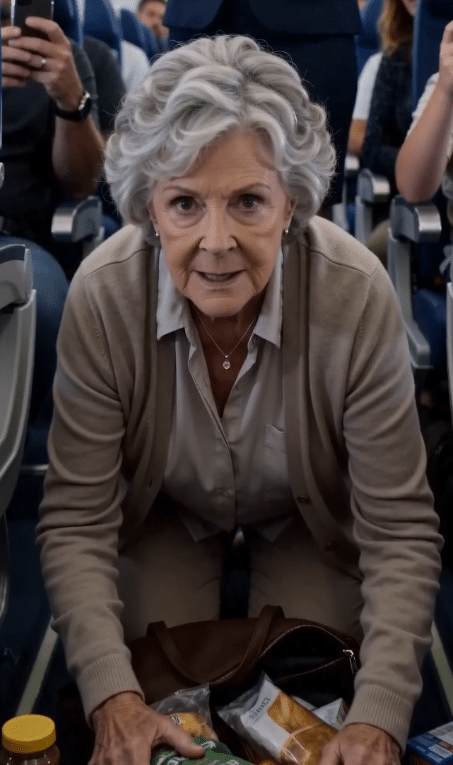
The crackers scattered. The juice pouch rolled under the armrest. Eli’s sandwich landed upside down, and the little paper sack carrying my son’s medication slid farther than I could reach from my seat. I bent down instinctively, one knee on the carpet, one hand grabbing for the pills before another shoe came down on them.
That was when she spoke.
“Look what we have!”
Her voice cut through the cabin loud enough to turn half the plane.
I looked up at the flight attendant standing over me in her pressed blue uniform. Blonde hair pinned tight. Jaw set. Hands at her sides in the posture of someone who had already decided she was in the right before the conversation began.
She didn’t ask if we needed help.
She didn’t offer napkins.
She looked at me the way some people look at delays, spilled coffee, or broken escalators—objects that have interrupted the smooth movement of their day and therefore forfeited the right to dignity.
I kept picking up what I could.
The floor was sticky under my fingers. My knees hurt. The little bottle of tablets had rolled two rows forward, and before I could reach it, one of the nearby passengers kicked it back toward me with an embarrassed little movement of his shoe.
“Then maybe you shouldn’t be flying if you can’t follow rules!” she said.
That got the full cabin’s attention.
A man in a baseball cap leaned into the aisle to see better. Two college-aged women across from us were already holding their phones chest-high, trying not to be obvious and failing. A businessman in 17C lowered his newspaper without pretending he wasn’t watching.
Behind me, Eli started crying.
Not loud at first.
Then harder.
“Grandma, I’m hungry!”
That did not move her.
If anything, it made her face harder. Some people hear children cry and become more human. Others hear it as proof the child belongs to the problem side of the room.
I reached the sandwich, the crackers, the bottle.
One thing was missing.
The paper prescription sleeve.
The one that had held Daniel’s cardiac tablets.
My son had gone to the lavatory minutes earlier, pale and sweating, insisting he only needed water and a minute to steady himself. I had told him to take the medicine before he stood. He had laughed weakly and said he’d be fine.
Now the flight attendant was standing over me while his tablets were gone.
I looked up from the carpet.
“Say that again,” I said.
The change in my own voice seemed to surprise even Eli. It was the same voice I used twenty years earlier in hearing rooms and federal offices when men mistook softness for surrender. My grandson stopped crying long enough to stare at me.
Then he pointed at the woman with his small, shaking finger and said the sentence that turned the entire plane into something else.
“Grandma, she took Daddy’s medicine too!”
The cabin went silent.
Not quiet. Silent.
And in that silence, as the flight attendant stepped back just half a pace, I knew this was no longer about a torn grocery bag in an airplane aisle.
Act II: The Son They Called Unstable
My son Daniel Mercer had spent most of the last year being called difficult by people whose jobs depended on him disappearing politely.
Officially, he was a senior maintenance compliance analyst for North Atlantic Air. Unofficially, he was the man who kept finding things buried inside aircraft safety reporting that should never have needed burying in the first place.
Faulty oxygen canisters logged as swapped when they were not.
Inspections signed by supervisors who were not on shift.
Medication kits onboard with expired replacements.
Crew incident reports vanished from digital review before federal audit windows opened.
At first, Daniel thought it was sloppiness.
Then he thought it was cost-cutting.
Then he found the pattern.
He called me three months before the flight and asked a question no son asks casually unless he has already understood trouble is no longer theoretical.
“If someone wanted to discredit a witness before he handed over records,” he said, “would they go after the records or the person?”
I was making lentil soup when he asked.
I turned the stove off and told him the truth.
“They go after the person first,” I said. “Records are harder to control after death, arrest, or humiliation. People are softer.”
He laughed at that.
Tired. Bitter. My boy had developed that laugh after his divorce and the two years of learning that bureaucracy always sounds cleanest when it’s hurting someone. I hated hearing it because it reminded me too much of his father.
My late husband, Thomas Mercer, had spent thirty-four years with federal transport enforcement before a clot took him in a courthouse corridor faster than anyone could explain it to me. He taught Daniel the same lesson he taught me: institutions do not rot suddenly. They rot in filing habits, in timing, in who gets asked to wait outside and who gets offered coffee while the damage is translated into safer words.
Two weeks before the flight, Daniel told me he was ready to bring his evidence to Washington.
Not to the airline.
Not to the internal ethics hotline that kept forwarding him back into management review.
To the Office of Transportation Inspector Oversight, where one of my former deputies still worked and, more importantly, still hated being lied to. Daniel had compiled maintenance irregularities, crew complaint deletions, and what he believed was a quiet scheme to remove certain in-flight medical supplies from budget classes that made them harder to audit.
That was why the medicine mattered so much.
Not just any medicine.
Daniel’s.
He had developed a cardiac rhythm issue after a crush-accident response years earlier, one of those lingering injuries that makes healthy-looking men suddenly vulnerable in ways strangers never bother to imagine. He carried the tablets with him because stress, dehydration, and flying could spike his heart rate unpredictably.
We were traveling together because he insisted on bringing Eli instead of leaving him with his mother, and because I did not trust him to carry evidence and a child on no sleep with a hidden heart problem while believing the world would remain merely procedural around him.
I also carried something he did not know about.
My old federal identification.
Retired, yes.
Dormant, yes.
But still traceable through the exact circles of transport oversight that North Atlantic had likely been trying to avoid.
Daniel hated that I kept it in my cardigan pocket.
“You’re retired,” he told me once.
“That only means they don’t like it when I still know where to call,” I said.
He smiled then.
God, I miss the version of him from just three days ago.
When Eli said the flight attendant took his medicine, I felt something inside me settle cold and straight. Not panic. Panic belongs to surprises. This was recognition.
I stood.
Slowly.
My knees protested. My back did too. But the woman in the aisle took another step backward, and that told me she had heard enough truth in a child’s sentence to understand the room was no longer hers to control.
“Where is my son?” I asked.
She didn’t answer.
Instead, she did what weak adults do when their authority begins to evaporate. She reached for policy.
“Ma’am, if you would return to your seat—”
I reached into my cardigan pocket.
The badge still felt the same in my hand.
Heavy.
Cold.
Precise.
When I flipped it open, the color in her face changed.
“Lock the doors,” I said. “This plane isn’t going anywhere.”
The officer I had been for thirty-one years did not leave my voice when I retired.
It just stopped using itself often.
The flight attendant blinked once.
“What?”
I held the badge steady.
“Federal Transportation Oversight,” I said. “And unless you want airport police boarding this aircraft to become the least interesting part of your afternoon, you are going to tell me exactly where my son is before I ask the next question in front of everyone recording you.”
That was when the man in 16D stood up and said, “He collapsed.”
Act III: The Lavatory Door No One Wanted to Open
He had been sitting three rows ahead on the aisle, a middle-aged man in a wrinkled charcoal suit with tired eyes and the expression of someone who had spent his life trying not to get involved until conscience caught up with him too late.
“He asked for help ten minutes ago,” he said. “She told him to wait until the cart passed.”
Every eye on the plane shifted back to the flight attendant.
Not because they trusted me yet.
Because once a crowd senses a specific lie in the room, it becomes hungry for structure. It wants the hierarchy clarified. Victim, witness, liar, consequence. Airplanes make that instinct worse. There is nowhere to put uncertainty except on another person’s face.
“Which lavatory?” I asked.
He pointed toward the rear.
Eli’s hand found mine as I started down the aisle. I squeezed once and left him with the woman across from us, a teacher from Ohio whose soft cardigan and immediate anger had already told me she was safer than most. She took Eli without a word and wrapped an arm around him like she had been waiting all morning to become useful.
The rear galley smelled like coffee grounds and plastic heat.
One flight attendant, not the blonde one, was standing near the beverage carts looking almost physically ill. When she saw the badge open in my hand, relief crossed her face so quickly it might as well have been confession.
“He’s in there,” she whispered.
The lavatory door was locked.
I knocked once.
No answer.
Then I heard it—shallow, irregular breathing, too fast to be sleep, too slow to be control.
I hit the latch release with the emergency key the younger attendant handed me, and the door swung inward.
Daniel was on the floor.
Folded awkwardly against the corner wall, one hand at his chest, face gray with sweat. His lips moved before any sound came. He saw me and tried, impossibly, to apologize.
“Mom.”
I knelt so hard my knees slammed metal.
“No. Stay still.”
His pulse was racing under my fingers. Too fast. Too uneven. He smelled like fear and recycled air and the chemical sharpness of a body trying to fail quietly in public. The younger flight attendant dropped beside me immediately, all training and no performance.
“Where’s the onboard emergency kit?” I asked.
She closed her eyes.
“The lead attendant locked the cabinet.”
That landed harder than I expected.
Not because it was shocking. Because it completed the shape.
Confiscate outside medication.
Delay help.
Control the scene.
Let the sick man look unstable, dramatic, disruptive, hard to manage.
Daniel fumbled weakly inside his jacket and pulled out a folded sheet of paper, damp with sweat.
“Take it,” he whispered.
I opened it with one hand while keeping pressure on his wrist with the other.
It was not a medical note.
It was a list of maintenance incident numbers cross-referenced to in-flight crew reports and three names highlighted at the top, including the blonde attendant’s.
A separate handwritten line had been added beneath them.
They know I’m carrying the flash drive.
My mouth went dry.
I looked at the younger attendant.
“Find the captain,” I said. “Now.”
She hesitated only a second before running.
Back in the cabin, voices were rising. Phones were definitely out now. Eli was crying again, but not in terror—now in that heartbreaking, furious way little boys cry when the grown-ups around them have finally become obviously wrong and they still have no power except noise.
The blonde attendant appeared in the galley doorway.
No longer loud.
No longer contemptuous.
She looked at Daniel on the floor, then at the paper in my hand, and I saw it happen—the instant she realized the old woman she had tried to humiliate in the aisle was not the easiest person in the room anymore.
“Ma’am,” she said, “we can handle this discreetly.”
I stood.
Slowly.
That frightened her more than if I had rushed her.
“No,” I said. “Now you’re going to handle it correctly.”
Then I asked the one question she had been praying I wouldn’t know enough to ask.
“Who told you to take his medication before takeoff?”
Act IV: The Man in 2A
She didn’t answer.
Of course she didn’t.
Instead, she made the same mistake the guilty always make when they are suddenly outnumbered by witnesses but not yet physically restrained: she looked toward the front of the aircraft.
Toward business class.
Toward row 2A.
That was enough.
I did not need a confession at that point, just speed. The captain arrived with the purser at almost the same moment, face already hardening into crisis-command while the younger attendant briefed him in clipped fragments. Medical distress. Withheld medication. Badge verification. Cabin witness. Possible evidence tampering.
The captain looked at me once.
Then at Daniel on the lavatory floor.
Then at the blonde attendant.
“Who authorized interference with a passenger’s medication?” he asked.
Silence.
That silence convicted her before anything else did.
Airport medics were called to meet the plane, but I knew from Daniel’s pulse we couldn’t wait for the gate. The younger attendant found the emergency kit key in the galley drawer the blonde had claimed was missing, and between the onboard supplies and a second pill bottle a passenger offered from his own cardiac case after checking the dosage, we stabilized Daniel enough to keep his eyes open.
It was only when the captain ordered everyone seated and the aircraft held at the taxi queue that the next layer surfaced.
The man in 2A got up.
He wore a navy blazer and the air of someone accustomed to moving through compliance barriers with a smile. I recognized him before his name came back to me. Peter Hollis. Vice President of Safety Integration for North Atlantic Air. Public face of modernization. Frequent witness at transport hearings. One of those executives who always looks as if he arrived from a fundraising dinner rather than a system failure.
He should never have been on that flight.
And certainly not without staff knowing who he was.
Unless, of course, they did know.
He moved toward the galley with both hands visible and said, “Captain, perhaps there’s been some confusion here.”
That phrase.
Confusion.
Institutions use it the way surgeons use anesthesia.
I stepped out into the aisle before he could get closer.
“My son is on the floor because your crew took his medication,” I said. “You can start with accuracy.”
Hollis blinked once, recalibrating. He had not expected the retired woman with the spilled food in economy to already know his name. That was obvious. What he certainly had not expected was for Daniel to have passed me the incident sheet before collapsing.
“I have no idea what you’re implying,” he said.
I held up the paper.
Three incident numbers.
Three crew names.
One handwritten warning.
Daniel, pale and sweating behind me, found enough voice to say the sentence that finally blew the cabin open.
“He signed the deferred maintenance override.”
Passengers heard that.
The phones went higher.
Hollis saw them.
Good.
Because truth hates small rooms only until it has enough witnesses.
What followed happened quickly. The captain, to his credit, did not try to soften it. He ordered Hollis seated. He ordered the blonde attendant relieved from duty pending airport authorities. He asked me, in front of three rows of passengers and two smartphones that had likely already uploaded half the aisle to the internet, whether I wished to make a formal federal interference complaint the moment wheels stopped.
“Yes,” I said.
Hollis tried one final angle.
“This is not the place for these allegations.”
I looked at the cabin around us.
At the crying child.
At the old woman’s groceries still scattered in the aisle.
At my son on the floor because policy and profit had found each other more useful than care.
At fifty witnesses who would never again hear the phrase service disruption without remembering the taste of it.
“No,” I said. “This is exactly the place.”
Act V: The Plane That Did Not Take Off
The aircraft never left the gate area.
Airport police met us on the jet bridge, followed by EMS, followed by a federal transport response team I still knew how to reach when the right combination of names, badge number, and fury came out of my mouth in the right order. Daniel was taken off first on a stretcher, conscious, angry, and weak enough that anger was all he had left to keep him upright.
Eli ran beside the medics until a paramedic lifted him gently out of the way and promised they would not lose his father now.
That word—now—stayed with me.
Because the whole story was made of timing.
Not whether Daniel had evidence.
Not whether Hollis had a role.
Not whether the blonde attendant was cruel enough to seize medicine from a sick man and call an old woman a problem in public.
Only when.
Before the hearing.
Before the gate.
Before the files changed hands.
The flight attendant’s name was Marissa Cole. She broke within six hours. Not because she was brave or remorseful, but because once corporate men stop protecting the women they use as shields, the women usually find clarity quickly. She admitted Hollis had instructed her at boarding to “delay and assess” Daniel Mercer if he appeared with hand luggage matching a specific description. She admitted she took the pill sleeve while claiming outside medication had to be reverified. She admitted the humiliating scene with me began after she recognized Daniel’s last name on our linked family boarding passes.
My groceries in the aisle were not random collateral.
They were part of the tactic.
Embarrass the old woman.
Distract the child.
Isolate the son.
Control the medicine.
Force a medical event.
Make the witness appear unstable, dramatic, or unfit before his records reach oversight.
It almost worked.
The flash drive was in Eli’s dinosaur backpack.
My son, smarter than I knew and far more frightened than he showed, had hidden it there before boarding because, as he later told me from his hospital bed, “no one checks the bag with juice boxes if they think the grandma is the weak one.”
That sentence made me prouder than anything else he has ever said and broke my heart in exactly the same measure.
The hearing happened three days later, not nine in the morning as scheduled, but in emergency session with federal counsel present and North Atlantic’s executive team suddenly discovering the public value of words like cooperation and independent review. Hollis resigned before noon. Marissa Cole lost her certification. Two outside contractors were later indicted over maintenance override fraud. And the medical kit reductions my son had traced—quiet little cuts filed under efficiency language—turned out to be linked to a larger cost-savings scheme that would have kept killing people neatly enough to look like bad luck.
At the hearing, I wore the same brown cardigan.
Not because I wanted symbolism.
Because I had spilled applesauce on the cuff and never washed it out. I wanted to remember exactly how contempt starts when systems think they are dealing with the wrong body.
Daniel spoke after me.
His voice was still rough from the hospital oxygen, but steady enough.
“They assumed if they made me sick in public,” he said, “the records would stop mattering.”
He was right.
That is how these people always think.
The witness is the problem.
The old woman is the easiest humiliation.
The child is background noise.
The scene can be managed until it reaches a room with fewer cameras.
What they never account for is how fast a room changes once one person stops apologizing for knowing exactly what she’s looking at.
I think about that flight often now.
Not the worst parts.
Not the pills.
Not Daniel on the lavatory floor.
Not even Eli pointing his little finger down the aisle while half the plane finally understood that the polite blonde woman in uniform had become something very ugly.
I think about the moment before all of it, when I was on my knees in the aisle picking up crackers and applesauce under the gaze of strangers, and Marissa Cole thought the old woman on the floor was the weakest person on the aircraft.
She was wrong.
I was the one person on that plane who already knew how men in offices move danger through procedure, how women in uniforms enforce cruelty one policy phrase at a time, and how institutions always reveal themselves in small humiliations before the indictments begin.
She thought she was putting me in my place.
What she really did was start the hearing before we ever left the ground.