Act I
Rain had a way of making grief look respectable.
It softened the edges of cruelty. It hid tears inside weather. It gave people something to stare at besides each other while the coffin waited in the mud, polished and dark beneath a spray of white roses. Black umbrellas crowded the cemetery like lowered flags, and behind them the old stone chapel stood silent, watching another powerful man go into the ground.
Chief Andrew Hale had been buried with honors in every headline already.
Decorated officer. War veteran. Public servant. Beloved husband.
But funerals had their own way of breaking polished lies open.
The first crack came before the priest finished the opening prayer.
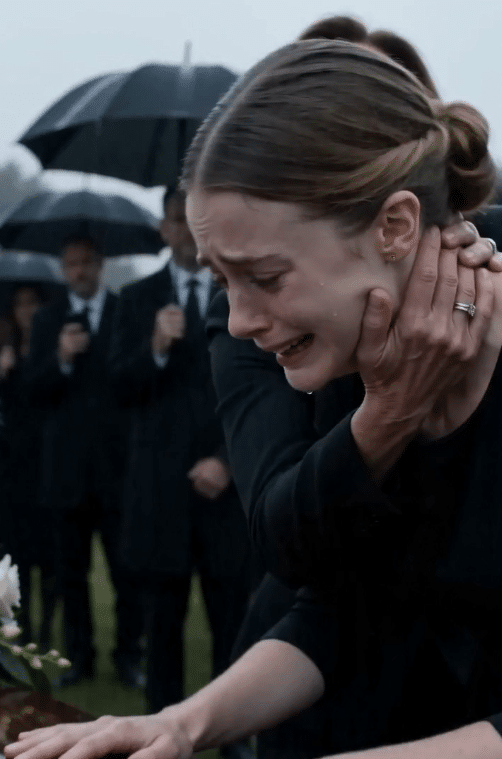
The young woman had been crying quietly at the edge of the mourners, trying to keep herself small. She wore a plain black dress with no expensive cut, no widow’s veil, no place in the front row. Her face was wet with rain and tears both, and whatever she felt was too real to be staged. That was exactly what made Victoria Hale hate her on sight.
Victoria moved fast.
One second she was standing rigid beside the coffin, elegant in black, every inch the grieving widow. The next, she crossed the slick grass, caught the young woman by the jaw and throat, and yanked her close enough for the whole front row to hear her rage.
“You will not cry over my husband after ruining my life.”
The young woman gasped in shock.
A few umbrellas shifted. Someone murmured. The honor guard did not move, but several of the officers’ faces hardened at once. Even in the rain, even in mourning dress, even with the coffin only inches away, the violence of the gesture was impossible to disguise.
The girl could not have been more than twenty-two.
She lifted both hands instinctively, not to strike back, only to steady herself, and that made the scene uglier somehow. She looked less like a rival and more like someone being punished in public for a grief no one wanted to name.
Victoria released her with a sharp shove.
The young woman stumbled backward, breathless and humiliated, dark hair plastered to her cheeks. She looked around at the crowd as if waiting for someone—anyone—to say this had gone too far.
No one did.
Not yet.
That silence made Victoria bolder.
She turned to the mourners, rain sliding off the severe line of her bun, and pointed at the young woman like an accusation made flesh.
“Tell them,” she snapped. “Tell them why he hid you until the day he died.”
A ripple passed through the crowd.
There it was at last. The shape of the scandal everyone had been too polite to name aloud. Not just grief. Not just a mysterious stranger. A young woman hidden by a powerful older man. A funeral ruined by the sudden appearance of what looked, to people hungry for the worst interpretation, like a secret.
Several faces changed at once.
Pity curdled into suspicion. Respectable grief became eager judgment. Near the back, a mourner even lifted a phone, half-concealed beneath an umbrella, recording the moment like the dead deserved one last spectacle.
The young woman shook her head, but no words came out.
Her mouth opened once. Closed again.
Whatever truth she carried, it was clearly the kind that had cost her too much already.
Father Brennan stepped forward then, voice low and strained. “Mrs. Hale—”
Victoria did not even look at him.
Instead, with the cold ceremony of someone reclaiming a stage, she removed a heavy gold wedding band from her gloved hand and laid it on the rain-slick coffin lid.
The ring landed with a faint wet click against the mahogany.
A strange silence fell.
Father Brennan’s eyes went to the band, and something in his face changed so abruptly that even the nearest mourners noticed. Not grief. Not confusion exactly. Recognition.
He leaned closer, rain spotting the shoulders of his black vestments.
Then he said, almost to himself, “That ring was buried with the first bride. Unless…”
He did not finish.
He didn’t need to.
Because the young woman’s head jerked up at the words, and for the first time since Victoria had laid hands on her, she looked less frightened than doomed.
As if she had known this day would come.
And now it had come in front of everyone.
Act II
Her name was Claire Rowan.
Until three months earlier, Andrew Hale had never spoken it in public.
That was part of what made the scene at the graveside so vicious. Victoria was not humiliating a stranger. She was humiliating the one person Andrew had spent his final weeks trying desperately to protect.
The story the city knew about Andrew Hale was neat enough to fit inside speeches.
A good man. A brave man. A man who had loved deeply and lost tragically before finding happiness again.
Twenty-two years earlier, his first wife, Eleanor Hale, had died after a brutal labor at St. Bartholomew’s Hospital. The baby girl she was carrying was declared stillborn hours later. Father Brennan had presided over both the funeral and the tiny graveside blessing that followed. The whole town remembered Andrew then as a young officer standing in black at two graves instead of one, his face so wrecked by grief that people lowered their voices when they said his name for months afterward.
Two years later, Victoria Lane entered his life.
She had worked at St. Bartholomew’s then, a junior nurse with a calm voice and a face people trusted quickly. She had been around in the terrible days after Eleanor’s death. She knew where Andrew’s pain lived before most people did. She knew which silences hurt him most. She knew, above all, how grief can make a man mistake closeness for rescue.
By the time she became Victoria Hale, the town called it fate.
No one asked too many questions. People rarely do when a handsome widower remarries a woman who seemed to understand his sorrow better than anyone else. It made a cleaner story than suspicion ever could.
Claire grew up an hour and a half away, under a different surname, in a house that never quite felt like hers.
She had no baby photographs before age four. No family medical history anyone would show her. Her adoptive mother drank too much and guarded paperwork like treasure. The only things Claire was ever told were these: she had been difficult to place, she should be grateful someone wanted her at all, and some questions were better left buried.
Buried.
It was a word that would come back to her later like a curse.
When she was nineteen, her adoptive mother died. Among old bills and junk-drawer receipts, Claire found a baptism certificate with her name handwritten in the margin and the signature of Father Brennan at the bottom. The date matched the day after Eleanor Hale’s death. There was no explanation attached.
Just a church seal.
And a beginning.
She might never have done anything with it if Andrew Hale himself had not appeared at the chapel months later holding the same document in one trembling hand and a DNA report in the other.
Claire would never forget the first time she saw him really look at her.
Not the way men looked at pretty young women. Not the way powerful people looked at people they were deciding whether to trust. He looked at her like someone staring straight at a wound that had survived him.
He had the same eyes she saw in the mirror.
The same left eyebrow that lifted slightly when startled.
The same small scar by the mouth, though hers came from childhood and his from a training injury decades earlier.
Andrew had found her through a retired hospital clerk who contacted him on her deathbed. The woman had spent twenty-two years carrying the knowledge that one infant had not died at St. Bartholomew’s when the official records said she had. She sent Andrew copies of altered forms, adoption transfers, and one handwritten note bearing Victoria Lane’s initials beside a line about “discreet placement.”
He nearly collapsed reading it.
By then, he was already sick.
Not publicly. Not in ways newspapers could exploit. But sick enough to know time had stopped being generous. So he did what grieving fathers and cautious policemen both do when the truth is explosive: he moved carefully. Too carefully, maybe. He placed Claire in a rented apartment under another name while he reopened old records, contacted an attorney, and prepared to tear apart the elegant marriage that had been built over the ruin of his first family.
Victoria found out before he was ready.
That was why she was pointing at Claire in the rain now with murder in her eyes. Not because Claire had seduced her husband.
Because Claire had exposed the lie Victoria had built her whole life upon.
And at the coffin, Father Brennan was still staring at the ring.
Because if that band truly belonged to Eleanor Hale, as he believed with terrible certainty it did, then one of two things had to be true.
Either the grave had been disturbed.
Or someone had lied long before the earth was ever closed.
Act III
Rain drummed softly on umbrellas. Somewhere behind the mourners, thunder rolled too far away to interrupt but close enough to warn.
Claire stood frozen.
Victoria’s accusation was still hanging in the air, thick and ugly, and the crowd had not decided yet which version of the story it wanted to believe. That was the worst moment in any scandal—the pause before truth arrives, when lies still have room to sound plausible.
Father Brennan broke it.
“Where did you get that ring?” he asked.
Victoria turned slowly, every inch offended dignity. “It was in my husband’s effects.”
“No,” the priest said.
The word came out sharper than anyone expected from him.
He stepped closer to the coffin, rainwater streaking down his lined face. “That ring was Eleanor Hale’s. I blessed it myself before burial. Andrew insisted she keep it with her.”
A murmur spread through the mourners.
Victoria’s posture shifted almost invisibly.
Only someone watching closely would have noticed. Claire did.
“It must be a similar band,” Victoria said.
“It is not.”
Father Brennan looked at the inscription on the inside edge where the rain had turned the gold slick and bright. Then he closed his eyes for one second, as if some old certainty had just broken open under his feet.
“E.H. to A.H. Until the last morning,” he said quietly. “I remember because I told them it sounded less like a vow and more like a promise made by people who thought they had endless time.”
Now the silence changed.
Not gossip anymore. Not curiosity.
Something colder.
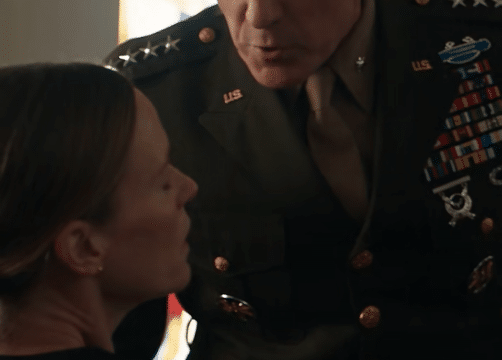
One of the uniformed officers stepped subtly nearer.
Claire’s breath caught in her throat. Andrew had shown her that inscription once in the dim light of his study, holding the ring like evidence and apology both. He had told her he found it in a locked box behind Victoria’s winter coats. Not in Eleanor’s grave. Not in church archives. Hidden inside his own home.
He had gone pale as ash when he realized what that meant.
Victoria had stolen it before Eleanor was buried.
Which meant she had access to the body.
The records.
The baby.
The truth.
“Tell them,” Victoria said again, but there was strain in it now. “Tell them why he kept you hidden.”
Claire looked at the priest. Then at the coffin. Then at the sea of faces waiting to consume her.
When she spoke, her voice shook only on the first sentence.
“Because I’m not his mistress,” she said. “I’m his daughter.”
No one moved.
No one seemed to breathe.
Even the rain felt quieter somehow.
Victoria laughed then, too quickly, too high. “That is insane.”
But Claire had already reached inside her dress pocket and pulled out the envelope Andrew gave her the week before he died. He had told her not to open it unless Victoria forced the truth into daylight before he could do it himself.
On the front, in Andrew Hale’s unmistakable hand, were six words:
For the chapel, if she attacks.
Claire passed it to Father Brennan.
His fingers trembled as he opened it. Inside were copies of a DNA report, old hospital documents, a notarized affidavit from the dying clerk, and a final letter from Andrew himself.
Father Brennan began reading aloud because there was no decent way left to keep such truth private.
“If this letter is being opened,” he read, “then my wife has likely done to Claire in public what she did to Eleanor in secret—turned another woman’s grief into a weapon. Claire Rowan is my daughter, born alive on March 18, twenty-two years ago at St. Bartholomew’s. I was told she died. I know now that was a lie.”
A woman in the second row covered her mouth.
An officer from the honor guard lowered his head.
Victoria’s face lost all color.
Father Brennan kept reading.
“I have reason to believe Victoria Lane removed Eleanor’s wedding band before burial and participated in the falsification of records surrounding my child’s disappearance. I confronted her three days before my death. She denied it. She also threatened Claire. That is why I kept Claire from public view while legal action was prepared.”
Claire looked down as the words landed around her like stones.
Not because she was ashamed.
Because after twenty-two years of being the wrong name in the wrong life, hearing herself named aloud at her father’s funeral was almost more than her body could bear.
And still the letter was not finished.
Because the final page contained the part Andrew had been too late to say himself.
Act IV
Father Brennan’s voice softened when he reached the last sheet.
“If I die before this is resolved, bury me beside Eleanor,” Andrew had written. “And let Claire stand where she was denied the right to stand her whole life. She has already lost enough to my cowardice and another woman’s ambition.”
The rain came down harder then, rattling the umbrellas, striking the coffin lid in silver bursts around the ring.
Victoria lunged for the papers.
She didn’t get them.
One of the officers stepped between her and the priest with the reflex of a man who had respected Andrew Hale too long to let his final truth be clawed out of the air. Another caught Victoria’s arm when she tried to push past him, and the movement was so sudden, so desperate, that several mourners gasped.
“Let go of me,” she hissed.
But the performance was over now.
Her face had changed. The polished widow was gone. In her place stood the woman Andrew must have finally seen too late—hard, cornered, and furious that the dead had betrayed her by telling the truth after all.
Claire did not step back this time.
That was the quiet miracle of the moment. Not the officers. Not the letter. The girl Victoria had just humiliated standing her ground in the rain while the whole lie cracked open around them.
“You stole everything,” Claire said.
Her voice wasn’t loud. It didn’t need to be.
Victoria stared at her with pure hatred. “I built that life.”
“No,” Claire said. “You stole it from a woman in labor and a father in shock.”
Father Brennan closed the letter slowly.
Near the back, the mourner with the phone was still recording, but now no one cared. Let them record it. Let the whole town see what elegant evil looked like when it finally ran out of script.
One of Andrew’s former detectives stepped forward from the crowd then. Lieutenant Marcus Dean. He had worked under Andrew for seventeen years and knew enough about chain of custody to recognize evidence when it was raining onto a coffin in plain sight.
He took the affidavit from Father Brennan, scanned the hospital seals, and looked at Victoria with something close to disgust.
“We’ll be reopening St. Bartholomew’s records,” he said.
Victoria’s composure shattered. “You can’t prove anything after twenty-two years.”
Marcus’s expression never changed. “That depends how many people got old and guilty before you did.”
It was such a simple sentence, but it landed like a verdict.
Claire felt something inside her loosen then—not pain, not exactly, but the iron grip of unreality. For weeks she had lived in Andrew’s shadow world of hidden apartments, sealed folders, whispered promises of soon. Soon he would tell the town. Soon he would fix the name she’d been denied. Soon he would explain why he waited too long.
Now there would be no soon.
Only this.
A coffin. A letter. Rain. And the truth arriving after the only man who could have spoken it himself was already beyond hearing.
Father Brennan bent and lifted Eleanor’s ring from the coffin lid.
He did not hand it to Victoria.
He handed it to Claire.
The whole cemetery saw it.
Not a scandal. Not a mistress receiving some guilty trinket. A daughter being given back the symbol stolen from the mother she never got to know.
Claire closed her fingers around the cold gold band and began to cry in a different way.
Not the helpless crying Victoria tried to shame out of her.
The kind that comes when grief finally has the right name.
And when the lowering straps began to move again, there was only one place left for Claire to stand.
At the front.
Where family belonged.
Act V
By evening, the story had outrun the cemetery.
The video spread first, of course. Victoria’s hand at Claire’s face. The accusation in the rain. The priest stopping mid-service when he saw the ring. But clips never carry the whole weight of truth. The real damage came later, in documents. Hospital ledgers. Adoption transfers. Statements from a retired clerk and a former orderly who remembered a nurse named Victoria Lane insisting on handling the Hale case personally the night Eleanor died.
What Andrew had feared was true.
He had not imagined the betrayal. He had only discovered it too late.
Victoria Hale was arrested forty-eight hours after the funeral on charges tied to record falsification, conspiracy, and the unlawful transfer of an infant. The homicide investigation into Eleanor’s death remained open, because grief and theft had already been proved, and sometimes once the ground gives way under one lie, older bones begin to surface.
Claire did not attend the arrest.
She had buried enough in one week.
Instead, she returned to the cemetery three mornings later with Father Brennan, Lieutenant Dean, and a single white rose. The rain was gone. The grass still held its memory, damp and dark under a pale sky, but the air had changed.
Andrew had been reinterred beside Eleanor exactly as he requested.
For the first time in twenty-two years, the stone bearing Eleanor’s name had another beside it that did not feel like an insult to her memory.
Father Brennan stood back and let Claire approach alone.
She looked at the two graves for a long time before kneeling between them. She thought of Andrew’s careful voice in the apartment kitchen, the way he used to apologize mid-sentence as if the habit had become part of his breathing. She thought of how he kept staring at her hands, her laugh, the tilt of her head, as if grief itself had returned to him in pieces and asked whether he was brave enough to claim them.
He had not been brave enough soon enough.
But in the end, he had tried.
For some daughters, that would never be enough.
For Claire, standing there with the life she’d been denied finally speaking her real name back to her, it had to be the beginning.
She placed the white rose across the seam between the headstones.
Then she set Eleanor’s ring not into the dirt, but against the base of her mother’s marker, where morning light could find it before the church arranged a proper setting for it inside the chapel memorial. Father Brennan had offered to bury it again. Claire had refused.
Too much had been buried already.
When she rose, Lieutenant Dean handed her a folder. Not thick. Not dramatic. Just the ordinary-looking weight of official correction.
A new birth certificate.
A restored family record.
Claire Hale.
She stared at it so long that Father Brennan quietly turned away to give her privacy with the moment.
That was the thing about justice when it finally arrived. It was rarely grand enough for the years it answered. It came in papers. In signatures. In names corrected too late to save the dead but early enough to rescue the living.
Claire pressed the folder to her chest.
“I used to think crying made people weaker in front of crowds,” she said softly, not sure whether she was speaking to the priest, the detective, or the two names carved in stone before her.
Father Brennan answered anyway. “Only when the crowd deserves the performance more than the truth.”
She gave a small, broken laugh at that.
Then she looked once more at her father’s grave and said the words Victoria tried to deny her at the coffin.
Not loudly.
Just clearly.
“Goodbye, Dad.”
The wind moved through the cemetery grass.
Somewhere beyond the stones, the chapel bell rang once.
And in the end, that was what people remembered most. Not the widow’s accusation. Not the phone held up under the umbrella. Not even the scandal that followed.
They remembered the moment a young woman everyone had been ready to judge stood in the rain beside a polished coffin, shaking with grief, while a priest looked down at a gold ring and realized the wrong woman had been called family for far too long.