Act I
The little girl’s voice barely rose above a whisper.
“I’m hungry…”
But in the silent luxury bakery, it sounded louder than breaking glass.
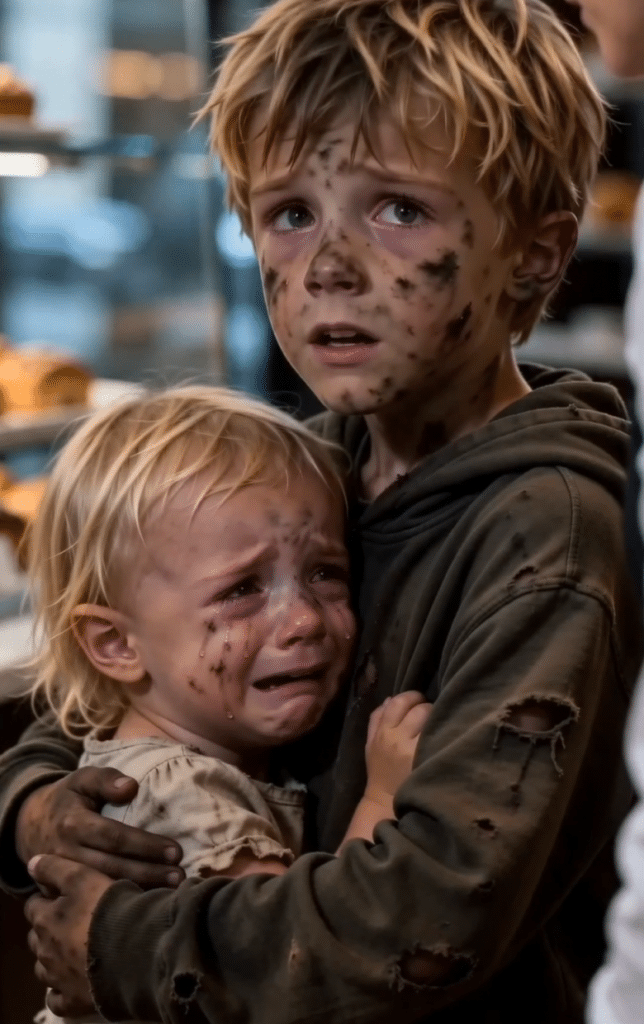
Her older brother tightened his arms around her small trembling body while standing at the counter beneath warm golden lights and shelves filled with pastries they could never afford.
He looked exhausted.
Too thin for his age.
Dirt streaked across his face beneath messy blonde hair, his oversized hoodie hanging loosely from narrow shoulders. The little girl in his arms cried quietly into his neck while staring at cupcakes behind the glass display.
The boy swallowed hard before speaking again.
“Do you have any bread from yesterday,” he asked softly, “that you sell for less?”
Behind the counter, the saleswoman barely looked at him.
“We don’t sell leftovers here.”
The words landed with cold precision.
The boy nodded once, like he was already used to hearing no.
Then his little sister began sobbing harder.
Every customer in the bakery heard it.
Most looked away.
Except one man sitting alone near the window.
Silver-haired.
Dark navy suit.
Watching carefully over the edge of a coffee cup.
The billionaire slowly stood up.
Act II
His name was Arthur Vale.
People in the city called him many things.
Investor.
Tycoon.
Kingmaker.
But before the wealth, Arthur had been a hungry boy too.
At nine years old, he once stole bread from a grocery store because his younger sister Lucy had not eaten in two days. The owner caught him before he reached the door.
Arthur still remembered the humiliation.
The shouting.
Lucy crying beside him.
And the old baker who stepped out from the kitchen afterward, placed a warm loaf into Arthur’s hands, and quietly said:
“No child should learn shame before kindness.”
Arthur never forgot it.
Not when he built his first company.
Not when he bought his third penthouse.
Not even when wealth turned every room silent after he entered it.
Especially not then.
Now, decades later, another starving boy stood in front of expensive pastries trying to protect a crying little girl from embarrassment.
And suddenly Arthur saw himself again.
Act III
Arthur walked toward the counter slowly, the polished floor echoing beneath his shoes.
The saleswoman straightened instantly when she recognized him.
“Mr. Vale—”
“Pack everything.”
She blinked.
“Sir?”
Arthur gestured calmly toward the shelves.
“The bread. The cakes. The pastries. Everything.”
The entire bakery froze.
Customers stopped eating.
Even the kitchen staff peered through the back doorway.
Arthur turned toward the boy.
“Come with me.”
The boy stared at him without moving.
Like kindness itself had become suspicious.
“What’s your name?” Arthur asked gently.
“Ethan.”
“And your sister?”
“Mia.”
Mia peeked out weakly from Ethan’s shoulder, tears still clinging to her dirty cheeks.
Arthur crouched slightly.
“When did you two last eat?”
Ethan hesitated too long.
That answer was enough.
Arthur’s jaw tightened.
Act IV
Boxes began filling the counters rapidly.
Croissants. Cakes. Sandwiches. Warm loaves wrapped in paper.
The saleswoman moved frantically now, her earlier coldness dissolving beneath Arthur Vale’s presence.
But Arthur barely noticed her anymore.
His attention stayed fixed on Ethan.
The boy never once asked for more than bread.
Not candy.
Not cake.
Bread.
Because children who grow up hungry stop dreaming extravagantly. They learn to ask only for survival.
Arthur recognized that too.
“Where are your parents?” he asked quietly.
Ethan lowered his eyes.
“Our mom’s at the shelter clinic.”
“And your father?”
Silence.
Then:
“He left.”
Arthur looked away briefly.
Some men abandon families physically.
Others abandon them long before walking out the door.
Arthur knew both kinds.
He removed his suit jacket and gently wrapped it around Mia after noticing she was shivering.
The little girl clutched the expensive fabric like it was a blanket from another world.
Then Ethan said something that nearly shattered Arthur completely.
“She hasn’t cried this much before,” the boy whispered. “I think she forgot what full feels like.”
Arthur closed his eyes for one second.
Just one.
Because suddenly he was nine years old again, watching Lucy cry herself to sleep from hunger in an apartment so cold their breath fogged the air.
And he remembered making a promise to himself:
If I ever become rich, no child near me will stay hungry.
Act V
Arthur did more than buy the bakery.
That night, he took Ethan and Mia to the best private clinic in the city to see their mother. He arranged food, housing, medical care, and school enrollment before sunrise.
Not through assistants.
Personally.
Because some wounds should never be delegated.
At the shelter clinic, Ethan stood beside Arthur quietly while doctors examined Mia.
“Why are you helping us?” he finally asked.
Arthur looked down at the boy for a long moment.
Then he smiled sadly.
“Because once,” he said, “someone helped me before I became worth helping.”
Ethan’s eyes filled instantly.
Not loud tears.
The dangerous kind.
The silent ones children cry when they realize they might finally be safe.
Weeks later, Arthur returned to the bakery.
The saleswoman greeted him nervously.
But the place had changed.
At the entrance stood a small new sign.
NO CHILD LEAVES HUNGRY.
Arthur stared at it silently.
Then he noticed another detail.
Beside the register sat a basket filled with wrapped bread labeled:
FREE. TAKE WHAT YOU NEED.
Arthur smiled faintly.
Not because he had bought pastries that day.
Because maybe, for the first time in years, he had bought something far more valuable.
A reminder.
That dignity costs almost nothing.
And withholding it costs everything.