Act I
“Are you hungry too?”
The young man on the stone steps did not answer.
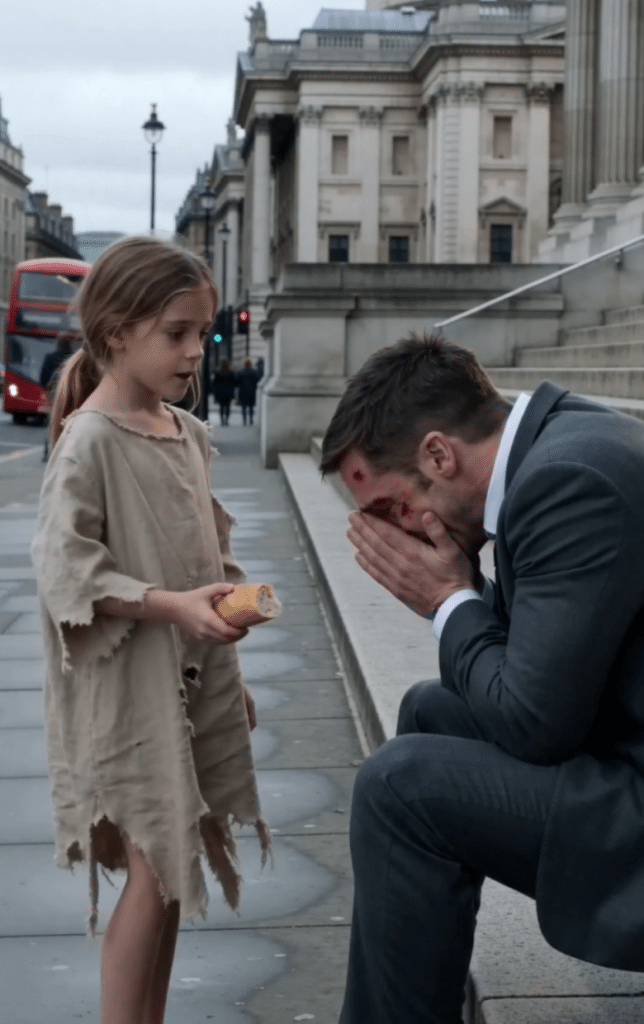
He sat outside the grand courthouse with his head bowed, both hands pressed over his mouth, shoulders shaking beneath a charcoal suit that looked too expensive for a man falling apart in public.
There was a fresh cut on his cheekbone. One eye was swollen. His tie hung loose at his collar.
People walked past him.
Some looked.
Most did not.
Then the barefoot girl stepped closer.
She could not have been more than nine. Her beige dress was frayed at the hem, too thin for the cold pavement beneath her feet. In one small hand, she held half a baguette.
“You can have some,” she said.
The man lowered his hands.
His eyes were red, stunned, almost ashamed to be seen by a child who clearly had less than he did.
“No,” he whispered. “I’m not hungry.”
The girl tilted her head.
“Then why are you crying?”
He tried to smile.
Failed.
Without waiting for permission, she broke the bread in half and pressed the larger piece into his hand.
The man stared at it.
Then at her.
Something about the gesture struck him so hard he forgot to breathe.
He leaned forward, voice shaking.
“What… did your mother say your name was?”
The girl blinked.
“Anna.”
The bread slipped from his hand.
Because Anna was the name of the daughter everyone told him had died.
Act II
His name was Julian Mercer.
That morning, he had lost everything.
Not his money. Not his firm. Not his reputation, though all of that was beginning to burn behind him.
He had lost the lie that held his life together.
For seven years, Julian believed his wife and baby daughter were dead.
A car accident outside Lyon. A rainy road. A police report. A closed casket. His mother’s trembling hand on his shoulder telling him not to ask to see what grief had already taken.
He had been twenty-six then.
Young enough to break completely.
Old enough to be useful to the powerful people who needed him numb.
His father’s law firm pulled him back into work. His mother managed the funeral. His older brother handled the insurance, the paperwork, the “necessary details.”
Julian became excellent at surviving.
He won cases. Built wealth. Married no one. Loved no one. Slept badly.
Then, that morning, he had walked into court to testify against his own family.
He had discovered forged adoption documents, false death records, and payments made to a private clinic in Marseille.
His daughter had not died.
She had been taken.
And when Julian confronted his brother outside the courthouse, the fight ended with Julian bleeding on the steps and his brother fleeing before the police arrived.
Julian was still sitting there, shattered, when a barefoot girl offered him bread.
Act III
“Anna what?” Julian asked.
The girl clutched the smaller piece of baguette.
“Anna Bell.”
Not Mercer.
His hope faltered.
Then she added, “But Mama said that wasn’t my first name.”
Julian’s heart slammed against his ribs.
“What was your first name?”
Anna looked toward the street, suddenly cautious.
“Mama said not to tell strangers.”
“That’s smart,” Julian whispered.
She studied his bruised face.
“You look like the man in her locket.”
Julian froze.
“What locket?”
Anna reached beneath the collar of her worn dress and pulled out a tiny silver oval on a chain.
Inside was a photograph.
Julian could barely see through the tears.
It was him.
Younger. Smiling. Holding a newborn wrapped in a yellow blanket.
On the other side was a woman with dark hair and tired, beautiful eyes.
His wife.
Clara.
Julian covered his mouth.
Anna watched him carefully.
“You know my mama?”
His answer broke in half.
“I’ve been looking for her since before I knew she was alive.”
Act IV
Clara was not dead.
She was hiding.
After the staged accident, she woke in a clinic under another name with no documents, no money, and a warning from Julian’s own brother.
If she returned, they would take the baby.
If she called Julian, they would make sure no one believed her.
For years, Clara moved from shelter to shelter, job to job, city to city. She raised Anna on bakery scraps, church donations, and lullabies from a life stolen before it could begin.
She told Anna stories about her father.
Not bitter ones.
Brave ones.
“He would come if he knew,” she would say.
Anna believed her.
That was why she recognized him from the locket.
That was why she offered him bread.
Because her mother had always told her, “When someone is crying, give what you can. Even if what you have is small.”
Julian stood too quickly, nearly stumbling.
“Where is she?”
Anna pointed down the street.
“At the shelter behind the blue door.”
Julian wiped his face with shaking hands.
“Can you take me to her?”
Anna hesitated.
Then she reached for his hand.
It was the first time in seven years Julian felt something stronger than grief.
Fear.
Hope.
Both.
Act V
Clara saw him from across the shelter courtyard.
For one long second, neither moved.
She was thinner than he remembered. Older in the eyes. Her coat was patched. Her hands were rough.
But she was alive.
Julian said her name once.
“Clara.”
She dropped the laundry basket she was carrying.
Anna ran to her mother, but Clara was staring past the child, straight at the man she had buried in her heart because surviving required impossible things.
“I thought you believed them,” she whispered.
Julian shook his head, tears falling freely now.
“I thought you were gone.”
Clara covered her mouth.
Anna looked between them.
“Is he the man in the locket?”
Clara knelt and pulled her daughter close.
“Yes,” she cried. “He’s your father.”
Julian sank to his knees in front of them.
Not caring about the stone.
Not caring about the blood on his face.
Not caring who watched.
He held out his hand, giving Anna the choice.
She looked at him for a long moment.
Then she placed the larger piece of bread back into his palm.
“You can still have some,” she said.
Julian laughed and sobbed at the same time.
The court case that followed destroyed the Mercer family’s name. His brother was arrested. His mother’s silence was exposed. The false records were overturned, one signature at a time.
But Julian never remembered that day as the day justice began.
He remembered it as the day a hungry little girl gave away the bigger half of her bread.
The day grief looked up and found a face it had been searching for.
The day his daughter asked why he was crying.
And finally gave him a reason to stop.