Act I
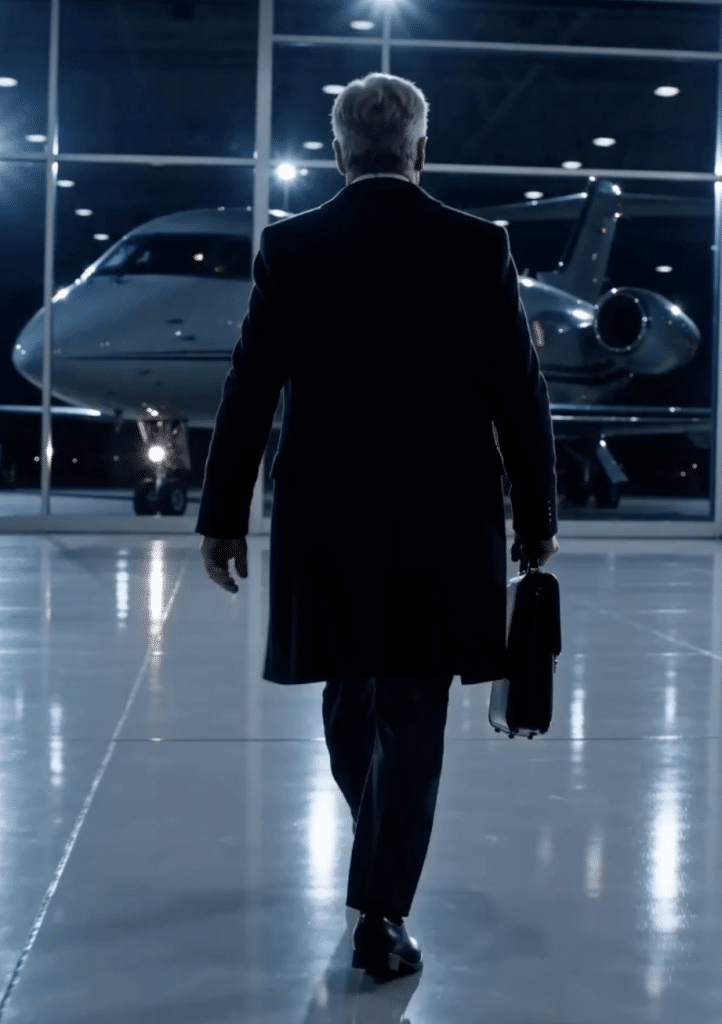
The private terminal was too bright for midnight.
White overhead lights spilled across the polished black floor, turning every step into a reflection. Beyond the glass wall, a silver private jet waited on the tarmac with its cabin lights glowing and its nose pointed toward the dark runway.
Victor Harlan was already late.
He crossed the terminal with his black overcoat flaring behind him, one hand gripping a leather briefcase, the other checking his phone for the fifth time in thirty seconds. His board was waiting in Geneva. His lawyers were waiting on a secure call. And somewhere in the city behind him, a dozen reporters were circling the biggest scandal his company had ever faced.
He could not afford delay.
Not tonight.
“Mr. Harlan!” someone shouted.
Victor did not slow down.
A commotion broke out near the security doors. Shoes squeaked against the glossy floor. A chair scraped. Then a boy’s voice cut through the terminal with raw panic.
“Sir, stop! Don’t get on that plane!”
Victor stopped, more irritated than afraid.
A security officer had both hands on a boy in a gray hoodie and ripped jeans, dragging him backward from the restricted corridor. The child could not have been more than eleven. His face was pale, his curls damp with sweat, and one sleeve of his hoodie was torn near the wrist.
Victor turned sharply.
“Who are you?” he snapped. “What the hell does that mean?”
The boy twisted against the guard’s grip.
“Don’t let them start the engines, please!”
The pilot, visible beyond the glass, glanced toward the terminal. A flight attendant froze beside the stairs. Two men in reflective vests moved near the jet’s left wing, their backs turned, their caps pulled low.
Victor’s jaw tightened.
He had spent thirty years building a company by ignoring distractions. Panic had a smell, and most of the time it came from people who wanted money, attention, or leverage.
“I don’t have time for this,” he said. “Get him out of here!”
The guard began pulling the boy toward the exit.
The boy dug his heels into the floor.
“No!” he shouted, his voice breaking. “The men under the left wing weren’t mechanics! Trust me, your life is in danger!”
That sentence did what the screaming had not.
It reached Victor.
Not because of the danger.
Because of the detail.
The left wing.
Victor slowly turned his head toward the jet.
One of the men in reflective vests looked up.
Only for a second.
Then he turned away too quickly.
Victor’s phone buzzed in his hand. The message came from an unknown number, one line only.
Do not board unless you want your brother’s secret to die with you.
Victor looked back at the boy.
And for the first time all night, he felt truly afraid.
Act II
Victor Harlan had made enemies before breakfast for most of his adult life.
He owned Harlan Aerospace, a private aviation empire that built engines, serviced jets, and transported people rich enough to believe the sky was their personal road. Presidents had used his aircraft. Royals had used his pilots. Tech billionaires had signed contracts with his company without reading the fine print.
Victor’s name meant speed, luxury, precision, and silence.
The silence mattered most.
In his world, problems were not solved. They were contained.
A lawsuit became a settlement. A mistake became a resignation. A dangerous truth became a missing file in a restricted archive.
But three weeks earlier, containment had failed.
A maintenance whistleblower named Daniel Reeves had died in a suspicious car crash after claiming Harlan Aerospace had falsified safety records on private aircraft used by high-profile clients. His final message, sent to three journalists and one government investigator, mentioned “the left-wing batch reports.”
Nobody knew what that meant.
Victor had denied everything.
Publicly, he called the accusations baseless.
Privately, he had ordered an internal audit so brutal that half his senior staff stopped sleeping.
That was why he was going to Geneva. The European board wanted answers. Investors wanted confidence. Regulators wanted documents. Victor intended to arrive before dawn, take control of the room, and stop the collapse before it reached the foundation of his company.
But now a child stood in his terminal talking about the left wing.
Victor lifted one hand.
The guard stopped.
“Bring him here.”
The boy’s eyes widened, as if he had expected to be thrown out, not heard.
The guard hesitated. “Sir, he breached perimeter security.”
“I said bring him here.”
The boy stumbled forward when the guard released him. He clutched a small canvas backpack to his chest as though someone might rip it away.
Victor looked him over.
“What’s your name?”
The boy swallowed.
“Ethan Reeves.”
The last name struck the air like glass hitting stone.
Victor’s expression changed.
Daniel Reeves had left behind a son. Victor remembered it from the crisis briefing. Age eleven. Mother deceased. No close relatives. The kind of detail executives skimmed, then buried under legal strategy.
The boy saw recognition in his face.
“My dad tried to warn you,” Ethan said. “Nobody listened.”
Victor’s voice lowered. “How did you get in here?”
“I followed the men.”
“What men?”
Ethan pointed toward the jet.
“The fake mechanics.”
Victor looked again through the glass. The men near the wing were now walking away, not toward the maintenance bay, but toward a service truck parked beyond camera range.
Too calm.
Too deliberate.
Victor turned to the security officer.
“Lock down the aircraft. No engines. No one leaves the tarmac.”
The guard nodded into his radio.
But his reply came back wrong.
No immediate confirmation. No crisp acknowledgment. Just static, then a delayed voice saying the ground crew had already cleared the aircraft.
Victor’s stomach tightened.
The terminal suddenly felt less like a passageway and more like a trap.
Ethan reached into his backpack.
The guard moved instinctively, but Victor held up a hand.
Slowly, the boy pulled out a cracked tablet wrapped in a plastic grocery bag.
“My dad made videos,” Ethan said. “He told me if anything happened to him, I had to find you before you got on a plane.”
Victor stared at him.
“Why me?”
Ethan’s face hardened with a child’s version of adult grief.
“Because he said you were the only one powerful enough to stop them.”
Victor almost laughed.
Not because it was funny.
Because he had spent years becoming powerful enough to never be surprised.
And yet here he was, standing in his own terminal, being saved by an orphan with dirty sneakers.
Then the lights flickered once.
And the jet outside went dark.
Act III
The blackout lasted only three seconds.
When the lights returned, every reflection on the polished floor seemed sharper.
Victor grabbed Ethan by the shoulder and pulled him behind a marble column as the guard drew his radio closer to his mouth.
“Control, confirm tarmac lockdown.”
Nothing.
The glass wall reflected Victor’s face back at him. For the first time in years, he looked his age.
Then the pilot appeared at the jet stairs, confused and angry, speaking to someone inside the cabin. The flight attendant stood beside him, clutching the handrail. The two fake mechanics were gone.
“Sir,” the guard said quietly, “we may have a breach.”
Victor almost snapped back.
Instead, he looked at Ethan.
“What did your father know?”
Ethan unlocked the tablet with shaking fingers. The screen was cracked through the corner, but the video loaded.
Daniel Reeves appeared in a dim garage, his face tired, his work jacket zipped to the neck. He looked like a man recording because he no longer trusted tomorrow to arrive.
“If you’re watching this, Ethan found you,” Daniel said.
Victor’s breath stopped.
The dead man looked directly into the camera.
“Mr. Harlan, the sabotage isn’t random. It’s internal. Maintenance records are being altered through executive clearance. Planes are being marked safe without inspection. I traced the overrides to Project Meridian.”
Victor’s hand tightened around the briefcase.
Project Meridian was not supposed to exist in any ordinary file.
It had been his brother’s program.
Marcus Harlan, Victor’s younger brother, charming, reckless, beloved by investors and feared by accountants. Marcus had run Harlan Aerospace’s defense contracts division until his sudden death five years earlier from a private helicopter accident in the Alps.
At least, that was the official story.
Victor had never fully believed it.
Not because he had evidence.
Because Marcus had called him the night before he died and left a message Victor still could not delete.
I made a mistake, Vic. If something happens, don’t trust the board.
At the time, Victor thought grief had turned that message into a ghost story.
Now Daniel Reeves was speaking from a cracked tablet in a midnight terminal, saying the same thing with different words.
The video continued.
“Your brother found the false certifications first. He tried to shut Meridian down. Someone on the board turned the program into a money funnel. Parts were being substituted. Reports were being forged. When Marcus threatened to expose it, his aircraft was serviced by the same private team now assigned to yours.”
Victor felt the floor disappear beneath him.
Ethan looked up.
“My dad said your brother didn’t die in an accident.”
The words were soft.
They still hit like a blow.
The security guard stepped closer, pale. “Sir, we need to move you to a secure room.”
“No,” Victor said. “We need that aircraft inspected.”
“Sir—”
“And we need everyone on my board call recorded.”
The guard stared.
Victor looked toward the jet.
Because suddenly he understood the brilliance of the trap.
If he boarded, he died as a tragic executive under pressure from scandal. The company’s stock would plunge, the board would blame him, and the same people who had buried Marcus would inherit full control of Harlan Aerospace.
If he refused without proof, he looked paranoid.
If he delayed, Geneva would move against him.
Either way, someone had planned for Victor Harlan to disappear from his own empire.
Ethan’s small voice broke through his thoughts.
“There’s another video.”
Victor looked down.
Ethan tapped the screen.
This time, Daniel Reeves was not alone. In the frame beside him sat an older woman Victor recognized instantly.
Clara Harlan.
Victor’s mother.
Dead for two years.
Her voice was weak but clear.
“Victor,” she said from the screen, “I should have told you what Marcus found. I was afraid the family would lose everything.”
Victor stepped back as if the tablet had burned him.
His mother had known.
The room began to tilt in a different way.
Then Clara said the sentence that made Victor forget the jet, the board, and the men under the wing.
“Marcus left something behind. Not just files. A child.”
Act IV
Victor stared at Ethan.
The boy stared back, confused by a truth he had clearly never been told.
On the tablet, Clara Harlan continued, her recorded voice trembling under the weight of confession.
“Daniel Reeves protected the child after Marcus died. He registered him under another name because he believed the people who killed Marcus would come for the boy too. I allowed it. God forgive me, I allowed a stranger to raise my grandson because I was too afraid of my own family.”
Ethan’s lips parted.
“No,” he whispered.
Victor could not speak.
He saw Marcus suddenly, not as the dead brother in newspaper photographs, but as the young man who used to steal Victor’s cufflinks before investor dinners, who laughed too loudly, who once said he would rather burn the company down than let it become a machine for cowards.
A child.
Marcus had left a child.
And that child had just saved Victor’s life while wearing a torn hoodie in a terminal where his own blood had tried to throw him out.
Victor crouched, slowly, until he was eye level with Ethan.
“What was your mother’s name?”
Ethan’s eyes filled.
“I don’t know. Dad said she died when I was a baby.”
Victor turned back to the video.
Clara’s face blurred on the cracked screen.
“His mother was Sofia Bell. Marcus loved her. The board would have destroyed her if the relationship became public during the Meridian audit. After Marcus died, Daniel took Ethan and vanished from the family’s reach. He was braver than all of us.”
The guard’s radio crackled.
This time a voice came through.
“Sir, we found unauthorized equipment near the left wing access panel. Maintenance confirms the assigned crew never reported to the aircraft.”
Victor closed his eyes.
Ethan had been right.
The boy flinched at the word equipment, though he did not understand the full meaning. Victor was grateful for that.
He stood.
“Evacuate the jet. Detain anyone on that service truck. Pull all security footage.”
“Already moving, sir.”
Victor turned toward the glass.
The terminal doors opened behind him.
Three board members entered fast, flanked by two private attorneys and a woman from crisis communications. They were not supposed to be there. They were supposed to be in Geneva.
That was the second trap revealing itself.
A tall man with silver hair stepped forward.
Graham Voss, chairman of the board.
He looked at Ethan first.
Then at the tablet.
Then at Victor.
“Victor,” Graham said smoothly, “step away from the child.”
The child.
Not boy.
Not Ethan.
Victor heard it.
So did Ethan.
Graham’s face carried the calm of a man who had survived every scandal by making other people drown first.
“You are under extreme pressure,” Graham continued. “This situation needs to be handled privately.”
Victor gave a small, humorless smile.
“Privately?”
Graham glanced at the security guard. “This terminal is company property. Remove the boy and surrender the device.”
Nobody moved.
The guard looked at Victor.
And in that moment Graham made his first mistake.
He looked annoyed.
Not surprised. Not concerned. Annoyed.
Victor opened his briefcase, removed his phone, and set it to speaker.
A woman’s voice filled the terminal.
“Victor, we’re live.”
Graham’s face changed.
Victor looked him dead in the eye.
“Federal aviation investigators, my legal team, and three independent journalists have been on this call since the lights came back on.”
The crisis communications woman went pale.
Graham recovered quickly. “You have no idea what you’re doing.”
Victor stepped closer.
“No. For once, I know exactly what I’m doing.”
He nodded to Ethan.
“Play the rest.”
Ethan’s hands shook, but he tapped the tablet.
Daniel Reeves appeared again.
This time he held up printed records, names, dates, authorization codes, and a photograph of Graham Voss standing beside the same two fake mechanics now being detained on the tarmac.
Graham did not run.
Men like him rarely did.
They simply went still, calculating whether silence could still save them.
It could not.
The terminal doors opened again.
This time, the people entering wore federal badges.
Act V
By sunrise, the private jet still had not moved.
It stood behind the glass wall like a monument to the life Victor had almost lost and the lies that had kept his family divided. Investigators moved around it in careful patterns. The fake mechanics sat in separate rooms. Graham Voss had stopped asking for privacy after his attorney arrived and advised him to say nothing at all.
The board call in Geneva was canceled.
The scandal did not stop.
It detonated.
By noon, Harlan Aerospace issued its first honest statement in company history. Not polished. Not evasive. Not soaked in legal perfume. Victor wrote it himself from a conference room with no sleep and coffee going cold beside him.
There had been falsified records.
There had been internal corruption.
There had been deaths that deserved new investigations.
And Daniel Reeves, the mechanic the company had dismissed as unstable, had been telling the truth.
Victor insisted on that line.
Ethan sat across from him, wrapped in a blanket someone had found in the pilot lounge. He looked smaller in daylight. Less like the brave messenger who had stormed a private terminal, more like a boy who had lost one father and discovered another family he did not know whether to trust.
Victor did not try to touch him.
Not yet.
He had learned enough in one night to know blood did not grant instant rights.
Daniel Reeves had earned the title of father in every way that mattered. He had packed lunches, checked homework, taken night shifts, hidden evidence, and died trying to keep Ethan safe. Marcus may have given Ethan his name and blood, but Daniel had given him a life.
Victor would not steal that.
A social worker arrived with a child advocate. Then Daniel’s old neighbor, Mrs. Alvarez, who had been watching Ethan whenever his father worked late. She came into the room crying and nearly crushed the boy in her arms.
Victor watched Ethan cling to her.
Something inside him loosened painfully.
He had spent so much of his life believing family was legacy, control, succession, bloodlines etched into marble. Marcus had rejected that. Daniel Reeves had understood better. Family was the person who ran into danger for you when nobody important was watching.
Later that afternoon, Victor walked with Ethan to the hangar’s quiet side entrance.
The sky was pale and clean after the long night.
Ethan held the cracked tablet against his chest.
“Am I supposed to live with you now?” he asked.
Victor stopped.
He could have answered like an executive. Quickly. Decisively. With a plan.
Instead, he answered like an uncle who had only just learned he was one.
“You’re supposed to be safe,” Victor said. “You’re supposed to be heard. And you’re supposed to have a say in what happens next.”
Ethan looked down at his sneakers.
“My dad said rich people always decide things before they ask.”
Victor nodded slowly.
“Your dad was right about too many things.”
The boy’s mouth trembled.
Victor looked away to give him privacy, but Ethan spoke before the tears fell.
“He knew I wasn’t his?”
Victor’s chest tightened.
“Yes.”
“And he still kept me?”
Victor crouched in front of him, the same way he had in the terminal.
“No,” he said gently. “He chose you.”
That was when Ethan finally broke.
Not loudly. Not dramatically. Just a small folding inward, grief finding the first safe place it could land. Victor put one hand on the boy’s shoulder, careful and light, and Ethan did not pull away.
For a while, they stayed like that beside the hangar door while the world outside prepared to turn Daniel Reeves into a headline.
Victor would not allow that to be the end of him.
A month later, Harlan Aerospace’s main maintenance facility was renamed the Daniel Reeves Safety Center. Reporters called it a symbolic gesture. Victor let them. They did not need to know about the small office inside, where Daniel’s videos were archived and where every new mechanic was required to hear his warning before touching an aircraft.
Graham Voss was indicted. Others followed. Project Meridian became a case study in how greed hides behind polish until one honest man leaves proof and one grieving child refuses to stay quiet.
Victor stepped down as CEO during the investigation.
People called it shocking.
He called it overdue.
He remained chairman only long enough to restructure the company, expose the old network, and create an independent safety board with power no executive could override. For the first time in decades, Harlan Aerospace belonged less to men in boardrooms and more to the people whose hands actually kept planes in the sky.
As for Ethan, there was no clean ending.
There never is when a child loses the man who raised him.
He moved first into Mrs. Alvarez’s home, then slowly into a shared guardianship arrangement Victor refused to rush. There were therapy appointments. Court hearings. Bad dreams. Angry silences. Days when Ethan wanted answers about Marcus, and days when he wanted everyone to stop saying the name Harlan like it meant something he had asked for.
Victor gave him space.
And when space was not enough, he gave him the truth.
He showed Ethan old photos of Marcus barefoot on sailboats, Marcus grinning with grease on his cheek, Marcus holding a newborn wrapped in a blue blanket while looking more terrified than proud.
On the back of that photo was a note in Marcus’s handwriting.
Keep him away from the company until I clean it.
Ethan stared at it for a long time.
“He didn’t clean it,” the boy said.
“No,” Victor answered. “But you helped finish what he started.”
One evening, nearly a year after the night in the terminal, Victor and Ethan returned to the private hangar.
The same polished floor reflected the same overhead lights. Another jet stood behind the glass, inspected, cleared, and watched by a maintenance crew whose names Victor knew personally.
Ethan stood beside him in a new hoodie, still gray by choice, though no longer torn.
“You ever think about getting on that plane anyway?” Ethan asked.
Victor looked through the glass.
He remembered his own arrogance. His impatience. The way he had ordered the guard to remove a child who had come to save him.
“Yes,” he said. “And it scares me more than the danger.”
Ethan nodded like he understood.
Maybe he did.
The boy stepped closer to the glass and looked out at the left wing.
“Dad always said machines tell the truth if you know how to listen.”
Victor smiled faintly.
“Daniel said that?”
“All the time.”
Victor stood beside him.
Beyond the glass, the crew chief raised a hand to signal that the inspection was complete. The engines remained silent. No one hurried. No one cut corners. No one acted as if time mattered more than lives.
Ethan watched carefully.
Then he glanced at Victor.
“You can start it now,” he said.
Victor looked at him.
The boy’s face was still touched by grief, but there was something steadier there too. Not healing, exactly. Not yet. Something earlier than healing.
Trust beginning to test its own weight.
Victor nodded to the crew chief.
Outside, the aircraft lights brightened.
This time, no one screamed.
This time, no child had to beg a powerful man to listen.
And as the first safe engine hum filled the hangar, Victor Harlan looked at the boy who had stopped him from boarding a death sentence and understood the truth his empire had forgotten.
A warning can sound like disruption.
A child can look like an inconvenience.
And sometimes the smallest voice in the room is the only thing standing between a dynasty and the truth it tried to bury.