Act I
The first thing Clara Bennett heard after giving birth was not her baby’s cry.
It was her husband’s voice breaking the room apart.
“Whose baby is this?”
The delivery room went still.
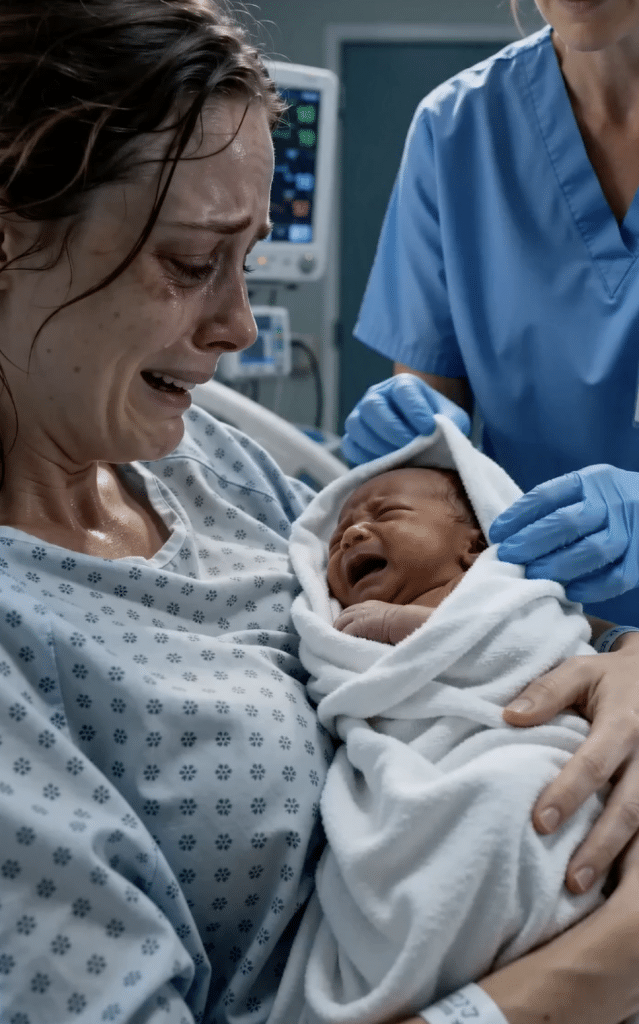
The nurse in blue scrubs froze with one hand beneath the newborn’s head. The heart monitor kept beeping in the background, steady and cruelly calm, while Clara sat trembling in the hospital bed, her damp hair stuck to her cheeks, her body weak from hours of labor.
She looked down at the baby wrapped in the white blanket against her chest.
Then she looked up.
Mark stood at the foot of the bed in a wrinkled light blue dress shirt, his dark tie hanging loose around his neck like he had been trying to tear it off. His hair was messy. His face was pale.
But his eyes were worse.
They were full of accusation.
“Mark?” Clara whispered.
He pointed at the baby like he was pointing at evidence.
“He’s not mine.”
The words landed harder than any scream.
Clara’s lips parted, but for a second no sound came out. She had imagined this moment a thousand times during pregnancy. Mark crying. Mark kissing her forehead. Mark holding their son with shaking hands and saying he was scared to be a father but ready to try.
Not this.
Not him staring at their newborn like the child was a betrayal.
“I never cheated on you,” she said.
Her voice cracked on the last word.
Mark let out a short, bitter laugh, but there was no humor in it. Only panic dressed up as anger.
“Then explain it.”
The nurse, whose badge read Emily Hart, shifted beside Clara. “Sir, I need you to lower your voice.”
Mark did not even look at her.
“Explain it, Clara.”
The baby stirred in Clara’s arms, his tiny face scrunching as if he could feel the violence in the room without understanding it. Clara held him closer, instinct taking over where strength had failed.
“I don’t know what you mean,” she said. “He’s our son.”
Mark shook his head.
“No. Don’t do that. Don’t sit there and make me feel insane.”
Clara stared at him through tears.
Hours earlier, he had been holding her hand in that same room. He had counted her breaths. He had whispered, “You’re doing amazing,” even when fear made him sweat through his shirt. When the doctor told him to step outside during a complication, he kissed Clara’s forehead and promised he would be right back.
But he had not come right back.
He had vanished for almost forty minutes.
And now he had returned as a stranger.
“Where were you?” Clara asked.
Mark’s jaw tightened.
“That doesn’t matter.”
“It matters to me.”
“You want to talk about where I was?” he snapped. “Fine. I was in the hallway while your nurse handed me a form saying our baby’s blood type doesn’t match mine.”
Nurse Emily’s face changed.
Not dramatically. Not enough for Mark to notice.
But Clara saw it.
A flicker.
A flash of alarm.
“What form?” Clara whispered.
Mark reached into his back pocket and pulled out a folded sheet of paper. His hand was shaking as he held it up.
“This form.”
Emily stepped forward. “Mr. Bennett, may I see that?”
Mark pulled it away.
“No. I want my wife to explain why the child she just delivered cannot be mine.”
Clara’s heart pounded so hard the room seemed to tilt.
“I can’t explain something that isn’t true,” she said. “You were the only man I ever loved.”
Mark flinched, but anger quickly covered it.
“Don’t.”
“Mark—”
“Don’t say it like that.”
The baby started to cry.
A small, thin cry.
Clara bent over him, her tears falling onto the white blanket as she whispered, “It’s okay. Mommy’s here. Mommy’s here.”
Emily reached gently toward the infant to adjust the blanket.
That was when she saw it.
The hospital bracelet around the baby’s ankle.
Her face drained of color.
Clara noticed.
So did Mark.
“What?” he demanded.
Emily did not answer.
Instead, she looked at the bracelet, then at Clara’s wristband, then back at the baby.
And suddenly, the question in the room was no longer whether Clara had lied.
It was why the baby in her arms had someone else’s name.
Act II
Clara and Mark Bennett had not been the kind of couple people expected to break.
They were the couple friends called steady. Ordinary. Safe. They met in a grocery store after Mark accidentally knocked over an entire display of oranges and Clara laughed so hard she had to sit down on a bag of dog food.
He was a construction estimator with ink stains on his fingers and a habit of overthinking every decision. She was a school librarian who remembered children’s favorite books and kept emergency granola bars in her purse.
They were not rich.
They were not powerful.
They were not interesting enough to be hated.
At least, that was what Clara had always believed.
The pregnancy had come after two years of disappointment and quiet doctor visits. When Clara finally held the positive test in her hand, she sat on the bathroom floor and sobbed before she even called Mark.
He had not said anything at first.
He had just slid down beside her, pulled her into his arms, and cried too.
For months, they built a life around the baby before he ever arrived. Mark painted the nursery pale green because Clara hated blue-for-boys clichés. Clara bought tiny socks shaped like animals. They argued about names in bed, whispered dreams into the dark, and made promises with the innocent confidence of people who think love protects them from everything.
But love did not protect them from Mark’s mother.
Victoria Bennett had never liked Clara.
She was elegant, cold, and wealthy in the way some people used wealth as a weapon rather than a comfort. Mark had grown up in a house where affection had to be earned and mistakes were remembered for years. His father died when Mark was nineteen, leaving behind a construction empire Victoria controlled like a kingdom.
Mark walked away from the company at twenty-five.
He chose a smaller life.
He chose Clara.
Victoria never forgave him for either.
When Clara became pregnant, Victoria returned with gifts that felt like traps. Imported blankets. A designer crib. A silver rattle engraved with the Bennett initials.
Clara tried to be grateful.
Mark told her not to trust it.
“She doesn’t give,” he once said, standing in the nursery doorway while rain tapped against the windows. “She invests.”
Still, Clara wanted peace. She wanted her son to know his grandmother, even if that grandmother smiled like she was always measuring the room for weakness.
Then, two weeks before the due date, Victoria arrived unannounced with a file folder.
Inside was a legal document.
A trust agreement.
The Bennett family trust, she explained, would only transfer certain assets to Mark’s child if paternity was confirmed within twenty-four hours of birth.
Clara remembered the way Mark’s face changed.
He looked embarrassed first.
Then furious.
“You’re not doing this,” he told his mother.
Victoria sat on their couch with perfect posture. “I am protecting this family.”
“From my wife?”
“From uncertainty.”
Clara stood in the kitchen, one hand on her swollen belly, feeling for the first time like the child inside her had become property in someone else’s war.
Mark threw the papers back at his mother.
“Get out.”
Victoria did.
But before she left, she looked at Clara and said something so softly Mark did not hear it.
“Women like you always think love is enough.”
Clara told herself it did not matter.
She told herself Victoria was cruel, but powerless.
Now, sitting in a hospital bed with Mark accusing her in front of a nurse and their crying newborn, Clara remembered those words like a warning she had failed to understand.
Emily reached for the baby’s ankle again.
“Mrs. Bennett,” she said carefully, “I need you to stay calm.”
Clara’s blood went cold.
“No.”
Emily’s expression softened. “Please. Let me check something.”
Mark moved closer, still holding the paper. “Check what?”
Emily glanced toward the delivery room door.
Then she lowered her voice.
“The baby’s ID bracelet does not match Mrs. Bennett’s.”
For one impossible second, nobody moved.
Clara looked down so fast the room spun.
The bracelet around the infant’s ankle was small, white, and printed in black.
Baby Boy Whitaker.
Clara stopped breathing.
“No,” she whispered.
Mark stared at the bracelet. The anger drained from his face so quickly it left something worse behind.
Fear.
Emily lifted the baby gently, checking the second band beneath the blanket. Her hands were professional, but Clara could see the tension in her fingers.
“There should be two matching bands,” Emily said. “Mother and baby. Yours should both say Bennett.”
Clara clutched the hospital sheet.
“Where is my baby?”
Emily did not answer immediately.
That silence told Clara everything.
Mark looked at his wife, then at the child, then back at Emily.
“What the hell happened?”
Emily pressed the call button on the wall.
“I need the charge nurse in delivery room four. Now.”
Clara’s voice rose, raw and broken.
“Where is my son?”
The baby in Emily’s arms cried louder.
And somewhere beyond the delivery room walls, another newborn was crying too.
Act III
The hospital tried to move quickly.
That was what they called it later.
Quickly.
To Clara, it felt like drowning while everyone around her discussed the temperature of the water.
A charge nurse arrived first, then a pediatric resident, then two administrators in pressed suits who spoke in calm voices designed to make panic feel impolite. They asked Clara to breathe. They asked Mark to step into the hallway. They asked Emily to write down exactly what she had seen and when she had seen it.
Clara refused to let them take the baby away until they told her where her son was.
“This child needs to be checked,” one administrator said.
“So does mine,” Clara snapped.
The woman blinked, unused to being spoken to that way by someone still shaking from labor.
Mark stood beside Clara now, no longer across from her. His anger had nowhere to go, so it turned inward and tore through him.
“I’m sorry,” he whispered.
Clara did not look at him.
Not yet.
His accusation still hung in the room, ugly and alive.
But there would be time for that wound later.
Now there was only one question.
Where was their baby?
Emily moved with quiet urgency, checking charts, calling the nursery, speaking to someone on the phone in clipped medical language. The more she listened, the more frightened she looked.
Finally, she turned back.
“There were two emergency deliveries within twelve minutes,” she said. “Yours and another patient’s.”
“Whitaker,” Mark said.
Emily nodded.
“The Whitaker baby was transferred to the NICU for observation.”
Clara’s stomach dropped.
“My baby is in the NICU?”
“We don’t know that yet.”
“Don’t say that to me.”
Emily swallowed.
“We are confirming now.”
Mark stepped forward. “Take us there.”
One administrator blocked the doorway with a polished smile. “Mr. Bennett, we need to follow protocol.”
Mark’s voice turned low.
“My wife has another woman’s child in her arms because your protocol failed.”
The smile vanished.
They moved.
Clara could barely walk, so they put her in a wheelchair. She hated it. She hated the weakness in her legs, hated the hospital gown, hated the way strangers looked at her with pity, hated Mark walking beside her like a man trying to undo a sentence after it had already been spoken.
The hallway outside maternity was bright and endless.
Every sound felt amplified.
Wheels squeaking. Shoes tapping. Phones ringing. Babies crying behind closed doors.
At the NICU entrance, Emily stopped.
Through the glass, Clara saw rows of bassinets beneath warm lights. Nurses moved carefully between them. Small bodies slept beneath blankets and tubes and monitors.
Then Clara saw him.
She knew before anyone said a word.
A newborn wrapped in a white blanket, one tiny fist pressed beside his cheek. A faint crescent-shaped birthmark curved near his left ear, the same mark Mark had hidden beneath his hairline all his life.
Clara reached toward the glass.
“My son.”
Mark saw the birthmark and broke.
He gripped the edge of Clara’s wheelchair like the floor had vanished under him.
A doctor checked the bracelet.
Baby Boy Bennett.
The world narrowed to that little band.
Clara sobbed, but there was no relief in it yet. Relief would come later, when her baby was in her arms. Right now, her body only understood that he had been taken.
Mark turned to Emily.
“How does this happen?”
Emily looked over her shoulder at the administrators, then back at Mark.
“It doesn’t happen easily.”
Something in her voice made Clara look up.
“What does that mean?”
Emily hesitated.
The senior administrator, a man named Lowell, stepped in. “We are conducting a full internal review.”
Emily’s mouth tightened.
“No,” she said.
Lowell stared at her.
“Excuse me?”
Emily’s face had gone pale, but her voice held.
“No more polished language. Not in front of her.”
Clara looked between them. “What are you not saying?”
Emily took a breath.
“The babies were not misidentified in the nursery. The bracelets were correct after delivery. I checked them myself.”
Lowell’s expression hardened. “Nurse Hart, be careful.”
Emily ignored him.
“That means someone changed them after I left the room.”
Mark’s eyes turned sharp.
“Changed them?”
Emily nodded.
“I was called away for an emergency supply issue. When I came back, the baby was already in Mrs. Bennett’s arms. I thought another nurse had completed the transfer.”
Clara’s hands tightened around the wheelchair blanket.
“Who called you away?”
Emily looked at Lowell.
He did not blink.
“I don’t know,” she said. “But I know who was in the maternity wing during that window.”
Mark went still.
Because from the end of the hallway came the crisp sound of heels against the floor.
Clara turned.
Victoria Bennett was walking toward them with a black handbag in one hand and a visitor badge clipped neatly to her coat.
Act IV
Victoria did not look surprised to see chaos.
That was Clara’s first clue.
Everyone else in the hallway had the shaken, breathless look of people caught inside something terrible. Mark looked ruined. Clara looked like grief had dragged her through fire. Emily looked afraid but determined.
Victoria looked prepared.
“My God,” she said, stopping beside Mark. “What happened?”
Clara stared at her.
No hug.
No rush to the glass.
No trembling question about the baby.
Just that smooth voice, cool as marble.
Mark turned slowly. “Why are you here?”
Victoria’s brows lifted. “My grandson was born.”
“You weren’t called.”
“I’m still family.”
Clara laughed once. It came out strange and hollow.
Victoria looked down at her. “Clara, you’re exhausted. Don’t make this worse.”
Those words lit something in Clara that pain had not managed to kill.
“Where were you forty minutes ago?”
Victoria’s face remained calm.
“In the waiting room.”
Emily spoke before Mark could.
“No, you weren’t.”
Victoria’s eyes shifted to the nurse.
Emily held up a tablet. “Visitor log shows you entered the maternity corridor at 2:18 p.m. You left at 2:31.”
Lowell stepped forward quickly. “That log is not verified for investigative purposes.”
Mark looked at him.
“How do you know that?”
Lowell went silent.
The hallway seemed to tighten around them.
Victoria adjusted the strap of her handbag. “This is absurd.”
“Is it?” Clara asked.
Her voice was still weak, but it no longer shook.
Victoria’s eyes narrowed slightly.
That tiny change gave her away more than any confession could have.
Mark stared at his mother as if he were seeing the architecture of his childhood for the first time. Every apology she never gave. Every silence she demanded. Every choice she called protection when it was really control.
“You did this,” he said.
Victoria’s mouth tightened. “I protected you.”
The words dropped like a blade.
Clara felt her hands go cold.
Mark stepped back from his mother.
“What did you say?”
Victoria inhaled slowly, then looked toward the glass where the Bennett baby lay sleeping under NICU lights.
“You have no idea what Clara brought into this family.”
Mark’s face twisted. “That is my son.”
“We didn’t know that.”
“You didn’t know because you refused to believe it.”
Victoria looked at Clara with quiet contempt. “The trust required certainty. Your father built that legacy. I was not going to let it be handed over because of emotion.”
Clara’s voice came out barely above a whisper.
“So you took my baby?”
Victoria did not answer.
She did not have to.
Emily pressed a hand to her mouth.
Mark moved toward his mother. “What did you do?”
Victoria looked past him to Lowell.
And Lowell finally looked afraid.
Mark saw it.
So did Clara.
“You helped her,” Mark said.
Lowell raised both hands slightly. “Mr. Bennett, there are legal complexities—”
Mark grabbed him by the front of his suit and shoved him against the wall.
Security alarms began to sound.
“Mark!” Clara cried.
He let go before anyone reached him, but his whole body was shaking.
“Tell me what you did.”
Lowell’s face was red. His dignity had cracked, and behind it was panic.
Victoria’s voice cut through the hallway.
“Enough.”
Everyone turned.
For the first time, her control slipped. Not into guilt. Into anger.
“I arranged a temporary exchange until the test came back. That is all.”
Clara stared at her in disbelief.
“A temporary exchange?”
“The other child was safe.”
“He was not yours to touch.”
Victoria’s eyes flashed.
“And the Bennett name was not yours to gamble with.”
Mark looked sick.
“You wanted me to see Clara holding the wrong baby,” he said slowly.
Victoria did not deny it.
“You wanted me to accuse her.”
Still nothing.
“You wanted to break us.”
Victoria’s silence became confession.
Clara felt the full cruelty of it then.
Not just the switched bracelets. Not just the stolen minutes after birth.
Victoria had planned the humiliation. She had wanted Clara weak, bleeding, exhausted, and defenseless. She had wanted Mark to look at his wife after the hardest hours of her life and see betrayal instead of love.
And for a few terrible minutes, it had worked.
Mark turned to Clara.
The apology in his eyes was unbearable.
Clara looked away.
Because loving someone did not erase what they had chosen to believe.
Emily stepped forward with her phone in her hand.
“I called hospital security,” she said. “And the police.”
Lowell’s head snapped toward her.
“You had no authority—”
“I’m a mandated reporter,” Emily said. “And someone tampered with newborn identification in my unit.”
Victoria’s face hardened. “You have no proof.”
A soft voice came from behind them.
“Yes, she does.”
An older cleaning woman stood near the supply closet, both hands wrapped around the handle of her cart. Her name tag read Rosa.
She looked terrified.
But she did not move away.
“I saw her,” Rosa said, nodding toward Victoria. “She came out of the room with that man.”
Lowell closed his eyes.
Victoria turned slowly.
Rosa lifted her chin.
“And I saw what she put in the trash.”
From the side pocket of her cleaning cart, Rosa pulled out a clear plastic bag.
Inside were two cut hospital ID bands.
Bennett.
Whitaker.
The hallway erupted.
Security came running. Lowell backed away, stammering. Victoria said nothing at all. She simply looked at the evidence like it had personally offended her.
Mark stood frozen.
Clara looked through the NICU glass at her son.
For the first time since Mark had burst into the delivery room, she allowed herself to breathe.
But the truth had not finished hurting them yet.
Act V
Clara held her son forty-seven minutes later.
She counted each one.
The police had taken statements. The hospital had locked down the maternity wing. The Whitaker parents, frightened and furious, were reunited with their own baby after tests confirmed what Emily already knew.
No child had been harmed physically.
That was what the hospital repeated.
No child had been harmed physically.
Clara wanted to scream every time she heard it.
As if fear did not leave marks.
As if a mother’s first memory of holding her son could be separated from the moment someone made her believe he had vanished.
As if a husband’s accusation could be folded away like a form and forgotten.
When the nurse placed Baby Bennett into Clara’s arms, the room changed.
Not completely.
Nothing was healed that easily.
But the air softened.
Her son rooted against her chest, warm and impossibly small. The crescent-shaped mark near his ear peeked from beneath the edge of his cap.
Mark stood near the door.
He did not come closer.
For once, he understood that regret did not earn him space.
Clara looked down at the baby.
“Evan,” she whispered.
They had chosen the name months ago during a thunderstorm, lying in bed with Mark’s hand on her belly. Evan Bennett. Their little boy. Their miracle after years of trying not to hope too loudly.
The name still belonged to him.
That was one thing Victoria had not managed to steal.
Mark’s voice broke from across the room.
“Clara.”
She did not look up.
“I believed her,” he said.
The words were quiet.
Worse than a dramatic apology.
More honest.
Clara stroked Evan’s cheek with one finger.
“Yes,” she said.
Mark swallowed.
“I saw the blood type form. I saw the baby. I heard my mother’s voice in my head before I heard yours.”
That made Clara close her eyes.
Because that was the real betrayal.
Not confusion.
Not fear.
The choice.
“You asked me whose baby he was,” she said.
Mark nodded, tears standing in his eyes.
“I know.”
“You said he wasn’t yours.”
“I know.”
“You made me defend myself while I was holding a newborn I had just been handed.”
His face crumpled.
“I know.”
Clara finally looked at him.
He seemed smaller than he had an hour earlier. Not weak. Stripped. Like the truth had taken away every excuse he had spent a lifetime building around his mother.
“I am sorry,” he said. “Not because I got caught being wrong. Because for one second, I let her turn me into someone who could hurt you.”
Clara wanted to forgive him.
That was the painful part.
Love did not disappear just because it was wounded. It stayed there, bleeding, asking what came next.
“I can’t fix that for you,” she said.
“I know.”
“And I won’t raise my son in the shadow of your mother.”
Mark stepped closer, then stopped himself.
“You won’t have to.”
By evening, Victoria Bennett was no longer in the hospital.
She left in the back of a police car with her perfect coat folded over her lap and her perfect expression finally fractured. Reporters gathered outside before midnight. The Bennett family trust became the center of a criminal investigation. Lowell was suspended, then arrested after security footage confirmed he had escorted Victoria through restricted access doors.
The hospital issued a statement.
It used words like isolated incident, internal safeguards, and deep concern.
Clara did not read it.
She was too busy learning her son’s face.
Evan’s tiny nose.
His stubborn little mouth.
The way his fingers opened and closed as if he were already trying to hold on to the world.
Emily came by after her shift ended, no longer moving like a nurse on duty but like a woman carrying the weight of what almost happened.
“I should have checked sooner,” she said.
Clara shook her head.
“You saw it.”
“Not soon enough.”
“You saw it,” Clara repeated. “And you didn’t stay quiet.”
Emily’s eyes filled.
Rosa came too, standing nervously in the doorway with a small knitted hat she said her sister made for babies in the hospital.
Clara asked her to come in.
Rosa cried when Clara thanked her.
“I almost threw it away,” Rosa admitted. “The bag. I thought, no, Rosa, mind your business. Rich people have lawyers. Hospitals have bosses.”
“What changed your mind?” Mark asked quietly.
Rosa looked at Evan.
“That baby cried,” she said. “And I remembered every mother knows the sound of something wrong.”
Mark lowered his eyes.
He would remember that sentence for the rest of his life.
Three days later, Clara went home.
Not to the house she and Mark had prepared together.
Not yet.
She went to her sister’s apartment, where the nursery was nothing more than a borrowed bassinet beside a couch, and the walls were too thin, and the neighbors played music too loudly in the afternoon.
But Evan slept there peacefully.
And Clara slept too, for the first time without hospital lights burning above her face.
Mark came every morning.
He brought groceries, diapers, and coffee he never expected her to drink. He assembled shelves. He washed bottles. He stood outside the circle of Clara’s trust and did not demand to be let back in.
That mattered.
So did the therapy appointments he scheduled without being asked.
So did the legal papers he signed removing himself and Evan from the Bennett trust until the investigation was complete.
When Victoria’s attorney sent a message requesting a private family meeting, Mark deleted it.
Then he blocked the number.
One evening, six weeks after Evan was born, Clara found Mark sitting on the floor beside the bassinet, whispering to their son.
“I was wrong,” he told the baby softly. “That’s the first thing you should know about me. I was wrong, and your mom was brave.”
Clara stood in the hallway, unseen.
Mark continued.
“I’m going to spend a long time making sure you never have to wonder whether love means control. It doesn’t. Love means you tell the truth. Love means you protect people when they’re too tired to protect themselves. Your mom did that for you before she even knew what was happening.”
Clara leaned against the wall, tears sliding down her face.
Not because everything was fixed.
Because maybe, someday, something could be rebuilt.
The court hearing came in winter.
Victoria entered wearing gray instead of black, as if she had mistaken the courtroom for a stage where restraint might look like innocence. She pleaded not guilty to every charge.
Lowell did not.
He testified.
He explained the trust clause, the phone calls, the private payment, the temporary switch, the forged internal note claiming the Bennett baby required NICU observation. He said Victoria believed once Mark saw Clara with a child that appeared not to be his, the marriage would collapse before the truth caught up.
The prosecutor placed the cut ID bracelets into evidence.
Clara watched the jury look at them.
Two tiny bands.
Two pieces of plastic.
So small, yet capable of tearing open an entire family.
Then Emily testified.
Then Rosa.
Then Mark.
When he took the stand, Victoria finally looked nervous.
Her son did not look at her.
He looked at Clara.
“My wife told me the truth,” he said. “I chose fear. My mother counted on that. She knew exactly where to press because she built the wound herself.”
Victoria stared straight ahead.
But Clara saw her hand tighten around the edge of the table.
By spring, Victoria Bennett was convicted.
The money could not save her.
The name could not shield her.
The polished voice could not turn a stolen baby into a misunderstanding.
Outside the courthouse, cameras waited.
Clara carried Evan against her shoulder. Mark stood beside her, close enough to support her if she asked, far enough not to assume he had the right.
A reporter shouted, “Mrs. Bennett, do you forgive your husband?”
Clara paused.
The old Clara might have tried to give an answer that sounded kind.
The new Clara had learned kindness without truth was just another cage.
“Forgiveness is not a headline,” she said.
Then she walked past them.
Mark followed silently.
At the car, Clara stopped and turned to him.
“Come over for dinner tonight,” she said.
His eyes widened slightly.
“Are you sure?”
“No,” Clara said. “But I’m willing.”
That was all she could give.
It was enough for that day.
Years later, Evan would not remember the delivery room. He would not remember the wrong bracelet, the bright lights, the woman who tried to turn his first breath into a weapon.
But Clara would remember.
Mark would remember.
And every year on Evan’s birthday, when the candles were lit and his laughter filled whatever room they had managed to make into a home, Clara would touch the small crescent mark near his ear and remember the moment she almost lost him.
Then she would remember something stronger.
She had not.
Because a nurse looked twice.
Because a cleaning woman refused to throw away the truth.
Because a mother, exhausted and humiliated and accused, still held on.
And because the question Mark had thrown at her in that hospital room was finally answered by every ordinary day that followed.
Whose baby is this?
He was Clara’s son.
He was Mark’s second chance.
And he was proof that even the cruelest lie cannot survive forever in the arms of a mother who refuses to let go.