Act I
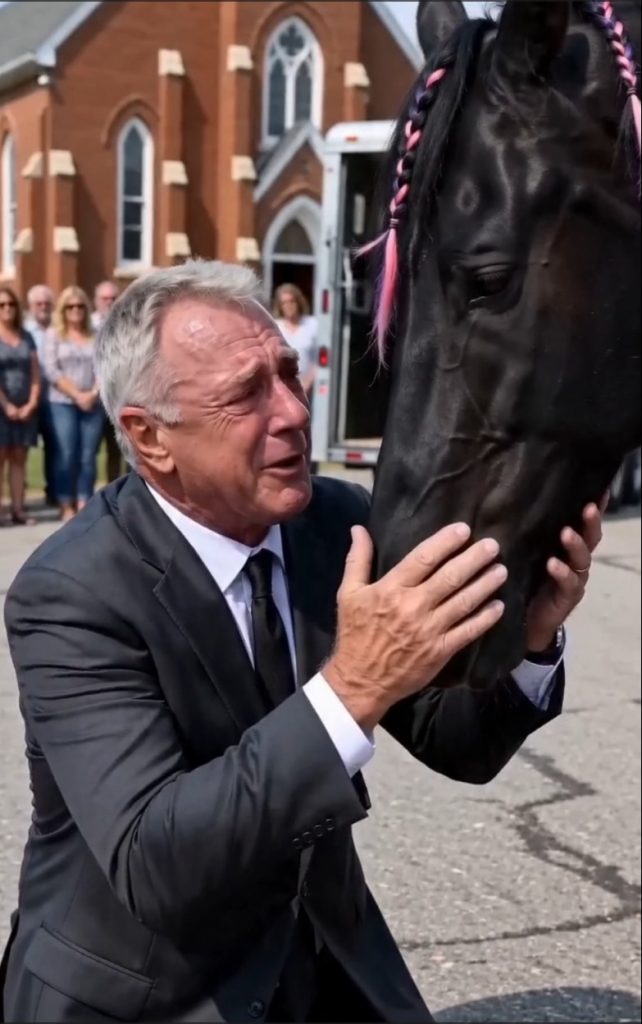
The old man fell to his knees in the middle of the road before anyone could stop him.
The asphalt outside St. Bartholomew’s Church was still warm from the afternoon sun, though snow-white clouds hung low over the red brick steeple. Villagers stood in a quiet line behind him, dressed in dark coats and Sunday shoes, not for a funeral, but for something that felt painfully close.
A horse trailer waited at the edge of the road.
Its back door was open.
That was where Shadow was supposed to go.
The black horse stood before the kneeling man like a monument carved from night. His coat shimmered in the hard sunlight. Pink and purple ribbons trembled in his mane, braided there by a little girl with weak hands and bright eyes just two days before she was rushed back to the hospital.
Arthur Whitfield pressed both hands over his face.
“Shadow…” His voice broke. “I’m so sorry.”
The crowd did not move.
Everyone in the village knew what the horse meant.
Shadow had belonged to Arthur’s late wife, Margaret. She had raised him from a frightened colt with trembling legs into the gentlest animal in the county. After Margaret died, Shadow became the last living piece of her that still breathed in Arthur’s yard.
Then Arthur’s granddaughter, Lily, got sick.
Heart surgery, the doctors said. Emergency transfer. Deposit before the specialist team could begin. Words that sounded clean in hospital hallways and monstrous in the mouth of a grandfather with no money left.
Arthur lowered his hands.
His face was red, his eyes swollen, his dated charcoal suit wrinkled from hours spent sitting beside Lily’s hospital bed.
He reached for Shadow’s muzzle with both hands.
“I promised her I’d never let you go,” he whispered. “But she’s running out of time.”
Shadow lowered his head.
Slowly.
Gently.
As if he understood every word.
Arthur pressed his forehead against the horse’s nose.
“Trade your freedom for her heartbeat, okay?” he pleaded. “Please… just save her.”
Behind him, a woman began to cry.
The buyer, a wealthy breeder named Harlan Pierce, stood beside the trailer with a folded contract in his hand. He looked uncomfortable, but not enough to leave. The bank transfer had already been prepared. Shadow was valuable. Too valuable for an old widower to keep when a child’s life was measured in numbers.
Arthur wrapped his arms around the horse’s head and held on like a drowning man gripping the last piece of land.
“You aren’t just a horse to us,” he whispered. “You’re her guardian angel. Go and do what I can’t.”
Then he pulled back, still on his knees, and stroked Shadow’s cheek one last time.
A small, ruined smile crossed his face.
“Go on now, Shadow,” he said. “Go save my little girl.”
The handler stepped forward with the lead rope.
Shadow did not move.
The handler tugged once.
Shadow stayed still.
Then the horse turned his head, looked past the trailer, and stared directly at the church doors.
And from inside the church, someone began running.
Act II
Arthur Whitfield had never been a man who asked for help easily.
He fixed his own roof, chopped his own firewood, patched the same fence thirty-seven times, and drove the same pickup until people joked the truck would outlive him. When Margaret was alive, she used to say his pride was useful until it started acting like a locked door.
Arthur would grumble.
Then she would kiss his cheek and unlock it anyway.
Margaret had been the soft part of the farm.
She sang while feeding the hens. She remembered birthdays of people who had forgotten hers. She took in damaged animals the way other women collected tea cups, insisting that broken creatures only needed somewhere safe long enough to remember themselves.
Shadow was her miracle.
He arrived during a storm, half-starved and wild-eyed, after being abandoned near the old quarry road. The vet told Margaret not to get attached.
Margaret ignored him.
For months, she slept in the barn when Shadow panicked at night. She read poetry aloud from a folding chair while he learned the sound of kindness. She tied his first ribbon with hands so gentle he did not even flinch.
Years later, when Margaret’s illness came, Shadow stood outside her window every afternoon.
After she died, Arthur could not enter the barn for three weeks.
It was Lily who finally led him back.
She was five then, all brown curls and stubborn questions. She took his hand and said, “Grandma said Shadow gets sad if no one tells him good morning.”
So Arthur told him good morning.
Every day after that.
Lily grew up with Shadow as her shadow. She fed him apples from her lunchbox. She tied ribbons in his mane for every holiday. Pink for spring. Purple for Margaret’s birthday. Gold for Christmas. Once, blue because she said Shadow looked like he was “thinking blue thoughts.”
Then Lily started getting tired.
At first, everyone thought it was childhood weakness after a cold. Then she fainted during church choir practice. Then came doctors, tests, and adult faces trying too hard to look calm.
Arthur sold the tractor first.
Then Margaret’s old silver tea service.
Then the strip of back pasture his father had left him.
None of it was enough.
When the hospital called about the specialist in Boston, Arthur wrote the cost on the back of an envelope and stared at it until the numbers blurred.
He did not tell Lily.
He did not tell the village.
He only went to the barn, stood beside Shadow, and cried into the horse’s mane where no one human could hear him.
But Lily knew.
Children always know when adults are lying through tenderness.
The night before she was transferred, she asked Arthur to bring her ribbon box to the hospital. Her fingers shook as she chose pink and purple.
“Grandma colors,” she said.
Arthur tried to smile.
She tied the ribbons into Shadow’s mane herself from the passenger seat of his truck outside the hospital entrance, because the nurses would not let her walk to the parking lot.
“Don’t let him be lonely,” she whispered.
Arthur promised.
Then, twenty-four hours later, he broke that promise in front of the church.
Because saving Lily meant losing the last thing Margaret had left behind.
Or so he thought.
Act III
The person running out of the church was Reverend Daniel Moore.
He was not dressed for drama. His black clerical shirt was half-buttoned under a brown coat, and he held a yellowed envelope in one hand as if it were burning him.
“Arthur!” he shouted.
The handler paused.
Harlan Pierce frowned.
Arthur slowly rose from the asphalt, one hand still resting on Shadow’s neck.
“Daniel?”
The reverend reached them breathless, his eyes bright with shock.
“Don’t load him yet.”
Pierce’s face hardened.
“The sale has been agreed.”
Daniel ignored him and looked at Arthur.
“I found something in Margaret’s old church archive box.”
Arthur blinked.
“What box?”
“The one she left when she ran the children’s fund. I was clearing the office after the roof leak.” Daniel held up the envelope. “Arthur, it has your name on it.”
The villagers moved closer.
Arthur stared at the handwriting.
Margaret’s handwriting.
His knees nearly failed again.
The envelope was addressed simply:
For Arthur, if he ever tries to sell Shadow for love.
Arthur could not speak.
Daniel opened it carefully and removed a folded letter, along with a small brass key taped to the page.
He read aloud, voice shaking.
My dearest Arthur,
If you are hearing this, then I was right about two things: you are doing something noble, and you are doing it alone because you are too stubborn to let anyone stand beside you.
A broken laugh moved through the crowd. Arthur covered his mouth.
Daniel continued.
Shadow is not to be sold as property. Not because he is worth nothing, but because he is worth more than money in this family. If a day comes when Lily needs help, open the blue trunk beneath the church office stairs. I put it there because you would never look in a church basement for something practical.
Arthur closed his eyes.
Margaret.
Even gone, she knew him too well.
Pierce stepped forward.
“This is sentimental, but I have a contract.”
Shadow turned his head sharply toward him.
The breeder stopped.
Daniel held up the brass key.
“There is a trunk.”
Arthur looked toward the church.
The villagers parted without being asked.
Within minutes, two men carried out an old blue trunk covered in dust and rusted at the corners. Arthur recognized it immediately. Margaret had kept blankets in it years ago, before it vanished from the farm.
Daniel inserted the key.
The lock opened.
Inside were papers, old savings bonds, jewelry wrapped in cloth, and a leather ledger filled with Margaret’s handwriting.
Arthur lifted the top page.
His hands shook.
It was a bank statement.
Then another.
Then a letter from a solicitor.
Margaret had been saving for Lily since the day she was born.
Small amounts. Quiet amounts. Egg money. Craft fair money. Donations she never spent on herself. A life insurance policy Arthur never knew she had kept active. A memorial fund she had redirected into a trust.
Daniel found the final document at the bottom.
Lily Whitfield Emergency Medical Trust.
Arthur could not read after that.
He handed it to the reverend.
Daniel’s voice broke on the amount.
It was enough.
Not just for the deposit.
For the surgery.
For recovery.
For travel.
For hope.
Arthur turned toward Shadow, stunned.
The horse nudged his chest gently, as if he had simply been waiting for the humans to catch up.
Act IV
Harlan Pierce was the only person who did not look relieved.
His jaw tightened as the crowd began to murmur around the open trunk. He looked at the contract in his hand, then at Shadow, then at Arthur.
“You signed,” Pierce said.
Arthur wiped his eyes.
“I signed because my granddaughter needs surgery.”
“And I agreed to pay.”
Daniel stepped between them.
“The circumstances have changed.”
Pierce’s voice sharpened. “A contract is a contract.”
The road went silent.
Arthur looked smaller than he had a moment before, but only for a breath. Then something in his face settled.
Not anger.
Resolve.
“No,” he said quietly. “A contract made by a desperate man kneeling in the road is not the same as a fair sale.”
Pierce laughed once.
“That horse is worth three times what I offered. I was doing you a favor.”
Arthur looked at him.
“That’s exactly why Margaret hid the trunk.”
The words landed hard.
The villagers understood then what Arthur was only beginning to see.
Pierce had known Shadow’s value.
He had come not as a savior, but as a man who saw grief and named it opportunity.
An older woman from the crowd stepped forward. Mrs. Bellamy, who ran the village bakery and feared no one with money.
“You knew he was selling because of Lily,” she said.
Pierce looked at her coldly.
“Everyone knew.”
“And you still offered him less than half the horse’s value.”
Pierce folded the contract.
“I offered cash immediately. That is what he needed.”
Arthur’s fingers tightened around Shadow’s lead rope.
For years, he had thought dignity meant enduring pain quietly.
But Margaret’s letter had opened more than a trunk.
It had opened his eyes.
He looked at Pierce and said, “You may leave now.”
Pierce stepped closer. “You’ll hear from my attorney.”
A voice from behind the crowd answered, “Good. He can hear from mine.”
A woman in a dark coat emerged from the back of the gathering, phone pressed in one hand, legal folder in the other.
Clara Whitfield.
Arthur’s daughter.
Lily’s mother.
She had driven straight from the hospital after Daniel called her.
Her face was pale from worry, but her eyes were fierce.
“Lily is stable,” she said to Arthur first.
Arthur’s face crumpled.
Clara took his hand.
“The hospital confirmed the trust transfer. Surgery is moving forward.”
Arthur bowed his head, overcome.
Then Clara turned to Pierce.
“I reviewed the document my father signed. No witness. No independent valuation. No cooling period. No disclosure that you had previously tried to buy Shadow through two intermediaries.”
Pierce went still.
Arthur looked at him sharply.
“What?”
Clara lifted the folder.
“Margaret kept copies of everything. Including the letters she wrote refusing your offers.”
The villagers shifted, anger moving through them like a wind.
Pierce’s mask thinned.
“He is a horse,” he snapped. “A valuable animal wasted in a village field.”
Arthur stepped toward him.
“No. He is a promise.”
Shadow lowered his head until his muzzle brushed the pink and purple ribbons.
The same colors Margaret had loved.
The same colors Lily had tied with trembling fingers.
Pierce looked around and saw no ally left.
Then he walked to his trailer, slammed the door shut, and drove away without the horse.
The crowd watched until the trailer disappeared beyond the church bend.
Only then did Arthur let himself breathe.
Act V
Lily’s surgery lasted six hours.
Arthur spent every one of them in the hospital chapel with Shadow’s ribbons wrapped around his wrist.
He had removed them carefully before leaving the church road, afraid the wind might loosen them. They smelled faintly of hay, dust, and the strawberry hand lotion Lily used because she said hospital soap smelled too serious.
Clara sat beside him.
Neither of them spoke much.
There are fears too large for conversation. They fill every chair, every corner, every second between footsteps in the hall.
At one point, Arthur unfolded Margaret’s letter again.
He read the last lines silently.
Do not sell love to pay for life, Arthur.
Let love reveal what I prepared.
And when Lily wakes, tell her Shadow kept his promise.
Arthur pressed the paper to his lips.
When the surgeon finally entered, Clara stood so quickly her chair struck the chapel wall.
The doctor removed his cap.
“She did well,” he said.
For a second, Arthur heard nothing after that.
Did well.
Two small words.
Enough to rebuild the world.
Clara began sobbing into her hands. Arthur sat down hard, the ribbons crushed against his chest, his whole body shaking with a relief so deep it hurt.
Lily woke the next morning.
Pale.
Weak.
Alive.
Arthur entered carefully, afraid to bring too much emotion into a room full of tubes, monitors, and soft beeping sounds.
Lily turned her head.
“Grandpa?”
He was beside her in three steps.
“Right here, little bird.”
Her eyes searched his face.
“Where’s Shadow?”
Arthur smiled through tears.
“Home.”
She blinked.
“You didn’t sell him?”
“No.”
“But my heart?”
“Your grandmother took care of that.”
Lily frowned sleepily.
“Grandma?”
Arthur kissed her hand.
“She left us a miracle in a blue trunk.”
Lily closed her eyes, and one tear slid sideways into her hair.
“I knew she would.”
Weeks passed before Lily could return to the farm.
When she did, the whole village came.
No speeches. No banners. No cameras.
Just neighbors lining the fence as Clara carried Lily from the car and Arthur walked beside them with one arm ready, though Lily insisted she could stand for a moment.
Shadow waited near the barn gate.
The instant he saw her, he lifted his head.
Lily smiled.
It was small, tired, and brighter than sunlight.
“Shadow,” she whispered.
The horse walked to her slowly, as if he understood that this child was not to be rushed. He lowered his massive head until his muzzle rested against her shoulder.
Lily wrapped both arms around his face.
Arthur looked away.
So did half the village.
Some reunions are too holy to watch directly.
After that day, the farm changed.
Not in grand ways.
In living ways.
The villagers repaired the barn roof. Mrs. Bellamy organized a fundraiser that Arthur pretended to dislike and secretly cried over. Reverend Daniel helped Clara establish the trust properly. Margaret’s blue trunk was cleaned, restored, and placed in the front room beneath her photograph.
Inside it, Arthur kept the ribbons.
Not because they were valuable.
Because they had survived the day he almost lost everything.
Harlan Pierce never returned.
His attorney sent one letter. Clara sent three back. That ended it.
Months later, when Lily was strong enough to walk to the pasture, Arthur took her hand and led her to the place where Shadow grazed under the evening sky.
“You know,” Lily said, “Grandma didn’t want Shadow to go.”
Arthur looked at her.
“No. She didn’t.”
“But you were going to let him.”
His throat tightened.
“I was trying to save you.”
Lily leaned against him.
“I know.”
The forgiveness in her voice nearly broke him.
Then she added, “Next time, ask Grandma’s trunk first.”
Arthur laughed.
A real laugh.
The kind he had not heard from himself since before Margaret died.
“I will.”
Shadow came over then, nudging Arthur’s shoulder as if agreeing.
The old man stroked his black coat, watching the last light move across the pasture.
For months, he had believed love meant sacrifice.
He had been willing to give away the last piece of his wife, the horse his granddaughter adored, the only steady thing left in a life torn open by fear.
But Margaret had known something better.
Love was not only sacrifice.
Love was preparation.
Protection.
A key hidden where pride would not look.
A trust built coin by coin.
A horse who stood still in the road until the truth arrived.
That day outside the red brick church, Arthur thought he was saying goodbye.
Instead, Shadow refused to leave.
And because he stayed, a promise was kept.
A child’s heart kept beating.
And the last gift Margaret Whitfield ever gave her family was not money in a trunk.
It was the proof that even after death, love can still arrive on time.