Act I
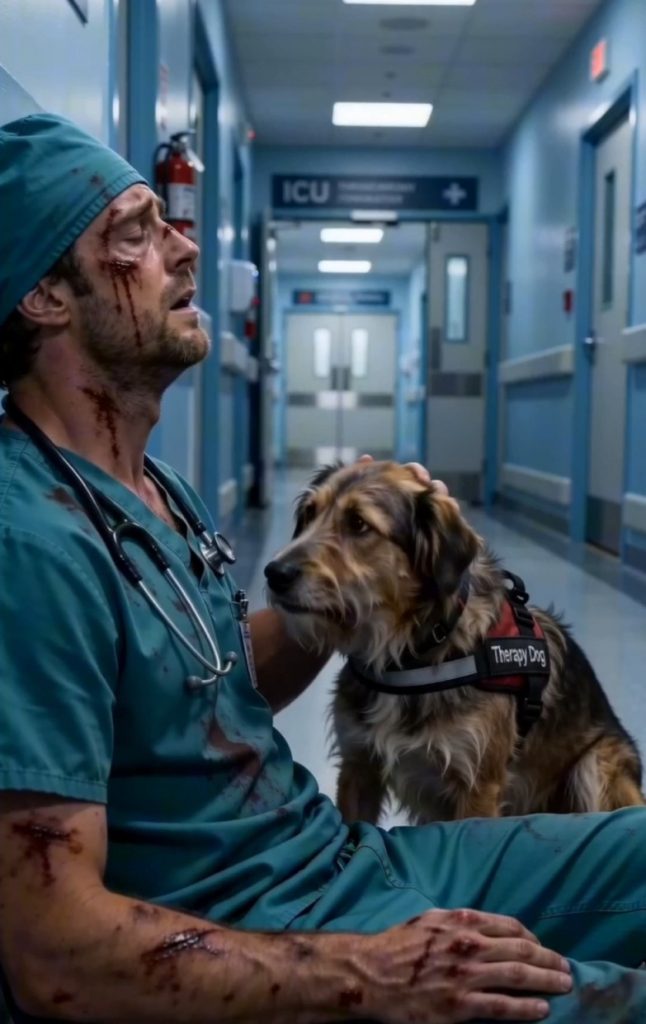
Dr. Elias Monroe slid down the hospital wall like his body had finally remembered it was human.
The corridor outside the Intensive Care Unit was empty, washed in cold blue light. Fluorescent bulbs flickered above him. A red fire extinguisher hung on the wall opposite, bright and silent, like a warning no one had yet understood.
His green scrubs were stained from a twelve-hour surgery.
His hands still trembled.
His surgical cap sat crooked on his head. Dried streaks marked his face where he had wiped sweat, tears, and fear away with the back of one gloved wrist. The stethoscope around his neck felt heavier than any medal, any title, any praise he had ever received.
He had saved thousands of strangers.
Tonight, the child on the table had been his own.
Mia.
His daughter.
His fourteen-year-old girl who hated mushrooms, drew constellations on napkins, and told him he worked too much with the tired honesty of someone who had stopped expecting him to deny it.
Now she was behind the ICU doors with machines breathing around her.
Elias sat on the floor with his legs spread, chest rising too fast. His eyes closed. His head hit the wall softly.
Inside him, one thought kept circling.
Please don’t let me be too late.
Something warm leaned against his hip.
Cooper.
The shaggy brown-and-tan dog wore a blue Therapy Dog vest, though no vest could explain what he meant to Mia. His fur was messy from spending all day at the hospital, refusing food, refusing water, refusing every nurse who tried to lead him away from the ICU doors.
Cooper sat between Elias’s legs and pressed his whole weight against him.
Not begging.
Anchoring.
Elias opened one eye and looked down.
“You’re the only one who can feel her heart beating too, aren’t you, boy?” he whispered.
Cooper lifted his head.
His ears tilted toward the ICU.
Elias ran a shaking hand through the dog’s fur. The motion was slow, automatic, almost prayerful. Cooper closed his eyes and leaned into his palm.
For a few seconds, the hospital was quiet.
Then Cooper’s body went rigid.
His head snapped toward the ICU doors.
A red alarm light began flashing above them.
The doors burst open.
A nurse ran into the hallway, pale and breathless.
“Doctor! Get up!” she screamed. “It’s her. She’s crashing. We’re losing her!”
Elias did not remember standing.
He only remembered Cooper lunging forward before him, barking once toward the doors, as if the dog had known the storm was coming before the machines dared to say it.
Act II
Before Mia was a patient, she was the girl who lived in waiting rooms.
Not because she was sick.
Because her father was always inside the hospital.
Elias Monroe had become a surgeon the way some men become soldiers. Fully. Obsessively. With no room left for ordinary weakness. He was the doctor other doctors called when a body was broken beyond hope. He could stand in an operating room for sixteen hours and still make the final stitch as steady as the first.
People called him gifted.
His daughter called him late.
Late to birthdays.
Late to school plays.
Late to dinner.
Late to the father-daughter dance where Mia sat in a blue dress beneath paper stars while Cooper rested his head in her lap and her teacher pretended not to look sorry for her.
Elias always had reasons.
Emergency surgery. A hospital shortage. A life no one else could save.
Mia never said the reasons were bad.
That made it worse.
After her mother died, Mia had stopped asking for much. Elena Monroe had been the warm center of the house, the one who remembered field trip slips and baked banana bread at midnight, the one who taught Mia that the moon looked closer when you were sad.
Cancer took her in eleven months.
Elias survived by working.
Mia survived by finding Cooper.
He had been a rescue dog with one torn ear and a suspicious heart. Mia met him at a hospital therapy program after Elena’s death and sat beside him for an hour without speaking. When she finally looked up at Elias, her eyes were red but clear.
“He listens better than people,” she said.
Elias adopted him the next day.
At first, Cooper was supposed to help Mia grieve.
Then he began doing more.
He woke her from nightmares before she cried out. He nudged her hand during panic attacks. He sat outside the bathroom door when she locked herself in after bad days at school. Somehow, without being trained for it, Cooper knew when Mia’s body was slipping into fear before Mia knew it herself.
Elias noticed, but he did not ask enough questions.
He was always rushing.
Then came the accident.
A rainy Thursday evening. A school debate event. Mia waiting on the curb outside the civic center because Elias had texted that he was ten minutes away.
He was thirty-two minutes late.
By the time he arrived, police lights were spinning across wet asphalt. A black SUV had jumped the curb. The driver claimed the brakes failed. Three students were injured. One teacher had a broken arm.
Mia had taken the worst of it.
Elias ran through the rain and saw Cooper first.
The dog had escaped the house somehow, or followed the scent, or done the impossible in the way animals sometimes do when love refuses distance. He stood beside Mia on the pavement, soaked and trembling, growling at anyone who moved too fast near her.
Elias dropped to his knees.
“Mia,” he said. “Baby, look at me.”
Her eyes fluttered open.
She tried to smile.
“You’re late,” she whispered.
Then she lost consciousness.
At the hospital, every rule Elias had ever believed in shattered.
Surgeons were not supposed to operate on family.
He knew that.
He had taught that.
But the only pediatric trauma specialist was across the city, trapped behind a freeway pileup. Mia’s blood pressure was dropping. Time was not a door they could wait politely beside.
The chief of surgery looked at him.
“Elias,” she said, “you don’t have to.”
He scrubbed in without answering.
For twelve hours, he was not a father.
He could not be.
He became hands. Breath. Commands. Decisions. Needle. Clamp. Repair. Again. Again. Again.
When it was over, Mia had a pulse.
A fragile one.
A fighting one.
That was enough to make everyone call it a miracle.
Everyone except Elias.
Because while they moved her to ICU, he looked down at Cooper sitting outside the operating wing with Mia’s torn blue ribbon in his mouth.
And the dog was still shaking.
Act III
When the nurse screamed, Elias ran.
The ICU room was chaos.
Monitors flashed. Nurses moved around Mia’s bed with fast, practiced fear. A respiratory therapist called numbers. Someone shouted for medication. Someone else adjusted the lines near Mia’s arm.
Mia lay pale and still beneath the white blankets.
Too still.
Elias forced himself to see the patient.
Not his daughter.
The patient.
“What happened?” he demanded.
“Pressure dropped,” the nurse said. “Heart rhythm unstable. Oxygen falling.”
Elias moved to the bedside.
His mind cut through exhaustion.
Bleeding. Clot. Reaction. Hidden injury. Surgical complication. Something missed.
The thought nearly broke him.
Something missed.
By him.
Cooper barked sharply from the doorway.
A nurse tried to block him.
“Get him out.”
“No,” Elias snapped.
Cooper pushed past her and went straight to the left side of Mia’s bed. He did not jump. He did not panic. He pressed his nose near the blanket beneath her ribs, then lifted his head and whined.
Elias stared.
“Again,” he whispered.
Cooper sniffed the same place, then pawed gently at the blanket.
A memory came back.
Mia laughing in the kitchen months earlier, dropping a spoon while Cooper shoved his nose against her side.
“He does this when my heart gets weird,” she had said.
Elias had barely looked up from his phone.
“Your heart is fine.”
“It doesn’t feel fine.”
“You’re anxious, sweetheart.”
She had gone quiet after that.
Now the words struck him with sickening force.
Your heart is fine.
He had dismissed what the dog had known.
What Mia had tried to tell him.
Elias ripped back the edge of the blanket and checked the area Cooper had marked. No obvious bleeding. No swelling dramatic enough to explain the crash. But something about the pattern of her monitors did not match the story they had been telling themselves.
“Get me an ultrasound,” Elias said.
A resident hesitated. “Doctor, we already scanned post-op.”
“Do it again.”
The machine was rushed in.
Elias took the probe himself.
His hand shook once.
Then steadied.
The image appeared in grainy black and gray.
For three seconds, no one understood.
Then Elias saw it.
A small hidden pocket of fluid pressing where pressure should never be. Not massive. Not obvious. Just enough. Just perfectly placed to steal time while looking like something else.
“Pericardial tamponade,” he said.
The room went silent.
It was rare after the repair Mia had needed. Easy to miss. Easy to blame on shock, exhaustion, medication, trauma.
Easy to lose her.
Elias looked at Cooper.
The dog stared back, eyes bright and desperate.
“Prep the room,” Elias said. “Now.”
The nurse’s voice trembled. “You just finished twelve hours.”
Elias looked at his daughter.
“No,” he said. “I didn’t.”
Act IV
The second procedure was shorter.
It felt longer.
Elias worked with the strange calm of a man standing at the edge of his own life. Every movement mattered. Every breath mattered. The room narrowed until there was only Mia, the monitor, and the terrible knowledge that love had almost made him blind twice.
Outside the operating room, Cooper waited with his body pressed against the door.
Security tried to move him once.
He showed his teeth.
No one tried again.
At 3:41 in the morning, Mia’s rhythm steadied.
At 3:47, her pressure climbed.
At 3:52, Elias stepped back and almost fell.
The assisting surgeon caught his elbow.
“She’s stabilizing,” she said.
Elias nodded, but he could not speak.
If he opened his mouth, he knew he would stop being a doctor in front of everyone.
So he left the room.
Cooper stood immediately.
Elias sank to his knees in the hallway, and the dog rushed into him, pressing his head beneath Elias’s chin. This time, Elias did not pet him like a doctor soothing an animal.
He held him like a father holding the only witness brave enough to tell the truth.
“I’m sorry,” Elias whispered into Cooper’s fur. “I should have listened.”
But the night was not finished with them.
At dawn, two police officers arrived.
They asked about the accident.
Elias had almost forgotten there was a world outside Mia’s room. The SUV. The curb. The driver who claimed the brakes failed.
Then one officer placed a plastic evidence bag on the table in the family consultation room.
Inside was Mia’s phone.
The screen was cracked, but intact.
“We recovered a video,” the officer said. “Your daughter had started recording before the vehicle hit.”
Elias went cold.
The video was shaky. Rain blurred the frame. Mia’s voice was faint, annoyed, almost normal.
“Dad’s late again,” she said to someone off camera. “Cooper’s going to be mad at him.”
Then headlights swung too fast into view.
A horn.
Screams.
But before impact, another voice came from near the SUV, sharp and furious.
“Do it now. He’ll come running if it’s his kid.”
Elias stared at the officer.
“What does that mean?”
The officer looked grim.
“The driver wasn’t random.”
The black SUV was registered to a contractor whose company had been under investigation for illegal dumping tied to hospital expansion land. Elias had testified against them the week before, after discovering forged safety reports involving contaminated soil near a children’s clinic site.
He had thought it was paperwork.
He had thought the threats sent to his office were desperate noise.
He had not thought they would touch Mia.
But the police had found messages.
Payments.
A plan not necessarily to kill, but to frighten, to silence, to make the surgeon withdraw his testimony before the hearing that could destroy millions in contracts.
They had chosen his daughter because Elias had spent years proving she was where he was weakest.
The guilt hit him so hard he had to sit down.
Cooper placed his head on Elias’s knee again.
This time, Elias did not look away from the pain.
He let it enter.
He let it name him.
A father who had saved strangers and missed warnings at home.
A doctor whose enemies knew his child mattered, even when his calendar had forgotten.
A man who had almost lost Mia twice in one night.
Once to violence.
Once to his own certainty.
Act V
Mia woke three days later.
Not fully.
Not dramatically.
Her eyes opened just enough to find the shape of her father sitting beside the bed.
Elias leaned forward so quickly the chair scraped the floor.
“Mia?”
Her lips moved.
No sound came.
He pressed the call button with one hand and took hers with the other.
Cooper, who had been sleeping beneath the bed against hospital policy no one cared to enforce anymore, lifted his head and rose.
Mia’s gaze shifted.
Her fingers twitched.
Cooper placed his chin carefully on the mattress.
Mia looked at him.
Then at Elias.
Her voice came out thinner than breath.
“You listened to him?”
Elias broke.
Not loudly.
Not in a way that frightened her.
Tears simply filled his eyes and fell before he could stop them.
“Yes,” he whispered. “Finally.”
Mia closed her eyes.
A tiny tear slipped toward her temple.
“Good,” she breathed.
The recovery was slow.
Painfully slow.
There were days Mia could sit up for ten minutes and days when ten seconds felt like too much. There were tubes, scans, therapy sessions, nightmares, legal interviews, and long silences where father and daughter had to learn how to be honest without the old habits swallowing them.
Elias took leave from the hospital.
At first, everyone praised him for it like sacrifice.
Mia did not.
She only said, “About time.”
He laughed because she wanted him to.
Then he cried in the hallway where she could not see.
The case against the contractor spread wider than anyone expected. The crash exposed the threats. The threats exposed the corruption. The corruption exposed a chain of officials, donors, and executives who had treated the hospital expansion like a gold mine and the neighborhood around it like disposable dirt.
Elias testified anyway.
This time, he brought Mia’s blue ribbon in his jacket pocket.
Cooper came too, wearing his Therapy Dog vest, lying at Elias’s feet in the courtroom as if daring anyone to lie where he could hear it.
When the prosecutor asked why Elias still chose to testify after what had happened to his daughter, he looked toward Mia’s empty seat. She was not strong enough to attend, and he was grateful for that.
Then he answered.
“Because silence is how people like this decide whose children count.”
The courtroom went still.
The convictions came months later.
They did not heal Mia.
They did not erase the surgery scars.
They did not give Elias back the years he had spent choosing emergency rooms over dinner tables.
But they gave the truth a shape.
That mattered.
When Mia finally came home, the house looked different.
Not because Elias had redecorated.
Because he had removed the things that proved he had always been halfway gone.
The pager no longer sat beside the dinner plates. The laptop no longer lived open on the kitchen counter. His hospital shoes stayed by the door. On the refrigerator, where schedules and discharge papers had once crowded everything else, Elias taped a handwritten note.
Listen first.
Mia read it and rolled her eyes.
“That’s cheesy.”
“I’m learning.”
“You’re bad at handwriting.”
“I’m learning that too.”
Cooper barked once.
Mia smiled for the first time without effort.
Spring arrived carefully.
Mia began walking again, first down the hallway, then to the porch, then one slow lap around the garden with Cooper pacing beside her like a royal guard. Elias walked behind them, close enough to catch her, far enough to let her try.
One evening, they sat outside under a pale sky streaked with the first stars.
Mia wore a blanket around her shoulders.
Cooper rested across her feet.
Elias sat beside her, holding two mugs of tea neither of them really wanted.
“Dad?” she said.
“Yeah?”
“When I told you something felt wrong before, you always said it was anxiety.”
Elias swallowed.
“I know.”
“It was sometimes.”
“I know.”
“But not always.”
He looked at her.
“No,” he said. “Not always.”
She nodded slowly.
“I need you to believe me faster.”
There it was.
Not anger.
Not accusation.
A boundary.
A child asking not to be dismissed by the person sworn to protect her.
Elias set his mug down.
“I will.”
Mia looked at him with the weary intelligence of someone who had survived too much to accept easy promises.
“Don’t say it like a doctor.”
He breathed out.
Then he nodded.
“I will believe you faster because you deserve that from me. Because I love you. Because being scared for you is not the same as listening to you.”
Mia looked away quickly.
But not before he saw her eyes shine.
Cooper lifted his head and nudged her hand.
She laughed softly.
“You’re so dramatic,” she told him.
The dog wagged his tail once, satisfied.
Months later, the hospital created a new policy for animal-assisted patient observation in pediatric trauma recovery. It was official, careful, full of medical language.
Elias hated the name.
Mia called it Cooper’s Rule.
That name stuck.
The first line of the training manual was simple:
Families notice what machines may not.
Elias returned to surgery eventually, but not as the same man.
He still saved strangers.
He still worked long hours when lives demanded it.
But he stopped worshiping urgency so much that it devoured everything quieter. He came home when he said he would. He answered Mia’s calls. He listened when Cooper paced, whined, or refused to leave her side.
And sometimes, late at night, he walked down the hospital corridor outside the ICU and remembered the cold floor, the red alarm light, the dog leaning against his hip, and the nurse screaming that his daughter was crashing.
He remembered the terror.
He remembered the guilt.
But most of all, he remembered the moment Cooper knew before anyone else.
Not because he was magic.
Because he was paying attention.
That was the lesson Elias carried for the rest of his life.
Love was not only the grand rescue.
Not only the twelve-hour surgery.
Not only the heroic sprint through flashing lights when everything was already falling apart.
Sometimes love was quieter.
A dog waiting at a door.
A daughter saying something felt wrong.
A father finally stopping long enough to hear her.
And on the nights when Mia slept safely at home with Cooper at the foot of her bed, Elias would stand in the doorway and listen to the ordinary sound of her breathing.
Steady.
Alive.
Enough.