Act I
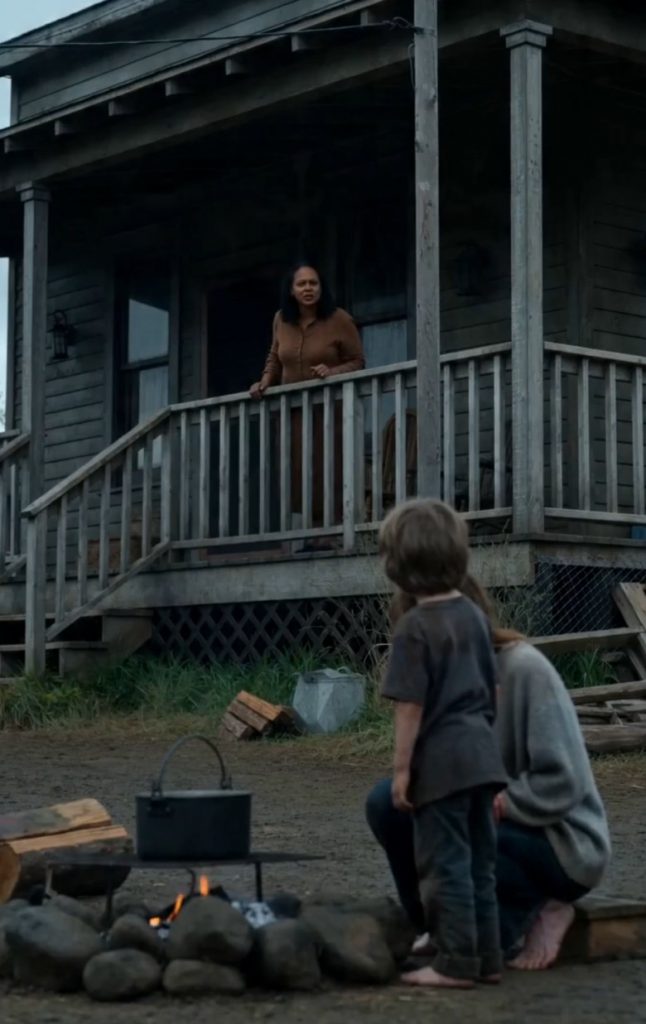
Erin Cole was crouched in the mud when the neighbor began shouting.
Smoke curled from the small fire pit in front of the weathered wooden house, carrying the thin smell of boiled potatoes and rainwater. The pot rattled softly on the metal grate, though there was barely enough inside to call it dinner.
Beside Erin stood Mason, five years old, barefoot on the damp ground.
His toes curled against the cold dirt. His faded shirt hung loose from his shoulders, and his face was smudged where he had rubbed his cheek with an ashy hand. He did not cry. That was what made Erin’s heart ache worse.
Hungry children eventually learn when crying changes nothing.
From the porch of the neighboring house, Darlene Price leaned over the railing with her arms folded and her mouth twisted into a smile that was not a smile at all.
“You should be ashamed of yourself,” she called. “Raising that boy dirty and hungry.”
Erin stiffened.
The words landed in the yard like stones.
Mason moved closer to her side.
Erin reached up and pulled him gently against her, one red, calloused hand on his small shoulder. Her grey sweater was stretched and dirty, the sleeves frayed at the wrists. She had gone barefoot because Mason’s shoes had holes and she had given him her last dry socks to wear at night.
“Mason,” she whispered, “don’t listen to her.”
But children listen to everything.
Darlene laughed from the porch.
“That boy needs a real home. Not a mother who cooks scraps outside like a stray.”
Erin lowered her eyes to the fire.
She could have answered.
She could have told Darlene that the electricity had been cut off two days earlier. That the landlord refused to fix the stove because Erin was already behind. That she had spent the morning washing Mason’s school clothes in a bucket and the afternoon standing in line at the food pantry, only to be told they had run out before her turn.
She could have said all of it.
But poverty is already loud enough without explaining itself to people waiting to enjoy the sound.
Then the low rumble of an engine rolled into the yard.
Darlene stopped mid-insult.
A black luxury SUV turned off the muddy road and pulled up near the broken fence, its tires sinking slightly into the wet ground. The vehicle looked impossible there, too polished for the neighborhood, too expensive for a place where people patched windows with plastic and prayed roofs lasted one more winter.
A man stepped out.
Dark navy suit. White shirt. Silk tie. Brown leather briefcase.
He looked at the house, then at the woman crouched by the fire.
“Erin Cole?”
Erin turned slowly.
“Yes,” she whispered.
The man walked toward her, his polished shoes darkening in the mud. He stopped a few feet away and held out a white envelope sealed with red wax.
“I’m here to deliver a formal notice,” he said. “It concerns an inheritance. You should open it right now.”
Erin stared at the seal.
Behind her, Darlene gripped the porch railing.
Because she recognized the crest pressed into the wax.
And she knew, before Erin did, that the woman she had just called worthless had been the owner of everything all along.
Act II
Erin did not take the envelope at first.
Her hands were too dirty.
That was the first thought that came to her, absurd and humiliating. Not the word inheritance. Not the black SUV. Not the lawyer standing in the mud like he had walked out of another life entirely.
Only her hands.
Red from cold. Rough from scrubbing laundry in a plastic bin. Dark under the nails from breaking scrap wood for the fire.
The lawyer seemed to understand.
He lowered the envelope slightly, not impatiently, not with pity, but with a quiet respect that nearly undid her more than Darlene’s cruelty.
“My name is Malcolm Reed,” he said. “I represent the estate of Margaret Cole Whitmore.”
Erin’s face went blank.
Mason looked up at her.
“Mommy?”
She could barely hear him.
Margaret Cole Whitmore.
The name was one Erin had not spoken in years.
Her grandmother.
Not the kind in storybooks who baked pies and sent birthday cards. Margaret Cole Whitmore had been a hard woman from a hard family, owner of timberland, rental houses, and half the mineral rights in Blackridge County. She wore pearls to breakfast and carried grudges like heirlooms.
When Erin was nineteen, she had left the Whitmore house with one suitcase and a bruised heart.
She had not looked back.
Or rather, she had looked back every day and pretended she hadn’t.
Erin’s mother, Ruth, had been Margaret’s only daughter. Ruth married beneath the family’s expectations, then died before she could repair what pride had broken. Erin grew up between two worlds: the big white Whitmore house on the hill and the small rented places her father could afford when Margaret cut them off.
By the time Erin was grown, she had learned that rich families could make abandonment look like discipline.
Margaret offered her a deal once.
Come back.
Use the Whitmore name.
Let the family choose her college, her career, her husband, her future.
Erin refused.
A year later, she fell in love with a mechanic named Caleb Hart, who loved her without asking permission from anyone. He died before Mason was born, crushed under a logging truck whose brakes should have been repaired weeks earlier.
The settlement never came.
The company denied fault. The paperwork vanished. Witnesses changed their stories.
Erin fought until she had no money left to fight with.
Then Mason arrived, small and furious and alive, and survival became louder than justice.
Margaret never came.
Not to the funeral.
Not to the hospital.
Not when Erin lost the apartment.
Not when she moved into the rotting house near Darlene Price and learned which floorboards would hold her weight.
For five years, Erin told herself she did not need the Whitmores.
But need is not always pride’s decision.
It lives in empty cupboards.
In unpaid power bills.
In a child’s bare feet on cold mud.
Now Margaret’s lawyer stood before her with an envelope sealed in red wax.
Erin finally reached for it.
Her fingers trembled so badly the paper shook.
Darlene descended her porch steps without realizing she was doing it.
“What’s this about?” she demanded.
Malcolm Reed did not look at her.
“This matter concerns Ms. Cole.”
Darlene’s face tightened.
“She lives there.” She pointed at the sagging house. “That’s my property line she’s always crossing with smoke and trash.”
Erin looked down at the envelope.
The wax seal bore the Whitmore crest: a pine tree above a river.
The same symbol that had hung over her grandmother’s fireplace.
The same symbol printed on trucks that once carried timber through half the county.
The same symbol on the company that killed Caleb.
And suddenly, inheritance no longer felt like rescue.
It felt like a door opening into a room full of ghosts.
Act III
Erin broke the seal with her thumb.
Inside was a formal letter, thick paper folded twice, with a second smaller note tucked behind it. Malcolm waited in silence while she read.
The first lines blurred.
Then one sentence became clear.
You are hereby notified that Margaret Cole Whitmore, deceased, has named Erin Ruth Cole as sole beneficiary and controlling trustee of the Whitmore Family Estate, including all residential properties, land holdings, mineral rights, business shares, and pending legal claims.
Erin stopped breathing.
Mason leaned against her knee.
“Mommy, what does it say?”
She could not answer.
Darlene pushed closer, trying to see the page.
“Sole beneficiary?” she snapped. “That can’t be right.”
Malcolm finally turned to her.
“Mrs. Price, unless you are named in this notice, I suggest you step back.”
Darlene recoiled, but only slightly.
Her eyes were wild now, darting between the envelope, Erin, and the black SUV.
Erin looked at Malcolm.
“Why now?”
His expression softened.
“Mrs. Whitmore died twelve days ago.”
The news struck Erin strangely.
Not like grief.
Not like relief.
Like a bell heard from underwater.
She had hated Margaret. Missed her. Feared her. Wanted her approval. Wanted never to see her again.
All of it rose at once.
Malcolm opened his briefcase and removed a second folder.
“There is more,” he said. “Your grandmother left a private letter. She instructed that you read it before anyone else speaks to you about the estate.”
Erin unfolded the smaller note.
The handwriting was Margaret’s.
Sharp. Elegant. Unforgiving even in ink.
Erin,
If you are reading this in hardship, then my worst fear came true: my pride outlived my sense.
I do not deserve your forgiveness. I mistook control for protection, and when you refused to be controlled, I called it betrayal.
I also know what happened to Caleb was not an accident.
Erin’s knees weakened.
She gripped the paper until it creased.
Malcolm stepped closer, ready to catch her if she fell, but Erin forced herself to stay upright.
She kept reading.
The logging company falsified maintenance records. Payments were made to silence witnesses. I allowed my board to settle it quietly because exposing them would have damaged the Whitmore name.
That was my sin.
Before my death, I reopened the claim. Evidence is enclosed. The men responsible will face trial if you choose to proceed.
All assets now belong to you and to Mason after you.
Do not let anyone tell you that you arrived too late.
You were always the heir.
Erin pressed one hand over her mouth.
A sound escaped her, small and broken.
Mason wrapped both arms around her leg.
Darlene whispered, “No.”
Not in sympathy.
In fear.
Malcolm looked toward the weathered house behind Erin.
“There’s one more matter,” he said.
Erin lifted her tear-filled eyes.
“What?”
He glanced at Darlene.
“This property is part of the Whitmore Estate.”
Darlene’s face drained.
“No, it isn’t.”
Malcolm removed another document.
“The deed was transferred into a subsidiary holding company eleven years ago. Mrs. Price has been collecting rent from tenants without legal authority since the company dissolved.”
Erin turned slowly.
Darlene backed up one step.
For years, Darlene had called Erin a squatter, a burden, a bad mother living in a house she could barely pay for.
But now the mud, the broken fence, the porch, the rusted barrels, the house with the leaking roof — all of it stood beneath a different truth.
Darlene had not been looking down at a poor woman from her porch.
She had been looking down at the owner.
Act IV
Darlene recovered fast.
Cruel people often do when survival requires a new mask.
She put one hand to her chest and laughed shakily.
“Well, obviously there’s been a mistake. I’ve managed this neighborhood for years. Everybody knows that.”
Malcolm’s voice was calm.
“You have no legal management authority.”
“I collected money because someone had to keep order.”
Erin’s head snapped up.
“Order?”
Darlene looked at her.
Then at Mason.
Then away.
Erin’s voice shook, but not from weakness now.
“You charged me rent on a house I owned?”
Darlene’s mouth tightened.
“You didn’t own anything five minutes ago.”
“I owned it,” Erin said. “I just didn’t know.”
The words seemed to straighten her spine.
Mason looked up at her, sensing the change before understanding it.
Malcolm opened the folder again.
“Ms. Cole, there are records of payments made by you to Mrs. Price over the last three years. There are also notices she filed threatening eviction under false authority. We can pursue recovery.”
Darlene’s anger flashed.
“Oh, listen to him. He shows up in a shiny car, and suddenly you think you’re better than everybody.”
Erin stared at her.
For years, Darlene had used shame like a fence.
Dirty child.
Bad mother.
Hungry boy.
Ashamed.
Ashamed.
Ashamed.
Now Erin saw the truth underneath.
Darlene did not hate poverty.
She hated seeing someone poorer than herself still holding on to love.
Erin pulled Mason closer.
“I never thought I was better than you,” she said quietly. “That was always your obsession.”
Darlene’s face twisted.
“You think money will fix you?”
“No,” Erin said. “But it will fix the roof. It will buy my son shoes. It will turn the heat back on. And it will pay lawyers to ask why my husband died under a truck your friends told me was safe.”
Darlene went still.
That was when Erin understood.
“You knew.”
The yard seemed to empty of sound.
Even the fire cracked softer.
Darlene swallowed.
“I don’t know what you’re talking about.”
Malcolm watched her carefully.
Erin stepped forward, barefoot in the mud, still wearing the dirty oversized sweater, still exhausted, still pale — but no longer small.
“You knew Caleb’s accident wasn’t right.”
Darlene’s eyes flicked toward the road.
One glance.
One tiny betrayal of panic.
Malcolm noticed.
“Mrs. Price,” he said, “I should inform you that the estate investigation includes witness tampering tied to the logging company. If you have information, now would be an excellent time to obtain counsel.”
Darlene’s porch suddenly looked much less high.
She opened her mouth, but nothing useful came out.
Behind Erin, Mason tugged her sleeve.
“Mommy,” he whispered, “are we in trouble?”
Erin crouched again.
But this time, it did not make her look defeated.
It made her eye-level with her son.
“No,” she said. “Not anymore.”
He looked at the pot over the fire.
“Can we still eat?”
The question pierced her.
Because to Mason, inheritance meant nothing yet.
The SUV meant nothing.
The lawyer meant nothing.
Dinner still mattered most.
Erin wiped his cheek with her thumb.
“Yes, baby,” she whispered. “But tonight we’re eating somewhere warm.”
Malcolm’s expression tightened with emotion, though he kept his professional posture.
“I can arrange immediate accommodations,” he said. “The estate house is ready whenever you are.”
Erin looked toward the road beyond the yard.
The Whitmore house on the hill had always seemed like a place that rejected her.
Now it was waiting.
But before she could leave, Erin turned back to Darlene.
“One day Mason will remember this yard,” she said. “I won’t let him remember you as the loudest thing in it.”
Then she picked up the envelope, took Mason’s hand, and walked toward the SUV.
Act V
The Whitmore house smelled like cedar, lemon polish, and old regret.
Erin had not stepped inside since she was nineteen. She expected the place to feel larger than memory, but it felt smaller. Sadder. As if wealth could preserve furniture but not time.
Mason stood in the foyer wearing socks Malcolm had bought at a gas station on the way up the hill.
He stared at the staircase.
“Do we sleep here?”
Erin looked at the chandelier, the polished floors, the portrait of Margaret above the fireplace.
“Yes,” she said. “For tonight.”
Maybe longer, though she was not ready to say that.
A house does not become home because a will says so.
It has to earn it.
That night, Mason ate soup at a long dining table that could have seated twenty. He fell asleep before finishing, his cheek resting against Erin’s sleeve. A housekeeper Margaret had kept on salary even after moving into hospice brought blankets and cried when she saw Erin.
“Your grandmother watched the road every birthday,” the woman whispered. “She never sent the cards. But she wrote them.”
The next morning, Malcolm showed Erin the study.
Margaret had left everything organized.
Files on Caleb’s accident. Copies of maintenance reports. Names of men who signed false statements. Bank records. Photographs. The entire machinery of a cover-up waiting for the person with the legal right to open it.
Erin sat at Margaret’s desk and shook.
Not because she was afraid.
Because for five years she had carried the weight of being dismissed.
Now the evidence had weight too.
And it was heavier than every insult ever thrown from Darlene’s porch.
The investigation that followed changed Blackridge County.
The logging company was forced into court. Two supervisors admitted the truck had failed inspection before Caleb’s route. A former mechanic testified that he had been ordered to sign off on repairs never made. Payments were traced to people who had pressured witnesses to stay quiet.
Darlene Price’s name appeared in the records.
She had not caused the accident.
But she had taken money to report on Erin, to discourage her from contacting lawyers, to make sure poverty kept her too exhausted to ask questions.
When Erin learned that, she did not scream.
She simply walked outside, stood beneath the old pine trees behind the Whitmore house, and let herself breathe through the rage.
Justice, she discovered, was not a lightning strike.
It was slow.
Paper by paper.
Signature by signature.
Truth dragged into daylight, even when it arrived covered in dust.
Months passed.
The house in the muddy neighborhood was repaired first, not sold. Erin turned it into a community kitchen and legal aid office for families fighting unsafe housing and wage theft. She had the rusty barrels removed, the yard leveled, the fence rebuilt.
Near the place where she once crouched over a fire, she placed a small wooden bench.
Not as a monument to suffering.
As proof that places can change.
Mason started kindergarten with new shoes, a green backpack, and a lunchbox he chose himself because it had dinosaurs on it. On the first cold morning, he stopped at the front door of the Whitmore house and looked down at his boots.
“Mommy?”
“Yes?”
“We’re not poor anymore?”
Erin paused.
Money could answer that question easily.
Life could not.
“We’re safe,” she said. “That matters more.”
He considered it.
Then nodded, satisfied.
At Margaret’s grave, Erin read the letters her grandmother had never sent. Birthday wishes. Apologies started and abandoned. One note written after Mason’s birth but never mailed.
I saw him once from the car. He has Ruth’s eyes. I was too ashamed to knock.
Erin folded that letter carefully.
She did not forgive Margaret all at once.
Maybe she never would completely.
But she understood, finally, that the inheritance was not only land or money or a house on a hill.
It was the truth.
Ugly. Late. Necessary.
One year after the SUV came through the mud, Erin stood outside the renovated community kitchen as families lined up for hot meals. The sky was grey again, but the yard was clean, the windows lit, the doorway open.
Mason ran across the gravel in bright yellow rain boots, laughing because he had discovered puddles were still fun even when you owned more than one pair of socks.
Erin watched him with tears in her eyes.
Malcolm Reed stood beside her, holding a folder.
“The final judgment came through,” he said. “The settlement is approved.”
Erin nodded.
Caleb’s name had been cleared.
Not brought back.
Nothing could do that.
But cleared.
She looked toward the old porch where Darlene once stood shouting shame into the yard. The house had been sold after the fraud case, and Darlene had moved away quietly, without one last insult.
For a long time, Erin thought that would be the moment that satisfied her.
It wasn’t.
The real victory was Mason running without flinching at raised voices.
It was heat humming inside the walls.
It was food served before anyone had to prove hunger.
It was a mother who had once crouched barefoot in the mud now standing upright in the same place, not because wealth made her taller, but because truth had finally stopped pressing her down.
That afternoon, Mason came to her with muddy hands and a grin.
“Mommy, can we eat now?”
Erin laughed.
“Yes, baby.”
He slipped his small hand into hers.
Together, they walked into the warm building.
Behind them, smoke no longer rose from a desperate fire pit.
The pot was gone.
The mud was drying.
And the red-sealed envelope that had arrived like a miracle was framed inside the kitchen, not as a symbol of money, but as a reminder.
No one is worthless because they are hungry.
No one is invisible because they are poor.
And sometimes, the woman the whole neighborhood mocks from the porch is the one who owns the ground beneath their feet.