Act I
The first lie was already written on the boy’s chest.
Dr. Marcus Hale saw it before the woman finished explaining.
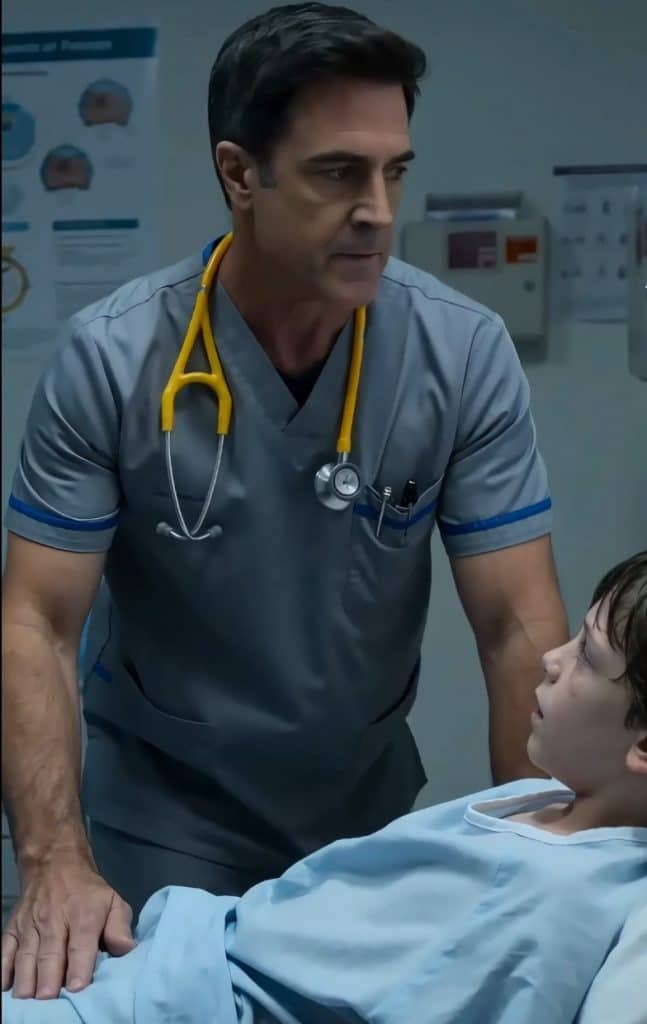
The child lay under light-blue hospital linens, pale and sweating, his dark hair stuck to his forehead. He could not have been more than eight. His breathing was shallow, and each inhale seemed to ask permission from the pain beneath it.
Beside the bed stood his mother, or the woman who claimed to be.
Her name was Natalie Price. She had given it to registration in a rush, one hand gripping the boy’s jacket, the other clutching a tan trench coat around herself like armor.
“He got scared,” she had told the nurse. “The dog lunged at him. He fell backward. It happened so fast.”
Now Marcus gently lowered the top of the boy’s hospital gown.
Two dark circular marks sat on the child’s chest.
Too round.
Too even.
Too deliberate.
Marcus kept his face neutral. Doctors learn early that shock can make frightened people shut down. He adjusted the yellow stethoscope around his neck and leaned closer.
“What’s his name again?” he asked.
“Eli,” Natalie said quickly. “Eli Price.”
The boy’s eyelids fluttered.
Marcus noticed that too.
“Eli,” he said softly, “can you hear me?”
The boy opened his eyes.
They were glassy with fever and fear. For a second, he looked at Marcus as if he wanted to speak but had been trained not to.
Then, in a voice barely louder than the hum of the lights, he whispered, “We have no dog.”
The room changed.
Not visibly. The white walls stayed white. The monitors kept their distant rhythm. The phone still hung on the wall beside the bed.
But something cold passed through Marcus.
Natalie stopped breathing.
Marcus straightened slowly.
He looked from the marks to the boy’s face. Then to Natalie.
She backed toward the door before he said anything.
“We’re leaving,” she said.
Marcus moved first.
He crossed the room and lifted the plastic receiver from the wall-mounted phone.
“I need an X-ray,” he said into it, voice calm but urgent. “Room Four. Pediatric. Now.”
Natalie lunged toward the bed.
“No,” she shouted. “We are leaving!”
Marcus turned sharply and stepped between her and the child.
The receiver swung against the wall with a dull plastic knock.
Natalie’s face twisted with panic. She tried to push past him, but he caught her by the shoulders and stopped her at the closed wooden door. Not roughly. Not violently.
Firmly.
The door thudded behind her.
Her breathing turned ragged.
Marcus held her gaze.
“You cannot leave,” he said. “I think we need to talk to the police.”
On the bed, Eli stared at the doorway, too weak to move.
But his eyes changed.
For the first time since he arrived, the boy looked almost hopeful.
Act II
Marcus had learned to distrust neat explanations.
Children fell from bikes, tripped on stairs, tumbled off playground equipment. Parents came in embarrassed, exhausted, apologetic, covered in juice stains and fear.
Real accidents were messy.
The stories had edges. A father forgot which side of the playground his daughter fell from because he had been running toward her too fast. A mother cried while insisting she should have caught her son, even though no one could have. Grandparents overexplained tiny details because guilt made them talk.
Natalie Price’s story had been different.
Too polished in the wrong places.
She knew exactly what happened, but not what time. She knew exactly where the dog came from, but not whose dog it was. She said Eli had screamed immediately, but the boy’s throat sounded unused, as if he had not screamed at all.
And then there were the marks.
Marcus had seen bites.
These were not bites.
He had seen bruises.
These were not ordinary bruises.
He had seen fear.
That, on the other hand, was unmistakable.
Eli wore it like a second hospital gown.
While nurses prepared imaging, Marcus stayed between Natalie and the bed. She had stopped fighting him, but not because she had calmed. Her eyes kept darting toward the hallway, toward the phone, toward the boy.
“Please,” she whispered. “You don’t understand.”
“Then help me understand,” Marcus said.
Natalie shook her head so hard her hair moved across her cheeks.
“You can’t call the police.”
“I already asked security to notify them.”
Her face went white.
“No. No, you can’t.”
Marcus watched her carefully.
There was guilt in her face, yes.
But there was something else too.
Terror.
Not the terror of being caught.
The terror of being found.
On the bed, Eli made a soft sound. Marcus turned.
The boy’s fingers had curled around the sheet, knuckles pale. Sweat shone along his upper lip. He was trying not to cry.
Marcus lowered his voice.
“Eli, you’re safe here.”
Natalie let out a broken laugh that sounded almost angry.
“No one is safe here.”
Marcus looked back at her.
“What does that mean?”
She pressed both hands over her mouth, as if she had already said too much.
Before Marcus could ask again, two nurses arrived with a portable imaging unit, followed by a radiology tech and hospital security. Natalie shrank back against the door.
Eli watched the equipment roll in.
His eyes widened.
“No,” he whispered.
Marcus moved to the bedside.
“It’s okay. It won’t hurt.”
Eli shook his head weakly.
“He said hospitals tell.”
Marcus went still.
“Who said that?”
The boy’s lips trembled.
Natalie closed her eyes.
Marcus already knew the answer was bigger than one lie about a dog.
Act III
The X-ray did not explain everything.
It explained enough.
The marks on Eli’s chest were not from an animal. They were paired contact marks, clean and circular, with tissue irritation beneath them. There were also older signs of harm, some healed, some recent enough to make the room fall silent when the images appeared on the screen.
No one spoke for several seconds.
Then Nurse Patel turned away and wiped under one eye with the back of her wrist.
Marcus stared at the images, his jaw tight.
This was not one accident.
This was a pattern.
Natalie stood by the wall, shaking so badly her coat sleeves trembled.
“I tried,” she whispered.
Marcus turned.
“What did you try?”
Her eyes lifted to him.
For the first time, her desperation had no performance in it. No defensiveness. No rehearsed story. Just exhaustion so deep it seemed to have hollowed her out.
“I tried to leave.”
The police arrived seven minutes later.
Natalie nearly collapsed when she saw the uniforms.
“Please don’t put his name in the system,” she begged. “Please. He’ll know.”
One officer glanced at Marcus.
“Who?”
Natalie looked at Eli.
The boy had turned his face into the pillow.
Marcus stepped closer to Natalie and spoke quietly.
“Who hurt him?”
She closed her eyes.
“My husband.”
The officer took out a notebook.
“Name?”
Natalie’s voice barely worked.
“Daniel Price.”
The officer stopped writing.
Marcus saw the hesitation.
So did Natalie.
Her laugh came out hollow and bitter.
“You know him.”
The officer did not answer quickly enough.
Daniel Price was a police lieutenant in the neighboring county. Decorated. Photographed at charity events. A man who gave safety talks at schools and stood beside mayors at press conferences.
A man everyone wanted to believe could not do something like this.
Natalie had believed it once too.
She had married him after Eli’s father died, when grief made practical kindness look like love. Daniel had been steady at first. Helpful. Protective. He fixed the porch light. Changed the locks. Told her she should not have to raise a child alone.
Then protection became control.
Control became rules.
Rules became punishment.
At first, it was only Natalie who paid for breaking them.
Then Eli got older.
He began asking questions.
Why couldn’t they visit Grandma? Why did Mom always have to ask before using the car? Why did Daniel listen outside doors? Why did the phone disappear whenever Mom cried?
Three months earlier, Eli told a teacher he did not like going home.
Daniel handled it.
The teacher later apologized to Natalie for “misunderstanding.”
After that, Eli stopped talking at school.
Natalie began planning.
A bag hidden behind the dryer. Cash taped beneath a drawer. A prepaid phone buried in a cereal box. A women’s shelter number memorized and never written down.
That morning, when Daniel left for a training seminar, Natalie took Eli and drove.
She made it forty miles before he started vomiting from fever and pain.
So she came to the hospital.
And then fear returned.
Fear told her hospitals asked questions. Hospitals made reports. Reports became phone calls. Phone calls reached men like Daniel Price before women like Natalie could disappear.
So she lied.
A dog. A fall. A rush to leave.
Anything to keep Eli out of the system long enough to run again.
But Eli, weak and feverish on the bed, had told the truth with four small words.
We have no dog.
And those four words had saved them both.
Act IV
Daniel Price arrived before midnight.
That was how Marcus knew Natalie had been right to be afraid.
No one at the hospital had called him. The police officers in the room claimed they had not either. But somehow, within an hour of Natalie giving his name, Daniel appeared in the emergency department wearing plain clothes and a badge clipped to his belt.
He was handsome in a controlled way. Clean-shaven. Calm. The kind of man who knew exactly how long to pause before speaking so people would mistake restraint for innocence.
“I’m here for my wife and son,” he told the desk nurse.
The nurse did not move.
Security had already been warned.
Marcus stepped out of Room Four and closed the door behind him.
Daniel’s eyes landed on him.
“Doctor,” he said, pleasant but cold. “There’s been a misunderstanding.”
Marcus said nothing.
Daniel smiled faintly.
“My wife gets overwhelmed. She has anxiety. She exaggerates when she’s scared.”
Marcus had heard this version before.
Different man. Same script.
He folded his arms.
“Your stepson is being treated.”
“I want him transferred.”
“That won’t happen tonight.”
Daniel’s smile thinned.
“I don’t think you understand who you’re speaking to.”
Marcus looked him directly in the eyes.
“I understand exactly.”
For the first time, a flicker of irritation crossed Daniel’s face.
Behind Marcus, through the narrow window in the door, Natalie watched. Eli was asleep now, one small hand still wrapped around the edge of the sheet.
Daniel leaned closer.
“I have full parental authority.”
“No,” a woman’s voice said from down the hall. “You don’t.”
Everyone turned.
A hospital social worker walked toward them with a silver-haired attorney Marcus had never seen before. Beside them was an older woman in a raincoat, her face swollen from crying.
Natalie’s mother.
Eli’s grandmother.
Natalie had not been allowed to call her in over a year.
But Nurse Patel had found the emergency contact buried in an old record from Eli’s birth, back before Daniel Price entered their lives.
The attorney opened a folder.
“Daniel Price is not Eli’s legal parent. His petition for adoption was filed but never finalized. The biological father’s family retains documented visitation rights, which appear to have been obstructed.”
Daniel’s composure cracked.
Just a little.
Enough.
“You people have no idea what she’s like,” he said.
Natalie opened the door behind Marcus.
Her mother saw her and made a broken sound.
Natalie stood barefoot in the hospital room entrance, still wearing the trench coat, her face pale but no longer hidden.
“I have the recordings,” she said.
Daniel went still.
Marcus looked at her.
Natalie’s hand trembled as she held up a small prepaid phone.
“I recorded him. Not everything. Enough.”
Daniel’s eyes hardened.
“Natalie.”
She flinched at her name.
Then she looked at Eli sleeping behind her.
And she did not step back.
“No,” she said. “Not anymore.”
The police officers who had first arrived were replaced before morning by state investigators.
That was not an accident.
The social worker made the call. The attorney made another. Marcus made a formal medical report that could not be buried by local favors. Nurse Patel printed everything twice and locked one copy in the hospital administrator’s office.
By sunrise, Daniel Price was no longer a respected officer collecting his family.
He was a suspect under investigation.
And for the first time, Natalie was not the only adult telling the truth.
Act V
Eli woke to sunlight through the blinds.
Not much sunlight. Just a pale strip across the hospital wall, softening the room that had felt so cold the night before.
Natalie was asleep in a chair beside him, her head bent at an awkward angle, one hand resting on the bed rail. Her mother sat nearby, watching both of them as if she had been given back two lives and did not yet trust the world to let her keep them.
Marcus entered quietly.
Eli opened his eyes.
The fear was still there.
Of course it was.
One night could stop the danger. It could not erase what came before.
But when Marcus stepped closer, the boy did not shrink.
“Good morning,” Marcus said.
Eli blinked.
“Is he here?”
“No,” Marcus said. “He can’t come in.”
The boy’s eyes moved to his mother.
“She lied.”
Marcus pulled a chair near the bed and sat down.
“Yes,” he said gently. “She did.”
Eli’s mouth trembled.
“Was I bad for telling?”
Natalie woke at the sound of his voice.
Her face collapsed.
“No, baby,” she whispered, reaching for him but stopping short, letting him choose. “No. You were brave.”
Eli stared at her for a long second.
Then he reached for her hand.
Natalie took it and cried silently into the blanket.
Marcus looked away.
Some wounds belonged to the people who had survived them.
The investigation that followed was careful and slow. That mattered. Fast outrage often faded. Careful evidence stayed.
The recordings on Natalie’s phone confirmed enough. Eli’s medical records filled in the rest. Teachers came forward. A neighbor admitted she had heard shouting but had been afraid to report it. One officer from Daniel’s department confessed that Daniel had asked him to “smooth over” a school concern months earlier.
The circle widened.
Daniel had not acted alone in hiding who he was.
He had benefited from a system too willing to trust his uniform and doubt the frightened woman beside him.
Natalie and Eli did not go home after the hospital.
Not to that house.
They left through a staff exit two days later with a protective order, a state advocate, and Natalie’s mother waiting in a borrowed blue sedan. Eli wore a sweatshirt from the hospital donation closet and held a stuffed turtle Nurse Patel had found in pediatrics.
Before they left, he asked to see Marcus.
The doctor met them near the side corridor.
Eli looked smaller standing up.
But stronger too.
He held out the stuffed turtle.
“You can keep it in your office,” he said.
Marcus crouched to his level.
“I think he belongs with you.”
Eli looked down at the turtle.
“He’s brave.”
“Then he definitely belongs with you.”
For the first time, Eli smiled.
It was tiny. Uneven. Gone almost immediately.
But it was real.
Months later, Marcus received a postcard with no return address.
On the front was a picture of a lighthouse.
On the back, in Natalie’s handwriting, were four lines.
He started school again.
He sleeps better now.
He told his teacher the truth.
Thank you for believing him.
Below it, in careful child letters, Eli had written:
WE STILL HAVE NO DOG.
BUT GRANDMA SAYS MAYBE SOON.
Marcus kept the postcard in his desk drawer.
Not because the case had ended neatly. It had not. Court dates dragged on. Daniel’s lawyers attacked Natalie’s memory, her fear, her choices. The department issued statements full of careful language. People who had once praised Daniel began pretending they had always suspected something.
Justice came, but it came like winter thawing.
Slowly.
Still, it came.
Daniel lost his badge first.
Then his freedom.
Natalie testified with her hands shaking and her voice steady. Eli did not have to face him in court. His recorded forensic interview was enough, along with the medical evidence and Natalie’s recordings.
When the verdict was read, Natalie did not cheer.
She closed her eyes.
Her mother held her hand.
Some victories are too heavy to celebrate.
A year later, Marcus saw them again.
Not in the hospital.
At a park near the river, on a Saturday morning bright with spring light. Marcus was walking to a coffee shop when he heard a child laughing.
He turned.
Eli was running across the grass, taller now, his hair flying, a yellow leash clutched in one hand. At the other end was a ridiculous little brown dog with ears too large for its head.
Natalie stood near a bench, smiling in a way Marcus barely recognized.
Free.
Tired, yes.
Changed forever, yes.
But free.
Eli saw Marcus and stopped.
For a second, the old shyness returned.
Then he lifted the leash proudly.
“We have a dog now,” he called.
Marcus smiled.
“I see that.”
“What’s his name?”
Eli looked down at the dog, who was busy trying to chew the leash.
“Sherlock,” he said. “Because he finds things.”
Marcus glanced at Natalie.
Her eyes shone.
“What does he find?” Marcus asked.
Eli thought about it.
Then he shrugged with the seriousness only children can manage.
“Good people.”
The dog pulled him forward, and Eli laughed again, stumbling after him across the grass.
Marcus stood there for a moment, watching the boy run beneath open sky.
He thought of the hospital room. The dim light. The marks that did not match the story. The child whispering a truth so small it could have been missed.
We have no dog.
Four words.
That was all it took to crack the lie open.
Because sometimes saving a child does not begin with a dramatic confession or a perfect piece of evidence.
Sometimes it begins with a doctor pausing long enough to hear the sentence everyone else was never supposed to hear.
And believing it.