Act I
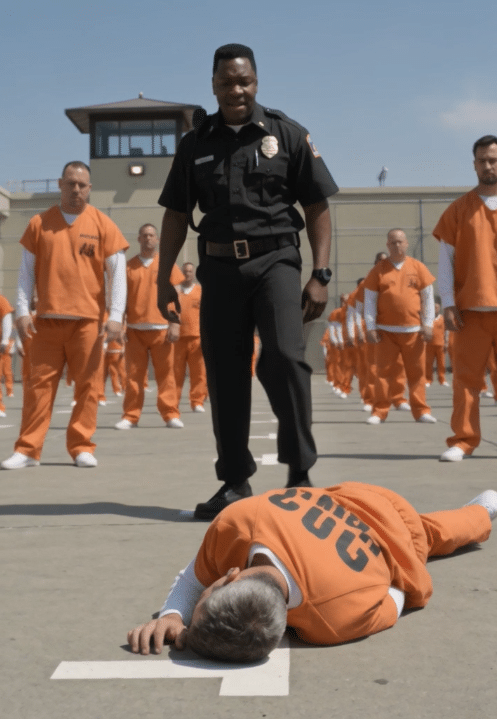
The entire prison yard fell silent a heartbeat after the old man hit the concrete.
No one moved.
Rows of inmates stood frozen on the painted lineup marks while the elderly prisoner struggled to push himself up with trembling hands. His chin had scraped against the rough ground, leaving only a small streak of red, but he never cried out. Instead, he lowered his eyes as if he had already accepted whatever punishment came next.
The guard wasn’t satisfied.
He stormed forward, towering over the gray-haired inmate with the confidence of a man who believed absolute authority belonged to him.
“Trash. Answer when I call you.”
The old prisoner blinked, confused. His hearing had faded years ago. He had barely understood his own name echoing across the yard before the kick slammed into his chest.
Gasps spread through the prisoners.
The guard sneered as though humiliating an elderly man was simply another part of the morning routine.
When the old prisoner curled instinctively against the cold concrete, the guard struck again.
And again.
“Maybe the floor can hear better.”
No one dared intervene.
Because inside those walls, survival often meant pretending you hadn’t seen anything at all.
But someone else had.
And within seconds, everything the guard believed about power was about to collapse.
Act II
To every correctional officer in the facility, Prisoner #81427 looked completely ordinary.
An aging inmate.
Quiet.
Reserved.
Never caused trouble.
He kept his bunk neat, thanked the kitchen workers, and spent most evenings reading weathered military history books from the prison library.
Many inmates assumed he had once been a schoolteacher.
Others guessed he had been a retired mechanic.
No one imagined the truth.
The old man never corrected anyone.
He never spoke about the medals that had once decorated his uniform.
He never mentioned the soldiers who had followed him into impossible missions.
And he certainly never revealed why a man once saluted by presidents now answered to an inmate number.
Years earlier, a disastrous operation had claimed the lives of several young officers under his command.
Although investigators ruled that he had acted within military protocol, he never forgave himself.
When legal responsibility and moral responsibility pointed in different directions, he chose the heavier burden.
He voluntarily accepted punishment that shocked the nation.
Not because he had to.
Because he believed leadership meant carrying the weight that others could not.
Outside prison walls, many had forgotten.
Inside them, nobody knew.
Until that morning.
The guard had mistaken silence for weakness.
He had mistaken dignity for helplessness.
It would become the biggest mistake of his career.
Act III
High above the yard, a security camera watched everything.
The kicks.
The insults.
The prisoners looking away.
The officers doing nothing.
Every second was being recorded.
At nearly the same moment, the heavy gate leading into the yard began to slide open.
A state inspection team entered alongside the prison warden.
The visit had been scheduled weeks earlier.
No one expected them to arrive in the middle of roll call.
The warden was already reviewing paperwork when something across the yard caught his eye.
An elderly prisoner on the ground.
A guard standing over him.
For one brief second, he simply stared.
Then the color drained from his face.
He recognized the old man instantly.
Not as Prisoner #81427.
Not as another inmate.
But as the decorated general whose leadership had once been studied in military academies across the country.
The man who had rescued civilians during disasters.
The commander who had refused promotions so younger officers could advance.
The leader whose reputation had survived every battlefield except the one inside his own conscience.
The warden broke into a run.
The inspectors followed without asking why.
The guard finally noticed them.
By then, it was already too late.
Act IV
The entire prison yard watched as the warden dropped to one knee beside the fallen prisoner.
His voice shook with genuine respect.
“General… forgive us.”
Every conversation stopped.
Even the wind seemed to disappear.
The old man looked embarrassed by the attention.
He tried to stand on his own.
The warden gently supported him before turning toward the inspection team.
Then he asked the question that froze every correctional officer in place.
“Who did this to you?”
Nobody answered.
Nobody had to.
The security camera hanging above the yard had already captured everything.
One inspector quietly requested the footage.
Another wrote down the guard’s badge number.
The guard’s confidence evaporated.
Only moments earlier he had barked orders with absolute certainty.
Now he couldn’t even meet the old man’s eyes.
For the first time that morning, he understood exactly who had been lying at his feet.
Not just an inmate.
A man whose honor had survived decades of sacrifice.
A leader respected even by those sent to oversee the prison itself.
Power had changed hands without a single threat.
Truth had done all the work.
Act V
The old general finally spoke.
His voice remained calm.
“I don’t want revenge.”
Everyone looked toward him.
“I only hope no one else is treated this way after I’m gone.”
The words landed harder than any accusation could have.
The state inspectors ordered an immediate investigation into abuse inside the facility.
Security footage from previous weeks would be reviewed.
Complaints buried for years would finally be reopened.
Several prisoners lowered their heads.
Some had accepted cruelty as part of prison life.
For the first time, they wondered if things could actually change.
The old general straightened his prison uniform before quietly returning to his place in line.
He asked for no apology.
No special treatment.
No recognition.
His dignity had never depended on rank.
It had always belonged to the man himself.
Across the yard, the guard stood completely alone.
The shouting was gone.
The arrogance was gone.
Only fear remained.
His lips trembled as the impossible truth echoed through his mind.
“How could it be?”
Sometimes the strongest people wear medals.
Sometimes they wear prison uniforms.
And sometimes, the greatest measure of a person’s character isn’t how they are honored when they hold power—but how they carry themselves when they have none.