Act I
The crowd barely noticed the little girl at first.
She stood near a busy intersection with an old yellow jacket wrapped tightly around her shoulders, offering lottery tickets to strangers who rarely looked her in the eye. Every smile she gave seemed practiced, as though she had learned long ago that kindness was often ignored.
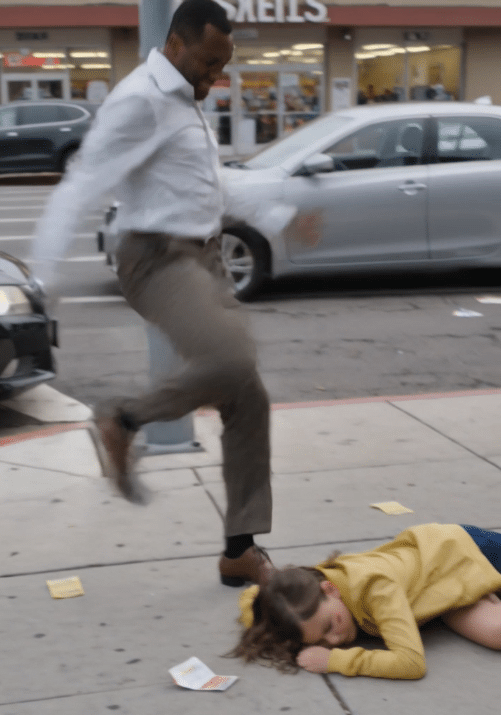
Then, in the rush of the evening crowd, she accidentally brushed against a man in a spotless white shirt.
It was nothing.
A moment so small most people would have forgotten it before taking another step.
He didn’t.
The man spun around with a face twisted by disgust. Before anyone understood what was happening, he shoved her violently aside. The small pouch of lottery tickets burst open as she hit the pavement, colorful slips scattering across the sidewalk like leaves caught in a storm.
The girl instinctively curled up, trying to protect herself more than the tickets.
Instead of stopping, the man towered over her.
“Trash. Don’t touch me.”
The words echoed louder than the traffic.
People stared.
Phones appeared.
No one moved.
The girl quietly reached for the tickets, her fingers trembling as if picking them up mattered more than the sting on her scraped cheek.
Then the man sneered again.
“Beg somewhere else.”
The silence from the crowd felt heavier than the insult itself.
But that silence was about to be broken.
Act II
Nobody on that sidewalk knew her story.
They saw an old jacket.
They saw cheap lottery tickets.
They assumed they knew everything.
Her name was Amara.
Every afternoon after school, she walked nearly three miles to the intersection because it was one of the few places where enough people passed by to make selling tickets worthwhile.
She wasn’t trying to earn pocket money.
She was helping keep the lights on.
Her mother worked double shifts after a chronic illness forced her to leave a better-paying job. Medical bills had swallowed every saving the family ever had. Rent was always overdue. The refrigerator was rarely full.
Amara never complained.
She simply smiled and kept walking.
The lottery tickets weren’t symbols of poverty to her.
They were groceries.
Medicine.
Another week with electricity.
She had learned to ignore rude comments, suspicious looks, and impatient customers.
But something about the man’s cruelty was different.
It wasn’t anger.
It wasn’t frustration.
It was contempt.
He looked at her as though she had no right to exist in the same space as everyone else.
The witnesses lowered their eyes.
Some whispered.
Some recorded.
No one crossed the invisible line between watching and helping.
Until the sound that cut through the entire street.
The sharp screech of brakes.
Act III
A black sedan stopped so abruptly at the curb that conversations died in mid-sentence.
The driver’s door never opened.
Instead, the rear passenger door swung wide.
A man in his early fifties stepped onto the sidewalk.
He wasn’t dressed extravagantly.
No expensive watch flashed beneath the streetlights.
No bodyguards rushed ahead.
Yet something about him instantly changed the atmosphere.
The pedestrians who had refused to move now instinctively stepped aside.
Even the bully’s expression shifted.
Only slightly.
Just enough for doubt to appear.
The older man’s eyes never left the frightened girl gathering lottery tickets with shaking hands.
He walked toward her without hurrying.
Without raising his voice.
Without showing anger.
When he finally spoke, the street became unnaturally quiet.
“Let the girl go.”
It wasn’t a request.
It wasn’t a threat.
It sounded like the kind of sentence people obeyed without thinking.
The bully laughed.
Or at least he tried to.
But the laugh came out thinner than he intended.
He suddenly realized something strange.
The man approaching him wasn’t looking for approval from the crowd.
He wasn’t performing.
He had already decided exactly what he was going to do.
And somehow…
Everyone else seemed to know it too.
The bully took one unconscious step backward.
Then another.
The balance of power had already begun to shift.
What nobody knew was why.
Act IV
Rumors spread faster than traffic.
Someone whispered that the man owned half the buildings in the district.
Another insisted he had once been a decorated federal investigator.
Others claimed he headed a foundation that quietly paid hospital bills for struggling families.
Nobody agreed on his identity.
Everyone agreed on one thing.
He was someone people did not ignore.
He crouched beside Amara instead of confronting the bully first.
Carefully, he picked up a lottery ticket that had landed near the curb.
Then another.
Soon several bystanders who had frozen moments earlier finally found the courage to help.
One by one, the scattered tickets disappeared back into the little pouch.
It was as if the older man’s calm had reminded everyone else of something they had forgotten.
Human decency.
Only then did he stand.
Without taking his eyes off the bully, he slowly rolled up his sleeves.
Not as an invitation to violence.
As a signal that he wasn’t leaving.
The bully’s confidence evaporated.
The insults disappeared.
The swagger disappeared.
For the first time that evening, he looked exactly like what he had tried so hard not to become.
Afraid.
The witnesses noticed it immediately.
Cruelty had made him look powerful.
Accountability made him look small.
He searched the older man’s face, desperate to recognize him.
Nothing came.
That uncertainty frightened him more than any shouted threat ever could.
Act V
The streetlights flickered on as the evening settled over the intersection.
Amara finally stood, clutching the pouch against her chest.
One by one, strangers approached her.
Some bought tickets.
Others quietly pressed folded bills into her hand without asking for anything in return.
A woman who had watched in silence only minutes earlier apologized through tears.
An elderly couple offered to call her mother.
A shop owner brought out a chair and a bottle of water.
The older man never accepted thanks.
He simply waited until he knew the girl was safe.
Then he turned to leave.
The bully finally found his voice.
It barely escaped his throat.
“Who are you…?”
The man paused beside the black car.
Without looking back, he answered softly enough that only those closest could hear.
“I’m the person who showed up.”
Then he closed the door.
The sedan disappeared into traffic.
No one ever learned his name.
Some insisted he was wealthy.
Others believed he held enormous influence.
A few thought he was simply an ordinary man who refused to look away.
Perhaps the truth mattered less than what happened after.
Because the story that spread across the neighborhood wasn’t about the bully.
It wasn’t about the black car.
It wasn’t even about the mysterious stranger.
It was about a little girl who had been treated as invisible until one person reminded an entire street that courage doesn’t always begin with strength.
Sometimes, it begins with refusing to stay silent.
And for the man who believed humiliating a child would earn him respect, the most terrifying punishment wasn’t what happened next.
It was realizing that everyone who had witnessed his cruelty would remember his face long after they forgot his name.