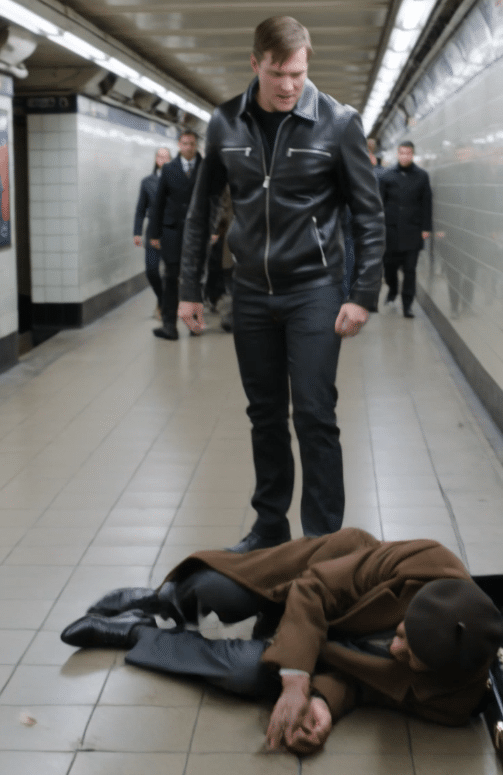
Act I
The melody stopped in the middle of a note.
One heartbeat earlier, the elderly violinist had been playing softly beneath the tiled ceiling of the subway corridor. Commuters hurried past without much notice, while a small circle of strangers lingered just long enough to hear the final phrase of an old piece that seemed oddly out of place amid the rumble of arriving trains.
Then a polished leather shoe slammed into his chest.
The seventy-eight-year-old man lost his balance instantly.
His violin slipped from his hands, sliding across the station floor before coming to rest beneath a bench. The open violin case tipped onto its side, sending a handful of coins bouncing across the tiles as if every small act of kindness the crowd had offered had suddenly been erased.
A scrape appeared across the back of his trembling hand as he instinctively reached toward the instrument.
He didn’t cry out.
He looked only at the violin.
As though protecting it mattered more than protecting himself.
The young man who had attacked him lowered his phone and glared with open disgust.
“Trash,” he snapped.
“Nobody wants your noise.”
Several people gasped.
No one moved.
The old musician stretched one shaking arm toward the violin.
Before his fingers reached it, two more vicious kicks landed against his side and back.
The bow clattered across the floor.
“Play on the floor,” the young man mocked.
The laughter he expected never came.
Instead, the small crowd quietly stepped apart.
Someone had begun walking toward them.
And judging by the silence spreading through the station, everyone recognized him except the bully.
Act II
The old violinist’s name was Arthur Bennett.
To hurried commuters, he was simply another elderly man playing for spare change in a subway corridor.
Few imagined that there had once been a time when audiences stood to applaud him before he ever lifted his bow.
Decades earlier, Arthur had performed on concert stages across Europe and North America.
Not because he chased fame.
Because music was the only language he believed every human heart already understood.
He could make crowded halls fall silent with a single sustained note.
He had trained gifted students who later filled prestigious orchestras around the world.
Then life changed.
His wife became seriously ill.
Treatment after treatment consumed everything they owned.
Arthur sold his apartment.
Then his investments.
Then, one by one, every valuable instrument except the single violin his late father had placed in his hands when he was ten years old.
When his wife finally passed away, the music remained.
So did the violin.
He refused to lock it inside a closet.
Instead, he carried it into subway stations where strangers who could never afford concert tickets might hear beauty for free.
If they left a few coins, he accepted them gratefully.
If they didn’t, he bowed anyway.
Because music had never belonged only to the wealthy.
The man who had attacked him believed otherwise.
Ethan Cross hated interruptions.
Especially during business calls.
To him, the violin wasn’t art.
It was background noise.
And the old man wasn’t an artist.
He was an inconvenience.
He never noticed that several members of the small audience hadn’t been listening casually.
They had remained because they recognized something extraordinary in Arthur’s playing.
And someone among them recognized far more than the music itself.
Act III
The man stepped forward wearing a navy overcoat and a neatly wrapped gray scarf.
He carried himself with the quiet confidence of someone who had spent a lifetime earning respect rather than demanding it.
The crowd instinctively moved aside.
No introductions were necessary.
Arthur looked up from the floor and smiled faintly.
The stranger didn’t speak immediately.
Instead, he bent down and lifted the fallen violin with both hands.
Carefully.
Almost reverently.
He examined the wood beneath the station lights.
His fingertips traced the worn varnish near the bridge.
Then he gently tightened one loosened string before placing the bow back into Arthur’s hand.
No one breathed.
Because anyone who understood classical music recognized exactly how he had handled the instrument.
Not like a collector.
Not like a customer.
Like someone greeting an old friend.
Only then did he stand.
He turned toward Ethan.
His voice remained calm.
“So calm that it somehow became impossible to ignore.”
“Do you know whose music you just silenced?”
The question echoed through the corridor.
Ethan laughed uncertainly.
“What, some street performer?”
No one else laughed.
Several faces in the crowd changed completely.
A young violin student covered her mouth.
An older commuter slowly removed his hat.
A transit officer who had been approaching stopped walking altogether.
The stranger quietly removed his scarf.
His eyes never left Ethan.
The atmosphere changed.
Not because anyone knew exactly who he was.
But because everyone suddenly realized they were standing in the middle of something much larger than an ordinary assault.
Act IV
Many years earlier, before Arthur disappeared from concert halls, he had taught at one of the nation’s most respected conservatories.
Students competed fiercely for the chance to study under him.
One of them arrived with remarkable talent but almost no confidence.
He constantly doubted himself.
Believed he would never be good enough.
Arthur refused to let him quit.
He opened rehearsal rooms early.
Stayed long after everyone else had gone home.
Corrected every mistake with patience rather than humiliation.
The student eventually became one of the world’s most respected conductors, invited to lead orchestras across continents.
The man now standing in the subway corridor was that student.
He never forgot the teacher who had changed his life.
The crowd recognized him immediately.
Not because he sought attention.
But because his face had appeared in magazines, documentaries, and concert broadcasts around the world.
Yet he offered no explanation.
He simply looked toward Arthur.
Then back to Ethan.
“Every city is judged by how it treats the people who create beauty.”
His words landed harder than anger ever could.
Transit security officers arrived.
Not rushing.
Simply observing.
Witnesses immediately began describing exactly what they had seen.
Several commuters handed over phone recordings.
Ethan looked around for support.
There was none.
The confidence that had fueled his cruelty dissolved into panic.
Only moments earlier, he believed everyone would agree with him.
Now every eye in the station carried quiet condemnation.
Arthur still held the violin.
His hand trembled slightly.
Not from fear.
From relief.
Because someone had finally reminded the world that dignity could never be measured by a person’s bank account.
Act V
Paramedics cleaned the scrape on Arthur’s hand while musicians from the crowd carefully inspected the violin.
A miracle.
It had survived the fall with only minor scratches.
Arthur smiled with genuine gratitude.
“The old thing has endured worse,” he joked softly.
The crowd laughed.
Not at him.
With him.
One by one, commuters returned the scattered coins to the violin case.
Then something unexpected happened.
No one walked away.
Instead, they waited.
The conductor looked at Arthur.
“Would you finish the piece?”
Arthur hesitated.
Then slowly lifted the violin beneath his chin.
The first note floated through the subway corridor.
This time, nobody spoke over it.
Even the arriving train seemed strangely distant.
For two unforgettable minutes, the station became a concert hall.
People who had entered exhausted from work stood motionless.
Some closed their eyes.
Others quietly wiped away tears they couldn’t explain.
When the final note faded, applause thundered through the corridor.
Arthur bowed exactly as he had done thousands of times before.
Not because he had regained fame.
Because, for one brief evening, people remembered that beauty deserved respect wherever it appeared.
Across the platform, Ethan stood completely alone.
His expensive leather jacket no longer looked impressive.
Only empty.
His lips parted.
His voice barely rose above a whisper.
“Who… is he?”