Act I
The silence in the ballroom broke long before anyone dared to speak.
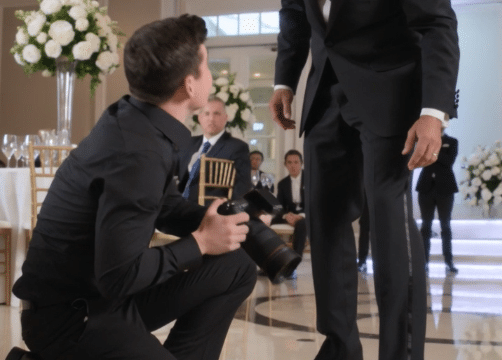
A shattered teacup rested on the polished floor, its fragments scattered beneath the glow of crystal chandeliers. Tea stained the sleeve of Daniel Whitmore’s tailored black suit, and the expression on his face shifted from irritation to something far colder.
Across from him stood his seventy-six-year-old mother, Eleanor, frozen with embarrassment.
“I’m so sorry,” she whispered, reaching instinctively for a napkin.
Instead of accepting the apology, Daniel recoiled as though her touch itself had offended him.
“Damn it,” he snapped loudly enough for every guest to hear. “You only embarrass me.”
The room fell silent.
Executives who negotiated billion-dollar mergers lowered their eyes. Friends who had toasted Daniel only moments earlier suddenly found their champagne glasses fascinating.
No one stepped forward.
Eleanor stood alone.
She had spent decades raising the man who now looked at her as if she were an inconvenience standing in the middle of his perfect life.
But what happened next would expose far more than one man’s cruelty.
It would reveal a secret about this family that almost no one in the room remembered.
And when the doors finally opened, everything Daniel believed he owned would disappear.
Act II
The Whitmore birthday celebration had become one of the city’s most exclusive social events.
Politicians attended.
Corporate executives competed for invitations.
Journalists speculated endlessly about who might inherit the enormous Whitmore fortune.
Everyone assumed the answer was Daniel.
After all, he had spent years presenting himself as the unquestioned future of the family empire.
What almost nobody knew was how carefully he had rewritten his own history.
Guests saw an accomplished businessman.
They never saw the elderly mother quietly eating alone in a modest apartment.
They never heard the unanswered phone calls.
They never knew that Eleanor had quietly sold her jewelry decades earlier to keep Daniel in college after his father died.
Tonight, she had only wanted to help.
She insisted on carrying tea herself despite the servants’ objections.
One small accident became the excuse Daniel had apparently been waiting for.
“You should never have been part of this family,” he said, his voice carrying through the room.
The words landed harder than any public insult.
Eleanor lowered her head.
Not because she believed him.
Because she could no longer recognize the son she had raised.
Behind the crowd, several longtime employees exchanged uneasy glances.
Someone had already made a phone call.
Act III
The massive double doors opened.
No announcement.
No introduction.
Just silence.
An elderly silver-haired gentleman entered with a polished cane, dressed in an impeccably tailored charcoal suit.
Every conversation stopped.
Then, almost instinctively, every guest stood.
Even the executives.
Even Daniel’s own board members.
The newcomer ignored them all.
His attention went directly to Eleanor.
Without a word, he offered his arm.
She looked up in disbelief.
“Arthur?”
The corners of the old man’s eyes softened.
“It’s been too long, little sister.”
The room seemed to forget how to breathe.
Daniel’s confident smile disappeared.
He suddenly understood something that many of the younger guests never had.
Arthur Whitmore wasn’t simply another relative.
He was the founder.
The architect of everything the Whitmore name represented.
For years he had lived overseas, rarely appearing in public, allowing others to assume retirement had removed him from family affairs.
They had assumed wrong.
And Arthur had witnessed every humiliating second.
The celebration had quietly transformed into an accounting.
Act IV
Arthur carefully helped Eleanor into a nearby chair before turning toward the room.
His voice never rose.
It didn’t need to.
“I built this family,” he said calmly.
“I can tolerate business failures.”
He paused.
“I cannot tolerate a man who humiliates the woman who sacrificed everything to raise him.”
No one moved.
Daniel attempted to explain.
“It was just—”
Arthur raised one hand.
The sentence died instantly.
He looked toward the attorneys standing near the back of the ballroom.
“I’ve reviewed every document during my flight.”
One lawyer stepped forward, already carrying a folder.
Arthur continued.
“Effective immediately, Daniel Whitmore is removed from succession planning, executive authority, and every position dependent upon my approval.”
Gasps rippled through the guests.
Some executives stared in disbelief.
Others looked strangely relieved.
Years of whispered complaints suddenly made sense.
Daniel wasn’t feared because he was respected.
He was feared because everyone believed he was untouchable.
Arthur had just proven he wasn’t.
Act V
The ballroom remained silent.
Daniel looked around, searching for support.
None came.
The same people who had applauded his speeches minutes earlier now avoided meeting his eyes.
His confidence dissolved into panic.
“Uncle…” he whispered.
“When did you come back?”
Arthur answered without anger.
“I came back the moment I learned your mother needed someone willing to stand beside her.”
Then he turned away.
Not toward the executives.
Not toward the lawyers.
Toward Eleanor.
“You’ve stood alone long enough,” he said gently.
For the first time that evening, she smiled.
It wasn’t because the family fortune had changed hands.
It wasn’t because anyone had lost power.
It was because, after years of quiet humiliation, someone had finally reminded the room of a truth wealth could never replace:
A family’s greatest inheritance is not its money.
It is the dignity with which it treats the people who gave it everything.
And that was the one fortune Daniel had already thrown away.