Act I
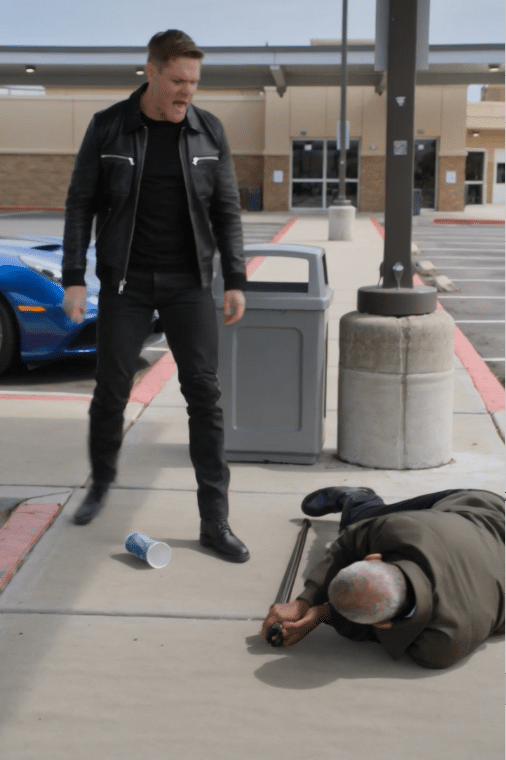
The paper cup landed less than a foot from the trash can.
It bounced once across the concrete before rolling to a stop in the middle of the walkway.
People noticed it.
Just as quickly, they looked away.
It was a busy highway rest area somewhere in America. Families stretched their legs after long drives, truckers grabbed coffee inside the convenience store, and travelers hurried between parked cars without paying much attention to one another.
Near the trash can stood a sixty-six-year-old veteran.
His weathered jacket had faded from years under the sun. A polished prosthetic leg supported his weight while one hand rested naturally on a worn cane that had accompanied him through more miles than anyone could imagine.
He wasn’t looking for trouble.
He simply looked at the expensive sports car, then at the discarded cup.
His voice was quiet enough that only those nearby heard him.
“Sir, the trash can is right there.”
It wasn’t an accusation.
It wasn’t sarcasm.
Just a gentle reminder.
The owner of the supercar slowly turned.
His leather jacket probably cost more than the veteran’s monthly pension. Designer sunglasses hid his eyes, but the contempt on his face needed no introduction.
For a moment, the parking lot became strangely still.
Then, without warning, he slammed a vicious kick into the veteran’s chest.
The older man lost his balance immediately.
His cane flew from his hand as he crashed backward onto the concrete.
A woman screamed.
The paper cup continued rolling lazily across the pavement.
The veteran had only tried to protect a place everyone shared.
Instead, kindness had been answered with violence.
But that wasn’t the attack’s worst moment.
Not even close.
Because the wealthy driver still wasn’t finished.
And hundreds of miles from the nearest city, justice was already driving toward the rest area.
Act II
The veteran remained on one knee, drawing slow breaths as pain spread across his ribs.
His prosthetic had twisted slightly beneath him, making it difficult to stand. A small scrape appeared on his knee where it had struck the concrete, but he ignored it, searching instead for the cane lying several feet away.
The businessman walked after him.
Smirking.
Looking almost annoyed that the older man was still conscious.
“Trash. Don’t lecture me.”
Several travelers froze with drinks in their hands.
A father instinctively pulled his daughter behind him.
Two college students quietly began recording with their phones.
No one expected what came next.
The bully drove one kick into the veteran’s back.
The older man’s shoulders lurched forward.
Then came a second kick into his ribs.
Exactly two.
The blows echoed across the parking lot.
“Pick it up yourself.”
He pointed toward the abandoned cup as though the man lying on the ground existed solely to clean after him.
The veteran closed his eyes for a second.
Not from fear.
From disappointment.
He had spent decades believing that small acts of respect kept communities together. Throwing trash away. Holding doors open. Warning strangers before accidents happened.
Little things mattered.
Because civilization was built on little things.
That belief had survived war.
It had survived hospitals.
It had survived losing a leg.
It would survive one arrogant man.
The veteran slowly reached toward his cane.
Then every engine in the parking lot seemed to go quiet.
A convoy of black luxury vehicles had just turned into the rest area.
Act III
At first, people assumed a politician had arrived.
Then they noticed something unusual.
The vehicles stopped with practiced precision.
Doors opened simultaneously.
Bodyguards stepped out first.
Not hurried.
Not nervous.
Disciplined.
Within seconds, they had quietly secured the immediate area without raising their voices.
The crowd instinctively moved aside.
Even the loud businessman hesitated.
From the center vehicle emerged a man around fifty years old wearing a perfectly tailored gray suit.
He carried himself with effortless confidence, the kind that came from responsibility rather than ego.
He didn’t ask anyone what had happened.
He had already seen enough.
His eyes moved from the paper cup…
…to the veteran on the ground…
…to the businessman still standing over him.
Without saying a word, he walked directly to the older man.
One bodyguard retrieved the fallen cane.
The gray-suited man offered his hand.
The veteran accepted it with quiet dignity.
Before letting go, the man gently brushed the dust from the veteran’s old jacket.
It lasted barely a second.
Yet somehow, that tiny gesture carried more respect than the businessman had shown anyone all day.
The veteran looked closely at the stranger.
Recognition slowly appeared.
Years earlier, they had met during a charity program supporting disabled veterans returning to civilian life. Back then, the younger businessman had built a transportation company that pledged to hire wounded service members long before such programs became fashionable.
The veteran had refused special treatment.
He simply asked for one promise.
“Leave every place cleaner than you found it.”
The gray-suited man had never forgotten those words.
Nor the man who first spoke them.
He turned toward the wealthy driver.
His expression became cold enough to silence the entire parking lot.
Only one word followed.
Act IV
“Enough.”
The businessman laughed.
A short, dismissive laugh.
“You own this parking lot or something?”
No one else laughed.
The bodyguards remained perfectly still.
One of them quietly spoke into an earpiece.
Another glanced toward the security cameras mounted on the convenience store.
The gray-suited man never raised his voice.
“You assaulted a disabled veteran.”
Silence.
“In front of dozens of witnesses.”
More silence.
“And directly beneath multiple surveillance cameras.”
Only then did the businessman finally look around.
People weren’t avoiding eye contact anymore.
They were staring directly at him.
Phones remained pointed in his direction.
The confidence draining from his face became almost visible.
One traveler whispered the gray-suited man’s name.
Another immediately recognized it.
Within moments the realization spread through the crowd.
He wasn’t a celebrity.
He wasn’t a politician.
He was the founder and chairman of one of the country’s largest highway hospitality and travel service companies—the organization responsible for operating hundreds of rest areas, convenience centers, and security systems across multiple states.
This location…
Was one of his.
He had stopped unexpectedly during a routine inspection after visiting a nearby logistics project.
The timing could not have been more unfortunate for the bully.
Or more fortunate for the veteran.
Local highway patrol officers, already stopping for coffee inside the building, walked outside after hearing the commotion.
They immediately recognized the chairman.
Then they noticed the veteran.
Finally, they looked at the businessman.
Everything suddenly fit together.
The wealthy driver took one uncertain step backward.
Then another.
His expensive clothes no longer impressed anyone.
Money had vanished from the equation.
Only consequences remained.
And reality finally reached him.
Act V
The parking lot fell completely silent.
Even passing traffic seemed distant.
The chairman turned back toward the veteran.
“Are you alright?”
The older man smiled despite the pain.
“I’ve been knocked down before.”
“I know,” the chairman replied softly.
“But you always get back up.”
Paramedics were called to examine the scrape on his knee and make sure his ribs hadn’t suffered a more serious injury. Witnesses willingly shared recordings with responding officers, each video confirming exactly what had happened from a different angle.
No one argued.
No one defended the assault.
The discarded paper cup still lay exactly where it had landed.
One of the bodyguards quietly picked it up and dropped it into the trash can.
The veteran noticed.
He smiled again.
Not because justice had arrived in an expensive convoy.
But because someone had understood the lesson.
Respect was never about a paper cup.
It was about the choices people made when they believed no one important was watching.
The businessman finally looked past the chairman.
Behind him stood calm bodyguards.
Security personnel.
Responding officers.
Dozens of silent witnesses.
His confidence disappeared completely.
His face turned pale.
His lips trembled.
For the first time that day, his voice carried no arrogance.
Only fear.
“Who are you…?”
The chairman offered no answer.
He simply rested a reassuring hand on the veteran’s shoulder and walked away with him.
Because names mattered far less than actions.
The businessman had believed wealth made him untouchable.
The veteran had believed every public place deserved respect.
Only one of those beliefs survived that afternoon.
Long after the convoy disappeared down the highway, travelers remembered neither the sports car nor the expensive jacket.
They remembered the elderly man who cared enough to point toward a nearby trash can.
And they remembered how a single act of ordinary decency exposed the extraordinary emptiness hidden behind wealth without character.
Sometimes karma doesn’t arrive with flashing lights.
Sometimes it arrives in a line of black cars, says one quiet word, and lets the truth do the rest.