Act I
“You’re very talented.”
The compliment lasted only a second.
For the young street artist, it meant another sketch sold, another few dollars earned, and another reason to believe she could keep going. Her six-year-old daughter smiled proudly beside the folding table, carefully organizing colored pencils while jazz drifted through the French Quarter.
The little sketch stand wasn’t a hobby.
It paid for groceries.
School supplies.
Rent.
Every portrait she drew was another chance to keep her family afloat.
The tourist accepted his sketch, thanked her warmly, and walked away.
That should have been the end of the moment.
Instead, someone else had been watching.
Her husband.
He emerged from the crowd with anger already burning in his eyes.
He wasn’t upset about the drawing.
He wasn’t upset about the customer.
He was furious that someone else had admired his wife’s talent.
To him, praise meant attention.
Attention meant losing control.
He marched toward the table before anyone realized what was happening.
Without warning, he lashed out.
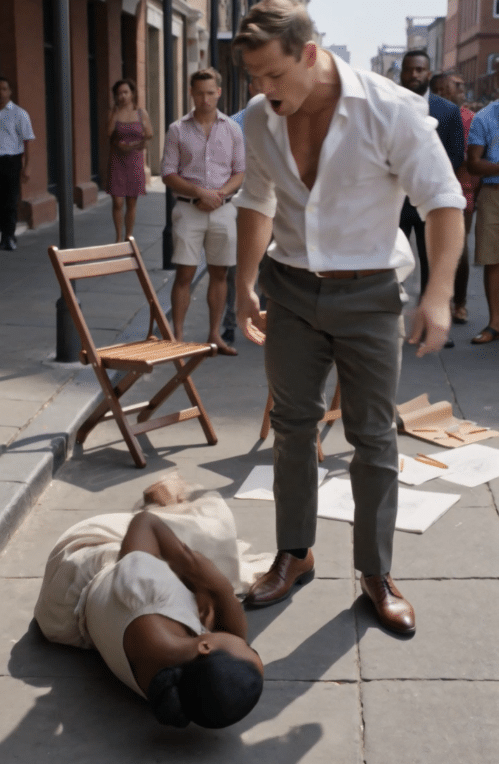
His kick struck her squarely in the chest, sending her crashing onto the stone pavement beside the display. Sketches scattered across the street, colored pencils rolled between tourists’ shoes, and loose pages fluttered through the warm morning air.
Her elbow scraped against the rough stone, leaving only a faint red mark.
Her daughter screamed.
The music continued playing.
But no one listened anymore.
The crowd had just witnessed jealousy transform into cruelty in the space of a heartbeat.
Act II
The artist struggled to sit up.
Pain shot through her chest, but her first instinct wasn’t to protect herself.
It was to find her daughter.
The little girl threw her arms around her mother’s shoulders, crying uncontrollably as unfinished drawings lay scattered around them.
The husband stepped closer.
Towering over both of them.
His face carried the confidence of someone who had spent years convincing another person they deserved less than they were worth.
“Trash.”
His voice echoed through the suddenly silent street.
“You think he cares about your art?”
The mother lowered her eyes.
Not because she believed him.
Because she didn’t want her daughter to remember her crying.
Then came another kick.
It struck her back.
She gasped, curling instinctively toward her child.
A second kick landed against her ribs.
Exactly two.
Nothing accidental.
Nothing impulsive.
Only calculated intimidation.
The little girl clung tighter to her mother as the woman wrapped one arm protectively around her despite the pain.
The husband pointed angrily toward the scattered sketches.
“You only paint because I let you.”
Those words hurt differently.
He wasn’t trying to steal her artwork.
He was trying to erase her identity.
Around them, tourists froze in disbelief.
Several reached for their phones.
Others whispered that someone should call for help.
Before anyone moved, a row of black luxury cars slowly appeared at the far end of the street.
The sound of jazz faded beneath the quiet rumble of expensive engines.
And suddenly, the crowd began stepping aside without being asked.
Act III
The vehicles stopped in perfect formation.
Doors opened almost simultaneously.
Bodyguards emerged first, creating a calm corridor through the gathering crowd.
No shouting.
No panic.
Only silent precision.
Then a woman in a perfectly tailored black suit stepped onto the sidewalk.
She walked with measured confidence, her attention fixed not on the famous street or the waiting photographers nearby, but on the frightened mother shielding her daughter among scattered sketches.
People recognized her immediately.
Gallery owners.
Market organizers.
Local business leaders.
Each instinctively moved aside.
The husband noticed.
His expression shifted from irritation to confusion.
The woman reached the family and stopped.
She didn’t speak at first.
She simply looked down at one drawing that had landed face-up on the pavement.
It was a pencil portrait of an elderly jazz musician smiling beneath a worn hat.
She carefully lifted it from the ground.
Years earlier, before she became one of the country’s most respected art patrons, she had wandered these same streets searching for unknown artists whose work deserved to be seen.
One rainy afternoon, when almost every tourist had disappeared, a struggling young woman had insisted she take home a portrait without paying.
“Art should find people,” the artist had said.
The woman in the black suit had never forgotten those words.
Nor the face of the artist who spoke them.
She had searched for her more than once.
Today, she found her.
Not in a gallery.
But on the pavement.
She quietly handed the drawing back to its creator.
Then she stepped forward.
Placing herself directly between the family and the abusive husband.
Behind her, the bodyguards stood in complete silence.
The street seemed to stop breathing.
Only one word followed.
Act IV
“Enough.”
The command was calm.
It didn’t need volume.
The husband laughed nervously.
“And who exactly are you supposed to be?”
She ignored the question.
Instead, she looked briefly toward the market managers gathering nearby.
Each of them nodded respectfully.
No introductions were necessary.
The woman turned back toward him.
“You attacked someone because a stranger appreciated her work.”
Silence.
“You tried to convince your daughter that her mother’s talent exists only with your permission.”
The crowd remained motionless.
She continued.
“Talent doesn’t ask permission.”
The husband looked around.
Every phone remained pointed toward him.
Every witness stayed exactly where they were.
He realized no one feared him anymore.
They were waiting.
Waiting to see what the woman would do next.
Whispers spread through the street.
Someone quietly recognized her as the founder of an internationally known arts foundation whose grants had transformed the lives of countless struggling painters, musicians, and sculptors.
Many of the nearby galleries existed because of her investments.
Many artists on the street had received scholarships funded by her organization.
That explained everything.
Why the crowd parted.
Why local organizers deferred to her.
Why her presence alone changed the atmosphere.
The husband’s confidence dissolved.
For years, he had measured power through intimidation.
Now he stood before someone whose influence came from lifting others rather than tearing them down.
And he had no answer for that.
For the first time, he understood how small control built on fear truly is.
Act V
The jazz music slowly returned.
Life around the French Quarter resumed.
But no one forgot what had happened.
Several artists quietly gathered the scattered sketches.
A child from another family picked up the colored pencils one by one and placed them neatly back into the little box.
The woman in the black suit turned toward the young artist.
“You never stopped drawing.”
The artist managed a faint smile.
“It was the only thing no one could take away.”
The woman nodded.
“And now no one will.”
Before leaving, she quietly instructed one of her assistants to purchase every sketch displayed on the table and arrange a private meeting with a gallery curator.
Not because the artist needed charity.
Because exceptional work deserved opportunity.
The little girl wiped away her tears as she looked at the empty display table.
For the first time in months, her mother wouldn’t have to worry about whether tomorrow’s sales would be enough.
The husband remained frozen.
His shoulders sagged.
His arrogance disappeared.
He looked from the silent bodyguards…
…to the respectful crowd…
…to the woman standing protectively before the family.
His face turned pale.
His voice barely escaped in a whisper.
“Who are you…?”
The woman offered no reply.
She simply stepped aside so the mother and daughter could stand together once more, holding their recovered artwork between them.
Because her name wasn’t the point.
The lesson was.
A person driven by jealousy believes praise must be controlled.
A true leader understands that talent grows when someone chooses to protect it.
Long after the tourists left and the music faded into the New Orleans evening, people remembered only one image.
A frightened little girl holding her mother’s hand.
A handful of scattered sketches rescued from the pavement.
And the quiet moment when dignity stood its ground while cruelty finally realized it had lost.