Act I
“It’s for rent. Not for alcohol.”
The words were barely louder than the chatter of tourists walking beside the Reflecting Pool.
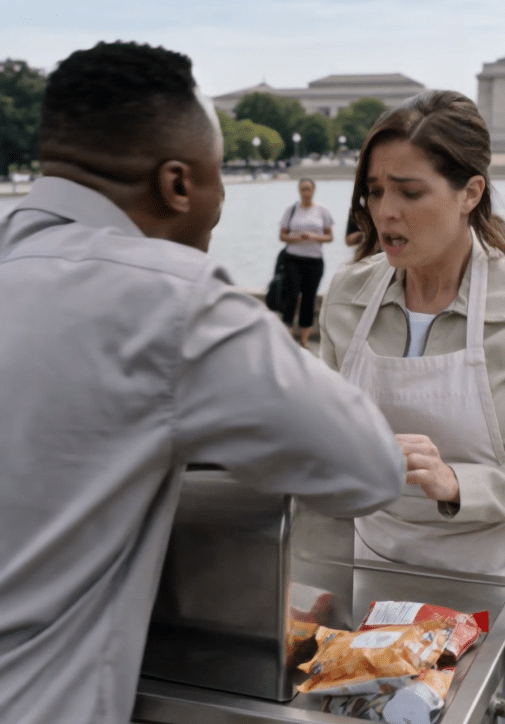
The small snack cart looked ordinary. Bottles of water stood in neat rows beside bags of chips and granola bars, while a laminated city permit fluttered gently in the morning breeze. Behind the cart stood a tired thirty-six-year-old mother wearing a faded apron, carefully protecting the small cash box that represented an entire month’s survival.
Her six-year-old son proudly arranged water bottles one by one, smiling every time someone stopped to buy a drink.
To him, it was helping Mom.
To her, it was keeping a roof over their heads.
Then a rough hand grabbed the cash box.
Her husband had arrived.
His shirt was wrinkled, his eyes bloodshot, and the smell of stale alcohol lingered around him before he spoke.
“I need the money.”
She held tighter.
“It’s for rent. Not for alcohol.”
The sentence only fueled his rage.
Without hesitation, he drove a brutal kick into her chest.
She crashed backward beside the snack cart as bottles rolled across the stone walkway and snack packs scattered in every direction. Her hand scraped against the pavement, leaving only a faint red mark, but the pain in her expression came from far more than the fall.
Her son screamed.
The crowd froze.
Yet the worst part hadn’t happened yet.
Because some people don’t stop once they’ve won.
They keep hurting others until someone finally stops them.
What no one realized was that someone important had just witnessed everything from the arriving traffic.
Act II
The mother struggled to lift herself from the ground.
Her first instinct wasn’t to reach for the spilled money.
It was to find her son.
The little boy knelt beside the scattered snacks, tears running down his face as he tried to gather everything back into neat piles, as though cleaning up fast enough could somehow make the violence disappear.
“Mom…”
She stretched one trembling hand toward him.
“Stay back.”
Not because she feared him.
Because she feared what his father might do next.
The husband stepped closer.
Towering over her with the confidence of someone who believed fear was ownership.
“Trash.”
His voice echoed across the busy walkway.
“You don’t tell me what I can buy.”
Several tourists stopped filming monuments and turned toward the commotion.
A park employee reached for a radio.
No one reached the family in time.
The husband lashed out again.
One hard kick struck her back.
She cried out but instinctively curled toward her son.
A second kick landed against her ribs.
Exactly two.
Nothing accidental.
Nothing uncontrolled.
Only deliberate cruelty.
Then he pointed toward the overturned snack cart.
“I own everything you make.”
The words landed harder than the blows.
Because they revealed what he truly believed.
Not that he deserved the money.
That he owned the woman earning it.
The little boy quietly picked up a bottle of water and placed it back on the cart.
His tiny hands shook uncontrollably.
He wasn’t thinking about money.
He was wondering whether his mother would stand again.
At that exact moment, a line of black SUVs slowed beside the curb.
The atmosphere shifted before anyone understood why.
Respect arrived long before introductions ever did.
Act III
The convoy stopped with perfect precision.
Doors opened almost together.
Bodyguards stepped onto the sidewalk first, creating a calm path through the gathering crowd.
Nearby security officers immediately straightened.
No one ordered them to move.
They simply did.
A man in a perfectly tailored navy suit stepped from the center vehicle.
Around fifty years old, he carried himself with the quiet confidence of someone who never needed to announce authority.
His attention ignored the monuments.
Ignored the cameras.
Ignored the curious tourists.
He looked only at the frightened mother and the little boy kneeling beside scattered bottles of water.
Without speaking, he walked to the overturned snack cart.
He gently straightened it, clearing enough space for the woman to stand safely.
Then he offered her his hand.
She hesitated.
Not because she distrusted him.
Because kindness had become unfamiliar.
He helped her to her feet.
The little boy instinctively hid behind his mother.
Then the man stepped forward, placing himself between the family and the abusive husband.
Behind him, the bodyguards formed a silent line.
The husband finally noticed something changing.
The crowd wasn’t watching him anymore.
They were watching the stranger.
Years earlier, before building an international real estate empire, the man in the navy suit had struggled through college with almost nothing to his name.
One freezing winter afternoon, a young woman running a tiny food cart had quietly given him a bottle of water and a sandwich after realizing he hadn’t eaten all day.
She refused payment.
“Just promise you’ll help someone else when you can.”
He had never forgotten that promise.
Nor the face of the woman who made him believe generosity could exist without conditions.
He had searched for her for years.
Today, he found her.
Just not under circumstances either of them deserved.
He faced the husband.
The silence became absolute.
Then he spoke six simple words.
Act IV
“Step away from your wife.”
His voice remained calm.
It didn’t need anger.
Authority already filled the space.
The husband forced a laugh.
“And who’s going to make me?”
No one answered.
Instead, every bodyguard remained perfectly still.
Nearby security officers lowered their radios and quietly waited.
The husband looked around.
Nobody appeared frightened anymore.
Every witness stood watching.
The man in the navy suit never broke eye contact.
“You demanded rent money for another drink.”
Silence.
“You assaulted the person who earned it.”
More silence.
“And your son watched every second.”
The husband’s eyes flickered toward the child.
For the first time, shame threatened to replace anger.
Whispers spread through the crowd.
Someone recognized the businessman.
Others nodded almost immediately.
He was known across Washington not for flashy speeches, but for quietly funding affordable housing projects and emergency family assistance programs.
Several park administrators had worked with his foundation.
Security personnel recognized him instantly.
That explained the respect.
The husband suddenly understood why nobody questioned the stranger’s presence.
Influence built through service was standing directly in front of him.
And violence suddenly looked very small.
His confidence crumbled.
For years he had mistaken intimidation for strength.
Now he realized genuine power never needed to shout.
The control he thought he possessed disappeared before his eyes.
Act V
Life slowly returned to the National Mall.
Tourists resumed walking.
Children laughed in the distance.
The Reflecting Pool shimmered peacefully beneath the afternoon sun.
Yet no one who witnessed the scene would ever forget it.
Volunteers and nearby vendors quietly gathered the scattered snacks.
Every bottle was returned.
Every package recovered.
Even the small cash box was found untouched.
The businessman handed it back to the mother.
“It belongs to you.”
She looked down at the box with tears in her eyes.
“It belongs to my son,” she whispered.
He smiled.
“Then let’s make sure he never has to fear losing it again.”
One assistant quietly arranged temporary housing support and legal resources before stepping away without fanfare.
No speeches.
No cameras.
Just action.
The little boy slipped his hand into his mother’s.
For the first time that day, he smiled.
The husband stood alone.
His shoulders slumped.
The anger that had filled him minutes earlier was gone.
He looked from the silent bodyguards…
…to the respectful security officers…
…to the crowd that no longer feared him.
His face turned pale.
His lips trembled.
Only one question remained.
“Who are you…?”
The man never answered.
He simply nodded toward the mother and son before walking back toward the waiting SUVs.
Because names weren’t what changed lives.
Choices were.
A man convinced that love could be controlled through fear lost everything the moment compassion stood in his way.
A mother who refused to sacrifice her child’s future discovered that courage has a way of attracting unexpected allies.
And long after the black SUVs disappeared into Washington traffic, people remembered only one image.
A little boy placing fallen bottles back onto a cart while refusing to let hope fall with them.