Act I
“I need to check your ID, ma’am.”
The request was routine.
The register had flagged an alcohol purchase, and company policy left no room for exceptions.
After ten exhausting hours on the night shift, thirty-year-old cashier Sarah had repeated the same sentence dozens of times.
Most customers smiled, handed over their identification, and moved on.
This customer didn’t.
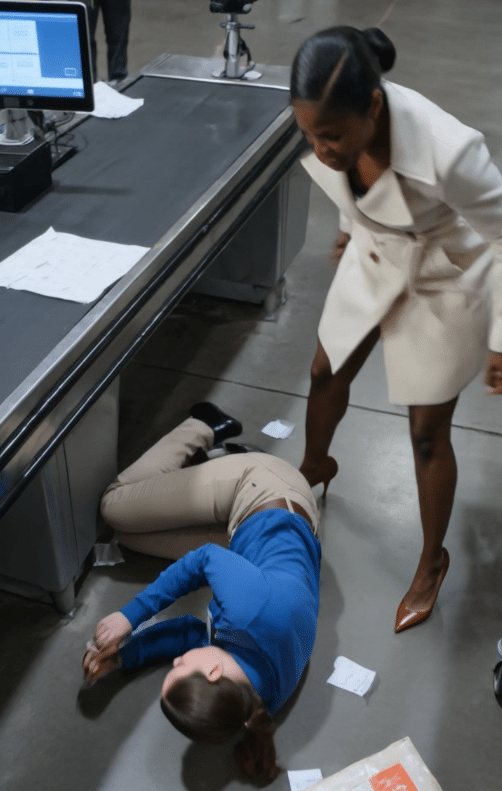
Dressed in a pristine white designer coat with a luxury handbag hanging from one arm, she stared at Sarah as though the request itself were an insult.
The checkout lane fell strangely quiet.
Then the woman exploded.
She shoved items across the conveyor, sending oversized packages tumbling to the floor as customers instinctively stepped back. Receipts fluttered through the air while the barcode scanner beeped uselessly.
“Trash,” she snapped. “Do I look like someone you can question?”
Sarah steadied herself against the counter.
“I’m just following store policy.”
The answer only made the woman louder.
Around them, phones slowly appeared.
Nobody expected what would happen next.
But someone far more influential than any customer in line had just walked through the entrance.
Act II
Humiliation was nothing new for Sarah.
Working nights meant dealing with impatient shoppers, impossible demands, and people who believed retail employees existed only to obey.
Still, she never raised her voice.
Her father had taught her something before he passed away.
“If you’re doing the right thing, never apologize for it.”
She remembered those words as the woman leaned across the checkout.
“Learn your place before you embarrass me again.”
Several employees exchanged uneasy glances.
The front-end supervisor reached for a radio.
The warehouse director was already moving toward the disturbance.
Then everything stopped.
Not because of the argument.
Because every manager suddenly looked toward the front entrance.
Act III
A small security team entered first, quietly clearing a path through the checkout lanes.
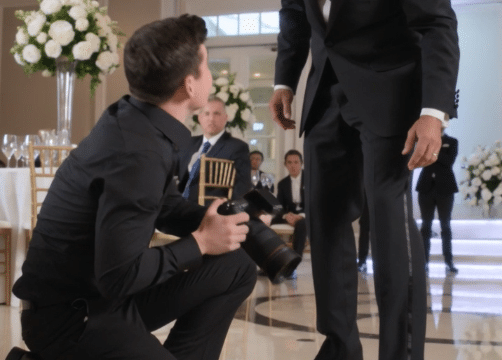
Behind them walked an older man in a tailored black suit.
He didn’t speak.
He didn’t rush.
Yet the regional manager immediately approached him with visible respect, followed by the store director.
Customers noticed.
Employees noticed.
Even the angry woman noticed.
The older man walked directly to Sarah.
“Are you alright?”
She nodded, still shaken.
He positioned himself between her and the customer before calmly turning to face the growing crowd.
Then he spoke only two words.
“Stop. Now.”
The warehouse became almost silent.
Act IV
The woman attempted to laugh off the moment.
“Do you even know who I am?”
The older man didn’t answer immediately.
Instead, he asked the store director one simple question.
“Did your employee follow policy?”
“Yes, sir.”
“Exactly as trained?”
“Yes.”
He nodded once.
“Then she did her job.”
Those few words transformed the atmosphere.
What had begun as a public humiliation of a cashier had become a public reminder that professionalism deserved respect.
The customer slowly realized she no longer controlled the situation.
Every eye in the warehouse was on her.
Act V
Employees quietly helped Sarah reorganize the checkout lane while nearby customers picked up the fallen merchandise.
Several shoppers who had witnessed everything thanked her for remaining calm.
The older man left without introducing himself or making a speech.
He didn’t need recognition.
He simply believed that rules should protect both customers and employees—and that dignity should never depend on someone’s job title.
The woman stood frozen.
Moments earlier, she had been certain money and status could silence anyone.
Now she understood that real authority looked very different.
As the older man walked away with the regional manager beside him, her confidence disappeared.
Her voice barely escaped her lips.
“Who are you…?”
No one answered.
Because the identity that mattered most wasn’t his.
It was Sarah’s—a professional employee who refused to compromise her integrity, even when someone tried to shame her for doing exactly what the rules required.