Act I
“Don’t feed the wildlife.”
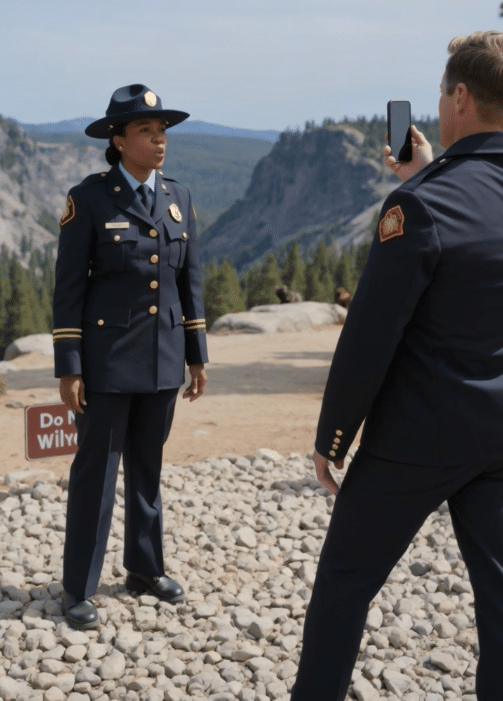
The ranger’s warning was calm, clear, and unmistakable.
She stood beside the weathered sign that every visitor passed before reaching the overlook.
DO NOT FEED WILDLIFE.
Beyond the safety railing, a herd of wild animals grazed peacefully in the distance. Tourists quietly raised cameras, careful to admire the scene from afar. It was exactly how the park was meant to be experienced.
Except for one man.
Holding his phone high above his head, the wealthy tourist grinned into the camera as thousands of viewers watched his livestream.
He tossed food toward the animals.
Then he did it again.
The ranger stepped forward.
“Don’t feed the wildlife.”
She wasn’t criticizing him.
She was protecting both the animals and every visitor standing nearby.
Years of experience had taught her that one careless decision could change an animal’s behavior forever. Wildlife that learned to associate humans with food often became aggressive, endangered themselves, and sometimes had to be relocated—or worse.
But none of that mattered to the man chasing viral views.
He turned sharply.
Without warning, his boot slammed into the ranger’s chest.
The impact threw her backward beside the warning sign.
Her radio slipped from her belt and skidded across the gravel.
As she instinctively reached to break her fall, her palm scraped against rough stones, leaving only a faint trace of blood before she pulled herself onto one elbow.
The overlook went silent.
Even the phones that had been recording the scenery slowly lowered.
The tourist stared down at her with open contempt.
“Trash.”
He pointed toward his phone.
“You ruined my shot.”
No one expected what happened next.
Least of all him.
Act II
The ranger drew a careful breath.
Pain shot through her side, but her eyes never left the trail leading toward the wildlife.
Her concern wasn’t for herself.
It was for the animals.
She reached toward the fallen radio.
Before her fingers touched it, the tourist stormed forward again.
His first kick struck her side.
The second landed across her ribs as horrified visitors recoiled.
Children clung to their parents.
Several tourists instinctively stepped forward, then hesitated, unsure whether approaching would only make the confrontation more dangerous.
The ranger never shouted.
She never cursed.
She simply tried once more to retrieve the radio.
That quiet determination only fueled the tourist’s anger.
“You don’t tell me what I can do.”
His words echoed across the valley.
To him, the national park was nothing more than a spectacular backdrop for social media.
Rules existed for everyone else.
Not for people with money.
Not for people with influence.
Not for someone convinced that online fame made him untouchable.
He never noticed the dozens of visitors quietly recording everything.
He never considered that every park overlook was monitored by patrol schedules, radio communications, and security systems designed to protect both wildlife and people.
He thought he had complete control.
Then the sound of approaching engines rolled across the overlook.
Everything changed.
Act III
Two ranger vehicles pulled to a controlled stop near the trail entrance.
The doors opened almost simultaneously.
Several uniformed rangers stepped out first.
Behind them came two federal inspectors.
Finally, an older ranger in a senior command uniform emerged from the lead vehicle.
No one announced his title.
No one had to.
Every ranger nearby immediately straightened.
Visitors instinctively moved aside to clear a path.
Even the inspectors waited half a step behind him.
Authority revealed itself not through words, but through the quiet respect surrounding it.
The tourist glanced over with mild irritation.
He assumed they were just more employees.
More people he could intimidate.
The senior ranger walked directly toward the injured woman.
Without speaking, he stepped between her and the tourist.
Behind him, the inspectors and the other rangers formed a silent line across the overlook.
The atmosphere shifted so completely that even the distant sounds of wildlife seemed to fade.
The senior ranger looked directly into the tourist’s eyes.
His voice remained perfectly calm.
“Step back.”
A pause stretched through the silence.
“Now.”
No one moved.
Then, almost without realizing it, the tourist obeyed.
His confidence faltered for the first time.
Because every person around him already understood something he didn’t.
Act IV
The senior ranger knelt beside the fallen officer.
“Can you stand?”
She nodded slowly.
“I’ll be alright.”
Even now, her first glance wasn’t toward the man who had assaulted her.
It was toward the wildlife beyond the overlook.
One ranger retrieved her fallen radio.
Another quietly checked the safety perimeter to ensure no visitors had crossed the boundary during the disturbance.
The federal inspectors exchanged brief looks before surveying the scene.
The tourist’s livestream was still running.
Several visitors had captured the confrontation from different angles.
The ranger vehicles themselves recorded activity around the overlook.
Nothing relied on memory.
Everything relied on evidence.
Then another ranger picked up the half-empty bag of food the tourist had been throwing toward the animals.
The label made the situation even worse.
Processed human snacks.
Exactly the kind of food park regulations strictly prohibited visitors from offering wildlife.
The ranger hadn’t interrupted a harmless video.
She had stopped behavior capable of altering wild animals’ natural instincts and placing future visitors at risk.
The tourist slowly noticed something unsettling.
No one was paying attention to his expensive camera anymore.
No one admired his confidence.
No one cared about his audience.
Every eye rested on the woman who had quietly upheld the rules designed to protect an entire ecosystem.
For the first time since arriving…
He realized he was completely alone.
Act V
His hands tightened around the phone that had captured every second of his own downfall.
The livestream comments, once cheering his boldness, had turned into a flood of disbelief.
Many viewers demanded authorities identify him.
Others urged witnesses to preserve the footage.
His smile disappeared.
Looking at the older ranger standing before him, he swallowed hard.
“Who are you?”
The senior ranger didn’t answer immediately.
Instead, he turned toward the injured ranger.
“Get checked by medical.”
She nodded.
“Then file the incident report.”
Duty came before everything else.
As fellow rangers helped her to her feet, federal inspectors quietly documented the scattered equipment, the food used to lure wildlife, and statements from the many tourists who had witnessed the assault. The videos recorded from multiple angles, combined with the livestream itself, left little room for dispute.
Only then did the senior ranger face the tourist once more.
His expression carried neither anger nor triumph.
Only disappointment.
The silence around them said more than any lecture could.
The tourist had believed the overlook existed for his content.
The ranger knew it existed to protect something far greater than any single visitor.
Long after the bruises faded and the crowd dispersed, one image remained impossible to forget.
A ranger lying beside a weathered sign after risking herself to protect wildlife she would never own.
A tourist who mistook arrogance for freedom.
And four quiet words that restored order without shouting or spectacle.
“Step back. Now.”
Because the strongest authority in places like these isn’t measured by wealth, popularity, or followers.
It’s measured by the willingness to protect what cannot protect itself—even when doing so comes at a personal cost.