Act I
“The bus won’t move until he’s buckled.”
The driver stood in the open doorway of the yellow school bus, one hand resting on the rail, her voice calm despite the growing tension.
Inside the bus, children sat quietly in their seats, backpacks on their laps. Some chatted softly while others watched through the windows. Outside, teachers waved goodbye to students as parents hurried through the busy afternoon pickup line.
It should have been an ordinary dismissal.
Instead, one father stormed toward the bus.
His son had climbed aboard without fastening his seat belt.
The driver had done exactly what every transportation policy required.
The bus would not leave until every child was safely secured.
She repeated herself.
“The bus won’t move until he’s buckled.”
The father exploded.
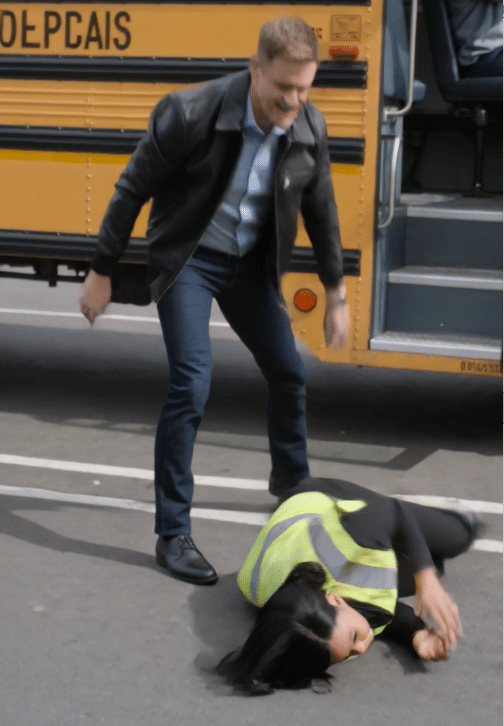
Without warning, he climbed onto the first step, grabbed the driver by the arm, and yanked her violently from the doorway.
She lost her footing.
Her body struck the pavement beside the bus.
Before she could recover, his foot drove hard into her chest.
The impact echoed through the loading zone.
Her reflective vest twisted as she hit the asphalt. Her forearm scraped against the rough pavement, leaving only a faint trace of blood before she instinctively tried to sit upright.
Inside the bus, several children froze.
One little girl covered her mouth.
Another began to cry.
The driver ignored her own pain.
Her eyes immediately turned toward the students.
Were they safe?
The father looked down at her with open contempt.
“Trash.”
He jabbed a finger toward the bus.
“You don’t delay my family.”
The children watched in stunned silence.
But the lesson they were about to witness had nothing to do with school.
Act II
The driver drew a slow breath and reached for the radio clipped to her vest.
Not to defend herself.
To report an emergency.
Before her hand reached it, the father stepped closer.
He lashed out again, striking her twice more as teachers rushed toward the bus from across the loading zone.
Several parents shouted for someone to call school police.
Children inside the bus cried, but no one left their seats. The driver had drilled them on emergency procedures throughout the year, and despite the chaos outside, they remained exactly where they were supposed to be.
Even now, she tried to reassure them.
“It’s okay,” she called gently. “Stay seated.”
The father laughed bitterly.
“You’re just a driver.”
To him, she was nothing more than someone hired to move children from one place to another.
He didn’t understand that she carried something far greater than a steering wheel.
Every morning and every afternoon, dozens of families entrusted their children to her care.
She wasn’t delaying his family.
She was protecting every family.
School transportation regulations had been written after years of painful lessons, investigations, and preventable tragedies. One unbuckled child could become a life-changing consequence if an emergency stop or collision occurred.
She knew that.
He didn’t care.
Then flashing lights reflected across the side of the bus.
Everything stopped.
Act III
School police vehicles rolled quietly into the loading zone.
Teachers immediately stepped aside.
Parents fell silent.
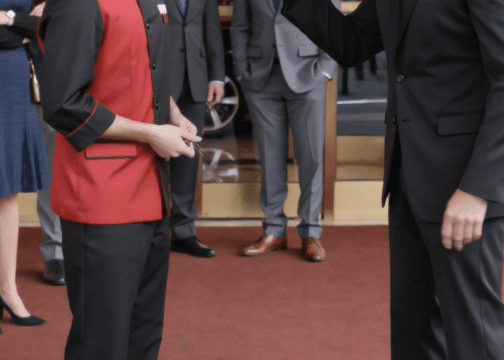
A uniformed transportation inspector emerged first.
Behind him came school police officers and transportation staff, moving with calm efficiency rather than urgency.
No one announced who the inspector was.
No one needed to.
The reactions around him spoke louder than introductions ever could.
Teachers straightened.
School administrators hurried from the building.
Even the officers waited for him to reach the scene before taking another step.
The father frowned.
He still believed he controlled the situation.
The inspector walked directly toward the injured driver.
Without a word, he positioned himself between her and the father.
School police formed a silent line behind him.
The loading zone, moments earlier filled with shouting and crying, became eerily still.
Only the quiet hum of idling bus engines remained.
The inspector locked eyes with the father.
His voice never rose.
“Get away from her.”
A brief pause.
“Now.”
The command carried across the parking lot with absolute certainty.
For the first time that afternoon, the father stepped backward without arguing.
His confidence cracked.
He looked around.
Everyone else already understood who stood before him.
He was the only one asking himself why.
Act IV
The inspector crouched beside the bus driver.
“Are you hurt?”
She nodded slightly.
“I’ll be alright.”
Then she looked past him toward the bus.
“Please make sure the children stay calm.”
Even after being assaulted, her first concern remained the students in her care.
Teachers quietly boarded the bus to comfort the frightened children while another driver prepared to complete the route once authorities finished securing the scene.
Meanwhile, transportation staff preserved everything exactly as it was.
The fallen radio.
The scattered paperwork.
The marks on the pavement.
The bus itself.
Modern school buses carried multiple interior and exterior cameras.
The loading zone was monitored by school security.
Several parents had recorded the confrontation from their phones.
There would be no uncertainty.
Only evidence.
Then another transportation supervisor quietly informed the inspector that the driver’s delay had lasted less than thirty seconds.
Thirty seconds.
That was all.
Thirty seconds spent ensuring a child’s seat belt was properly fastened before departure.
The rule the father had called unnecessary was the very rule designed to save his own son’s life.
The irony settled heavily over the crowd.
One by one, parents began thanking the driver for refusing to compromise safety.
The father noticed something he had never expected.
No one admired his anger anymore.
Every eye in the parking lot rested on the woman he had called “just a driver.”
And suddenly, that title seemed far more honorable than anything money could buy.
Act V
The father swallowed hard.
His voice, once booming across the loading zone, barely rose above a whisper.
“You are?”
The transportation inspector didn’t answer immediately.
Instead, he turned toward the injured driver.
“Medical is on the way.”
Then he addressed the staff.
“Get the students home safely.”
Nothing more.
The priorities were unmistakable.
Children first.
Always.
As paramedics examined the driver’s minor injuries, school police began interviewing witnesses and collecting statements from teachers and parents. The bus’s onboard recordings, security cameras around the loading zone, and cellphone videos preserved a complete record of the assault from multiple angles.
The father stood alone.
No applause.
No supporters.
No special treatment.
Only the quiet realization that he had attacked the very person entrusted with protecting his own child.
The driver eventually stood, brushed the dust from her reflective vest, and looked once more toward the bus.
Several children waved through the windows.
She smiled back.
Not because the afternoon had ended well.
But because every child was still safe.
Long after the parking lot emptied and the buses disappeared down neighborhood streets, one image remained impossible to forget.
A school bus driver who refused to move a vehicle until one child was properly protected.
A father who confused impatience with authority.
And four calm words that restored order without shouting, threats, or spectacle.
“Get away from her. Now.”
Because the people who seem to delay us are often the very ones standing between us and tragedy.
And true responsibility is measured not by how quickly you move—but by what you’re willing to stop in order to protect a life.