Act I
“We can’t approve this adoption today.”
The words were gentle, but they landed like an insult.
Inside the bright adoption center, rows of clean kennels lined the walls while dogs waited quietly behind secure gates. Families filled out paperwork at nearby tables, hoping to give an animal a second chance.
One woman wasn’t interested in waiting.
Dressed in designer clothing and carrying herself with absolute confidence, she slammed both hands onto the adoption desk.
“What do you mean you can’t?”
The shelter worker remained calm, holding the folder in front of her.
“The application needs additional review before we can release the dog.”
It was standard policy.
Nothing personal.
But the wealthy applicant wasn’t hearing policy.
She heard rejection.
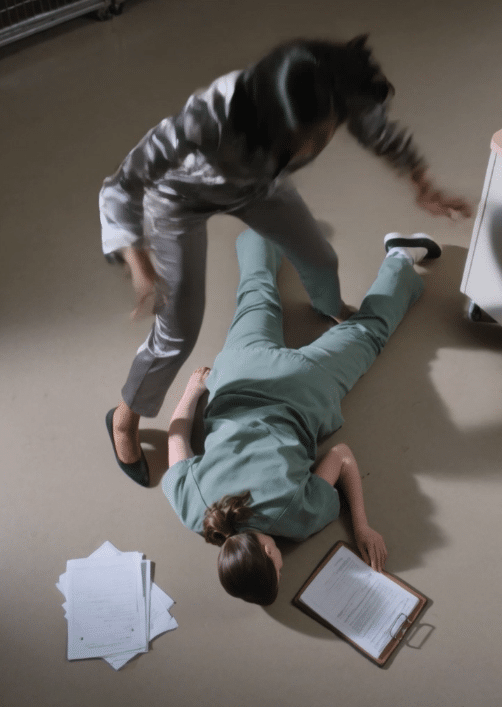
Without warning, she lashed out, striking the shelter worker with enough force to send her backward onto the floor beside the desk.
Adoption forms scattered across the room like leaves.
Her elbow struck the tile, leaving a faint scrape and a small trace of blood before she instinctively pulled her arm close.
The barking began almost immediately.
The dogs couldn’t understand the argument.
They only sensed fear.
The woman stood over the fallen employee.
“Trash.”
Then, loud enough for everyone in the lobby to hear, she sneered,
“You don’t decide what I can have.”
The room fell silent.
Act II
The shelter worker slowly tried to sit up.
Not to argue.
Not to defend herself.
Only to gather the adoption paperwork that had been scattered across the floor.
The woman wasn’t finished.
She stepped forward again, delivering another violent blow before striking once more as the employee tried to protect herself.
Families rushed their children toward the exit.
Volunteers quickly closed kennel doors to keep the frightened dogs calm.
The barking echoed throughout the building.
The shelter worker never raised her voice.
She simply said,
“The decision wasn’t made because of your income.”
That only fueled the woman’s anger.
“You’re just a kennel worker.”
She believed the shelter should have been grateful for someone willing to spend money.
She assumed donations, expensive clothing, and social status entitled her to bypass every safeguard.
What she didn’t know was why the application had been delayed.
The review wasn’t about paperwork.
It was about animal welfare.
Earlier that morning, staff had noticed inconsistencies in the references listed on the application. A routine verification had raised concerns about previous pet ownership, prompting the shelter to pause the adoption until the information could be confirmed.
The policy existed for one reason.
To protect animals that had already been abandoned once.
Then the office door opened.
Act III
Conversation stopped instantly.
A woman in a black blazer stepped into the lobby with several senior staff members beside her.
An animal control officer followed close behind.
Nobody announced who she was.
Nobody needed to.
Employees immediately straightened.
Volunteers stepped aside.
The atmosphere shifted without a single explanation.
The director walked directly toward the injured shelter worker before positioning herself between her and the furious applicant.
Behind her, the animal control officer remained perfectly still, watching every movement.
The silence became almost overwhelming.
The director looked at the woman.
Only four words left her mouth.
“Get away from her.”
She didn’t shout.
She didn’t threaten.
She simply waited.
For the first time since entering the shelter, the woman hesitated.
The confidence that had filled the room moments earlier began to disappear.
Act IV
Medical staff from a nearby clinic were called to examine the injured employee.
She apologized for delaying the adoption process.
Even after being assaulted, her concern remained the dogs waiting safely behind the kennels.
The director gently shook her head.
“You followed policy.”
Around them, staff quietly began collecting evidence.
Security cameras covered the adoption lobby from multiple angles.
The reception desk camera had recorded the confrontation.
Hallway cameras captured the moments leading up to it.
Visitors who had witnessed everything willingly offered statements.
Even the applicant’s own phone, still recording from a partially active livestream, had preserved much of the encounter.
The woman slowly realized every action had been documented.
No amount of anger could erase what dozens of people had seen.
Meanwhile, the director reviewed the application file.
The unresolved concerns that had delayed the adoption remained.
Now there was something far more serious attached to it.
The shelter existed to protect vulnerable animals.
Its employees deserved the same protection.
Around the lobby, frightened dogs slowly settled as volunteers spoke softly to them through the kennel doors.
The building regained its calm.
Only one person continued losing hers.
Act V
The injured employee accepted first aid before returning to organize the scattered paperwork.
One volunteer quietly gathered every page and placed the folder back into her hands.
Several families who had witnessed the incident thanked her for remaining calm throughout the confrontation.
One little girl hugged the stuffed dog she hoped to adopt and whispered to her mother,
“She’s protecting them.”
She was right.
The rules had never been about denying someone a pet.
They were about ensuring every animal found a safe, permanent home.
The wealthy applicant looked toward the woman standing in front of her.
Gone was the arrogance.
Gone was the certainty that money could solve everything.
Her voice had become almost unrecognizable.
“You are?”
The director didn’t answer immediately.
Instead, she turned to the injured employee.
“Are you okay?”
The worker nodded.
“I’ll be fine.”
Only then did the director face the applicant.
Her expression remained calm.
“Compassion isn’t measured by what you can buy. It’s measured by how you treat those who cannot defend themselves.”
No one applauded.
No one celebrated.
The lesson didn’t need cheering.
Everyone in the room already understood it.
The dogs waiting patiently behind their kennel doors couldn’t choose who adopted them.
That responsibility belonged to the people willing to enforce difficult rules—even when those rules angered powerful people.
Long after the lobby returned to normal and families resumed meeting the animals, one memory lingered.
A shelter worker who refused to compromise her principles.
A woman who mistook privilege for permission.
And a single calm command that ended the confrontation without raising a voice.
“Get away from her.”
Because the people protecting the most vulnerable are often the easiest to underestimate—until integrity proves stronger than intimidation.