Act I
The shipping label was wrong for less than three seconds.
Sweat stung Harold Mason’s eyes as he reached to peel it off the carton and replace it with the correct one.
“I can fix it right now.”
Before his fingers even touched the label again, a booming voice cut across the warehouse.
“Trash. You slow down my floor.”
The conveyor belts kept moving, but everyone nearby stopped working.
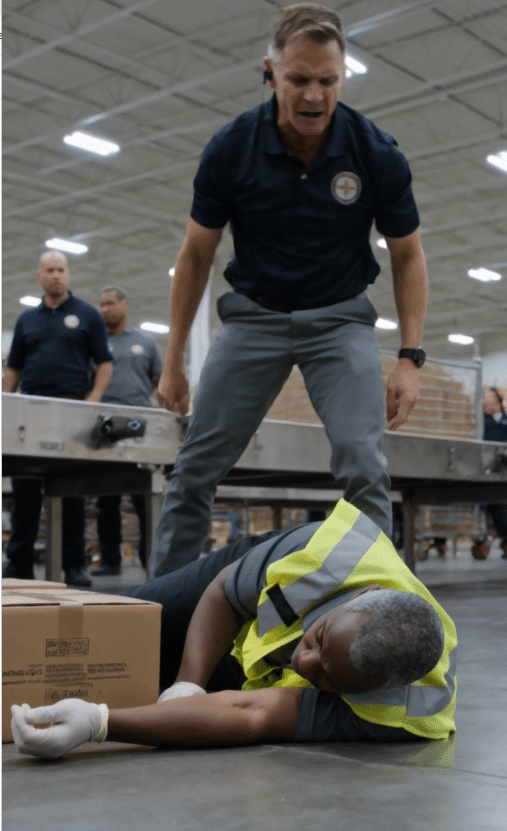
The night-shift manager stormed over, shoved the loaded cart aside so boxes spilled across the concrete, and grabbed Harold by the front of his reflective vest.
At seventy-two years old, Harold struggled to keep his balance.
The manager ripped off his scanner, threw it onto the conveyor, and loudly declared that older workers had become “dead weight.”
“People like you don’t belong on this line.”
No one dared answer.
Everyone knew the manager had made people disappear from the schedule for speaking up.
What nobody knew was that this wasn’t an ordinary night shift.
Act II
Harold had spent nearly five decades working.
Factories.
Distribution centers.
Machine shops.
When retirement savings disappeared after his wife’s long battle with cancer, he quietly returned to work instead of asking anyone for help.
He never complained.
He arrived early.
He covered extra shifts.
Even in the middle of a brutal summer heatwave, he refused to leave coworkers short-handed.
The warehouse manager saw none of that.
He saw only numbers on a productivity screen.
One incorrect label.
One excuse to embarrass someone in front of an entire shift.
As Harold bent down to gather the fallen cartons, several younger employees instinctively moved to help.
The manager barked at them to get back to work.
The room fell silent.
Then the loading dock doors thundered open.
Act III
Several black SUVs rolled to a stop outside.
The warehouse doors slid open, and a group wearing headquarters badges walked inside.
They weren’t smiling.
They weren’t chatting.
They were already taking notes.
At the center walked a gray-haired executive whose calm expression somehow made the entire building feel quieter.
Without acknowledging the manager, he walked directly toward Harold.
“Are you alright?”
Harold nodded automatically, still apologizing for the mislabeled carton.
The executive looked at the scattered boxes before turning toward the stunned manager.
“You just humiliated the wrong employee.”
The manager frowned.
“Who are you?”
No one answered.
They didn’t need to.
The reactions of the HR team, regional auditors, and floor supervisors said everything.
Act IV
The surprise visit hadn’t been scheduled.
It was part of an unannounced workplace culture audit following anonymous complaints from multiple facilities.
Every camera feed.
Every scanner log.
Every personnel report.
Everything was already being reviewed.
One auditor quietly replayed footage from minutes earlier.
Another interviewed employees one by one.
For the first time, workers who had stayed silent for months began speaking.
They described intimidation.
Public humiliation.
Threats over minor mistakes.
Pressure to ignore safety concerns.
Harold’s mislabeled package wasn’t the issue anymore.
It was simply the moment that exposed everything else.
The manager’s confidence vanished as quickly as it had appeared.
Act V
Harold was offered paid leave for the remainder of the week while the company completed its investigation.
The executive personally thanked him for maintaining professionalism despite the treatment he had received.
Within weeks, the warehouse introduced new heat-safety procedures, additional staffing, and mandatory leadership training.
Several long-ignored employee complaints were finally addressed.
The manager’s badge no longer opened the warehouse doors.
Months later, Harold still worked the night shift—not because he had to, but because he enjoyed mentoring younger employees.
The same conveyor belts still hummed through the building.
The same scanners still beeped.
But one thing had changed.
People no longer feared making an honest mistake.
Because everyone remembered the night a seventy-two-year-old worker quietly said, “I can fix it right now,” and the people who truly mattered finally listened.