Act I
The old man stopped moving for barely twenty seconds.
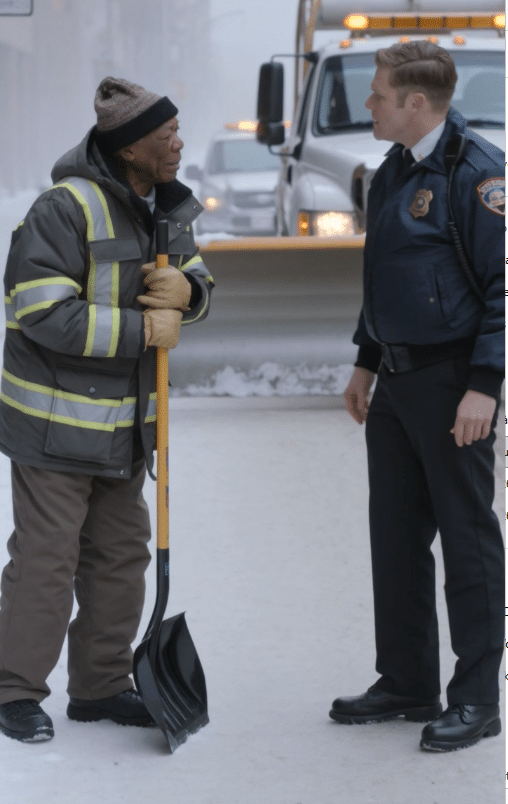
Snow whipped across the sidewalk as he leaned on his shovel, struggling to catch his breath in the bitter wind. His reflective jacket was dusted white, his gloves stiff with ice, and every breath came out in visible clouds.
“Just a few seconds, please.”
Instead of understanding, the crew leader exploded.
“Trash. You don’t rest on my clock.”
Every worker nearby froze.
The seventy-five-year-old had spent hours clearing sidewalks before sunrise. He wasn’t refusing to work. He simply needed a moment to breathe.
The supervisor didn’t care.
He ripped the shovel from the old man’s hands, threw it into the snow, and shoved him hard enough that he lost his footing and crashed onto the icy roadside. The elderly worker tried to brace himself, leaving only a small scrape on his elbow, but the humiliation hurt far more than the fall.
Then the supervisor stood over him.
“People like you freeze the whole crew.”
No one dared speak.
Until the sound of braking vehicles cut through the storm.
Everything changed.
Act II
Most people on the crew knew him simply as Walter.
Long before retirement age, Walter had already spent decades maintaining roads, parks, and sidewalks through every season imaginable.
After losing his wife several years earlier, he returned to work because his pension barely covered rent and medication.
Despite his age, he never complained.
He always arrived first.
He volunteered for the coldest assignments.
He quietly helped younger workers learn the job.
The new crew leader viewed those years of dedication very differently.
To him, experience meant slowness.
Compassion meant weakness.
Every shift became a competition against impossible productivity targets.
Workers stopped taking breaks.
Some skipped meals.
Others ignored injuries because they feared losing their jobs.
Walter’s twenty-second pause became the excuse the supervisor had been waiting for.
But fate had arranged something neither of them expected.
Act III
Several city vehicles pulled to the curb.
Orange warning lights reflected across the snow.
Doors opened against the freezing wind.
A woman stepped onto the sidewalk, followed by inspectors and traffic officers carrying clipboards.
Conversations stopped immediately.
The workers recognized the city badges before anyone spoke.
Without acknowledging the supervisor, the woman walked directly toward Walter and helped him back onto his feet.
Only then did she turn.
Her expression remained calm.
“Step away from him. Now.”
The supervisor frowned.
“Who are you?”
She never answered.
She didn’t have to.
The inspectors quietly surrounded the scene while nearby supervisors straightened their posture.
The crew leader suddenly realized this wasn’t a routine visit.
It was an unannounced field inspection.
And every pair of official eyes had witnessed exactly how he treated one of his oldest employees.
Act IV
The city leader asked Walter only one question.
“Are you all right?”
He nodded, embarrassed more than angry.
Then she addressed the entire crew.
“How many of you have skipped breaks because you were afraid?”
Nearly every hand slowly rose.
She asked another question.
“How many of you have seen someone publicly humiliated for slowing down?”
Again, hands filled the air.
The supervisor tried to defend himself.
“We have deadlines.”
She interrupted him.
“You have responsibilities.”
There was a difference.
An inspector reviewed body-camera footage from the inspection team, while another interviewed workers individually.
Stories poured out.
Missed safety breaks.
Threats.
Public humiliation.
Pressure to work through dangerous weather.
By the time the interviews ended, the supervisor’s confidence had completely disappeared.
Act V
Medical personnel checked Walter and confirmed he had only minor injuries, but everyone understood the deeper damage had been the public humiliation.
The city leader gathered the crew before leaving.
“No deadline is more important than a worker’s safety or dignity.”
She announced an immediate investigation into management practices, mandatory safety retraining for supervisors, and new cold-weather policies requiring scheduled warming breaks for every employee.
The crew leader was removed from duty pending the outcome of the investigation.
For the first time in months, workers spoke openly without fear.
One younger employee retrieved Walter’s shovel, brushed away the snow, and quietly handed it back.
“You earned that break,” he said.
Walter smiled.
Not because justice erased what had happened.
But because someone with the authority to make a difference had finally seen the truth with their own eyes.
As the snowfall eased and the first rays of morning broke through the clouds, the crew returned to work together—this time knowing that respect, not fear, was what kept a city running through the longest winter.