Act I
The fish slipped from her numb hands and landed on the wet factory floor.
For a split second, the entire packing line seemed to pause.
The seventy-year-old worker immediately bent down to remove it before it could affect the production line.
“My hands are numb. I’m sorry.”
She had barely finished speaking when the line foreman stormed toward her.
“Trash. You contaminate my line.”
Workers looked away.
They had seen his temper before.
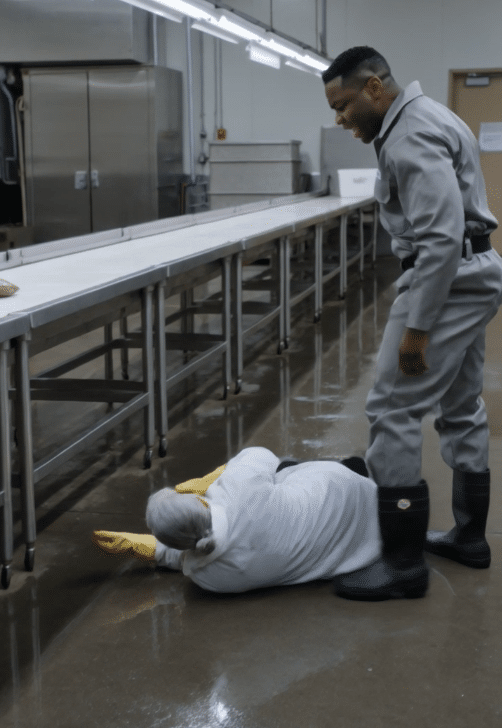
He snatched the fallen fish aside, berated her loudly in front of everyone, and shoved her back so abruptly that she lost her footing on the slick floor. She landed hard beside the stainless-steel table, leaving a small scrape on her elbow as she tried to brace herself.
Instead of helping her up, he stood over her.
“Old hands don’t belong on fast lines.”
The conveyor belts continued humming.
No one spoke.
Then the sound of several vehicles stopping outside echoed through the building.
Everything changed.
Act II
Her name was Eleanor.
She had spent decades working in seafood processing plants along the coast before arthritis and age slowed her hands.
Retirement wasn’t possible.
Medical bills for her late husband and rising living costs meant every paycheck mattered.
Even in the freezing production room, she never complained.
She volunteered for overtime.
She trained new employees.
She quietly corrected mistakes before they became larger problems.
Everyone respected her.
Everyone except the foreman.
Since his promotion, production speed had become his only measure of success.
Every delay became someone’s fault.
Every accident became a public lesson.
Workers feared making even the smallest mistake.
Today, Eleanor had simply dropped one fish.
It could have been replaced in seconds.
Instead, it became another opportunity for humiliation.
None of them realized someone important was about to witness the aftermath.
Act III
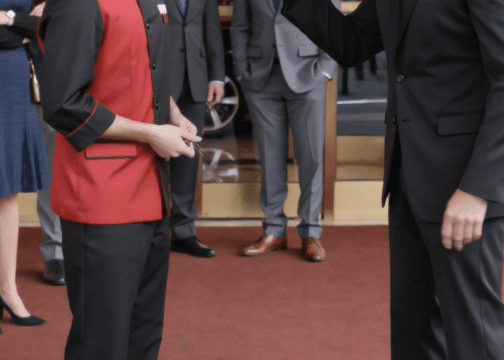
A convoy of black executive vehicles stopped outside the plant.
Moments later, the heavy production door swung open.
The owner of the seafood processing company entered alongside senior operations leaders and corporate staff.
The room fell silent.
Without acknowledging the foreman, the owner walked directly toward Eleanor and offered her a hand.
Only after making sure she was safely back on her feet did he turn toward the supervisor.
His voice remained calm.
“You just crossed the final line.”
The foreman frowned.
“Who are you?”
No one answered.
The operations leaders standing behind the visitor said enough through their expressions alone.
The foreman’s confidence evaporated.
This wasn’t a scheduled visit.
It was an unannounced executive inspection.
And the highest-ranking person in the company had arrived at the worst possible moment.
Act IV
The owner looked across the production floor.
“How often does this happen?”
At first, nobody answered.
Then one employee quietly spoke.
“Almost every week.”
Another admitted workers were afraid to report injuries or mistakes because they feared being humiliated.
Others described skipped breaks, constant intimidation, and unrealistic production demands.
The owner listened without interrupting.
Corporate staff documented every statement.
When the foreman attempted to defend himself, claiming he was only protecting productivity, the owner calmly replied,
“Quality begins with people. If your employees are afraid of you, you’ve already failed.”
The entire room remained silent.
The authority in his words was stronger than any raised voice.
Act V
Medical staff examined Eleanor and confirmed she had only minor physical injuries, though the emotional toll of the incident was unmistakable.
Before leaving the plant, the owner addressed every employee.
“No shipment is more valuable than the people who prepare it.”
He announced an immediate investigation into workplace conduct, mandatory leadership retraining, and new reporting channels that allowed employees to raise safety and harassment concerns without fear of retaliation.
The foreman was removed from supervisory duties pending the investigation.
For the first time in months, workers spoke openly.
Several thanked Eleanor for quietly enduring so much, even when no one had found the courage to speak beside her.
As the shift resumed, one younger employee placed a fresh pair of insulated gloves beside her workstation.
“You’ve carried this line for years,” he said softly.
“It’s our turn to look out for you.”
Eleanor smiled through tired eyes.
The conveyor belts started moving again.
The work hadn’t changed.
But the atmosphere had.
Sometimes justice doesn’t arrive with shouting.
Sometimes it arrives through a factory door, with people willing to remind everyone that respect is the most important standard any workplace can uphold.