Act I
The line of waiting cars grew by only a few seconds.
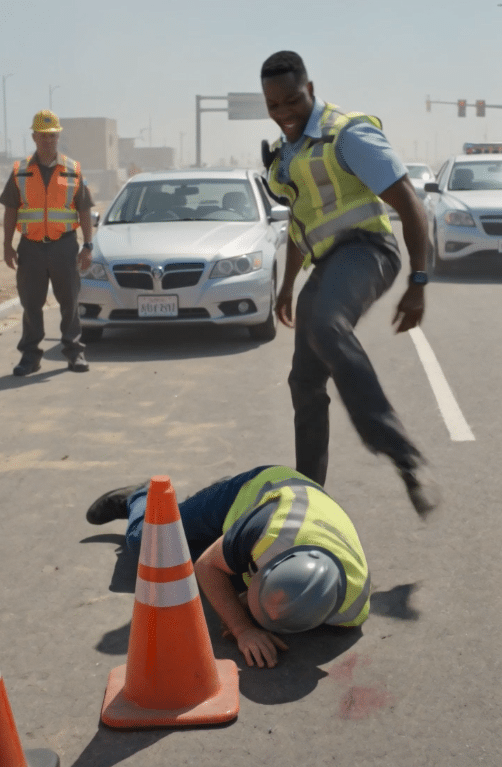
Standing beneath a relentless summer sun, the seventy-three-year-old flagger shifted the STOP/SLOW sign from one aching hand to the other. Hours of heat had drained his strength, and for a brief moment he struggled to keep his balance.
“The heat got to me,” he said quietly, already raising the sign again.
Instead of recognizing exhaustion, the roadwork supervisor exploded.
“Trash. You’re holding up my road.”
The entire construction zone fell silent as the supervisor berated the elderly worker in front of coworkers and frustrated drivers. The delay had barely been noticeable, but the public humiliation was impossible to ignore.
The old man lowered his eyes, embarrassed by a mistake that had lasted only seconds.
Then, in the distance, several official vehicles slowed to a stop beside the work zone.
No one knew they had arrived for an inspection.
Act II
The elderly flagger had spent decades working dangerous roadside jobs.
He had endured freezing winters, heavy storms, and blistering summers without complaint. Even after retirement age, he returned each season because he believed keeping motorists and fellow workers safe still mattered.
The new supervisor believed something else entirely.
Every second lost meant lower productivity.
Every worker was replaceable.
Experience meant nothing if it couldn’t keep pace with impossible expectations.
Over the past year, complaints about the supervisor’s behavior had quietly accumulated, but few employees were willing to risk speaking up.
Fear had become part of the uniform.
No one expected that to change on an ordinary afternoon.
Act III
The convoy stopped beside the orange cones.
Vehicle doors opened.
A group of inspectors stepped onto the hot pavement, followed by a calm, composed leader from the infrastructure authority.
Nobody introduced them.
Nobody had to.
The safety officers walking behind them said enough.
Workers instinctively straightened their reflective vests.
The supervisor’s expression shifted.
The visitors ignored the machinery, the asphalt, and the traffic flow.
Instead, the authority leader walked directly toward the elderly flagger, who was still trying to compose himself after the confrontation.
Standing between the supervisor and the older worker, the official spoke only one sentence.
“You just failed the whole inspection.”
Silence spread across the construction site.
The supervisor stared.
“You are?”
Act IV
The inspection leader didn’t raise their voice.
Instead, they looked toward the elderly flagger.
“We’ve spent months reviewing safety reports from projects across the region,” they said. “Today we arrived unannounced to see how people are treated when they think no one important is watching.”
Inspectors quietly began documenting the scene.
Several workers, who had remained silent for months, finally stepped forward.
One described coworkers being pressured to ignore heat breaks.
Another admitted they had hesitated to report unsafe conditions out of fear of retaliation.
A third revealed that experienced employees had resigned because of constant intimidation.
The tiny delay that had sparked the confrontation suddenly seemed insignificant.
The real problem had never been traffic.
It had been leadership.
Act V
The authority leader helped the elderly worker into the shade and made sure medical staff evaluated him for heat exhaustion before any questions continued.
Then they faced the supervisor.
“A safe project depends on protecting workers,” they said. “Not intimidating them.”
The inspection continued throughout the afternoon.
Safety violations were documented.
Employee statements were collected.
Management was informed that a formal review would begin immediately.
The supervisor’s confidence disappeared as quickly as it had appeared.
By the time the convoy departed, every worker understood the lesson.
A few extra seconds of delay had never endangered the project.
Treating exhausted employees without dignity had.
The following week, shaded rest stations, additional water breaks, and revised heat-safety procedures were introduced across the site.
As for the elderly flagger, he returned to work only after being medically cleared.
When he stepped back onto the roadside, several younger workers quietly thanked him—not because he had caused a delay, but because his courage had exposed a problem everyone else had been too afraid to confront.
Sometimes the strongest person on a construction site isn’t the one giving orders.
It’s the one who keeps doing the right thing, even when no one else does.