Act I
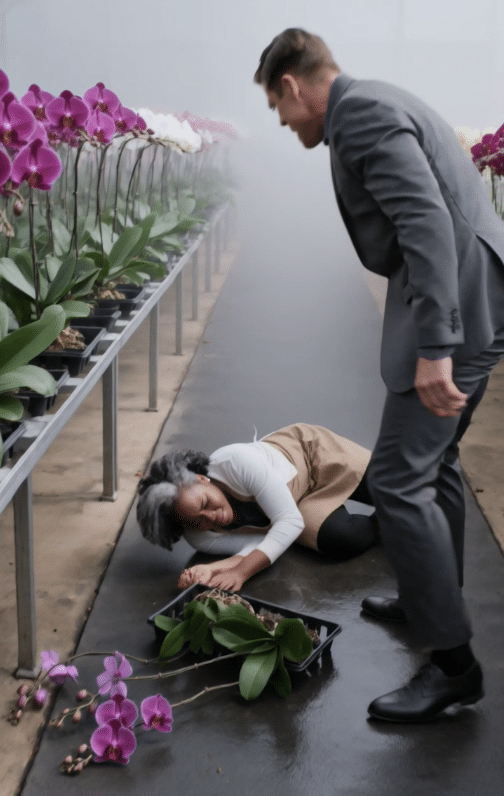
The orchid stem snapped with a sound so soft that most people would have missed it.
The sixty-nine-year-old greenhouse worker froze in the narrow aisle, staring at the single broken bloom in disbelief. She had spent the morning carefully moving trays through the crowded greenhouse, but one awkward turn was all it took.
“I’m sorry. It was an accident.”
Before she could even reach for the damaged plant, the greenhouse manager stormed toward her.
“Trash. You broke premium stock.”
Heads turned from every row of orchids.
The broken stem represented only a tiny fraction of the day’s harvest, but the manager treated it as though the entire greenhouse had been destroyed.
He continued humiliating her in front of everyone, accusing her of ruining valuable inventory and questioning why someone her age was still working.
The elderly woman lowered her head.
She looked more heartbroken over the flower than anyone else.
Then the sound of tires crunching across the gravel outside interrupted the silence.
Act II
She had worked with orchids for nearly thirty years.
Every morning she arrived before sunrise to inspect temperature controls, water delicate roots, and care for plants that many people considered too fragile to grow commercially.
She knew every greenhouse aisle by memory.
She could identify unhealthy roots with one glance.
Many of the younger employees had learned the trade by watching her.
The new manager never cared.
He measured success only by inventory numbers, replacement costs, and production quotas.
To him, workers weren’t people.
They were expenses.
And older employees were the easiest to blame whenever something went wrong.
Nobody challenged him anymore.
Until that afternoon.
Act III
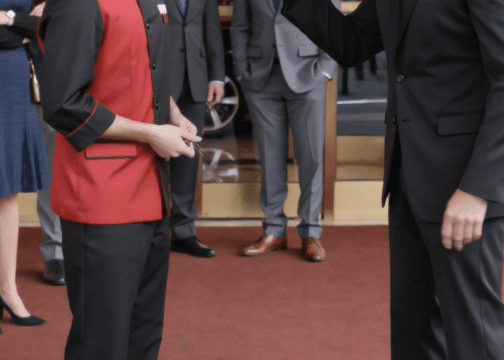
A black sedan stopped outside the greenhouse entrance.
The glass door swung open.
Several operations staff entered first.
Behind them walked a composed fifty-eight-year-old executive whose presence instantly changed the room.
Supervisors stood straighter.
Employees exchanged nervous glances.
The manager’s voice disappeared.
Instead of inspecting inventory, the visitor walked directly toward the elderly woman, who was still quietly gathering the fallen orchid tray.
The executive gently helped her to her feet before turning toward the manager.
Then came a sentence that echoed through the greenhouse.
“That orchid was nothing. What you did is everything.”
The manager blinked in confusion.
“Who are you?”
Act IV
The executive didn’t answer immediately.
Instead, they picked up the broken orchid.
“You know why this flower mattered so little?” they asked calmly.
“Because plants can be replaced.”
The greenhouse fell completely silent.
“But people who dedicate decades to teaching others cannot.”
Operations staff quietly began taking notes.
Several employees who had remained silent for months finally stepped forward.
One described constant public humiliation.
Another spoke about workers being threatened over tiny mistakes.
A third admitted many experienced growers had resigned because they no longer felt respected.
The executive listened without interrupting.
Then they looked back toward the elderly worker.
“I’ve reviewed production reports for years,” they said. “Your name appears again and again whenever this company trains outstanding growers.”
The manager stared in disbelief.
He had never bothered to learn who she was.
Only what she earned.
Act V
The executive asked the elderly woman if she needed medical attention after the frightening confrontation and made sure another employee accompanied her to the staff office.
Then they addressed the greenhouse team.
“A successful greenhouse isn’t built by perfect flowers,” they said.
“It’s built by people who care enough to grow them.”
A formal workplace investigation began before the afternoon ended.
Employee interviews were scheduled.
Management practices were reviewed.
The manager was removed from supervisory duties pending the outcome of the investigation.
In the days that followed, something unexpected happened.
The broken orchid was quietly propagated from one of its healthy nodes.
Months later, it bloomed again.
The elderly grower smiled when she saw it.
Not because it was rare.
But because it reminded her that care, patience, and respect can restore far more than people expect.
Just as the orchid recovered from one broken stem, the greenhouse slowly recovered from a culture that had forgotten its most valuable asset wasn’t the flowers growing inside.
It was the people who had spent a lifetime helping them bloom.