Act I
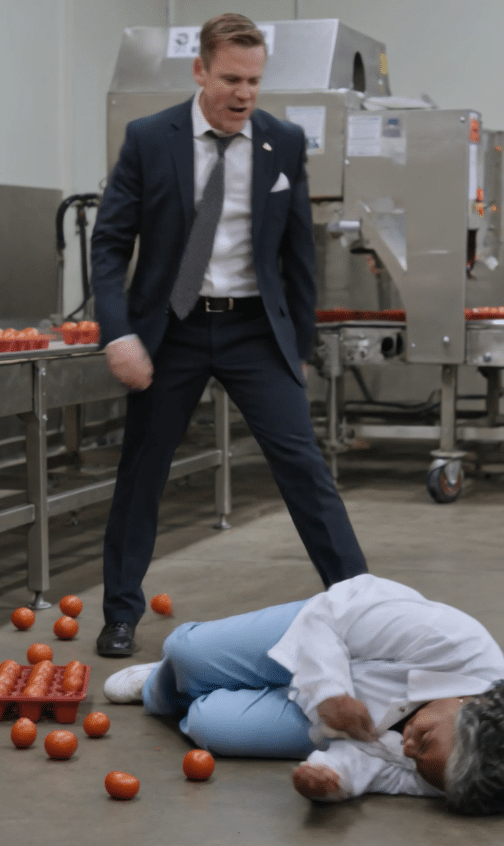
Tomatoes were already rolling across the production floor before anyone said a word.
An exhausted sixty-seven-year-old worker had lost her grip on a single tray. Fatigue had made her hands tremble, and the spill was small enough that it could have been cleaned up in moments.
She immediately bent down, gathering the tomatoes as quickly as she could.
“My hands slipped. I’ll clean it.”
Instead of helping, the line foreman stormed toward her.
“Trash. You ruined the line.”
The conveyor kept moving.
Everyone else stopped.
Because everyone knew what came next whenever he lost his temper.
But this morning, something else had arrived outside the building.
Act II
The woman had worked in food processing for decades.
Long shifts inside refrigerated facilities had stiffened her joints and numbed her fingers, but she never complained.
She simply worked harder.
The foreman measured people by numbers instead of effort.
Every tray counted.
Every second counted.
And every mistake became an excuse to embarrass someone publicly.
He kicked another tray aside, sending tomatoes scattering even farther across the floor.
“Old hands waste fresh product.”
The workers lowered their eyes.
Not because they agreed.
Because they were afraid.
Then came the unmistakable sound of several SUVs braking outside.
Act III
The production door swung open with a metallic bang.
A small group entered without hesitation.
At their center walked a sharply dressed woman flanked by quality assurance leaders and senior operations executives.
She didn’t acknowledge the foreman.
She walked directly to the elderly worker, helping her stand before quietly examining the scattered tomatoes.
Only then did she face the foreman.
“You just destroyed more than a tray.”
The entire production floor fell silent.
Behind her, QA inspectors were already documenting the scene.
The foreman’s expression changed instantly.
Act IV
Inspection badges flashed beneath the bright production lights.
Executives watched without speaking.
Workers exchanged uncertain glances as inspectors requested security footage from the line.
What had begun as a routine quality inspection had suddenly become an investigation into management conduct.
For months, employees had accepted humiliation because they believed no one important would ever see it.
Today, the cameras had seen everything.
Act V
The conveyor slowed until the factory seemed unusually quiet.
The elderly worker stood surrounded by people who treated her with dignity instead of contempt.
The foreman looked from one executive to another, realizing exactly who had witnessed his behavior.
His confidence disappeared.
His voice barely came out.
“Who are you?”
No one rushed to answer.
The presence of the executives, the QA team, and the respectful silence throughout the factory already said enough.
The spilled tomatoes had never been the real problem.
The real failure had been a manager who believed intimidation was leadership—and who discovered too late that accountability had arrived at his production line.