Act I
“I’m sorry. My crutch slipped.”
The apology came almost as quickly as the accident itself.
A metal crutch had caught the edge of a long wooden reading table, nudging a paper coffee cup just enough for a few drops to splash onto the polished wood and the corner of an expensive business laptop.
The seventy-four-year-old man froze.
His hands trembled as he instinctively reached for a napkin.
“I’m so sorry,” he repeated.
Across the table, the businessman rose slowly.
Readers nearby looked up from their books.
The library remained silent, but the atmosphere changed in an instant.
The man glanced at the tiny coffee spots before glaring at the elderly visitor.
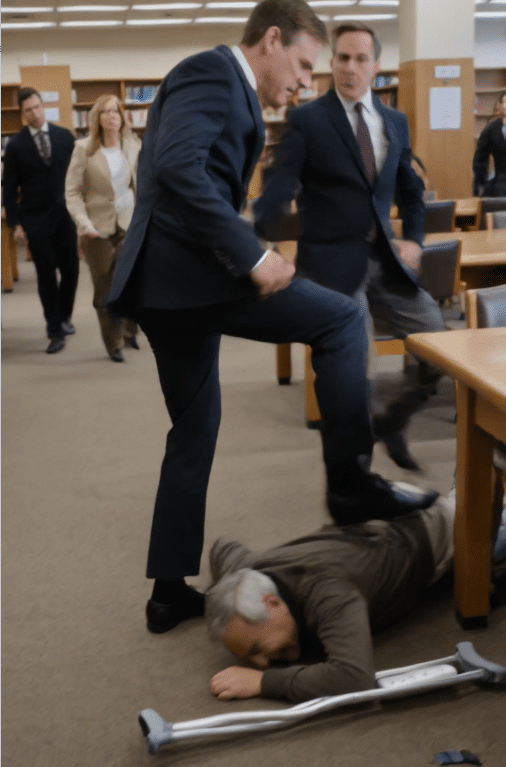
“Trash,” he said coldly. “You almost ruined my laptop.”
The old man lowered his eyes.
He had spent his life apologizing for taking up too much space.
Today felt no different.
What no one noticed was that someone important had just stepped through the library entrance.
Act II
The businessman refused to let the apology end the matter.
He stood over the older man, his expensive suit and polished shoes making the contrast between them impossible to ignore.
The elderly visitor leaned heavily on his crutches, embarrassed by the attention gathering around him.
He had only come to return a borrowed history book and spend a quiet afternoon reading.
Instead, he found himself becoming the center of the room.
“People like you should stay home,” the businessman snapped.
Several readers looked away.
Others remained perfectly still.
It wasn’t agreement.
It was discomfort.
Few people expect cruelty in a place built for learning.
The old man quietly reached toward the book that had slipped from his hands.
Before he could gather himself, footsteps echoed from the entrance.
The room instinctively turned.
Act III
The library director appeared first, moving with unusual urgency.
Beside her walked a distinguished man in a long luxury coat whose arrival changed the posture of every staff member in sight.
Conversations stopped.
Employees straightened immediately.
Even security personnel near the front desk became noticeably attentive.
The businessman frowned.
He didn’t recognize the older visitor.
But he recognized the reaction.
The civic patron slowly surveyed the scene.
His eyes rested on the crutch lying across the floor.
Then on the fallen book.
Finally—
On the businessman.
Without raising his voice, he spoke.
“Step away from him.”
The words were calm.
Yet they carried an authority that silenced the entire library.
Act IV
The businessman forced a smile.
“This is just a misunderstanding.”
Neither the library director nor the civic patron responded immediately.
Instead, the director quietly picked up the elderly man’s book and handed it back with both hands.
The patron turned to the businessman.
“This library exists for everyone.”
His voice remained measured.
“Especially those who need kindness more than judgment.”
The businessman looked around for support.
He found none.
Readers who had remained silent moments earlier now watched him with unmistakable disappointment.
The director explained that the patron had personally funded accessibility renovations, literacy programs, and senior outreach services for years.
He wasn’t simply an honored guest.
He had dedicated decades to ensuring older residents would always feel welcome in places like this.
The businessman suddenly realized how badly he had misjudged the room.
Act V
The elderly man accepted his book with a grateful smile.
“I’m sorry for the trouble,” he said quietly.
The civic patron gently shook his head.
“The accident wasn’t the problem.”
He looked toward the businessman.
“The response was.”
The library remained silent.
Not with fear.
With reflection.
The businessman stared at the polished floor where only a few drops of coffee had started the confrontation.
It had never truly been about the coffee.
It had been about dignity.
The patron helped the elderly visitor steady his crutch before walking with him toward a reading table by the window.
Sunlight stretched across the pages of the old history book.
For the first time that afternoon, the room felt like a library again.
Behind them, the businessman stood motionless.
His confidence had disappeared.
As the reality of the situation settled over him, only one question escaped his lips.
“Who are you?”
No one rushed to answer.
They didn’t need to.
Because everyone in the room had already learned the lesson that mattered most:
Respect is measured not by how we treat the powerful, but by how we treat the person least able to defend themselves.