Act I
“I’m sorry. The wind took it.”
The older man’s apology was almost drowned out by the automatic glass doors sliding open and shut.
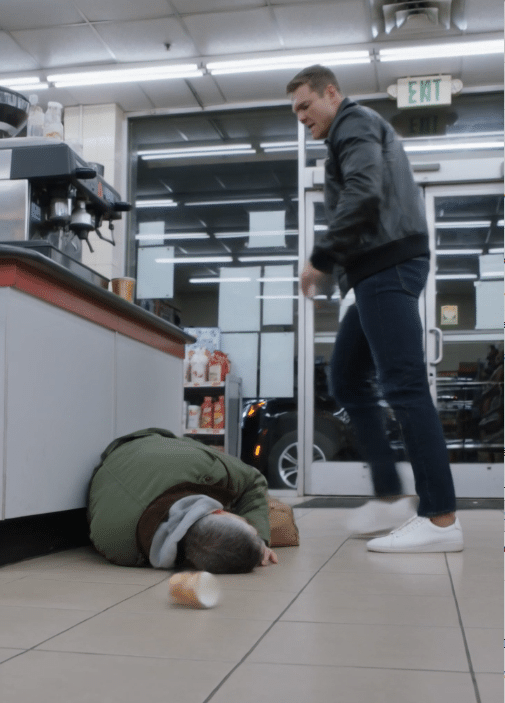
A cold gust had rolled his empty paper cup across the bright tile floor until it lightly tapped the polished white shoe of a young customer.
The sixty-eight-year-old man immediately reached for it.
He never got the chance.
The young man looked down at the cup as though it had contaminated the entire store.
“Trash,” he snapped. “Keep your filth away from me.”
The homeless man lowered his eyes.
His faded military coat hung heavily around his shoulders, offering little protection against the cold that swept in each time the doors opened.
“I didn’t mean—”
The customer cut him off with a glare sharp enough to silence the room.
Late-night shoppers froze beside the coffee machine.
The cashier looked up from the register.
No one spoke.
The homeless man quietly picked up the cup and clutched it in both hands.
He had spent years learning that survival often meant avoiding confrontation.
But sometimes, avoiding conflict isn’t enough.
Act II
The young man refused to let the moment end.
He stepped closer, his expensive leather jacket and luxury car keys reflecting the bright store lights.
The contrast between the two men couldn’t have been greater.
One carried designer shopping bags.
The other carried everything he owned in a worn cloth satchel resting beside the entrance.
“Get out before I throw you out.”
The words echoed across the quiet convenience store.
Several customers exchanged uneasy glances.
No one wanted the situation to escalate.
The older man looked toward the cashier.
“I’ll leave,” he said softly.
He wasn’t asking to stay.
He simply wanted to leave with what little dignity remained.
Outside, headlights swept across the front windows.
A black SUV came to a smooth stop.
The young customer never noticed.
Act III
The automatic doors opened once again.
This time, several security staff entered first.
Behind them walked a distinguished man whose calm presence instantly changed the mood inside the store.
Employees straightened immediately.
The cashier stood a little taller.
Even the assistant manager hurried from the stockroom.
The newcomer paused only long enough to take in the scene.
The elderly man’s worn bag.
The paper cup in his trembling hands.
The frightened silence filling the store.
Finally—
He looked directly at the young customer.
“He stays,” the man said.
A brief pause followed.
“You leave.”
No shouting.
No threats.
Just quiet certainty.
The young man frowned.
“You own this place?”
The distinguished man didn’t answer immediately.
He simply continued walking until he stood beside the older man.
Act IV
Only then did the assistant manager quietly speak.
“Sir…”
Every employee knew exactly who had arrived.
He was the founder and owner of the convenience-store chain, known throughout the region for insisting that every store remain open through the night so people could find warmth, food, and safety when they needed it most.
Years earlier, he had experienced homelessness himself after returning from military service.
He never forgot what it felt like to be invisible.
He looked at the young customer without anger.
“This store was built for people,” he said evenly.
“Not for pride.”
The young man’s confidence began to disappear.
He looked around for support.
Instead, he found only disappointed faces.
The owner continued.
“A person’s circumstances do not determine whether they deserve respect.”
Silence settled over the brightly lit store.
For the first time that evening, the young man seemed to understand that everyone had witnessed not just an argument—but his character.
Act V
The owner turned toward the older man.
“Would you like a fresh cup of coffee?”
The homeless man hesitated.
“You don’t have to do that.”
“I know.”
The owner smiled gently.
“I want to.”
An employee quietly prepared a hot coffee while another brought a warm sandwich from the kitchen.
The older man accepted them with both hands, visibly overwhelmed.
Outside, the winter wind continued to blow against the glass doors.
Inside, the atmosphere had changed completely.
Customers who had remained silent moments earlier began offering quiet smiles and simple words of kindness.
Sometimes compassion only needs one person willing to act first.
The young customer stood motionless near the entrance.
The confidence that had filled him only minutes earlier had vanished.
He looked at the man who had transformed the entire room without ever raising his voice.
“You own this place?”
The owner finally answered.
“No.”
He glanced around the store.
“I simply remember what it feels like to need one.”
No one said another word.
They didn’t have to.
Because everyone present had just learned that true wealth isn’t measured by what a person owns—but by how they choose to treat someone who has almost nothing.