Act I
“I’m sorry, sir. I’ll pick it up.”
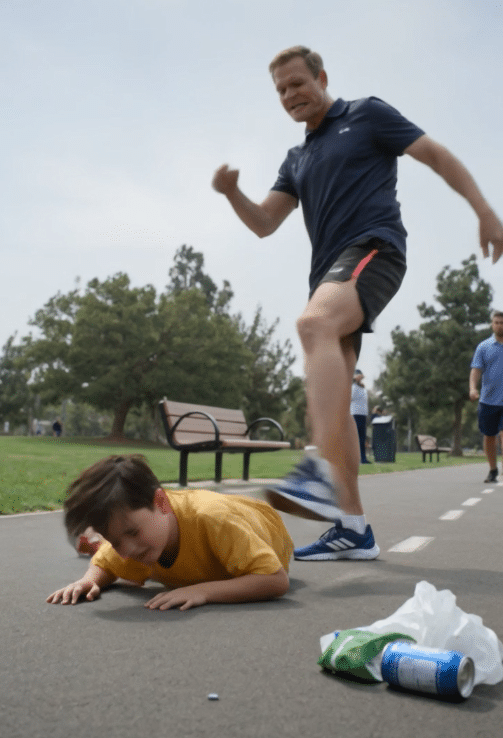
The twelve-year-old boy bent down the instant the empty can rolled across the jogging path.
A light breeze had pushed it just far enough for it to bump against a jogger’s expensive running shoe, leaving a tiny drop of water on the polished toe.
The boy reached for it immediately.
He never expected what came next.
The jogger looked down as though something disgusting had touched him.
“Trash,” he snapped. “You ruined my shoes.”
Morning runners slowed.
People sitting on nearby benches looked over.
The boy clutched the worn cloth bag hanging from his shoulder.
It was filled with empty cans he had collected since sunrise.
Each one represented a few more cents toward helping his family pay bills.
“It was an accident,” he said quietly.
“I’ll clean it.”
The man wasn’t interested in hearing him.
He wanted everyone else to.
Act II
The jogger stepped closer, towering over the child.
His designer athletic clothes and expensive smartwatch contrasted sharply with the boy’s faded yellow T-shirt and worn sneakers.
The child lowered his eyes.
He had grown used to being judged before anyone learned his story.
His father had been injured at work months earlier.
His mother worked double shifts whenever she could.
Collecting recyclable cans after school wasn’t something he enjoyed.
It was something his family needed.
The wealthy jogger pointed toward the park entrance.
“Pick trash somewhere else.”
His voice carried across the path.
Several people stopped jogging.
No one intervened.
Not because they agreed.
Because they assumed someone else would.
The boy quietly began gathering the cans that had spilled from his bag.
Then the sound of a vehicle door closing echoed from the nearby parking area.
Act III
A black SUV stood beneath the shade of an old oak tree.
Its rear door opened.
A distinguished man in his sixties stepped out, followed by an assistant.
The moment he appeared, several park employees straightened instinctively.
A volunteer coordinator hurried toward him.
The jogger noticed.
His confidence faltered for the first time.
The older gentleman didn’t rush.
He simply looked across the path.
At the scattered cans.
At the frightened boy kneeling on the pavement.
Then at the man standing over him.
He walked forward until only a few feet separated them.
“Back away from the boy.”
His voice was calm.
Firm.
Impossible to ignore.
The jogger frowned.
“Who are you?”
The older man offered no answer.
Not yet.
Act IV
The assistant quietly helped the boy gather the cans while the community leader remained focused on the confrontation.
Only after every can had been placed back into the cloth bag did he speak again.
“This park belongs to everyone.”
He looked around at the people who had gathered.
“Especially children trying to make an honest living.”
The volunteer coordinator finally broke the silence.
“Sir, this is the chairman of the city’s Community Renewal Foundation.”
Recognition spread across the crowd.
For years, the foundation had funded park improvements, youth programs, and neighborhood assistance projects.
The jogger’s expression changed instantly.
He had donated to the foundation himself.
More importantly, he had hoped to secure a partnership with it for his own business.
The community leader didn’t mention any of that.
He simply asked one question.
“What lesson do you think that boy learned from you today?”
The jogger couldn’t answer.
Act V
The community leader knelt beside the boy instead.
“What are you collecting these for?”
The child hesitated before answering.
“My family.”
It was only two words.
But they carried more weight than any speech.
The community leader smiled gently.
“There is no shame in honest work.”
He reached into his pocket, handed the boy a business card, and asked him to have his parents call.
The foundation was expanding a youth assistance program that offered part-time work, school support, and family resources.
The boy stared at the card in disbelief.
Around them, people who had watched silently only minutes earlier began helping gather the remaining cans.
One runner even carried the bag back to the child.
The atmosphere in the park had changed.
Not because someone powerful had arrived.
Because someone powerful had chosen compassion over status.
The wealthy jogger remained frozen where he stood.
His confidence had dissolved into uncertainty.
He looked at the distinguished man one final time.
“Who are you?”
The community leader smiled.
“I’m someone who believes no child should ever be embarrassed for helping their family.”
The park fell quiet.
And for the first time that morning, the boy stood a little taller—not because his circumstances had changed overnight, but because someone had reminded him that dignity can never be measured by the contents of a bag full of empty cans.