Act I
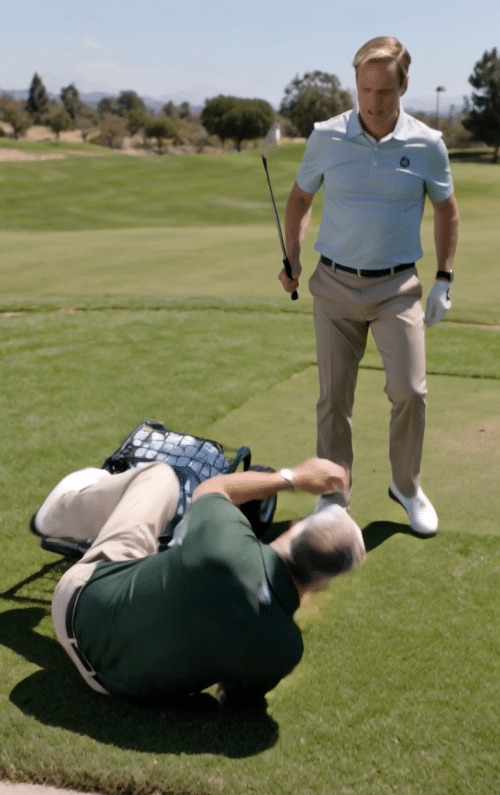
The golf ball rolled only a few feet before it drifted into the member’s hitting lane.
The elderly groundskeeper immediately stopped pushing his ball cart.
“I’m sorry. It rolled out.”
The apology came before anyone could complain.
But the wealthy club member had already lowered his golf club and turned with obvious irritation.
“Trash. You ruined my shot.”
The practice range fell strangely quiet.
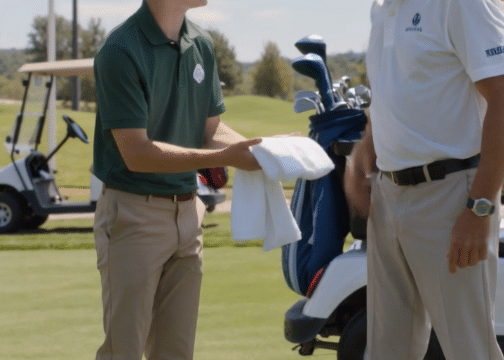
The seventy-year-old worker had spent decades collecting golf balls under the hot afternoon sun. Most members barely noticed him, and that was exactly how he preferred it.
Today, one harmless mistake made him impossible to ignore.
The member stepped closer, his voice growing louder with every word.
“Staff should stay invisible.”
Golfers nearby exchanged uneasy glances.
Everyone sensed the situation had crossed a line.
No one realized someone important had witnessed the entire exchange.
Act II
The old worker bent to retrieve the stray ball, keeping his head down.
His hands trembled slightly—not from fear alone, but from exhaustion after another long shift.
The wealthy member continued berating him in front of everyone on the range.
A few employees looked toward the clubhouse, uncertain whether to intervene.
The older man quietly began gathering the scattered balls again.
He refused to answer the insults.
Years of hard work had taught him that dignity sometimes meant staying calm when others lost theirs.
That only seemed to anger the member more.
The atmosphere became painfully tense.
Then the sound of tires on the cart path broke the silence.
Act III
A management golf cart came to a sharp stop beside the practice range.
Several board members stepped out first.
Then a silver-haired gentleman climbed down from the passenger seat.
The reaction was immediate.
Course employees straightened.
Golf instructors removed their caps.
Even longtime members stopped talking.
The newcomer walked directly toward the elderly groundskeeper before looking at anyone else.
Only then did he turn to the furious member.
“You just crossed the wrong fairway.”
His voice was calm.
Calm enough to make the entire practice range fall silent.
The member frowned.
“You’re the owner?”
No one answered.
They didn’t need to.
Act IV
The club owner helped the elderly employee to his feet.
“Are you alright?”
The old man nodded with quiet dignity.
The owner then addressed the crowd.
“This gentleman has cared for this course for more than thirty years.”
He paused.
“He was here before many of us joined this club.”
Several longtime members nodded in agreement.
The owner looked at the wealthy golfer.
“You see someone collecting golf balls.”
“I see the man who helped build the reputation of this course.”
Management quietly requested the member’s club identification.
Confidence began draining from his face.
For the first time that afternoon, he realized everyone around him was watching—not the worker, but him.
Act V
The owner announced that disrespect toward employees would never be tolerated at the club, regardless of a member’s status or wealth.
Several golfers walked over to help gather the scattered practice balls.
Others thanked the elderly groundskeeper personally for his years of service.
The old man smiled with quiet gratitude, more touched by the respect than by the attention.
Before returning to the clubhouse, the owner placed a reassuring hand on his shoulder.
“People remember beautiful courses,” he said.
“But they’re built by honorable people.”
The member stood speechless as management escorted him away to discuss the consequences of his conduct.
The practice range slowly returned to normal.
Golf balls were gathered.
Clubs swung again.
But everyone present carried home the same lesson:
The true measure of a person isn’t found on a scorecard—or in a membership badge—but in how they treat the people whose work makes everything else possible.