Act I
“I’m so sorry. I didn’t see it.”
The apology barely left the elderly volunteer’s lips before the silence inside the church shattered.
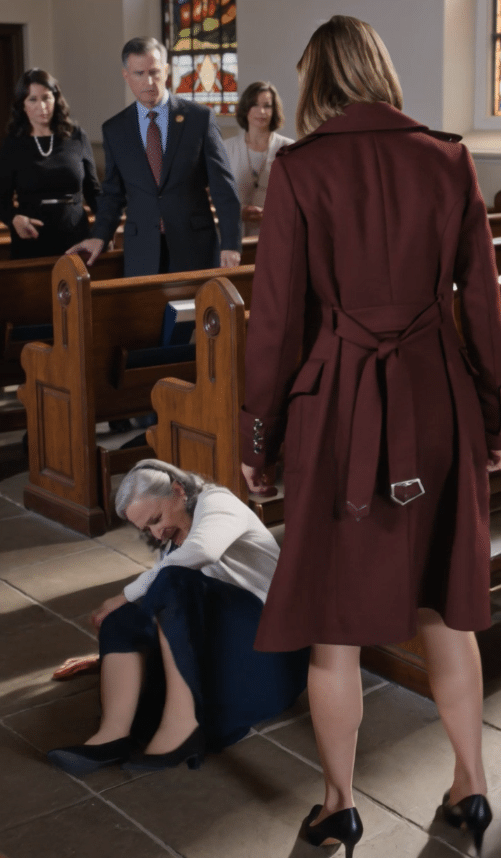
As parishioners slowly filed toward the doors after Sunday service, the seventy-nine-year-old woman had been sweeping the stone aisle with the same quiet care she had shown every week for nearly thirty years. Distracted by her work, she accidentally stepped on the edge of an elegant designer dress.
The mistake lasted less than a second.
The humiliation that followed seemed determined to last much longer.
The wealthy visitor spun around, her face twisted with outrage.
“Trash. You stepped on designer fabric.”
Every conversation stopped.
The old volunteer lowered her eyes, clutching the small broom with trembling hands.
She apologized again.
It only made the visitor louder.
“Volunteers should know their place.”
No one expected what would happen next.
Act II
To the visitor, the elderly woman looked invisible.
Her cardigan was worn.
Her shoes had clearly seen better years.
The broom in her hands made her look like little more than another cleaner finishing the day’s chores.
What the visitor never bothered to ask was why nearly every member of the congregation greeted the woman by name.
For decades, Margaret had quietly cared for the church without asking for recognition. She had arranged flowers after funerals, cleaned pews before weddings, stayed late after Christmas services, and welcomed strangers who had nowhere else to go.
Children she had once helped in Sunday school had grown into parents themselves.
Some of the priests serving today had known her since they were seminarians.
She had become part of the church’s foundation—not through wealth, but through faithfulness.
The visitor saw only an old woman.
Everyone else saw something entirely different.
Then the great wooden doors opened.
Act III
The sound echoed through the sanctuary.
Two aides entered first.
Behind them walked a senior leader from the diocese, visiting the parish for an afternoon meeting.
The atmosphere changed instantly.
Priests straightened.
Staff fell silent.
Even the departing congregation instinctively stepped aside.
His eyes moved across the room before settling on the frightened volunteer still holding her broom.
Then they shifted toward the woman towering over her.
His voice remained calm.
“Not in this house.”
He walked directly to Margaret before saying another word.
“Are you hurt?”
She offered the same gentle smile she always had.
“I’m all right.”
Only then did he turn toward the visitor.
There was disappointment in his expression more than anger.
And somehow, that felt even heavier.
Act IV
The visitor tried to regain control.
“I was only teaching her to be careful.”
No one answered.
Instead, one of the aides quietly picked up the volunteer’s cleaning cloth from the floor.
Another parishioner took the broom from Margaret’s hands so she could sit down.
The church leader addressed the room rather than the visitor.
“This woman has served this parish longer than many of us have held our positions.”
Heads nodded throughout the sanctuary.
A retired teacher quietly wiped away tears.
A young couple whispered that Margaret had organized the meal train after their daughter was born.
An elderly veteran remembered she had visited him every week during his recovery.
Story after story surfaced without anyone being asked.
Respect had never belonged to the loudest person in the room.
It belonged to the one who had quietly earned it.
The visitor suddenly realized she was standing alone.
Act V
The church leader helped Margaret back to her feet.
“You’ve cared for this place for decades,” he said warmly. “Today, let us care for you.”
Several parishioners insisted on finishing the cleaning themselves.
Others gathered around Margaret with gentle smiles and grateful embraces.
The sanctuary, moments earlier filled with tension, slowly returned to the peace it had known before.
The visitor looked around at faces that no longer reflected admiration for her expensive clothes or confident posture.
Instead, every eye rested on the elderly volunteer whose life had quietly touched hundreds of people.
She had mistaken humility for weakness.
She had confused simple clothing with low worth.
And in a place built on compassion, she discovered the lesson she had ignored all along:
True honor is never worn.
It is earned, one act of kindness at a time.